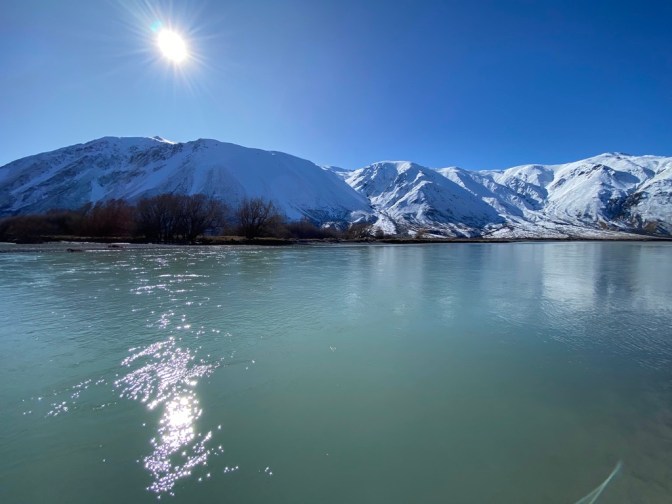
A winter hike into the valley of Forest Creek on Mesopotamia Station, in the headwaters of the Rangitata River on the South Island of New Zealand.
I am there now, as I write; I fancy that I can see the downs, the huts, the plain, and the riverbed – that torrent pathway of desolation, with its distant roar of waters.
– Samuel Butler, Erewhon
Beyond Peel Forest, the tarmac road gives way to rutted gravel. Bushy snow tussocks tremble in the nor’west wind; herds of farmed deer graze behind fences along the roadside. Undulating gently between low hummocky foothills, the road crosses mountain streams that leap downhill in deep ravines. The gradient increases as it climbs a long narrow valley overlooked by muscular hills.
Shepherd Days
I pass a shepherd, his sheepdogs gathered beside him as he stands beside a muddy 4WD. Ahead on the road, the tail end of a big mob of sheep, crossbred ewes, probably Romdales, wander along the grassy verge. As I pass, slowly and carefully, keeping an eye on his dogs lest one should accidentally get in front of my truck, a drone takes off from beside the shepherd’s truck. It flies rapidly skyward and up the road over the mob.
I remember my days as a high country shepherd when drones, cell phones and GPS were things we couldn’t have imagined. When I was a shepherd, I used to practice juggling three pebbles to pass the time while I was droving. These days, a shepherd can capture some amazing aerial footage of his flock while he drives them. Technology has embedded itself into every facet of our lives. I glance down at the array of technology on the passenger seat: two phones, a GoPro camera, and a microphone. On the stereo, I have an audiobook running. Above me, I see the drone on its return trajectory to its point of origin. I wind the window down and capture some footage of my own as I drive into the mob. Technology.
There are thousands of sheep in the mob, which is strung out over several kilometres. I drive slowly through the scattered bunches of ewes, low range, second gear, keeping the engine revs low so as not to spook the sheep into racing ahead. The mob move to the right-hand side of the road as I pass. In the rearview mirror, I can see them following along behind me: thousands of sheepish faces raising a miasma of dust from the gravel.
At White Rock Station the landscape suddenly bursts wide open, like a page in a picture book flipped over.
Below the road, the hillside falls away steeply until it is lost in shadow. Somewhere down there, hemmed by black bluffs, the Rangitata River is roaring, invisible in its deep gorge where the warmth of the sun won’t touch it until mid-morning.
The Rangitata rises in a hidden valley called the Garden of Eden, high in the Southern Alps. Melting snowfields feed the river as it descends from the mountains in a vast U-shaped valley created by the massive glaciers that once gouged and scored the landscape. The glaciers are still there (we are, after all, still in the tail end of an Ice Age) but they are now hidden in the depths of the jagged ranges that dominate the head of the valley. Enlarged by tributaries such as Bush Stream and Forest Creek, the river gathers momentum before surging into the confines of the Rangitata Gorge. The gorge squeezes the river into a series of cataclysmic rapids before pouring out across the Canterbury Plains to the sea.
Eventually, I clear the mob of sheep. The road descends from a low saddle slung beneath the flanks of Mount Peel. At White Rock Station the landscape suddenly bursts wide open, like a page in a picture book flipped over. The Upper Rangitata Valley lies before me, stretching deep inland towards a skyline of blue ranges.
Samuel Butler
It was into this valley that a young Englishman, Samuel Butler, rode in 1860. Butler had taken classics at Cambridge two years before and had spent the intervening time quarreling with his father. He wanted to paint but his father hoped for his son’s ordination. Emigration to New Zealand offered an attractive escape.
Seeking land suitable for grazing sheep, Butler began exploring deep into the mountains. He found a huge, hitherto uncharted valley and established a sheep station there which he named Mesopotamia.
Butler farmed Mesopotamia for four years, battling floods, snow, and isolation. He built a cob homestead in the wilderness and amused himself by playing Bach’s fugues on his piano.
In 1864 he sold the run and, having doubled his money, left New Zealand never to return. But he used his experiences at Mesopotamia as the basis for his novel Erewhon (an anagram of “nowhere”), in which he satirized the morals of Victorian society and prophesied that machines would one day dominate the world.
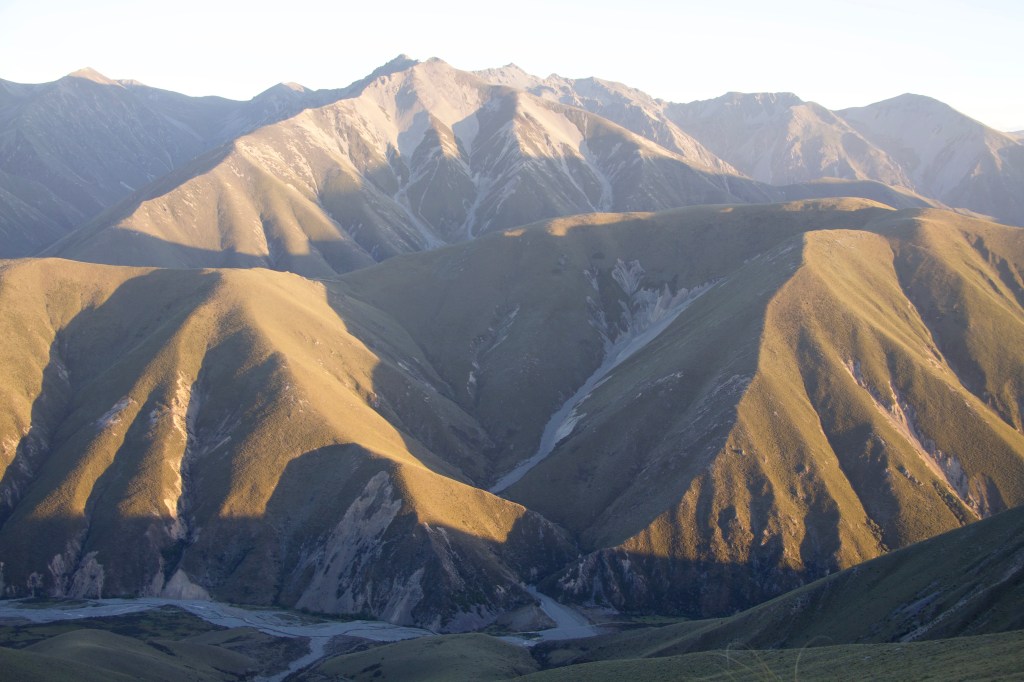
To the west, the downlands of Mesopotamia Station stretch away towards the bluffs of the Sinclair Range.
The elements of wind, sun, and water are the masters of the valley. The road steps across steep fans of grey, shattered shingle and glistening creeks. Around the homestead at Rata Peaks Station, trees lie where they have been uprooted by a past storm. On the river flats, pencil-thin Lombardy poplars lean eastwards, their trunks pushed off balance by the prevailing westerly wind. Further on, the timber and tin buildings of Ben McLeod Station stand slump-sided and sway-backed from years of buffeting wind and baking summers. The sheep yards are a sea of mud; from a ramshackle outhouse beside the woolshed, tendrils of toilet paper flap in the breeze. It is a raw, elemental landscape, full of energy and change.
At Forest Creek, a wooden bridge spans a stream of crystal-clear water. Fine-woolled merino sheep mooch in a paddock beside the creek. As my truck bumps across the uneven planks of the bridge I feel as if I am entering Butler’s kingdom: the fabled world of Erewhon.

Forest Creek
I park in a lay-by on the far side of the bridge between stockpiles of crushed gravel used to repair the road after floods. I pull on my hiking boots, shoulder my pack and scramble down the loose shingle to the bed of Forest Creek. The riverbed, a vast swathe of broken gravel, boulders, and low vegetation, climbs away before me to the southwest. A skein of cloud hangs over the declivitous face of Ben McLeod, which is riven with gullies of running shingle beneath a cap of pure white snow, towers above the eastern side of the creek. To the west, the downlands of Mesopotamia Station stretch away towards the bluffs of the Sinclair Range.
The afternoon sun is warm as I walk and before long, unused to the weight of a backpack, I’ve worked up a sweat. I stop to remove a couple of layers. I am alone in the centre of a vast open space. Ben McLeod rears above me. The creekbed drops steeply to the bridge, now almost invisible, then on down to the Rangitata River. Apart from the trilling of a skylark, and the distant rustle of water, the valley is silent.
There is no real path to follow up the creek. A Department of Conservation walkway was established in Forest Creek several years ago. However the owner of Ben McLeod station, a demented crackpot whose nickname, The Oracle, perhaps gives a clue about the fellow’s sanity, so resented the incursion of hikers along the edge of his property, bulldozed the path markers and other trail infrastructure into oblivion. What little remained was consumed by the creek when it flooded. So I had to content myself with finding my own route up the creek bed, following old sheep tracks through the matagouri and boulders.
Many a Ben McLeod wether had its throat cut in those isolated backcountry valleys by frustrated shepherds with a long way to walk and a short amount of daylight left.
A flock of half-bred wethers, grazing a wide river flat at the foot of the range, fled at my approach, giving the sharp nasal whistle that sheep give as a warning at the approach of danger. Their acrid smell remained long after they had begun stringing out in long lines across the flat and up onto the hillside. The smell, along with the easily recognisable (for a former shepherd, at least) shape and colour of half-breds, reminded me of the long-ago days when I worked as a shepherd at Dry Creek Station. The Hewson River, which lay on the far side of the Ben McLeod Range from where I was walking, forms the boundary between Dry Creek Station and ben McLeod Station. The Ben McLeod wethers, the ancestors of the sheep now stringing up the face above me, used to constantly cross the Hewson to graze on the sunny hillsides of Dry Creek.
During the bi-annual wether musters on Dry Creek (one in spring and one in autumn) the Ben McLeod wethers used to give us shepherds all manner of trouble as we tried to collect them up with the pure-bred merinos that Dry Creek ran. The half-breds were often wool-blind, skinny and in poor condition. They sulked and lay down when you tried to hunt them along with a dog; or tried to escape back across the Hewson River, leading some of the Dry Creek wethers with them. Many a Ben McLeod wether had its throat cut in those isolated backcountry valleys by frustrated shepherds with a long way to walk and a short amount of daylight left.
By three o’clock I am deep in the hills. The valley narrows and the sun dips behind the skyline of the Sinclair Range. I follow a 4WD track past a sign reading: BEN MCLEOD STATION. DO NOT TRESPASS. Forest Creek, now a torrent, roars in its bed. The track crosses a ford bulldozed in the shingle. I try to find a way upstream without having to cross, but the creek flows hard against the foot of a black bluff. There is now way past unless I wade across.
I am reluctant to get my boots wet this late in the day, with the prospect of a very cold night ahead. So, having chosen a crossing place with a relatively smooth bottom, I take off my boots and socks, tie the laces together, and with the boots slung around my neck, I step into the water.
The coldness sends an immediate shockwave of pain up my legs. The shingle under my feet, though mostly rounded and smooth, hurts the soles of my feet. I hold my phone up and record my crossing for Snapchat. The resulting footage is peppered with “fucks” and exclamations of pain. But the crossing only takes a few seconds, half a minute at most, and, despite the achingly cold water, when I reach the other side I feel glad that I chose the barefoot method in order to keep my socks and boots dry. The only downside, I reflect, as I rub my feet dry and pull my socks and boots back on, is that I will have to re-cross the creek further up to reach my campsite.
The bulldozed track skirts the foot of the hill on the shady side of the valley. The ground here is frozen solid; the tussocks rimed with frost. A cloud of vapour envelops my head with each exhalation. Thick, olive-green beech forest cloaks the lower slopes, dark and impenetrable. In places, the chris-cross wheel-marks of a 4WD are frozen into patches of clay.
Further upstream, the hillside above me collapses into a labyrinth of pillars and channels eroded into the heaped layers of clay and stones, coloured like beach sands in a bottle, that are the remains of ancient glacial outwash from the range above. The gullies rattle and clatter with the sound of falling rocks. The river roars in its bed of stones.
To be continued…

 TravelWriterLife