Once you get down Lambeth way
Ev’ry evening, ev’ry day,
You’ll find yourself
Doin’ the Lambeth walk.
– From Me and My Girl by D. Furber, L.A. Rose and N. Gay

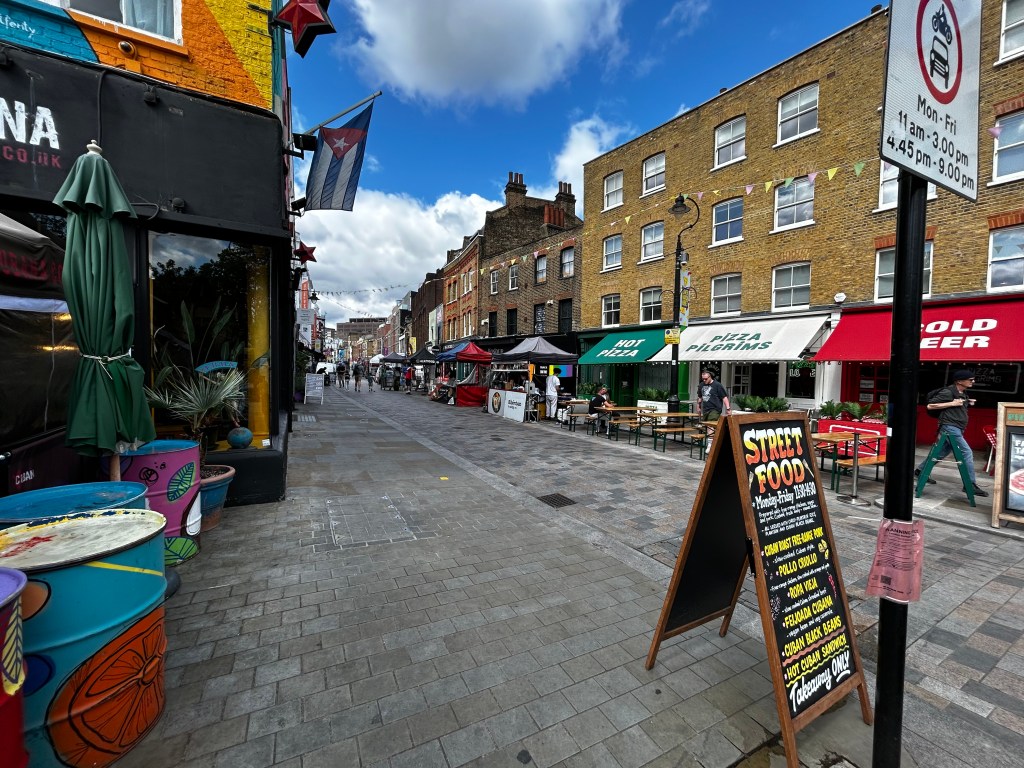
Morning in my old neighbourhood. I sit with a latte at an outside table at the LBP Café at the northern end of Lower Marsh Road. Beneath a gloomy sky of roiling clouds, the street vendors are setting up their stalls. Music plays from an open window on the top story of Number 32. There are green flower boxes overflowing with colour outside the Universe Remedies shop; the Iceland supermarket has avocados for 99p each.
The cobbled street is freshly cleaned and the facades are all free of graffiti. There’s no rubbish blowing along in the gutters and I’ve yet to see a dosser. My coffee is excellent; the conversations at the other tables are all about bike rides, exercise regimes and weekends. I could be on any suburban street in London. But Lower Marsh Road doesn’t look anything like the street I remember from the winter of 1989-90.

Lower Marsh Road in 2023 is a very different place from what it was during that long-ago time when we lived and worked at The Red Lion pub, on the corner of Lower Marsh Road and Westminster Bridge Road. In those days, this part of Lamberth was rundown, squalid, and, in places, just plain dangerous. The local market was a place where you could buy almost anything; and if the local vendors didn’t have it in stock, they would arrange for it to be stolen and sold to you at a knockdown price.
The staff at The Red Lion were all dressed in clothes stolen to order. The pub’s stereo system and TV had all been stolen to order. Even the bikes we rode around the streets of Lambeth had been pinched for us by a guy who kept a pair of bolt cutters in his backpack, especially for the business of bike thievery.
As well as the dodgy vendors, Lower Marsh Road was inhabited by an eclectic cross-section of lowlifes, businesspeople and derelicts. There were drunks clutching cans of Carlsberg Special Brew shouting abuse at passers-by; fights were common between street vendors who thought their patch was being “queered” (taken by rival vendors); petty crime was rife and unemployment was high. The side street known as The Cut was notorious for robbery and violence, not to mention the stink of piss. It was a glorious, violent, littered, feculent mess. Charles Dickens would have loved it!
We had first arrived on Lower Marsh Road at the beginning of December 1989. We were freshly back in England after four months on the road in Africa. We’d travelled from Nairobi in Kenya, all the way back to London, via Uganda, Zaire, the Central African Republic, Cameroon, Nigeria, Niger, Algeria, Morocco and Spain.
Our four-month African Overland had taken us to some of the most extreme environments in the world. We had climbed a volcano in Zaire to sit with mountain gorillas. We’d floated down the Congo River on a freight barge full of dried fish. We had been bogged in the jungle, spotted wildlife on the savannah and crossed the Sahara Desert. We had watched the sunrise in the Hoggar Mountains of Algeria, been chilled by the autumn winds of Morocco’s Haute Atlas mountains, and lost ourselves in the medinas of Marrakesh and Fez.
Our journey had been full of adventures, narrow escapes, drunken nights and hot days. But now we were back in wintery England: skinny, unwell, and almost completely broke. The night we’d arrived back in London we had been deposited on the pavement of a back street in Earls Court and watched our Kumuka overland truck disappear into the night. I found an ATM and checked my bank account. I had four pounds and thirty-seven pence to my name. Linda had a few more quid, but essentially we were broke. We needed a job and we needed one fast.
After a night in a cheap Earl’s Court hotel, we went round to New Zealand house on Haymarket — a short street running from Trafalgar Square up to Piccadilly Circus — and grabbed a copy of TNT. This was one of several magazines published for the expat Kiwi, Aussie and South African community living in London, which at any one time numbered around 20,000 people. In the job section at the back of the magazine there was an advert for a live-in bar couple at a pub in Lambeth called The Red Lion.
We made an appointment and that afternoon we met Brian Bradley, the publican, who turned out, coincidentally, to come from a town called Moeraki, just an hour south of where we come from on the South Island of New Zealand.
Short and muscular, with a walrus moustache and permed hair, Brian turned out to be a great guy. He gave us the job on the spot. We had a few days until we would move in. So we decamped back out to Wormley West End, in Hertfordshire, where we had left most of our gear and stayed for a few nights with friends on their farm. Back in London later in the week, we moved into a small but cosy room on the fifth floor of The Red Lion.

The Walrus
The Red Lion itself was a squat, angular brick building of five storeys, built hard against the steel overbridge where the lines of the Southeast rail network enter Waterloo Station. Trains would begin running at 5 in the morning, and not stop till 11 at night Every train made the building shake and shudder. However, after a few days, we tuned the sound of the railway out and it didn’t bother us.
We already had plenty of experience working as live-in bar staff, having spent four months before we headed off to Africa working in a country pub called The Woodman out at Wormley West End. So with this experience to fall back on, we were able to step straight into the role of city barkeepers without any extra training. The dress code was a shirt and tie, and I pulled my first pint at 11 am on that Monday morning in December 1989.
Linda’s job was to work in the kitchen, three stories above and connected to the bar by a dumb waiter. She would cook during the day sessions and then work behind the bar in the evenings. The Red Lion had two bars: one on the ground floor and one on the second floor.
The second-floor bar was generally used for functions, parties, and monthly get-togethers by a Lonely Hearts Club called City Circle, where single people would come to meet other single people. The staff on duty would surreptitiously play songs such as You Picked a Fine Time to Leave Me, Lucille over the stereo as a joke during these gloomy and tedious sessions.
The Red Lion’s clientele bore a startling similarity to the crowds that peopled Lower Marsh Road outside. They were businessmen, tradesmen, bricklayers, shopkeepers. There was a large number of middle managers and engineers from British Rail whose office was in Waterloo station. There were also a large number of government and civil service workers who worked at ILIA (the Inner London Education Authority) whose offices were in Country Hall nearby.
Another large chunk of the Red Lion’s clientele was made up of student nurses from nearby St Thomas’s Hospital. They would arrive en masse after their shifts, order large quantities of drinks and packets of Silk Cut cigarettes, and proceed to get uproariously drunk on several nights of the week. I would often be called on to gather up a passed-out nurse from the floor of the ladies toilet, carry them out onto Westminster Bridge Road, and bundle them into a taxi where they would be consigned back to Gassiat House Nurses’ Hostel where they all lived.
They were fun days. We were young and carefree and we had no ties to anything. We lived in the moment and planned our next adventure — we would end up travelling in Greece and Turkey during April and May of 1990 — in our fifth-floor room. And we’ve kept in touch with some of the girls we knew when we worked at The Red Lion over that winter of 1989 to 1990. They are all now working in health authority management, married, and settled down with grown-up kids.
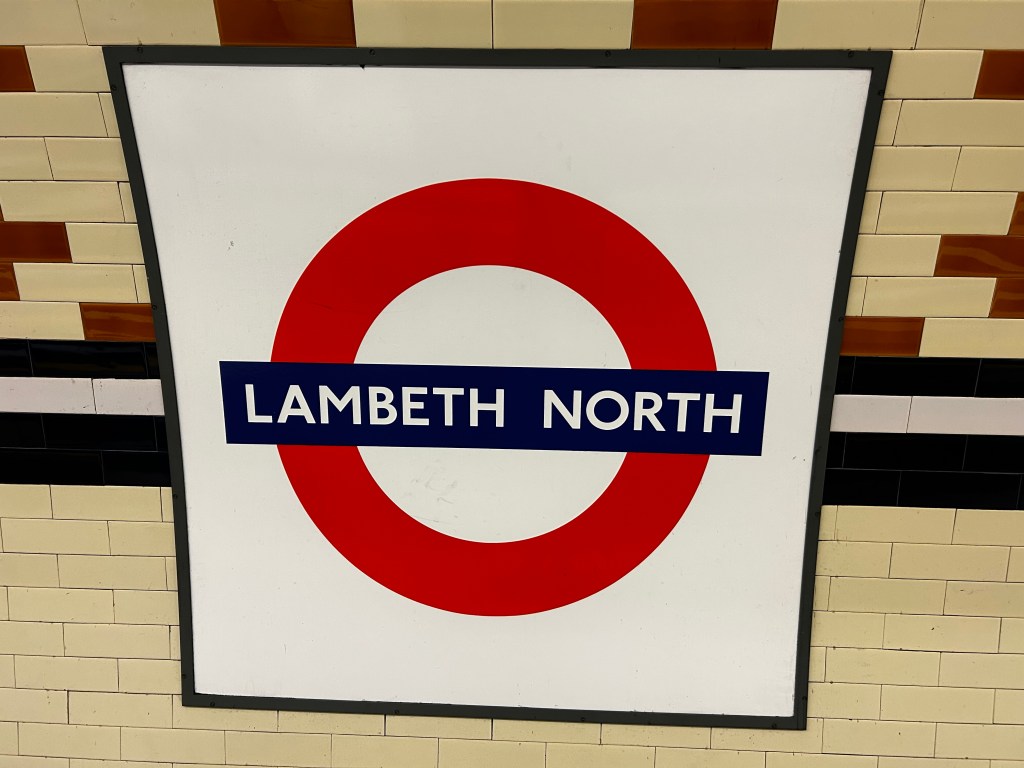
During the five months we spent at The Red Lion we became Londoners. We dressed like Londoners. We knew how to run the London scams that everyone needs to know to get by in a city of 10 million people. We rode the Bakerloo Line on the Underground from Lambeth North Station just up the street from the pub. The Number 12 bus took us from outside The Red Lion and over to Piccadilly Circus whenever we needed a fix of the city. We went to shows — Return to the Forbidden Planet, ‘Allo ‘Allo, Starlight Express — and witnessed the Poll Tax Riot firsthand.

And all through that time, Lower Marsh Road was our neighbourhood. It was our shopping street, it had our favourite restaurants, it took us from The Red Lion to Waterloo Station and the big world outside our corner of London. It was home.
And now I am back. On this August morning, thirty-two years after we worked at The Red Lion, my head is almost spinning as I relive those far-off days. Lower Marsh Road bears no resemblance to the street I knew back then. But I bear no resemblance to the person I was then. Nothing changes by everything changes…that’s how it’s meant to be.
The sky has cleared. The sun paints the street with a wash of warm light. I finish my coffee and set off towards Westminster Bridge.


 TravelWriterLife