“The gentleness of heaven is on the sea;
Listen! the mighty being is awake…”
– William Wordsworth, By the Sea (1807)

It was sunny in Aberystwyth. Cardigan Bay lay like a blue blanket against the coast of Pembrokeshire. A few fluffy cumulus clouds hung on the horizon. The Irish Sea spread out beneath the sky from rim to rim. Down on the pastel seafront, holidaymakers lolled on the grey sand of North Beach or perused the shops along Marine Terrace. Gulls cried in the backstreets behind the promenade and circled the Victorian-era Royal Pier. Somewhere in the distance, a church bell tolled the hour with the tempo of a Bruno Mars song.
Earlier on that August morning we had left the gloomy hills of Snowdonia and driven south down the spine of Wales. The heathered hills with their slate-mine scars and slanted villages of stone terrace houses, had given way to rolling sheep hills of viridescent green. A nuclear power station stood hunched against the prevailing wind at Trawsfynydd. Rows of newly mown hay and silage striped the fields in the valley bottoms.
But despite the shops selling dubious seaside tat and meretricious gawds…
Finally, we had driven down to the coast, where broom decorated the clifftops with smudges of yellow and fishing villages hung suspended on the edge of the land above harbour walls and brightly painted fishing boats.
Leaving the cars parked in a spot beside the Aberystwyth Tesco supermarket, we walked up into the centre of town past shops selling the usual seaside bric-a-brac: peppermint rock, plastic buckets, balloons emblazoned with the red and green Welsh dragon, greasy food, pints of beer and postcards of the “wish you were here” variety.

But despite the shops selling dubious seaside tat and meretricious gawds, the coffee and bara brith (fruit loaf) at the Amgueddfa Ceredigion Museum were delicious, and in the big Edwardian auditorium next door a blind woman played note-perfect renditions of old show tunes on an upright piano.
Later, I left the others exploring the seafront and set off along backstreets to find The Bookshop By The Sea. Away from the glitter of the promenade, Aberystwyth seemed a little decayed and dowdy: like a dowager widow, still keeping up appearances of gentility and refinement on a reduced budget.

The terraced houses along Eastgate Street were a mixture of student dives (the highly-regarded University of Aberystwyth has been in existence since 1872) interspersed with brightly painted flats piled three stories high. The bow windows and stout doors, which opened directly onto the street, told a story of the grand days when Aberystwyth was a de rigueur Victorian and Edwardian holiday destination.
The Bookshop By The Sea is TikTok famous. At least, that’s how I knew about it. Their account had turned up on my fyp one day and I had followed it out of curiosity. Now, here I was, walking a backstreet in a Welsh seaside town looking for it. And I had a specific book in mind: one by another TikTok famous person, the historian Alice Loxton.
Turning a corner I came across a small chalkboard sign — “Two floors of new & pre-loved books” — on the footpath and there it is. The shop’s big bay window was adorned with a display of books new and old. I stepped inside and into book-lover’s heaven.

I love books…especially old books. I love the tactile feel of them and the slightly foxed smell of the paper. Most of all, I love the stories they tell, not just the printed words themselves but the stories of the books themselves: the hands that held them, the people who read them, the places they’ve been. Old books are stories wrapped in other stories and whenever I hold one I am adding to the story. And The Bookshop By The Sea was full of stories.
At the counter — piled high with books and bits — I asked if they had a copy of UPROAR! by Alice Loxton in stock. The girl (I think her name was Freya) checked on her computer but, alas, they didn’t have it. I wasn’t surprised…it was a long shot at best. But I already had a plan for getting hold of a copy from The Bookshop By The Sea: they could order it and post it to me. After all, I was going to be in the United Kingdom for several more weeks. There was easily enough time for it to arrive in Aberystwyth and be forwarded to Dymock, in Gloucestershire, where I was staying.
So Freya arranged it for me. I gave her the address and paid for both the book and the cost of postage. And it was done. But I still wanted to buy a book from this charming store. Descending the stairs to a lower room, I browsed shelves of books (old and new) about English history, science, and philosophy.
That’s what I love about books: their story is never really complete.
I held second-hand copies of RF Delderfield’s classic story A Horseman Riding By and The Malakand Field Force, Winston Churchill’s first-hand memoir of fighting in the North-west Frontier Province of India in the 1890s. I found In Search of England by HV Morton and, The Happy Isles of Oceania by Paul Theroux.
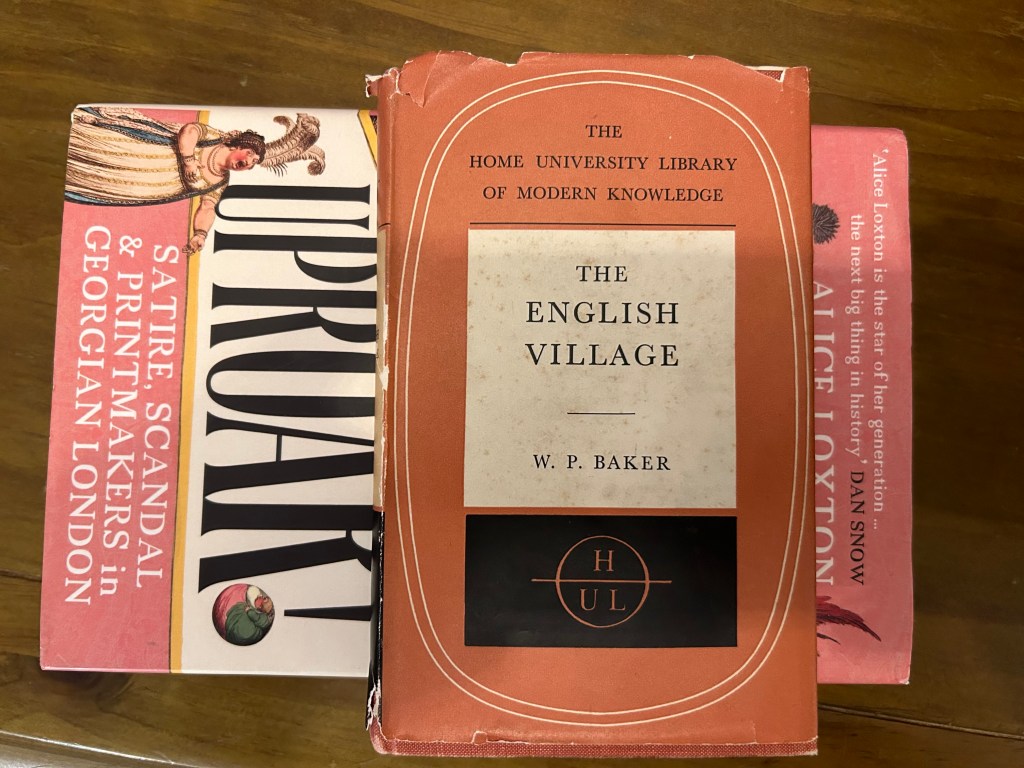
Finally, I settled on a copy of The English Village, by W.P. Parker, published in 1953 by The Home University Library. Its red paper dust jacket was a little torn; the pages were slightly foxed and well-thumbed. Inside the fly-leaf was the name HR John Davies written in faded ink.
It was a book that had been well read somewhere, had graced someone’s bookshelf or desk, and had pitched up here on a shelf in The Bookshop By The Sea, shifted around by some unknown current of history. The next chapter in its story was that it would be going to New Zealand with me.

That’s what I love about books: their story is never really complete. My copy of The English Village sits beside me now as I write this in a busy café on the South Island of New Zealand. For it to be here, it had to journey from where it was printed, through the hands of one (or more) owners, find its way to a small bookshop on the coast of Wales, and then be discovered by someone who had heard about the bookshop from a digital platform called TikTok. Who knows where it will end up next. I wonder if Mister Baker, writing The English Village in a study somewhere in England in the early 1950s could have imagined the journey that a copy of his book would go on. Can any of us imagine where the things we hold and love will end up?
As I sip my latte and turn the pages of the book, my mind returns to Aberystwyth on that August day, when I stepped from The Bookshop By The Sea into the summer sunlight by the sea…out into the endless tide of history.
Footnote: My copy of UPROAR! by Alice Loxton turned up in Dymock a few days later. It is a superb book that tells the story of the Georgian satirical printmakers James Gilray, Thomas Rowlinson and Issac Cruikshank. Mixing detailed research with period gossip, pop culture, social media references and laugh-out-loud observations, Loxton’s book is a raucous masterwork for anyone familiar with caricatures such as A Voluptuary Under Pain of Digestion or The Plumb Pudding in Danger.


 TravelWriterLife