It is late afternoon when we arrive in Llangattock. The sun is streaming down the valley of the River Usk, lighting up the vast, encircling expanse of escarpments and peaks, and gilding the landscape moment by moment. Flocks of sheep, pure white against thick swards of viridian grass, graze stone-walled fields etched with geometric precision onto the hillsides. The great blue dome of the sky is empty save for a tracery of cirrus, stretched from east to west, high above this corner of South Wales.

Hillside Road is crowded with cars. We find a spot for the car on Park Drive and walk down to the Horse Shoe Inn. The door of the inn opens directly off the street. A collection of dogs, locals, and motorbike riders form an impromptu guard of honour as we cross the threshold. Inside the bar it is lively and welcoming. A throng of drinkers keep up a low chatter; a band in the corner sings sonorous Welsh songs. The barman recognises our Kiwi accents straight away.
It would be nice to settle in with a pint and a bag of pork scratchings straight away but we have things to do. We leave our bags in the upstairs room that Lydia has booked for us then set off up Hillside Road towards the canal.
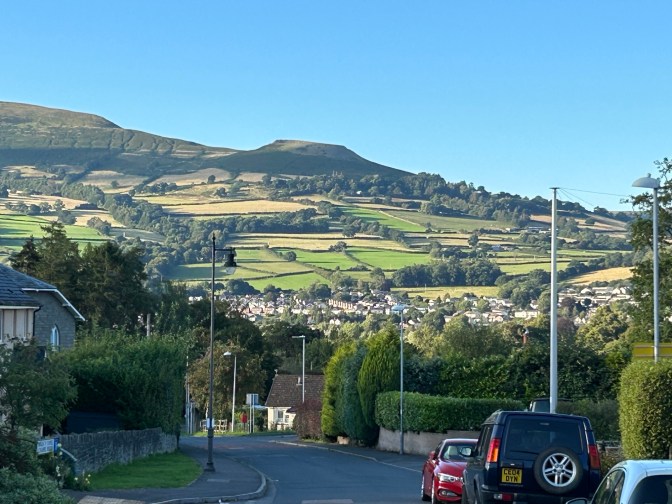
Llangattock lies on the southern side of the Usk Valley, opposite the equally lovely, and somewhat larger town of Crickhowell. The original Parish of Llangattock is one of the oldest in Wales and, indeed, archaeological evidence points towards human habitation in the area for at least 4,000 years. The village is bisected by the Monmouthshire and Brecon Canal which once conveyed coal and iron through the Brecon Beacons.
At the top of Hillside Road, we clamber down the abutment of an old stone bridge to the canal’s tow-path. Here, the canal runs through a tunnel of foliage, with the towpath following its left hand side. The opposite bank is heavily overgrown with hawthorn, willow, alder, ash and hazels. Sycamores drape their branches over the water and big old oak trees stand resolute beside the path. Skeins of sunlight are draped through the trees and, in places, shimmer on the canal.

A few colourful canal boats are tethered at rickety jetties beside ramshackle cottages that look, for all the world, as though they are tumbling into a deep, timeless slumber by the canal’s edge. The water is almost motionless: an opaque brownish mirror upon which near-perfect reflections shimmer. Tiny ripples give the reflections of the trees a soft, almost Impressionist rendering. A blue narrowboat with a red lifebuoy is reflected with such clarity that it seems to be anchored only by its contact with the water, balanced on the threshold between the tangible world and the mirrored world beneath.
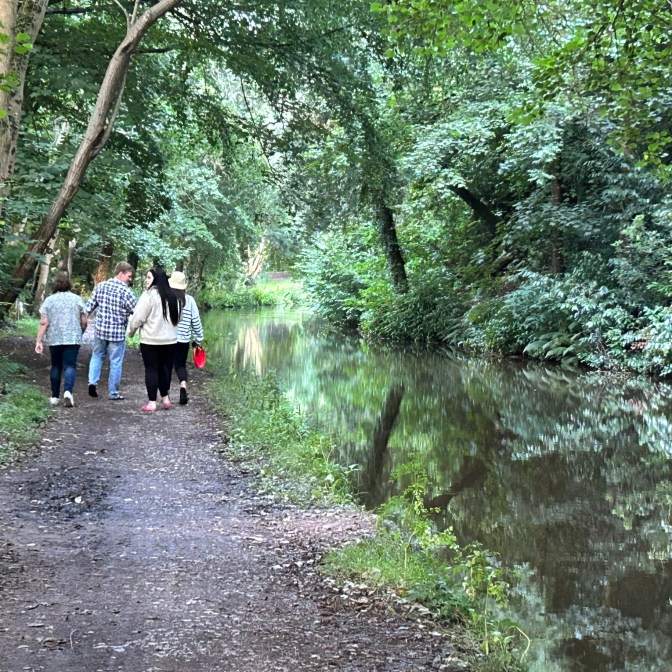
As the shadows lengthen, we leave the canal and descend through a stand of conifers lit by traceries of golden sunlight. Beyond the trees, we watch a couple of shepherds pass by with a flock of newly-shorn ewes, fat and sleek, then follow a path across a grassy field back to the village. The grass is cool and damp and I walk barefoot, revelling in the feel of the soft ground beneath my feet.

By the time we reach the Horse Shoe Inn, the bar has emptied out. We order beers and I chat to the barman about the recent defeat by Wales of the England rugby team. We are all still full from the large celebration lunch we had eaten earlier in the day, so we collectively decide not to order any food. Instead, we opt for a few bags of crisps and a packet of pork scratchings, the main item of English cuisine you can find in every pub throughout the kingdom.
The beer is cool and refreshing. It is the local brew known as Butty Bach: Welsh for “Little Friend.” Outside, the evening is still glowing. A lone sheep bleats in the small walled paddock behind the pub. Out on Hillside Road, the last of the local dogs has wandered off home. I wonder if I should go out for another walk, to make the most of this wonderful Welsh summer evening. But there’s time for more exploring tomorrow. For now, it’s nice to simply relax here with my family, enjoying a beer at the Horse Shoe Inn.


 TravelWriterLife