And I have felt
A presence that disturbs me with the joy Of elevated thoughts; a sense sublime
Of something far more deeply interfused,Whose dwelling is the light of setting suns,
And the round ocean and the living air,
And the blue sky, and in the mind of man: A motion and a spirit, that impels
All thinking things, all objects of all thought, And rolls through all things.
– William Wordsworth, Lines Composed a Few Miles Above Tintern Abbey
Morning in Betws-y-Coed. Alone beside the River Conwy, I watch the water tumbling over the falls upstream from the Pont-y-Pair bridge. The river above the falls is smooth and calm, overhung by a viridian tunnel of alder, hazel, and birch. As it cascades down the falls between ragged pillars of hard, resistant stone, the water shatters into rainbows in the sunlight.
Freed from the violence of the falls, the river regains its composure as it flows under the bridge, runs parallel with the A5 for a hundred yards or so, then curls round to the left and out of sight. The roar of the falling water drowns out the noise of the cars and trucks passing through Betws-y-Coed. The glittering shards of water are almost mesmerising. Above the town, steep hills, cloaked with heavy forest, climb to the skyline. The sky beyond is a sublime blue.

To the poets, writers, artists and philosophers of the late eighteenth and early nineteenth century’s Romantic Movement, places like this were the epitome of what they described as “the sublime.” To them, the raw grandeur and beauty of nature elicited a profound emotional response, often mixed with awe, terror and an overwhelming sense of the vast and the infinite. This fascination drove them to seek out landscapes that could evoke such feelings and inspire them in their creative endeavours. And in the landscapes of Snowdonia they found the sublime in every stone, forest, valley, mountain and river.
Standing on the bridge at Betws-y Coed, amid the roar of the falls, the shattering water and the glittering sunlight, with the bold, muscular hills rising above the town, I can imagine how the poets felt in the presence of such powerful natural forces. And today, we are going to follow the Conwy upstream into the heart of Snowdonia and into the sublime.
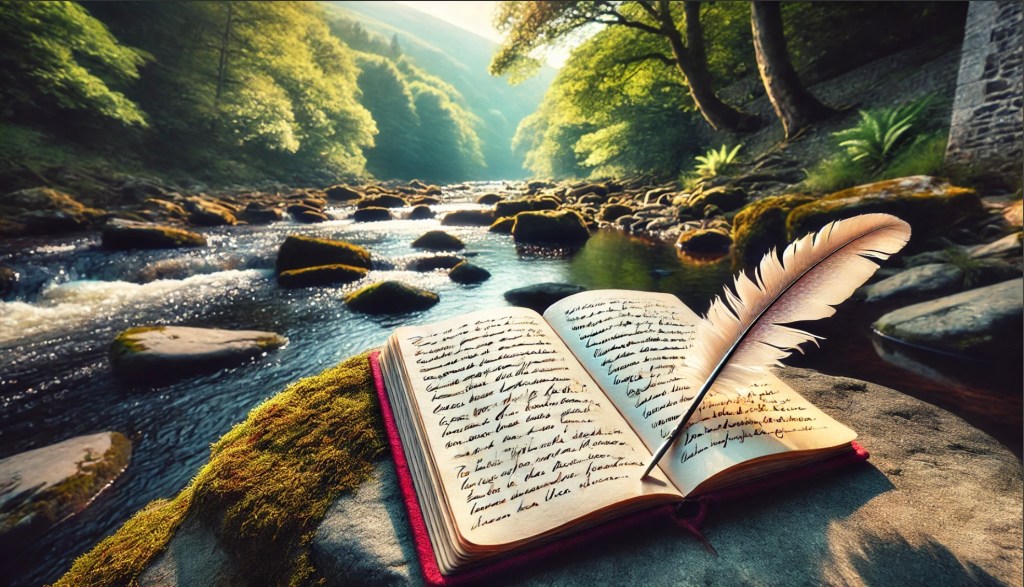
The River Conwy rises in the Migneint, a large expanse of moorland deep in Snowdonia National Park. Rain and mist, filtered through peat bogs and collected by tiny rivulets, drains into tiny lakes, cradled by ancient, eroded mountains. The river begins its journey to the Irish Sea in Lyn Conwy, a small, rush-girt lake cradled in soft, rounded hills. From the lake’s narrow outlet, the river steps cautiously down from the highlands through sheep fields and villages. The Conwy is a short river by world standards. But it makes up for its brevity — it is only 27 miles from its source to its end in the Conwy Estuary — by passing through some of the loveliest scenery in North Wales.
North-east of Betws-y-Coed, the river drops over the Rhayader Ewynnol Falls. A series of concrete stairs lead down to the base of the falls which cascade in a series of almost vertical cataracts into a deep pool of tannin-stained water. A thick screen of trees overhangs the river and the roar of the falling water resounds from the black, dripping walls of the canyon like a symphony of timpani and brass.

This is the sort of place in which the poets and writers of the Romantic movement found the sublime in an almost immeasurable quantity. The raw power of the water, the reverberating sound, the danger, and the beauty filled them at once with a sense of awe and dread. At Rhayader Ewynnol, the elements give full voice to their unbridled strength, manifesting as a spectacle both terrifying and magnificent: the sublime forces of nature in their purest form.
“The sounding cataract haunted me like a passion,” wrote William Wordsworth in Lines Composed a Few Miles Above Tintern Abbey. “The tall rock, the mountain, and the deep and gloomy wood, their colours and their forms, were then to me an appetite; a feeling and a love that had no need of a remoter charm, by thought supplied, nor any interest unborrowed from the eye.”
In places such as the Rhayader Ewynnol Falls, Wordsworth and his contemporaries experienced a profound and mesmerising emotional response to natural scenery. This reflected the Romantic ideal of finding deep, spiritual enrichment and sublime experiences in the natural world. These days, of course, an emotional response is generated by social media engagement. As I stand watching the falling water, spellbound by its motion and sound, I am surrounded by New Romantics taking selfies and snapping photographs on their devices. I idly wonder what would Wordsworth have made of this scene?
Beneath the vast expanse where heavens stretch wide,
They stand, small souls, to nature’s marvel blind.
With faces turned not to the glen or tide,
But to glass screens, for hollow likes designed.
Where once the soul in solitude might soar,
Now but a backdrop for their shallow lore.
Of course, I can’t resist the lure of social media engagement either. I snap off a few pics — they look great on the ‘gram when I post them later on — then ascend the stone stairs back to to roaring cataract of traffic on the A5.

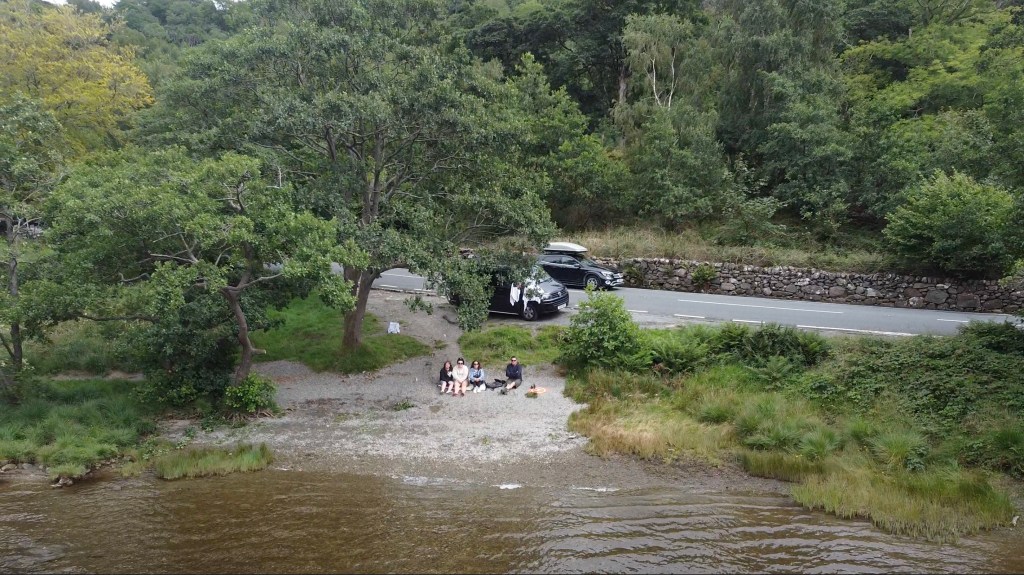
We leave the vale of the Conwy and drive over a low pass slung beneath the eastern flank of Snowden. The road is narrow and crowded, with steep drops to rushy meadows on the outside of the drystone barrier wall. The road wiggles and winds down into a U-shaped valley, its glacier-carved sides scored with benches gouged by the inexorable ice of the LGM. At the bottom of the valley, Llyn Gwynant lies in a frame of dark green conifer forest. We park at a small layby and sit on a tiny skirt of shingle beach eating a picnic lunch. Charlie does a two-kilometre swim in the dark water; I fly my drone.
On the opposite side of the lake, great bluffs of resilient rock, strong enough to resist the inexorable grinding of the ice, rise from the water. Behind them, the bracken-covered hillside climbs to the skyline. Drystone walls frame tiny sheep fields. Screes of boulders, shattered from the tops, bisect the faces. Back in the car, we follow the A498 down the valley to Beddgellert.

In a moment of blinding rage and heartbreak, Llywelyn the Great drew his sword and struck down his beloved dog, Gelert. The hound’s pained howls echoed through the castle, a sound that would haunt the prince forever. As Gelert’s life ebbed away on the stone floor, his eyes still held a glimmer of unwavering loyalty. It was a loyalty that Llywelyn would soon realise he had tragically misjudged.
Earlier that day, Llywelyn had returned from a hunt to a scene of apparent disaster. His infant son’s nursery was in disarray. His cradle overturned and there was no sign of the child. All that remained was his Gelert, his muzzle smeared with blood. In the throes of despair, Llywelyn allowed his fear to guide his hand, condemning his loyal dog without a moment’s pause for the truth.
But now, as Gelert lay dying, the reality of his mistake struck him. He heard a soft whimper beneath the cradle. There, shielded by the very bed he had assumed Gelert had overturned, was his son, unharmed. Beside the boy lay the body of a massive wolf, slain by Gelert as he protected the child.
The realisation of what he had done washed over Llywelyn like ice water. Gelert had not betrayed him; he had died a hero, defending his son from true danger. Overwhelmed with grief and remorse, Llywelyn buried Gelert with all the honours of a fallen knight. He marked the grave with a stone, upon which he inscribed the tale of Gelert’s bravery and fidelity.
The prince decreed that the place was henceforth to be known as Beddgelert — Gelert’s grave — a perpetual reminder of his tragic error. He vowed never to raise his hand in haste again, living out his days in the shadow of his faithful dog’s unjust death.
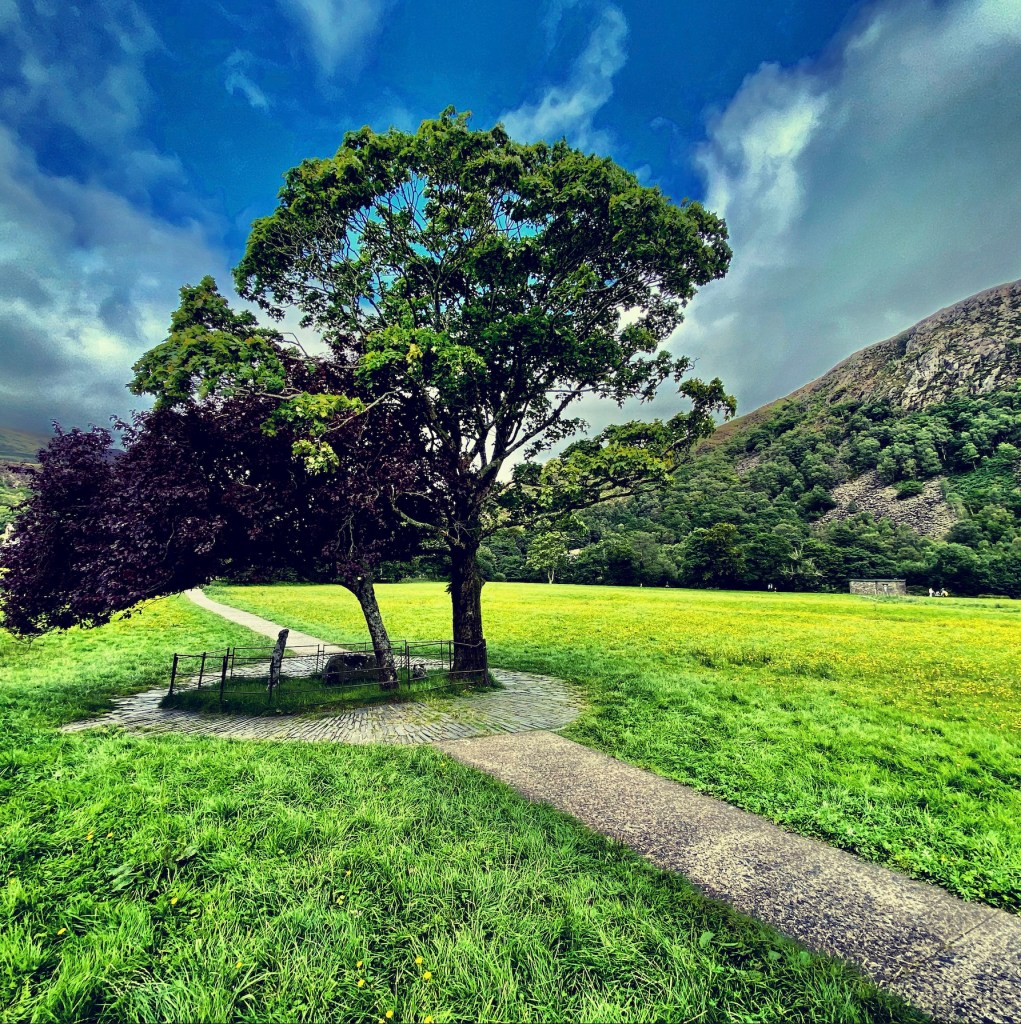
The grave of Gellert lies in a grassy meadow that runs down to the tree-lined bank of the Afon Glaslyn. Buttercups and daisies sway in the gentle breezes that waft down from Moel Hebog; a few elms at oaks are dotted about the field. As we walk up through the meadow we pass walkers with dogs, a few hikers fresh from the nearby peaks, and an assortment of kids playing about in the sun. A few sheep graze the grassy sward. The grave itself is a simple stone plinth, sheltered by a copper beech and an alder. Nearby, in the tumbled-down remains of a stone crofter’s hut, a bronze statue of Gellert peers out at the hills.

Places like Gellert’s Grave, where narrative and landscape intertwine, perfectly capture the essence of the sublime: a somewhat difficult concept to get hold of. They poignantly blend natural beauty and deep-seated emotional resonance, feelings that the Romantics strove to comprehend and describe. The momentary escape into the vastness of nature and the complexities of human experience were foundational aspects of their art, poetry, and writing.
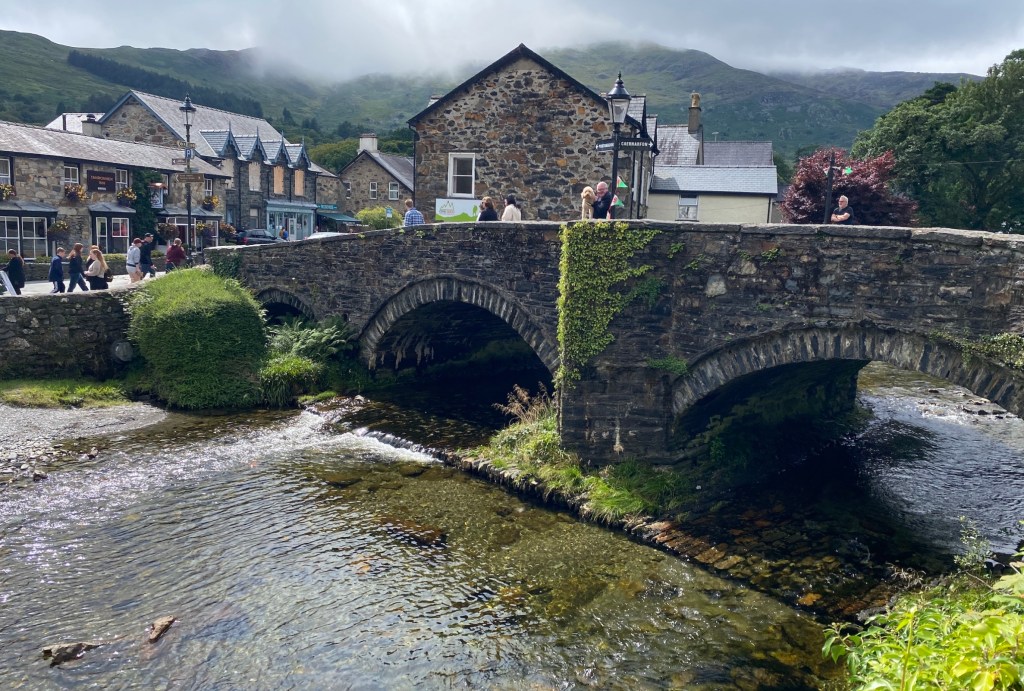
But where the sublime is found, the ridiculous is never far behind. The town of Beddgelert (pronounced “Beth-gellert”) itself is a bit of a tourist trap, with souvenir shops, bunting, and crowds of day-trippers…including us. We choose a tea shop and refresh ourselves with cups of tea and a selection of treats. The Afon Colwyn trickles through the centre of town, its banks aswim with a colourful profusion of wildflowers and spanned by a graceful stone bridge.
It is a lovely, relaxing place to sit and it is tempting to stay all afternoon, watching the world go by over the rims of endless cuppas. But we are soon to leave the bright world of the sublime and descend into the Stygian realm of tunnels dug deep into the bones of of the hills.
In the shadowed heart of ancient Snowdonia, mountains wield the sky and the venerable Cambrian slates whisper tales of epochs untold. Here, beneath the stoic gaze of craggy peaks, the earth had once roiled with the fire of subterranean furnaces, spewing forth the molten innards of a nascent world. In these primaeval depths, amid the clashing of titanic forces, a miracle of alchemy occurred. Hydrothermal veins, surging with the lifeblood of the planet, coursed through the fractured bedrock, depositing rich seams of chalcopyrite and malachite. Over millennia, these lustrous veins wove themselves into the very fabric of the mountains; hidden vaults of copper awaiting the daring exploits of men. Thus was set the stage for a saga of human endeavour, as miners would one day delve into these ancient repositories, coaxing forth the copper that flowed like the prophesied rivers of a promised land. Excerpt from Veins of the Dragon: The Copper Chronicles of Snowdonia by Evan Meredyth (1790-1883)
Deep in the Sygun Copper Mine, the air is thick with humidity. The walls drip with moisture which collects in mirror-calm pools that reflect stalactites of copper ore and the harsh gleam of incandescent lights. We have followed the tunnels of the mine into the heart of the mountainside. Hewn by hand, these passages yielded a fortune in copper throughout the 19th century, as miners tenaciously chipped away at the hard rock, following the dragon’s veins as it dipped and veered through the dark underworld.
There was nothing sublime about working in these chambers and caverns. The men who hewed the ore may have lived in the sunlit world of the valley outside. But their workdays were spent far from the light and life of the meadows above. For them, darkness was an old friend; the silence was broken only by the clink of metal against stone, the sibilant dripping of water, and the resonating boom of explosive charges.

The mining of copper in Wales dates back to the Bronze Age. Combined with tin to form the alloy that gave an entire era of human advancement its name, copper allowed humans to create stronger tools and weapons. This facilitated more efficient systems of agriculture, warfare, and daily life, catalysing the development of early societies.
This early use of copper set the stage for its myriad applications, transforming civilisations with its durability and workability. As societies evolved, so too did the uses for copper, extending beyond simple tools and ornaments to more complex and critical roles in architectural and engineering contexts.
During the Napoleonic Wars, copper found a strategic application in naval warfare. The Royal Navy sheathed the hulls of its warships with copper to protect against shipworms and to improve the vessels’ speed and durability. This innovation significantly enhanced the manoeuvrability and longevity of warships, giving them a crucial advantage at sea.
With the advent of the Industrial Revolution, copper emerged as a crucially important metal. Its excellent conductivity of both electricity and heat made it an invaluable resource for the development and expansion of the numerous technologies and infrastructure projects that defined the era.
Copper’s malleability and ductility allowed it to be easily worked into wires and sheets, facilitating its wide application in the burgeoning electrical industry. The growth of electric power generation and transmission systems in the 19th century also dramatically increased the demand for copper. It became essential for electrical wiring, motors, and generators, fueling innovations and technological advances that were central to industrial growth.
Moreover, copper was also indispensable in the creation of steam engines and the expanding railway networks that became the lifelines of Britain’s trade and commerce during the Industrial Revolution. The metal’s resistance to corrosion and its ability to withstand high temperatures made it ideal for use in steam engine boilers and other critical components. Beyond its industrial applications, copper was also used in the minting of coins and in the construction sector for roofing and plumbing.
The reliance on copper not only drove its mining and refining but also stimulated global trade, as countries sought to secure stable supplies of this precious resource. The strategic importance of copper during the Industrial Revolution thus had profound implications on economic development, technological progress, and even the geopolitics of the era, reshaping societies and industries in enduring ways.

The copper ores found in the Sygun Mine are primarily associated with hydrothermal veins that occurred during the Ordovician period, around 450 to 480 million years ago. The primary copper-bearing minerals found at Sygun include chalcopyrite (copper iron sulphide) and malachite (a green copper carbonate hydroxide). These minerals were formed from hydrothermal fluids that infiltrated cracks and fractures within the surrounding rock, particularly through the country rock of Cambrian slate. As these hot, mineral-rich fluids cooled, they precipitated copper along with iron, sulphur, and other elements, forming the veins that would later be mined.
As we explore the tunnels and shafts, I try to imagine Wordsworth, Coleridge, Percy Bysshe, Keats and Co cacking their britches in this subterranean darkness and later composing brooding lines of verse about the stark contrast between the claustrophobic depths and the sublime expanse of nature’s surface. Jacked up on opium and absinthe, with guttering candles casting flickering shadows across the walls of their cottages, far from the black depths of the mine, their pens might have bled inky versus such as:
Beneath the verdant Welsh hills’ sunlit grace,
Lies a shadow realm, a hidden, somber place.
Where men with iron wills and hearts so brave,
Delve deep in earth’s cold, unforgiving cave.
Here, the echoes of their picks resound,
In search of copper veins within the ground;
A world apart from the verdant fields above,
Bound forever by toil, yet driven by love.

It takes us an hour or so to navigate the mine from end to end. As we emerge, blinking into the sunshine, the world outside seems impossibly bright and vast. The contrast between the dark, constrained spaces below and the expansive sky above is stark. The air is fresher, filled with the scent of wildflowers and earth warmed by the sun. It feels as though we are stepping out of a long-ago time, leaving behind the shadows of the past to return to the luminous clarity of the present. In this moment, on the threshold between the underground darkness and the radiant world above, we step back into the sublime.

 TravelWriterLife