I dream of high clouds
Flush with the light of daybreak.
I’m gonna dive in
To waters so cold it makes your bones ache…
– David Grey, From Here I Can Almost See the Sea
“Why the fuck did you do that, bach?” says the man in the chair beside me. Amid a general roar of jeers and insults from the England supporters gathered at the Harbour Inn, the England team score a try from the awarded penalty. The Welsh fans, flushed with bravado after their team’s win the previous weekend are now suitably chaste. A chanted chorus of “who’s laughing now” erupts from the England supporters.
On the big screen TV, jammed into the corner of the bar, the Welsh players regroup. The big man next to be is now sharing a joke with an England supporter sitting on his right. It is a good-natured crowd here on this Saturday afternoon in Slova. The bar is full. I have a pint of Butty Bach in my hand. Outside, a passing shower patters against the window. I can see down the harbour to the fishing boats moored head and stern on the outgoing tide. The gusting easterly wind shakes the trees along the shore in slow motion.

As the match ends with a win by the English, the intensity in the Harbour Inn shifts from fiery competition to a relaxed camaraderie. The game’s outcome, now a footnote to an enjoyable afternoon, sees former adversaries sharing rounds and stories. Laughter and talk resounds across the room. The crowd begins to thin, leaving only a few lingering souls savouring the last of their drinks.
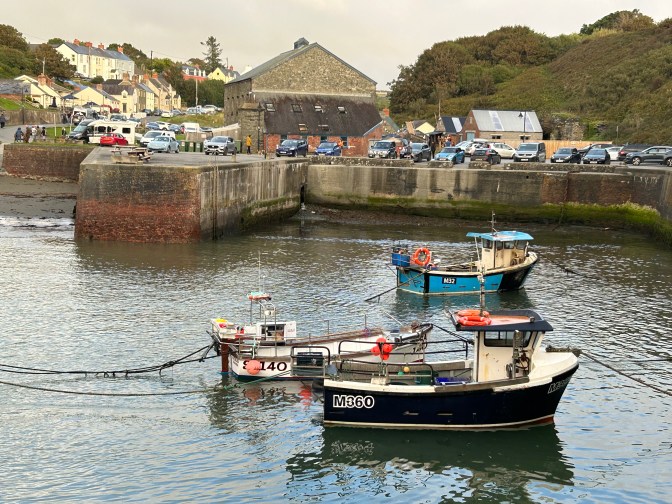
I leave the bar and walk down to the quay. The fishing boats rock gently at their moorings. The rising wind keens through the halyards and down-hauls of the yachts in the channel. Stainless steel shackles and sheaves clink against their masts with a rhythmic tap-tap-tap. And another squally shower comes down like a benediction.

The dog-legged harbour at Solva is one of countless inlets notched into the coast of Pembrokeshire, in southern Wales. Located halfway along the northern edge of St. Brides Bay, Solva catches the full force of the Atlantic gales that sweep up St. George’s Channel, which separates Wales and Ireland. It is a wild coastline of towering basalt sea cliffs, windswept headlands and inaccessible coves, interspersed with sandy beaches and holiday towns such as Little Haven and Newgale. Even in summer, the weather here is moody and unpredictable. And on this August day I have seen the weather change innumerable times: from grey rain to bright summer sunshine and back again in the time it takes to drink a pint at the Harbour Inn.

The British singer and songwriter David Grey grew up in Solva. Born in Cheshire, his family moved to Solva when he was nine to run a gift shop and clothing business. “I had an amazing time growing up there,” he said in a 2017 interview. “My imagination could run wild…” His song Slow Motion, from his 2005 album Life in Slow Motion is one of my favourites. To me, it perfectly sums up life in places such as Solva: long, languid days, warm nights and a pace of life that moves as regularly and predictably as the tides.

St. David’s Anglican Church (not to be confused with St. David’s Cathedral in nearby…er, St. David’s!) stands on the edge of a field of grazing Fresian cows on the hill above Solva. Leaving the house early one morning, I drive up to the church. A cold wind is pushing showers of light drizzle across the fields. The wind screeches around the eaves of the church and rattles in a nearby copse of chestnuts.
The church’s recorded history dates back to 1291 when it belonged to the Cistercian order. It is locked and shuttered but the graveyard looks interesting so I stroll about among the headstones and table tombs, with the sloe-eyed cows peering at me from beyond the drystone walls.
One of the tombs is that of Henry Whiteside, who died in 1826. Whiteside, a musical instrument-maker, was the designer of the first Smalls Lighthouse, which stood on the largest of a group of wave-washed basalt and dolerite rocks known as The Smalls, approximately 20 miles west of Marloes Peninsula. The lighthouse that Whiteside designed was constructed in 1776 and had a unique design: standing on nine oak pillars which allowed the sea, which constantly breaks over the rocks, to pass through beneath it.

During the winter of 1775-1776, Whiteside had the entire prefabricated structure of the lighthouse erected at Solva. Before it was dismantled and transported out to The Smalls themselves, iron rings were fixed to the rock to which the workmen tied themselves. There were constant setbacks during the construction of the lighthouse, most of them related to the unpredictable weather experienced by this stretch of ocean. At one point, Whiteside was stranded on the rock for over a month by gales that never abated. During this time, he wrote a message to a friend in St. David’s and placed it in a bottle inside a casket with a note which read: “We doubt not but that whoever takes this up will be so merciful as to cause it to be sent to Thomas Williams, Esq, Trelithin, near St. David’s, Wales”. Two days later, the casket washed up on the beach at Solva and was duly delivered to Whiteside’s friend in Trelithin.

Despite its innovative design, the lighthouse faced all sorts of challenges. Severe weather conditions and massive waves — one of which smashed the lightroom’s floor up against the ceiling, injuring all three keepers, one of them fatally — led to significant repairs and modifications over its 80-year lifespan. The light was initially provided by oil lamps, which were later upgraded to more efficient silvered parabolic reflectors. The timber structure was eventually replaced with the current lighthouse which was constructed in 1861 and was based on John Smeaton’s Eddystone tower.
A gruesome event known as The Smalls Lighthouse Tragedy occurred at the lighthouse in 1801. The two keepers, Thomas Howell and Thomas Griffith, who were stationed at the lighthouse were known to quarrel. When Griffith died (from natural causes) his fellow keeper, Howell, fearing accusations of murder, preserved the body in a makeshift coffin which he lashed to the lighthouse’s external railing. Unfortunately, the coffin was partially broken open by a freak wave, causing the corpse’s arm to appear, flailing around as if beckoning. This incident highlighted the isolation and psychological strain faced by lighthouse keepers, prompting reforms in their working conditions which included always having three keepers stationed on lighthouses.

The lighthouse was automated in 1987 and remains an essential navigational aid operated by Trinity House. It features a First Order catadioptric lens with an intensity of 39,800 candela, visible up to 18 nautical miles away.
Standing beside Whiteside’s tomb, it is hard to equate the isolation and peril of the lighthouse far out in the bleak, icewater realm of the Atlantic with this bucolic landscape of cows, drystone walls, copses and lanes. I close the wicket gate with a shiver and retreat back to the warmth of our rented house in Solva for a coffee and breakfast.

The carpark at Abereiddy is packed. The enterprising young man collecting the fees — ten quid for a day — directs us to a gap right on the edge of the shingle beach. Charlie backs the van in and Lydia parks her car next to it. We unpack our stuff, walk north along the beach and over the headland to the Blue Lagoon. This deep amphitheatre was once a slate quarry, hewn into the steep side of the lobed peninsula that forms the northern side of Abereiddy Bay. When slate mining ceased, the locals blasted the thin wall of remaining rock to allow the sea into the quarry. The terraced platforms where the slate was dressed and packed for transport over the hill to Porthgain are now places for intrepid swimmers to jump off.
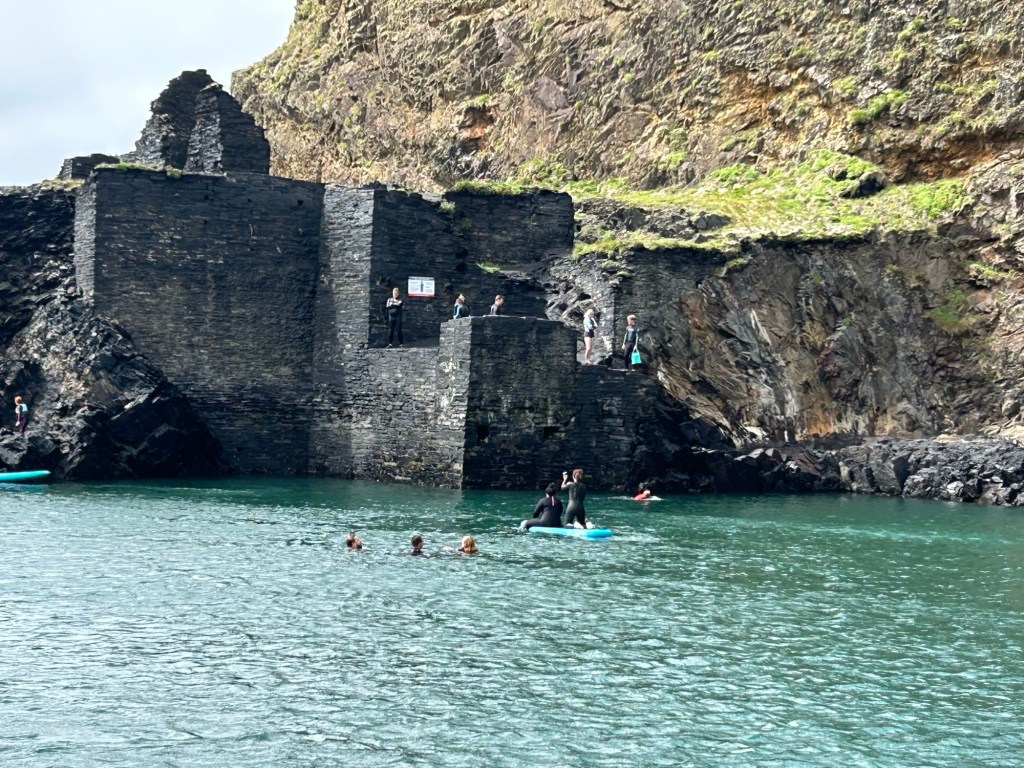
Leaving the family to play in the water, I climb the steep path to the grassy headland above. The trail skirts the top edge of the quarry then continues across a grassy meadow fringed with stunted gorse bushes. Grazing sheep peer at me unconcernedly with their wide, slit-pupiled eyes; gulls ride the updrafts rising from the sheer, shattered sea-cliffs. The coastline wiggles away to the north, notched with bays and beaches. To the west, beyond a pair of martello towers perched on the other edge of the peninsula, a grey squall hangs in the sky.

Later, back down at Abereiddy Beach, I kick off my shoes, take off my shirt and walk out into the Irish Sea. The water is cold at first but as I go deeper, and the waves wash over me, it becomes pleasant and refreshing. I feel the clean salt taste in my mouth and the invigorating chill of the ocean enveloping me. As each wave surges over me I can hear the sounds of the shoreline: rushing water, the distant clang of metal, the rattle of stones being pushed to and fro by the surges. I submerge completely and imagine the Atlantic stretching out from this point, washing the coasts of Ireland, Nova Scotia and scattered islands of the Hebrides, racing over The Smalls, crashing against the distant Eddystone, swirling around the Grand Banks, and shimmering under the hyperborean sun. I feel the pull of the water, drawing me out into this vast, interconnected liquid space: an inexorable, intractable force that seems as though it could make me disappear without trace. I put my feet on the sandy bottom and walk back to dry land.

In the evening, we adjourn to The Ship Inn at Porthgain for dinner. This tiny village, with its tight, concrete-sided harbour, was once the place where slate and dolerite quarried from Abereiddy was loaded onto ships for transport to the building sites of Britain. When quarrying ceased, granite-crushing took over. In the late Victorian period, when the great turnpike roads of Britain, Scotland and Wales were being constructed, crushed rock was a valuable and indispensable component.
I walk along the old quay beneath the towering brick wall of the shingle hoppers that dominate the northern side of the hook-shaped harbour, imagining the activity there in the heyday of the port. Stone from the local quarries was tipped into the crushing machinery at the top of the facility. Steam-driven hammer mills reduced it to the size and consistency needed for the roads, then it was fed down a series of wide chutes to the quayside where it was loaded by conveyor belts into the holds of moored vessels. The din must have been terrific, reverberating around the narrow valley running up from the shore.

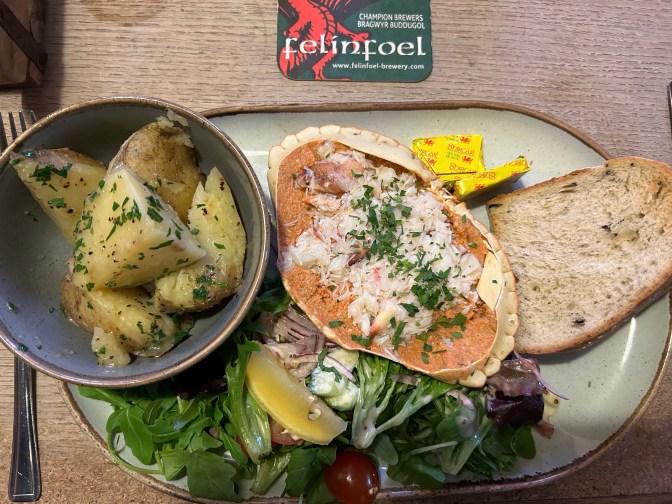
The Ship Inn sits on a terrace overlooking the harbour. It is a pseudo-authentic sailor’s inn, stacked to the gunnels with a tidewrack of dubious maritime bric-a-brac, gimcrack nautical memorabilia, and meretricious seafaring trinkets. We order drinks and take seats at a trestle table. The menu is impressive, with a selection of dishes that would satisfy any Jack Tar who happened to walk in looking for a square meal. I decide to try the crab — a local speciality — cooked and served in its own shell with bread, potatoes and salad. Crab, however, as I soon discover, is a melancholy meat. It tastes good for a start but as I work my way through the meal I feel less and less hungry. The pub is chock full of diners tucking into all manor of savoury dishes. But as I eat, washing each mouthful down with post-mix Coca Cola, I find myself yearning for the simpler fare of the Harbour Inn: a pint of Butty Bach and a bag of pork scratchings.
But, of course, melancholia is only ever a passing feeling for me and as we step outside into the golden gloaming of a perfect Welsh evening, my spirits revive. The sun lights up the harbour with an even, honey-coloured light, shimmering on the ocean outside the breakwater, and casting elongated shadows across the village. The laughter of children echoes from the now silent brick walls of the gravel chutes. The swell pushes gently into the harbour and retires like a polite butler. By the time we get back to Solva it is dark.
A warm sea breeze is blowing off St. Bride’s Bay as we walk up the path to the headland overlooking Little Haven. Gentle waves are pushing up onto the sandy beach below. Kids cavort in the water, watched over by tanned and muscular surf lifesavers in yellow and red. The path winds up between hedgerows of sloe bushes, their blue-black fruits shimmering in the sunlight. I pause to taste one. They look as though they should be sweet and juicy. In fact, they are bitter and dry. Perfect for the gin they are used to flavour.

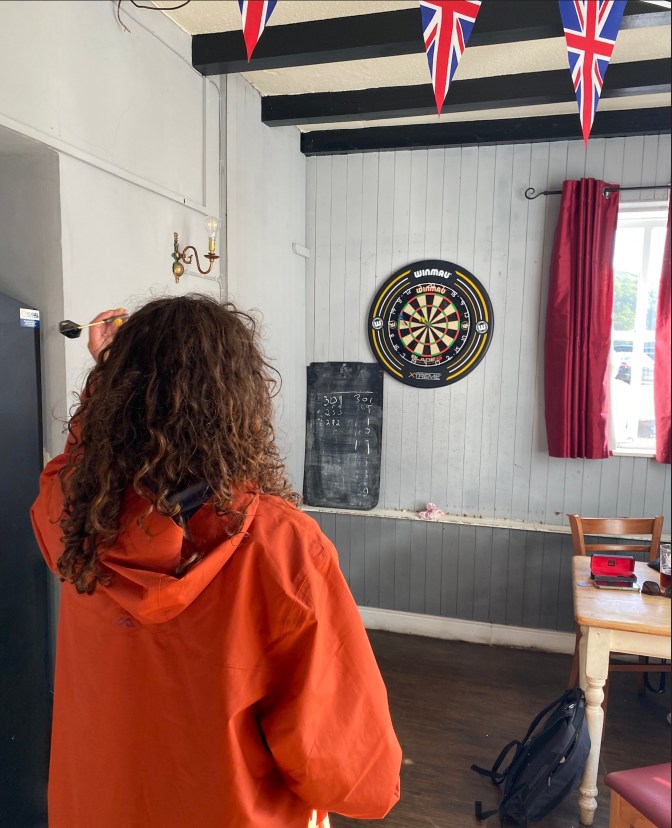
Today is a sloe day [pun intended]. We have just finished a large late lunch at the St. Bride’s Inn down in the village. This walk is just a slight nod towards getting a bit of fresh air on the hill above town. But we don’t go far and end up just sitting in a grassy meadow watching the cloud-shadows roll across the bay. Back in Solva later on, we wander down to the Harbour Inn for a couple of pints and a game of arrows.
On our last evening in Solva I walk out to the headland overlooking the entrance to the harbour. It is one of those long, languid Welsh evenings that seem to hold a special charm. The sun lingers in the sky as if it is drawing out the day: holding its breath for as long as it can before dusk wraps the countryside in its soft, ethereal light.
It’s the sort of evening that inspired a Roman writer, penning a panegyric about Britain to the Emperor Constantine in 310 CE, to observe that the sun in Britain “doesn’t so much set as merely pass by…”, fading briefly into a soft, warm night before the dawn follows, seemingly, almost immediately.
Standing on the headland, with the lights of Upper Solver beginning the gleam, and the long arcing Atlantic waves rolling onto the beach below with a sibilant hiss, the prolonged dusk feels like a gracious pause, allowing time for the day to settle gently before night finally falls. This is a time for legends to awaken, as the boundary between day and night blurs, and the past conjoins with the future.
The horizon stretches wide before me, slowly transitioning from the gentle blush of sunset to the deep, thoughtful, sloe blue of twilight. Time seems to slow down, unfolding sedately like the tide withdrawing from the harbour, only to return in a few hours with the new day. This serene and steady rhythm mirrors my days here in Wales, each one flowing gently together: life in slow motion.


 TravelWriterLife