In Nanjing I am following in the footsteps of my great uncle, the Victorian explorer Thomas Wright Blakiston.
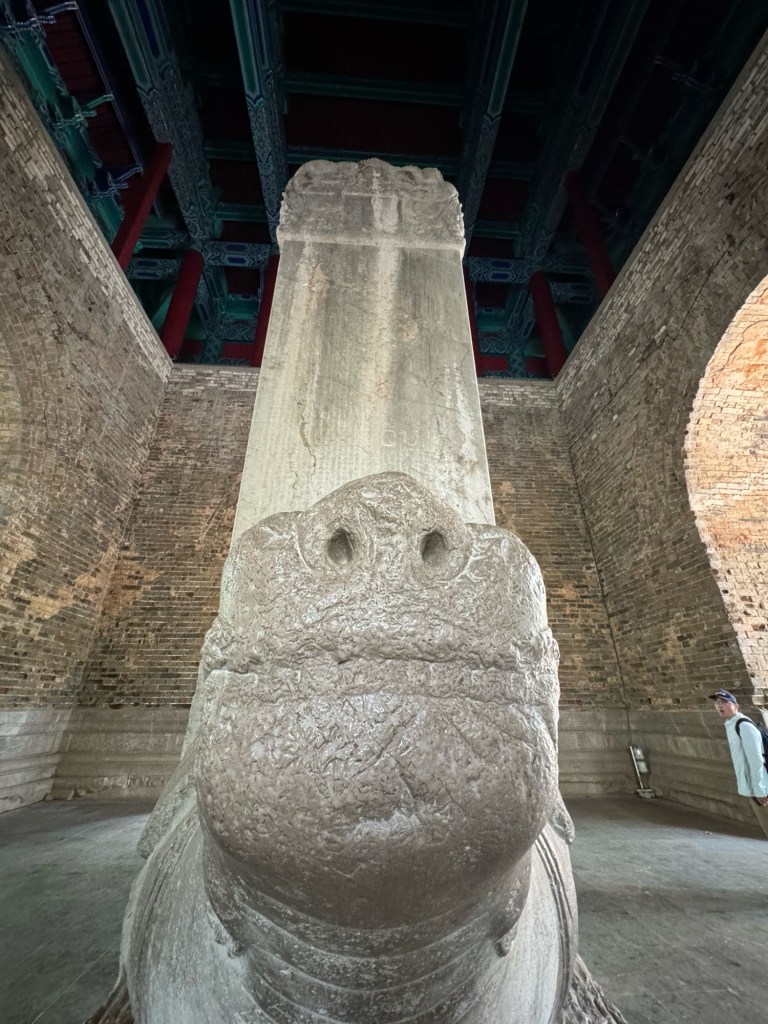
The tortoise stands before me, its stone visage aloof, inscrutable and solemn. Its wide, rounded snout and heavy-lidded eyes give it an air of quiet endurance, as if it has borne the weight of the towering stele on its back—and of time itself—without complaint. The faintly upturned corners of its mouth could almost be a knowing smirk, or perhaps just the erosion of centuries smoothing away its original features. There is no warmth in its stare, but neither is there menace: only the unshakable patience of something built to outlast the rise and fall of dynasties.
The four sides of the immense stone stele are blank. Where proclamations or wisdom should be inscribed, there is emptiness: an unmarked expanse of glossy stone. Whatever the stele was created for, its sculptors left no record, no voice, nothing more than an enigma. Beneath my feet, the flagstones are also smooth, burnished by the passage of time and the countless people that have passed by this place.
Time travel
Sometimes, when I’m travelling, I find that I have to go a long way in order to come back to the same place. But today, the distance I’ve travelled is not only across China, but also through time itself. Because I am not the first Blakiston to stand here before this great stone stele. In March of 1861, my ancestor, Captain Thomas Wright Blakiston, stood on this very spot, gazing up at this same weathered monument.
Now, more than 160 years later, I find myself standing where he once stood. The surface of the stone, the hush of the trees surrounding the monument, even the scent of the wind—these things bind me to him in a way that feels immediate and intimate. Did he trace his fingers across the stone as I do now? Did he feel the same weight of history pressing in with the cool air of the mausoleum? The past lingers here, not just in the lithic textures of the stele, but in the silent echoes of those who have come before: explorers, emperors, wanderers, and now, me.
And yet, even Blakiston and I are only fleeting visitors here. This place belongs, above all, to the man entombed somewhere beyond these stone gates; a ruler who shaped an empire, whose vision and iron will forged a dynasty that would last for nearly three centuries.

The Hongwu Emperor.
Zhu Yuanzhang was born in 1328. His rise from impoverished peasant to emperor of China is a tale of resilience, ambition, and ruthlessness. As the Hongwu Emperor, he was the founder of the Ming Dynasty and one of the most transformative rulers in Chinese history
Humble beginnings in Anhui
Born into a poor family in Anhui province, Zhu Yuanzhang experienced hardship from an early age. His family struggled to survive, and when famine and plague struck, he was left orphaned. Seeking refuge, he joined a Buddhist monastery, where he learned to read and write—a rarity for someone of his background. However, political turmoil soon pulled him towards a greater destiny.
In the mid-14th century, the Mongol-led Yuan Dynasty was in decline, plagued by corruption, internal strife, and widespread peasant uprisings. Zhu joined one such rebellion, the Red Turban Movement, which had a mix of religious zeal and anti-Yuan sentiment. His intelligence and leadership quickly set him apart, and he rose through the ranks, eventually taking control of a formidable army.
Will to power
Through a combination of military prowess and strategic alliances, Zhu conquered Nanjing in 1356, establishing it as his power base. Over the next decade, he systematically defeated rival warlords and the remnants of Yuan resistance. In 1368, he proclaimed himself Emperor of the Ming Dynasty, adopting the title Hongwu, meaning “Vastly Martial.” His forces pushed north, capturing Beijing and forcing the last Yuan emperor to flee to Mongolia, marking the end of Mongol rule in China.
As emperor, Hongwu was a strict and often ruthless ruler. Determined to prevent the corruption that had weakened previous dynasties, he implemented sweeping reforms. He centralised power, eliminating the influence of powerful aristocrats and bureaucrats who might challenge his rule. The civil service examination system, based on Confucian principles, was restored and expanded, ensuring that government officials were selected based on merit rather than birthright.
Economic rebuilding
Hongwu’s economic policies aimed to rebuild China’s war-torn infrastructure. He promoted agriculture, distributing land to peasants and encouraging self-sufficiency. Large-scale irrigation projects and tax exemptions for farmers helped boost agricultural output, reinforcing the Confucian ideal of a society based on agrarian stability. Trade flourished, and he imposed strict laws to regulate markets and ensure fair commerce. Yet, he remained suspicious of merchants, seeing them as a potential source of corruption and instability.
One of his most lasting legacies was his military restructuring. The Ming army became a formidable force, with a system of hereditary military service ensuring that soldiers remained loyal to the throne. The Great Wall was strengthened to guard against northern threats, and he maintained a defensive posture, wary of foreign influence.
Despotism and paranoia
Despite his many achievements, Hongwu’s later years were marked by increasing paranoia and despotism. He executed tens of thousands of officials in purges, convinced that conspiracies threatened his rule. Even his own sons were not safe from his suspicion. After his death in 1398, his grandson briefly took the throne before being overthrown by Zhu Di, the future Yongle Emperor.
The Hongwu Emperor left behind a China that was stable, centralised, and prosperous, laying the foundation for nearly three centuries of Ming rule. His legacy is a complex mix of visionary reform, brutal autocracy, and profound influence on Chinese governance and society.
The march of time
The Hongwu Emperor died in 1398. After a brief and bloody succession struggle, his grandson ascended the throne as the Yongle Emperor, inaugurating one of the most ambitious and outward-looking reigns in Chinese history. The centuries unfolded. Dynasties rose and fell, maps were redrawn, cultures collided. Foreign ships arrived on China’s southern shores bearing clocks, muskets, cannons—and opium. The British came in search of trade and influence, while within China, the fires of rebellion would soon erupt into the apocalyptic fervour of the Taiping Rebellion. And it was here that my great uncle, Thomas Blakiston, would enter the story.

Blakiston and Co.
Thomas Wright Blakiston, soldier, businessman, ornithologist and explorer, was one of those quintessential Victorian men imbued with insatiable curiosity and adventurous spirits. Exploration and scientific inquiry drove them into the furthers corners of the world in search of rivers whose sources were yet to be found, summits no European had seen and creatures whose feathers and fur had yet to be catalogued
The son of a Baronet, Blakiston had fought in the Crimean War and been part of the Palliser Expedition that mapped the western section of the USA-Canada border. He had been the first European to see the Waterton Lakes in Alberta, naming them after the naturalist Charles Waterton. He had been posted to Canton during the Second Opium War in 1859. China fascinated him and it was in Canton (Guangzhou) that he decided to mount an expedition to explore the Yangtze River.
The great Yang-tse Exploring Expedition
Beside the stone tortoise, a giant camphor tree spreads a pool of shade over a flagstone terrace. I sit and write notes in my journal as kids screech and play while their parents chatter.
I imagine Blakiston sitting here, perhaps in the shade of the same tree, sketching the scene and negotiating with their guides. These Englishmen were a long way from home, on a mission that would go down in history…and in family lore.
Blakiston and his companions had departed Shanghai on the 12th of February, 1861, aboard the Royal Navy vessel Titan, bound upriver on what he surely described to his sponsors as a reconnaissance expedition, but which was in truth more akin to a Boy’s Own Adventure. His merry band of travellers included Lieutenant-Colonel H.A. Sarel of the 17th Lancers, Dr. Alfred Barton, and the Reverend S. Schereschewsky—a missionary from the marvellously named American Episcopal Board of Foreign Missions. Each man had his own ambition. The Reverend no doubt hoped to win souls for the Lord; the Colonel was surely scouting military opportunities; and Thomas himself, ever the pragmatic businessman, was hunting for a trade route over the Himalayas that might link China to British India.
In his book about the journey—Five Months on the Yang Tze— he writes with a tone of cheerful curiosity laced with typical British propriety and the genteel arrogance of empire.
“We were four Europeans, four Sikhs, and four Chinese;” he writes. “But one of the latter falling sick was sent back to Hankow.” The Chinese contingent included a “writer”—a teacher for the missionary—and two “boys,” as servants were called in those days, identified only by their phonetic names: Quei-quei and Bin-quei. Also in the party, as guards and general factotums were four Sikhs, Sepoys of Her Majesty’s 11th Punjab Infantry, led by the stalwart Havildar Kumal Khan, along with Privates Zuman Shah, Fuzil Deen, and Mahomed Buksh.
The expedition had the air of a colonial caper, a gallivant into the unknown. But sitting here now, beside the giant tortoise, I can’t help but feel that the past is far more than just a series of adventures and archived facts. It’s something that seeps up from the soil, whispers from the trees, and lingers in the stone. My own journey—twenty-first-century passport, smartphone and all—has somehow come full circle. And though my reasons for being here are different, perhaps even the opposite, I feel, in this moment, very much a part of the story that Thomas began.
Tales of silver
Blakiston’s expedition had been organised informally and its participants had had to come up with all the funding from their own pockets. Their reserve of cash for hiring porters, buying food and for the purchase or hire of craft in which to navigate the river, comprised Mexican silver dollars and small lumps of silver known as taels.
In Five Months on the Yang-tse, Blakiston describes these silver treasures, along with the gear they took. It is a delightfully Victorian inventory, emblematic of a man from a world that unshakably believed that British men could tame chaos with careful packing and a stout heart.
“Each of us,” he wrote, “carried 450 taels of silver…equal to about six hundred dollars, and, for fear of loss from shipwreck or other mishap, we distributed the amount among our different packages. Mine was tied in old socks, and kept various company; one lot was in the next compartment of a box to my sextant; another lay snugly between two dangerous bedfellows, a bag of No. 1 shot and a tin of “Curtis and Harvey” [gunpowder]; while the remainder was distributed so as to equalise the weight of each box as nearly as possible, along with nautical almanacs, logarithm tables, flannel shirts, quinine, fish-hooks, and writing paper.”

The Taiping Rebellion
At the same time as Blakiston and his chums were heading up the Yangtze, the Taiping Rebellion was in full swing. This brutal civil war cost somewhere between thirty and forty million lives, making it probably the deadliest war in human history. But with typical British resolve, Blakiston’s expedition pressed on upriver. During the course of the next four months, they would be involved in a number of shootouts with Taiping rebels.
At Pingshan [sic], the party encountered fierce opposition to their presence. Blakiston takes up the story: “After a long while the first gun was fired, and then commenced a regular cannonade of gingalls and matchlocks in our direction.
“Going aft…I found the captain and our China boys huddled together in the Captain’s cabin in great alarm. We were ourselves all ready to reply to the fire and pick a few fellows off the walls which would no doubt have decided the battle in our favour immediately; but we waited, before doing so, to allow of a shot or two striking the boats.
“This, however, did not take place; and although the firing, and an immense amount of noise, were kept up for an hour and a half, not one shot was observed to strike near us, and we did not hear the whiz of a single bullet. When the firing ceased, we were left under the impression that during the whole time there had been nothing more dangerous than powder expended; but, as our ensign was flying, it was in any way a gross insult to the British flag.”
According to Blakiston, a strongly-worded message was sent to the Prefect of Pingshan demanding an apology but by then the die was cast. The locals had seen enough of the expedition and, on the evening of March 28th, a large crowd of locals descended on the riverbank, intent on murdering the entire party.
“Our first impression,” continues Blakiston, “was that the whole population of the city were sallying forth en masse on our boats. The Doctor, who was on board the large junk, rushed ashore to reach his own vessel, but he found that, the hawsers having been cut, it was already clear of the bank, and he only just managed to get on board by springing off the stern of the larger junk.
“Now was a scene of confusion on our junk. We all rushed to the gangway, rifles in hand, and one of our party was on the point of shooting the fellows who were helping get the gang plank in, taking them for some of the attacking party; sepoys covered the gunwales with their fingers on both triggers of double-barrelled guns; the captain, white as a sheet, was rushing about distractedly with his hands over his head, blowing out lights, and upsetting everything in his way, until he was finally upset himself by a cuff on the head from one of us, and retired into a corner to ruminate on the chance of losing his head. Hubbub and confusion reigned supreme from the old captain to the one-eyed cook.”
Under fire, Blakiston’s men managed to get their junk away from shore and out into the river. The other, smaller, junk with the Doctor and a Sikh sepoy aboard also managed to sail out of harm’s way. But in the confusion one of the party, Mr. Schereschewsky had become separated from them. Blakiston ordered the junk to be moored on the farther shore – this order was not obeyed until a pistol had been pointed at the steersman’s head – and resolved to return to rescue his comrade at dawn.
At first light, Blakiston, armed with a revolver and sword, and one of the Sikhs, armed with a pistol and rifle, set off in search of Mr. Schereschewsky. After a two-hour walk along the river bank they encountered Doctor Barton along with his Sikh and the missing Schereschewsky.
After such a narrow squeak, the party decided to let discretion be the better part of valour and retreat. For their part, the boatmen were happy to head back downstream and set about making the voyage as rapid as possible. And so it was, that on the 30th of June, 1861, Blakiston and his party reached the mouth of the Yangtze and Shanghai.

The Heavenly Path
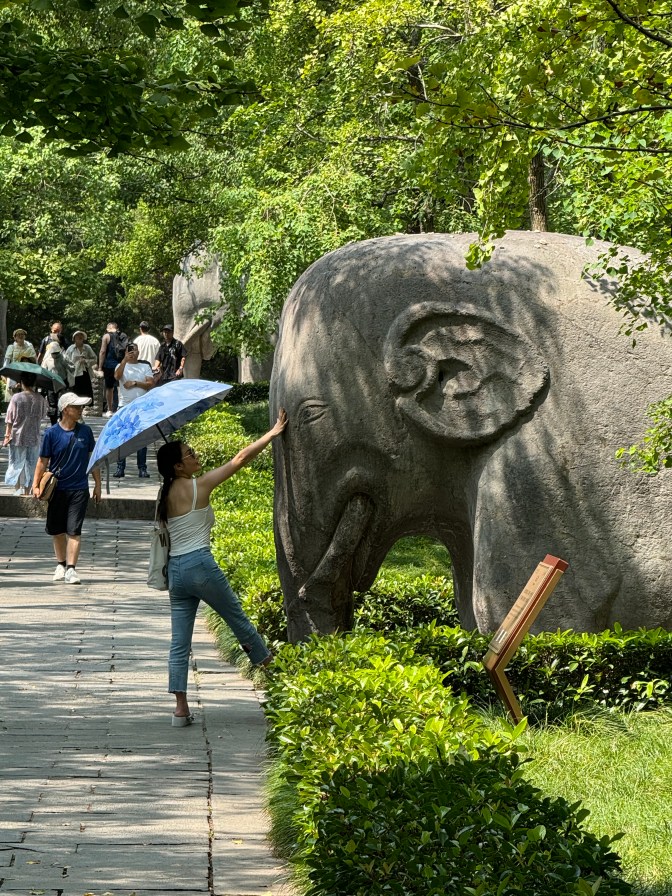
I leave the great tortoise to its blank reveries and walk slowly up a long cobbled path framed by statuary. The Sacred Way of the Ming Xiaoling Mausoleum is a corridor of shadow and shade, flanked on both sides by statuary. The stone beasts are sentinels: not just decorative, but symbolic guardians of the emperor’s eternal journey. They stand in pairs along the path: lions, elephants, qilin, horses. Each one carved from a single block of stone, each one weathered yet immovable.
It is quiet here: no traffic, no noise. Just birdsong, the soft shuffle of my own footsteps, and the quiet echo of dynastic memory. It’s a walk not just through a forest, but through history—through the ceremonial heart of a vanished empire that once ruled all under heaven.
Parasols and pathways
Suddenly, as if they have materialised out of nowhere, a stream of people begins to flow gently along the flagstone path. Parasols bloom like flowers beneath the trees—white, blue, black—shielding their bearers from the midday sun. A woman in a white skirt drifts past with a casual grace, her steps slow and measured in the filtered sunlight.
The pathway, once still and meditative, now thrums with quiet voices and the soft tap of footsteps. The stone camels gaze impassively over the heads of the visitors, as if unfazed by the centuries and the crowds. Their shadows stretch across the path like extensions of history itself.
It’s an odd juxtaposition: the deeply ceremonial and the delightfully mundane. Tourists angle their phones for the perfect shot. Children chase one another between the legs of stone beasts. A young woman with bright red hair stands out in the green stillness like a brushstroke of rebellion on a classical scroll.
Warriors watching
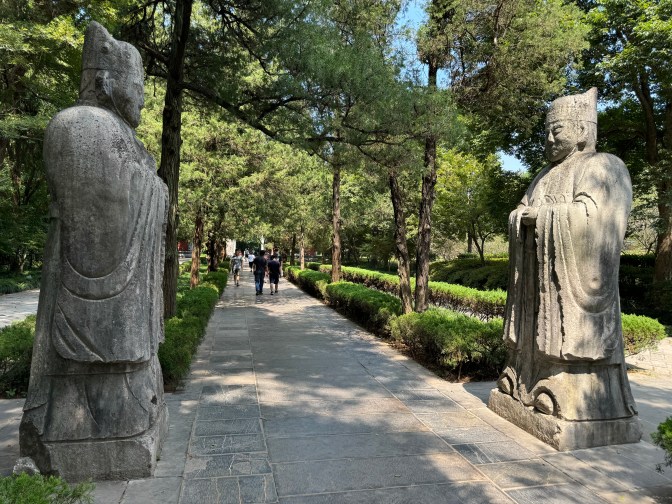
The pathway changes. The gentle procession of stone animals gives way to something sterner, more solemn. I step between two immense warrior statues, frozen mid-watch, their faces carved with the gravity of centuries. They stand with their swords resting against their robes, hands clasped, as if awaiting imperial inspection. Clad in intricately detailed armor, with scaled tunics and layered helms, they project a presence that is both protective and forbidding.
This part of the Sacred Way has a different energy. The trees still whisper overhead, but there’s an undercurrent now, a hush weighted with the legacy of power. These aren’t just decorative figures. They are guardians of an emperor. Each statue looms like a sentinel from another era, watching all who pass with stony resolve. I feel my pace slow. There is something about their gaze that is not quite threatening, but deeply serious, as if to remind me that this is not simply a historical site, but sacred ground. This is where the Hongwu Emperor lies in eternal rest. And these guardians stand ready to defend him.

Stone scholars
Beyond the stone warriors, the martial solemnity yields to a quieter dignity. Now it is the scholars, the civil officials, the wise men who stand in attendance. They wear long robes and tall, winged hats. Their hands are clasped at their waists in gentle reverence, guardians of thought, of law, of ceremony. Their faces are calm, their expressions impassive but peaceful, as though they’ve spent centuries in contemplation under these whispering trees.
There is something deeply serene about this part of the path. Perhaps the statues are reminders that the might of an emperor does not lie only in swords and soldiers, but also in wisdom, in ritual, in the silent weight of tradition. The tomb ahead is no longer just the resting place of a conqueror. It is the culmination of an entire philosophy of rulership; a perfect balance between force and thought, action and restraint.
The Apogee of Architecture
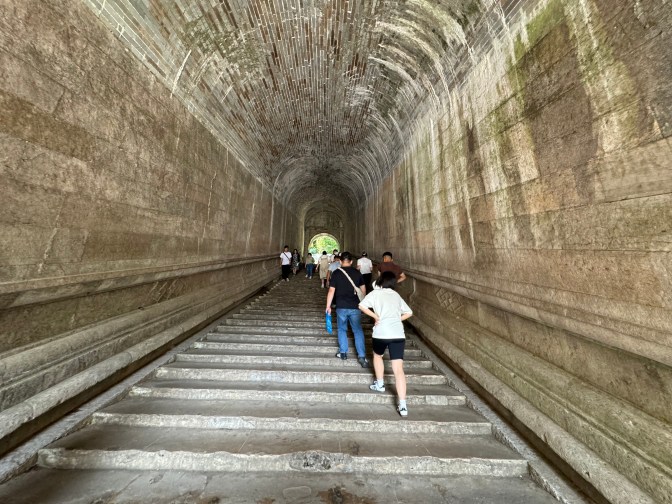
A vast set of stone steps leads upwards towards the entrance to a tunnel. The air cools noticeably as I enter. The tunnel swallows sound, muting footsteps to a hollow echo that reverberate off the damp, vaulted walls. The bricks glisten faintly in the dim light like the inside of some ancient throat. It feels as though I’m being swallowed, drawn into the very bones of the mountain.
This is the final ascent—or at least, it feels like it should be. One last ceremonial passage before standing in the presence of the dead emperor himself. But the truth is far more enigmatic. The actual tomb of the Hongwu Emperor lies somewhere beneath the nearby hill. Its location remains a mystery. No one has ever entered it. No one knows what treasures, secrets, or silence it holds.
So this tunnel is more than just a physical passage. It’s a metaphor. A suggestion. A threshold not into a known space, but into uncertainty—a liminal corridor between the visible and the imagined; between history and myth.
Into the light
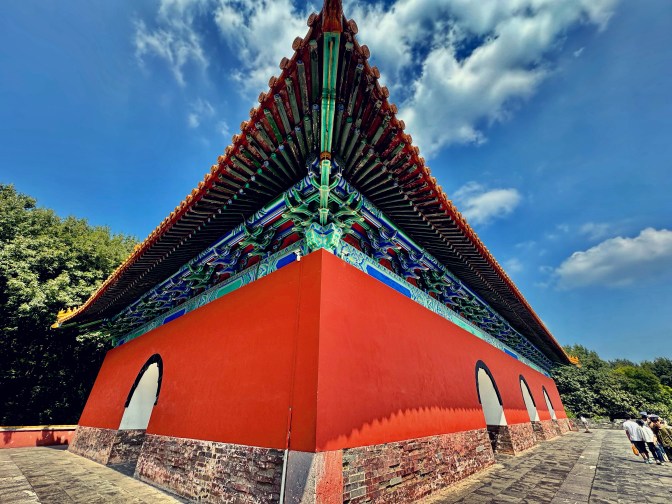
I reach the top and step once more into the light. Before me rises a structure so sharply composed it feels like an announcement, a proclamation: here before you lies the Son of Heaven.
The wall is a searing red—the imperial red of the Ming—slashed at intervals by stark white arches. Above, the roofline soars outward, layered with glazed tiles of peacock green and lapis blue, held aloft by a cascade of dougong brackets that resemble frozen waves. The eaves curve skyward, lifting the whole building toward heaven.
I walk along its flank, dwarfed by its scale, overwhelmed by its precision. Every detail seems calculated to command awe—from the geometrical rigidity of the base to the flamboyant flourishes of the eaves. Even the shadows feel ceremonial here, slashing down the red walls like banners.
And yet, for all its grandeur, this hall, for all its power, is not a revelation, but a veil. Architecture has the ability not merely to house, but to proclaim. And this building doesn’t just mark the entry to a tomb. It asserts the presence of an empire. The dead may be silent, but here in China, they still speak—in brick, and tile, and stone.
The dignified Emperor
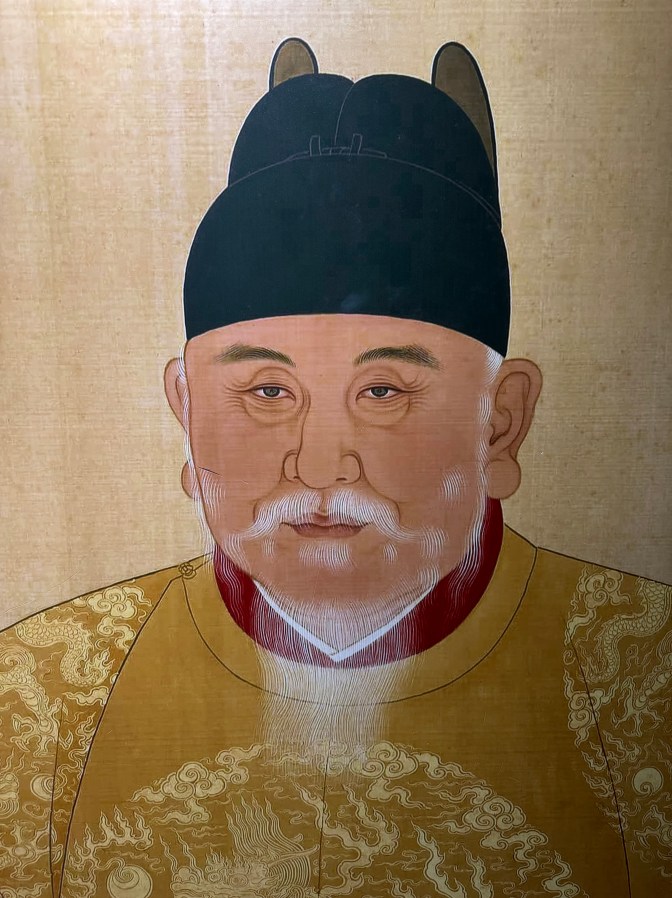
Inside, in the hushed, reverent silence, I find myself standing in front of the Emperor himself. Zhu Yuanzhang: farmer, monk, rebel, conqueror, emperor. His portrait is almost gentle. The brushwork is delicate, reverent: a soft wash of age and wisdom across his face, the white beard meticulously fanned like a scholar’s ink stroke. His eyes are lidded, calm. His robes are golden and covered in dragons—creatures of power and destiny—yet he gazes out with a kind of measured restraint, as if he’s contemplating a Confucian text, not the empire he carved with fire and fear.
Behind the mask
The Emperor’s avuncular expression belies the soul of a man who clawed his way from famine and plague to the Dragon Throne. A man who survived as an orphan by begging, rose through the ranks of a peasant uprising, and crushed the Yuan Dynasty in a storm of blood. Who distrusted so completely that he executed tens of thousands of his own officials — sometimes on a whisper, a dream, a bad omen.
This is the paradox of emperorship in China. He appears serene, dignified, almost tender — a father of the people, a sage. But the truth is written between the lines of silk: he was also a man shaped by chaos, who brought order with iron and suspicion. His laws were harsh. His punishments, brutal. His vision, absolute.
Convergence
It is in places like this that I can feel the convergence of history, time, travel and memory. Thomas Wright Blakiston, the great stone stele, the Hongwu Emperor and myself—a 21st century traveller, enmeshed with technology but still a product of history— are all inextricably linked to this place.
But it is the Emperor whose presence looms largest in this story. He sleeps, somewhere beneath the forest-clad mound rising behind these crimson walls. Untouched. Unopened. As if China still isn’t quite ready to meet him again. As if even in death, the founder of the Ming remains inscrutable.
I look at his face for a long time. The more I stare, the less I see a portrait. The more I see a mask.


 TravelWriterLife