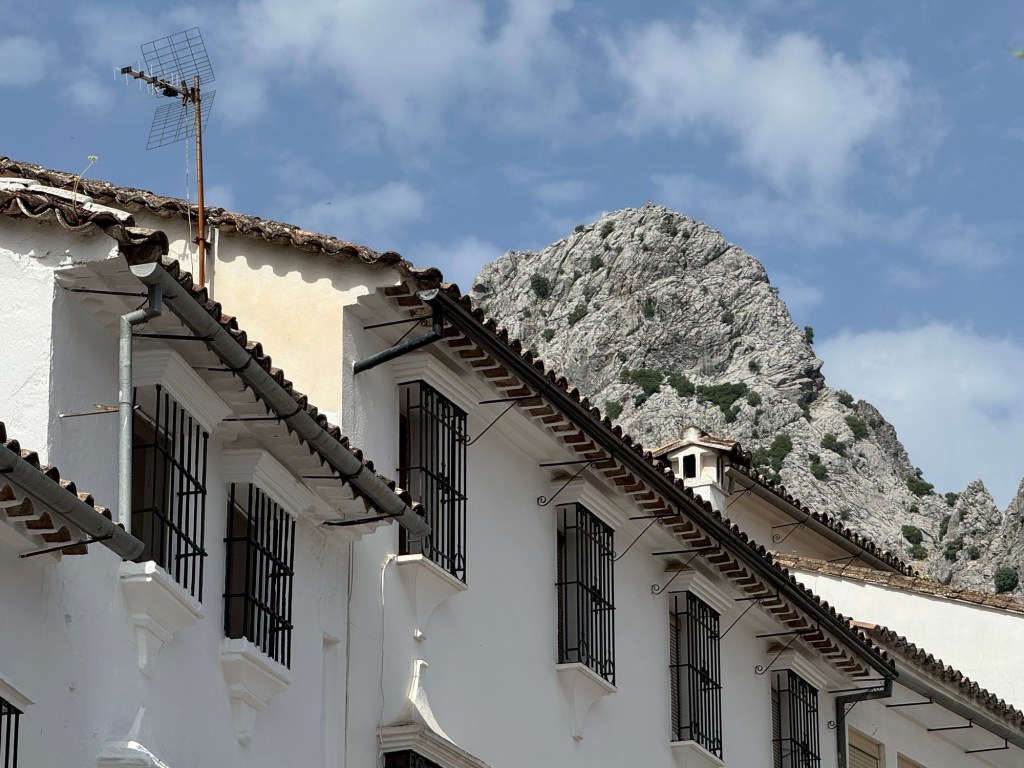
I arrive in Grazalema under a sky that can’t make up its mind — bright sun one moment, cloud-shadowed the next. The air is cool despite the Andalusian summer, and a breeze carries the scent of pine and dry earth down from the jagged peaks above. This is a vertical village in a perpendicular landscape — whitewashed walls rising in defiance of gravity, tucked tightly into the steep folds of the Sierra de Grazalema.
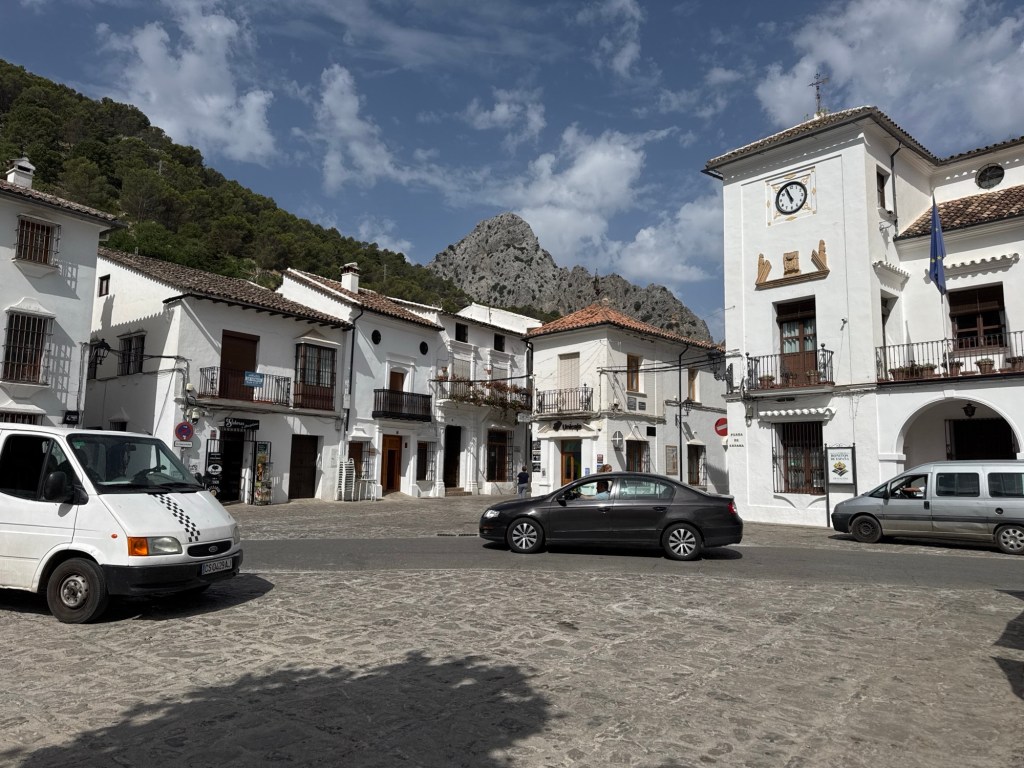
The heart of the village is its square — paved in worn stone, edged with shade trees, and pulsing with quiet life. Locals linger under wide umbrellas at pavement cafés, sipping coffee or cold beer. The chatter is low, contented, and slow. I sit for a while at a table beneath a Cruzcampo-branded parasol, watching the dance of sun and cloud as it flickers across the buildings. Flower boxes burst with geraniums and petunias, magenta and crimson spilling from balconies and concrete planters. It’s a village that knows how to wear colour.
To one side of the plaza, the Casa Consistorial stands dignified and neat, its arches and flags a reminder that this is still a functioning town, not just a postcard. On the opposite side, an old man waters flowers in the shade of an ancient stone wall. Children chase each other around the iron lampposts, their footsteps echoing on the tiles.
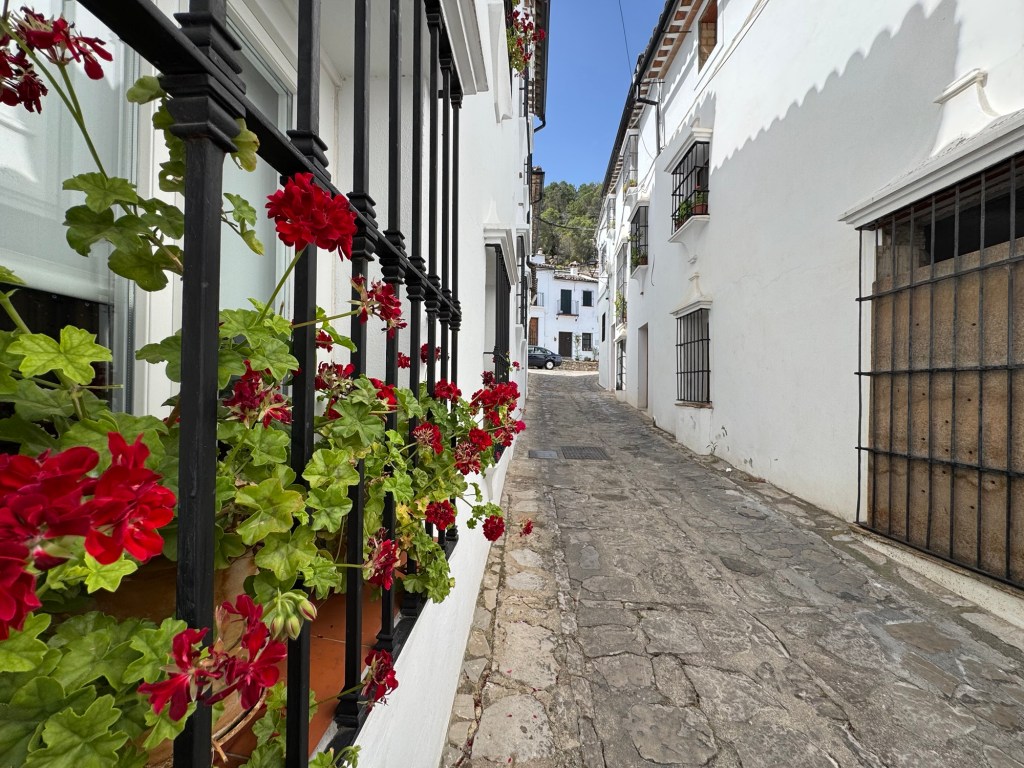
Wandering through the back lanes, I climb slightly and turn a corner — and there it is: the face of the village revealed. A haphazard scattering of rooftops clings to the slope like something poured out of a jug and left to settle. Crumbling stone outbuildings lean into the hillside, their roofs patched with rusting metal and old tiles. Dry grass crackles underfoot, and here and there a fig tree or olive clings to the slope with stubborn grace. Beyond, the mountains rise — grey, wild, and timeless.
Catholicism runs like a quiet undercurrent through daily life here — not loud or overbearing, but ever-present, like the tolling of a distant bell or the scent of incense that lingers long after a procession has passed.
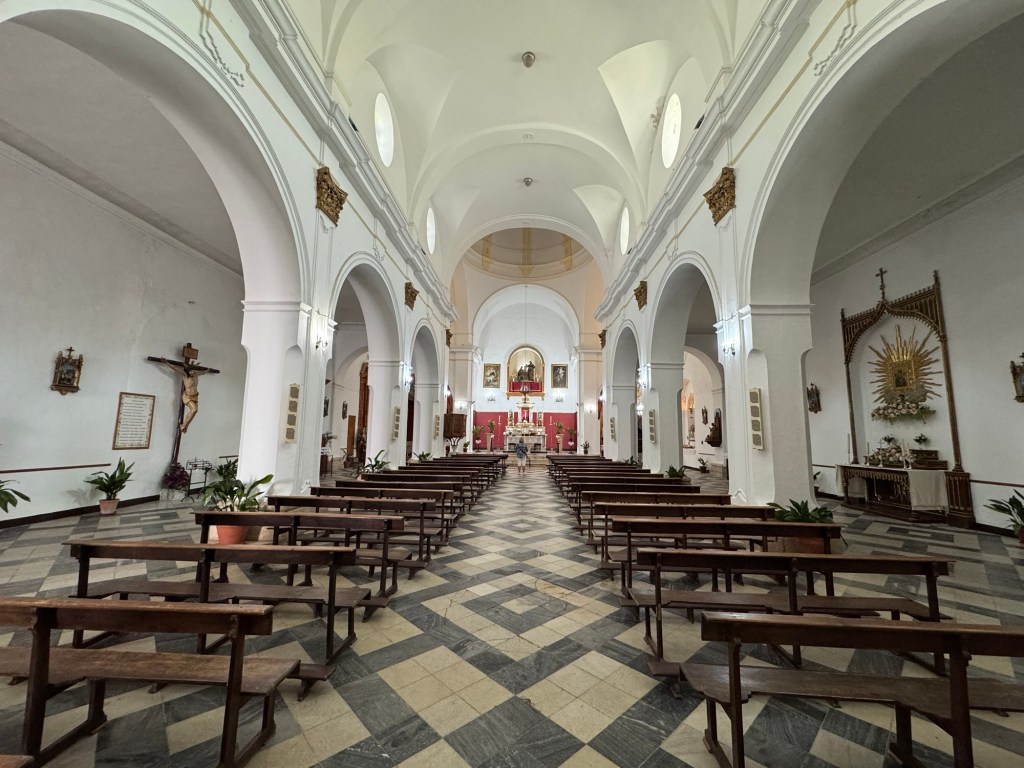
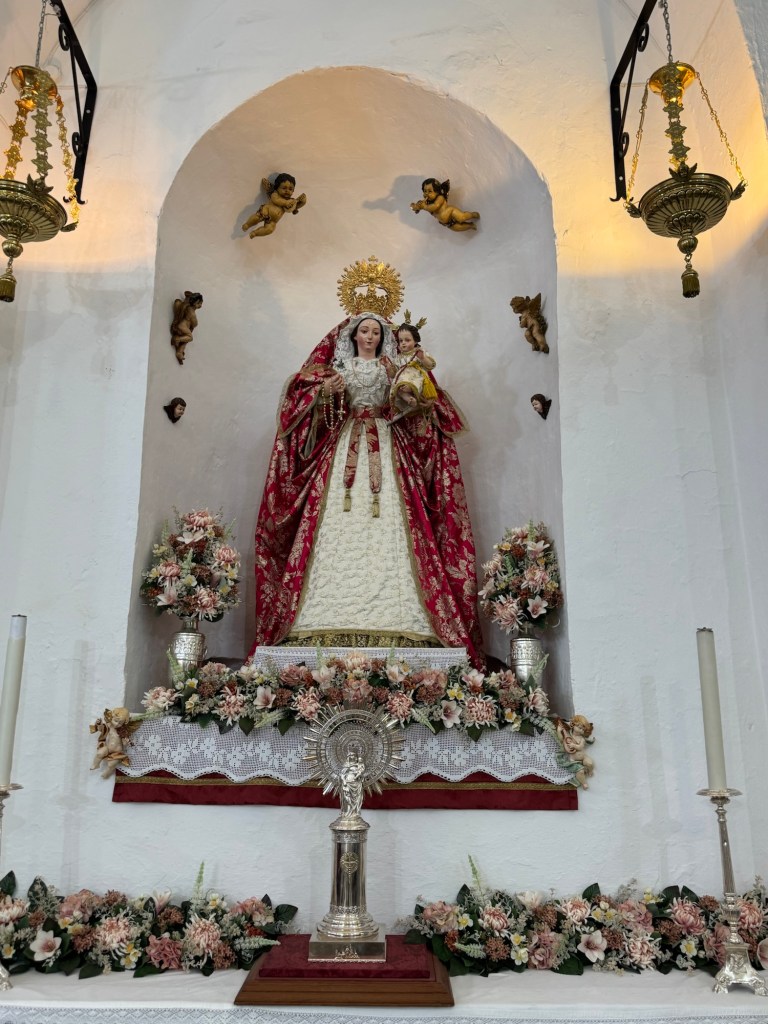
In a side chapel of the village church, I find a shrine to the Virgen del Carmen, dressed in fine brocade robes and crowned in gold, holding the infant Christ with serene confidence. Around her, cherubs float midair — little carved messengers frozen in adoration. The altar is layered with flowers, candles, and silverware polished to a mirror shine. Everything here speaks of devotion, of continuity, of lives marked by ritual and reverence. This isn’t simply decoration — it’s a living symbol of faith that still holds sway over Grazalema’s rhythm.
In Andalucía, Catholicism is not just a religion. It is a cultural inheritance, deeply rooted in festivals, family life, and the turning of the seasons. Every village, no matter how small, has its patron saint, its annual romería, and its sacred calendar. In Grazalema, as in so many other pueblos blancos, the Virgin is not a distant symbol — she is a neighbour, a protector, a mother figure whose presence permeates the village. Her image adorns street corners and home entrances, her processions wind slowly through cobbled alleys on holy days, followed by musicians, candles, and whispered prayers.
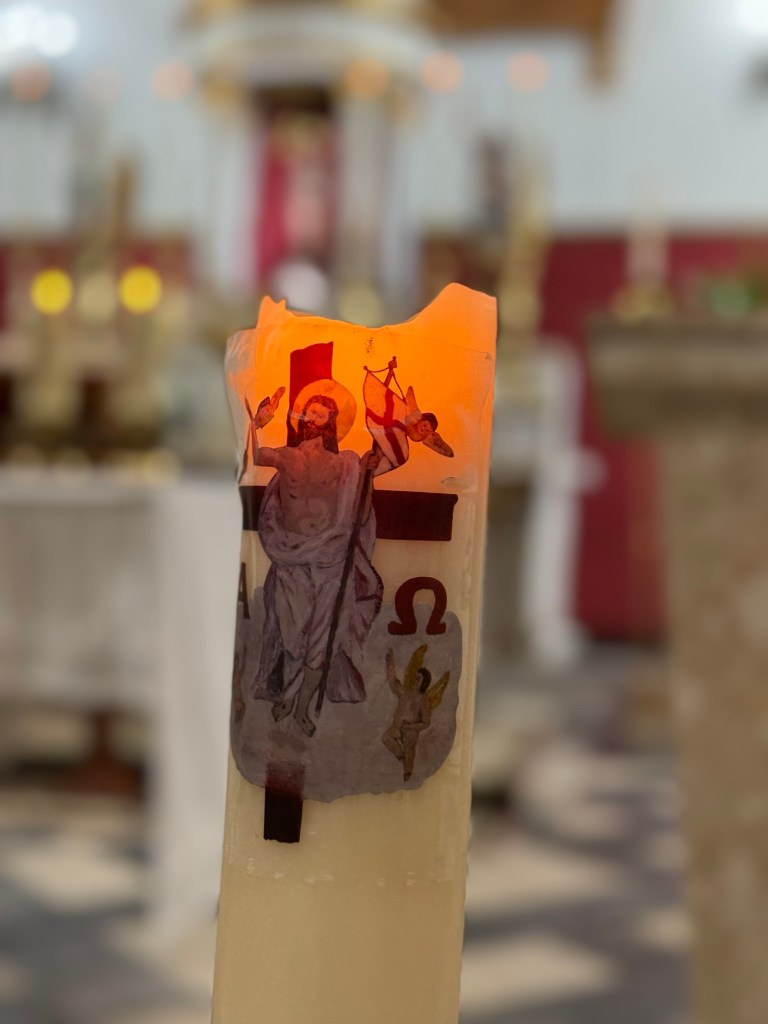
Even for those who no longer attend Mass, the visual language of Catholicism is still deeply familiar — a shared grammar of meaning woven into stone, wood, and tradition. It’s part of what makes this place feel ancient and intimate at once. You sense it not just in the churches, but in the way people greet each other, the way they pause before a shrine, the way they live with a kind of grounded dignity. In Grazalema, as in much of Andalucía, faith is not something worn on the sleeve — it’s something that breathes through the walls.
Back in the square, I find another corner, quieter this time. A stone church looms at the end of a wide open space, its Baroque façade darkened by centuries of weather. Three bell towers — ornate, almost theatrical — reach into the sky as if challenging the cliffs behind them. Beneath their shadow, wrought-iron benches line the path. A pair of elderly women sit in silence, watching the slow movement of the day. I join them on a nearby bench and let the stillness settle.
The clouds gather again, dimming the sunlight to a silvery glow. A cool breeze stirs the trees and lifts the scent of the mountain. Grazalema exhales, and so do I. This is not a place to rush through. This is a place to sit, to breathe, to feel the weight of stone and the grace of white walls pressed up against the sky.

 TravelWriterLife