“There is one town that would be better than Aranjuez to see your first bullfight in if you are only going to see one and that is Ronda.”
– Ernest Hemingway, Death in the Afternoon
There is a moment in the Andalusian day when time seems to hold its breath. The shadows darken, the heat thickens, and the land, the hot and broken land, glows with something both ancient and unsettling.
This is not the soft countryside of northern Spain or the polite avenues of Madrid. This is a country shaped by hoof and sabre, carved by wind and sun, and hardened by centuries of dust and defiance. The mountains do not roll here: they rupture. Cracked ridges. Sheer bluffs. And the town of Ronda stands at the heart of it.
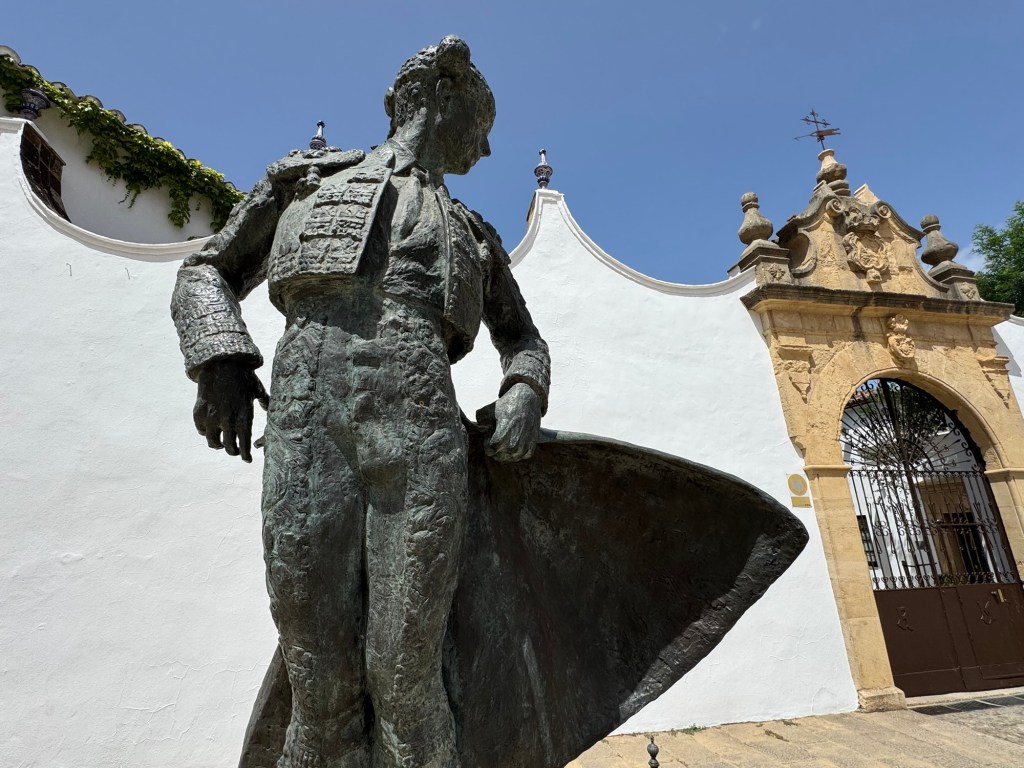
The arena in Ronda is quiet. Golden dust lies undisturbed beneath a sky as sharp and blue as a blade. The wooden railings cast long shadows across the sand, and the heat presses down like a hand. But if you listen—if you sit in the shade of the colonnade long enough—you can almost hear it. The snort of the bull. The roar of the crowd. The silence before the kill.
Hemingway came here once. He came for the ritual, not just the spectacle. He came for the code, the discipline, the dance with death that the bullring demanded. He called it “death in the afternoon,” but what he really meant was truth in the afternoon. Because here, in the hot light of Ronda, there was no room for lies.
Every pass of the muleta, every charge, every pause before the strike of the sword. These were not just moves. They were acts of grace, of courage, of fatal symmetry. The matador didn’t fight the bull. He partnered it, drew it in, honoured it. And then, at the ordained moment, ended it..

Today, tourists wander the ring, cameras raised, unaware of the ghosts watching from the upper tiers. But the shape of the arena remains unchanged. A circle. No corners to hide in. No escape. Only the sun, the sand, the crowd, and the reckoning.
Perhaps Hemingway saw himself in that dance: struggling to live honestly in a world that flinched from pain. He wanted the purity of blood on sand. He wanted to see how a man behaved when there was nothing left but instinct, ritual, and fate.
And here, in Ronda, under a burning Spanish sun, he found it.

As I stand in the ring at Ronda, the sun that beats down like judgement. The arena is empty, but not silent. The ghosts are loud. I can still feel the weight of history here: the ritual, the pageantry, the sharpened edge of theatre that Hemingway immortalised. I try to understand why he was drawn to it. The dance, the danger, the coded grace. The matador’s poise. The courage. The rawness of it all.
But understanding is not the same as accepting. Because I am also repelled. Deeply. Unshakably.
Bullfighting, for all its ceremony and antiquity, is a form of cruelty. However noble the dress, however choreographed the movements, the fact remains: it is a slow and ritualised torment of an animal, done for applause. For sport. For spectacle.
This is where I find myself caught between the pull of cultural heritage and the hard knot in my stomach. I understand that traditions are not simple things to condemn. They emerge from time and place, from values and identity. Bullfighting is woven into the fabric of Andalusia: its festivals, its architecture, even its literature. To visit here is to acknowledge that. But acknowledgement is not endorsement.
As I walk the arena I can see both truths. I see the poetry and the violence. The precision and the pain. The humanity and the inhumanity. And maybe that’s what places like this ask of us: not that we choose one side and close the door, but that we stand in the middle of the ring, dust underfoot, and hold both thoughts at once. Like the sun and shadow that move across the sand, the truth is complex. It always has been.
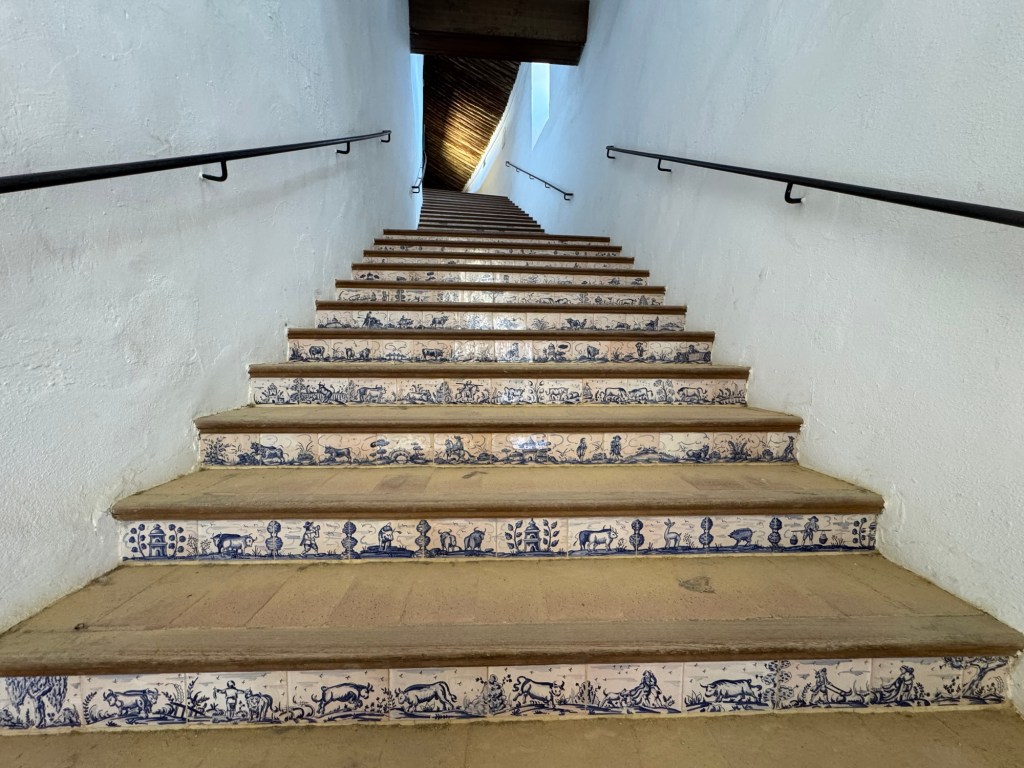
I climb a set of dark stairs to the colonnade seating: flat timber benches arrayed in tiers right around the arena. Looking down on the bullring, I try to imagine Hemingway sitting beside me. He wouldn’t speak right away. He’d watch me watching the ring. He’d notice the tension in my jaw, the way my eyes linger not on the architecture, but on the imagined blood.
Then, perhaps, without turning his head, he’d lean in slightly and murmur:
“You don’t have to love it. But you do have to look at it. All of it. Even the part that hurts.”
He’d sip whatever drink he had in his hand—probably something stronger than water—and go on.
“The bull dies badly. Yes. And that’s the point. It dies in full view of the crowd, with courage, with dignity, with terror, just like we all do if we’re unlucky enough to live long. It’s not entertainment, not really. It’s exposure. It shows you the truth. That’s why they call it art.”
And then, with a half-smile and a harder stare, he might say:
“Most people run from death. Here, they meet it head-on. They give it choreography. They give it meaning. You think it’s cruel, and you’re right. But it’s also honest. Can you say that about most things?”
Then he’d lean back, eyes fixed once again on the dust and sunlight, as if waiting for the afternoon to begin.
“But the bull has no choice about being here,” I say. “The people do, but the bull does not. How is it brave to kill an animal that is essentially cornered?”
Hemingway doesn’t answer at first. He takes a long breath, eyes narrowed under the brim of his hat.
“No, the bull doesn’t choose,” he says slowly.
“But neither do soldiers in most wars. Nor the poor. Nor the ones that life throws into the ring whether they want it or not.”
I shake my head. “That’s not the same, and you know it.”
He nods, grudgingly. “You’re right. It isn’t. The bull is innocent. And yet, that’s what makes its death matter in this ritual. It’s supposed to hurt you to watch. It’s supposed to feel wrong. If it doesn’t, then there’s no truth in it. No poetry. Only blood.”
I glance down at the sand, scorched and silent, knowing full well that no matter how much ritual or honour is wrapped around it, the animal never consented to this pageant.
He sees that in my face.
“I won’t convince you,” he says, almost kindly. “But let me say this. Most people never look death in the eye until it’s theirs. The ring forces them to. That’s why I came. Not for the gore, not for the cheers. For the confrontation.”
We both fall silent. The sun shifts again, and the arena grows hotter. Somewhere, a cicada buzzes. A swallow dips low over the sand. In this moment, our disagreement holds its own kind of honour. Two truths, side by side in the silence of Ronda.
So is bullfighting a metaphor for war? The answer is yes…and no. That’s the brilliance and the brutality of it.

For Hemingway—and many of the writers, poets, and philosophers who wrestled with the meaning of the corrida—the bullfight could function as a metaphor for war, but it was never only that. It was more primal, more personal. A symbolic space where life, death, courage, beauty, cruelty, honour, spectacle, and inevitability were played out in full view.
In Hemingway’s world, the matador becomes the soldier; the ring becomes the battlefield. But the metaphor collapses the moment you remember the bull never volunteered.
If the bull cannot choose, is it still art? Is it still brave? Or is it just a pageant of power disguised as ritual? Sitting in the corrida, looking down at the hot circle of yellow sand, I find that the answer is easy. It is cruelty and barbarism dressed up as tradition and bravery. But there is nothing brave about killing a cornered and defenceless animal; and the tradition, however deeply rooted in Andalusian culture, has no place in the 21st century.
I walk back down the dark steps and out into the ring once more. The sun beats down with an almost tactile force, like a blade pressing against my skin. The circle of sky is as blue as a porcelain bowl held overhead. Apart from the tourists, the arena is silent and watchful, as if the sand itself remembers: the bellowing, the footfalls, the cheers, the blood, the rituals, the courage, the cruelty, and the deaths in the afternoon.


 TravelWriterLife