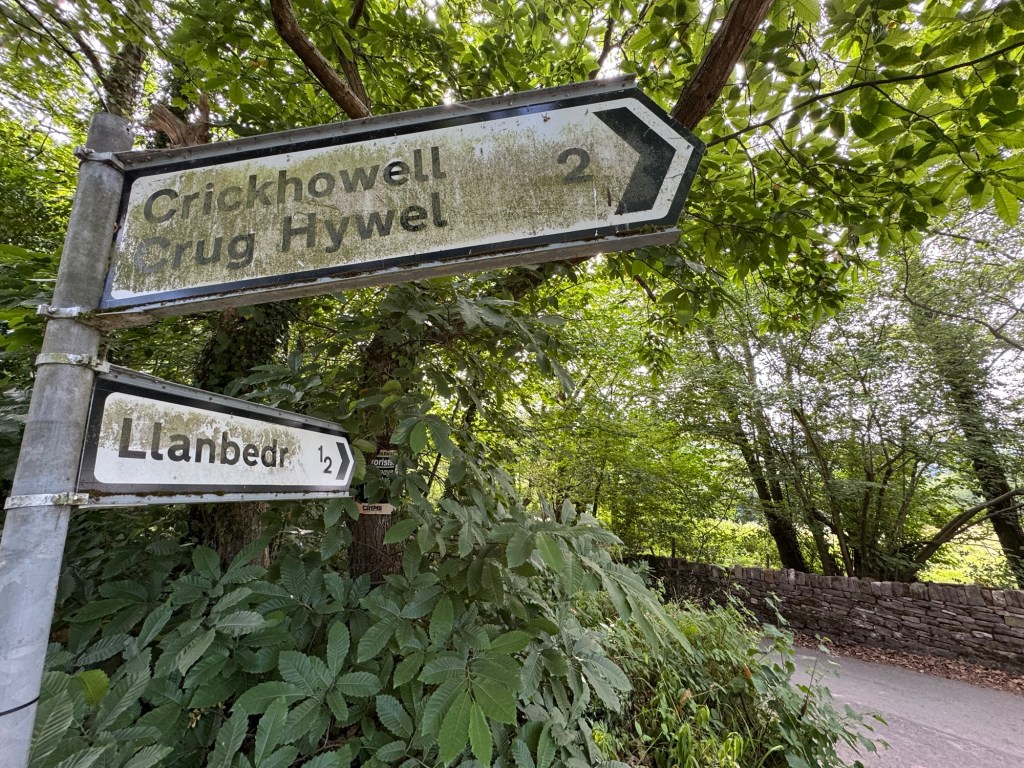
This is truly my happy place. I am somewhere above Crickhowell in Wales. The narrow country lane meanders between tall hedgerows and drystone walls, just wide enough for one car—if that—and I’m the only one here. The sun is out, the sky is impossibly blue, and I feel that gentle, expansive quiet you only get in the hills. I don’t need a map. I’m not even sure where I’m going. But the bracken-clad slopes above me are steady companions, and the sheep in the fields look up when I pass, as if they recognise a fellow wanderer. T

Somewhere down in the village I’ll find a coffee and a quiet table. But there’s no rush. Right now, I’m content just walking. One foot in front of the other. Road warm beneath my soles. Hedgerows alive with birdsong and bees. The air filled with the hush of mid-summer and the promise of nothing urgent.
I can hear the trilling of skylarks somewhere overhead, their song thin and bright, like silver wire spun in the wind. Off to the left, a wood pigeon mutters its slow, familiar mantra: Take two cows, Taffy. Take two cows, Taffy. I grin. It’s the kind of nonsense that makes perfect sense out here.
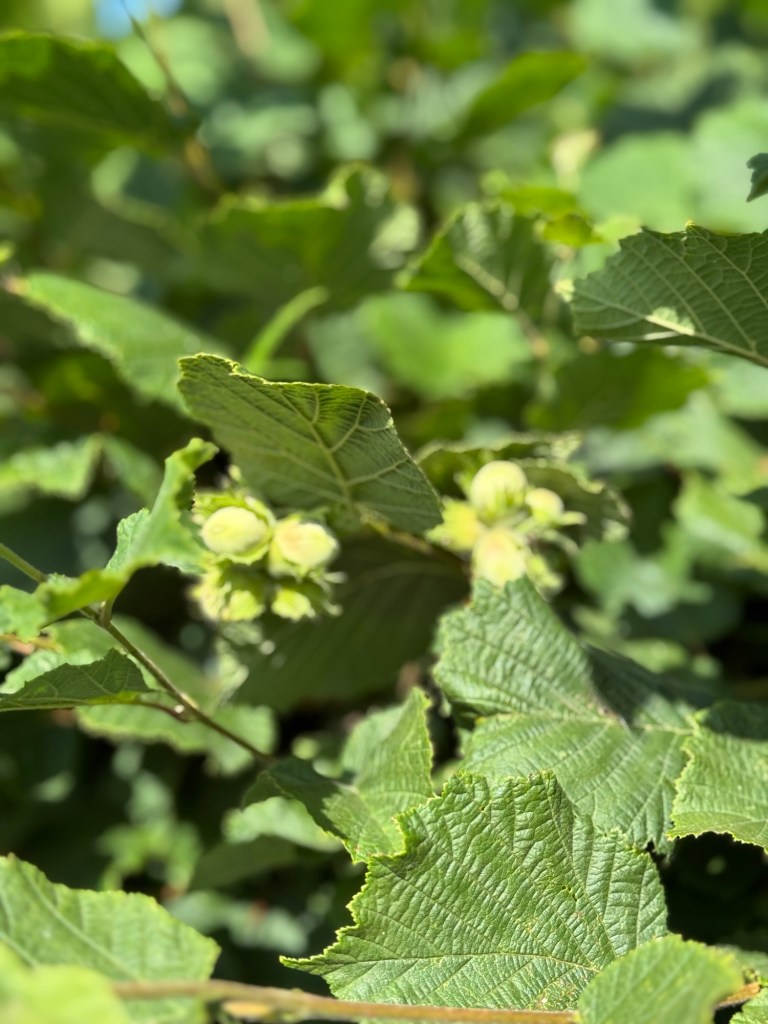
The hedgerows themselves are a marvel. Living, breathing structures of bramble, sycamore, holly, blackthorn, hawthorn, blackberry, and ivy—layered and interwoven over decades, sometimes centuries. They’ve been trimmed back recently, just enough to let tractors pass without swallowing the road entirely. But not too early. The farmers here wait until the end of summer now. It’s the law, but also the rhythm of the land—to let the birds nest, let life go on undisturbed in these green corridors of South Wales.
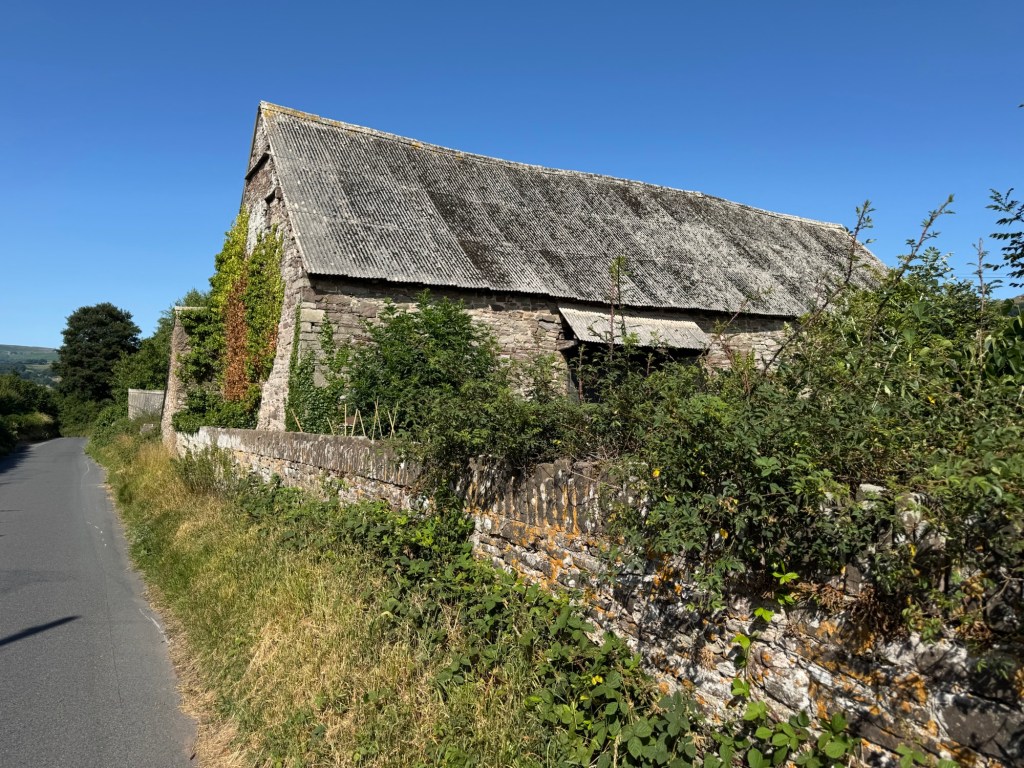
There’s an old stone barn along the way, just off the road. Its roof, streaked with lichen and softened by years of weather, leans at a comfortable angle. The walls are thick and rough and half-swallowed by vegetation. It doesn’t feel abandoned, not exactly. More like a building that’s retired. Content. It has done its part—stored the hay, sheltered the ewes, stood fast through storms—and now rests under the sun in well-earned peace.
I turn a corner and there is Crickhowell, nestled in the folds of the valley, caught in the spaces between trees and fields. From here, it looks like it has grown from the land itself: white cottages and slate roofs tucked among orchards and hedgerows, the church tower rising just enough to be noticed. The hills behind are a patchwork of soft greens and bassalt blacks, stitched with hedgerows and stone.
Farther along, the road curves downhill, and suddenly I’m gifted one of those perfect views. The spire of , framed by the branches of an overhanging tree, like a painting in a natural frame. The hedgerows dip just enough to give me a glimpse of the village roofs, the copper beeches and old oaks that shade the lanes below. It’s theatrical, almost—as if the leaves have drawn back a curtain, revealing the quiet grace of a place that waits to be discovered, step by step, turn by turn.

These British country lanes are truly unique. We’ve got nothing like them in New Zealand, where the landscape sprawls wide and wild, where the sky dominates and snowy mountains call from miles away. In the South Island, the views stretch on forever—but they can be overwhelming in their vastness.
Here, the views are shorter. Tucked in. Hedges and trees and folds of land gently shape the world into something more manageable. There’s something comforting about it. Something human in scale. You see only a little ahead—a gate, a rooftop, a cow’s flicking tail—and the rest reveals itself gradually, like a story well told.
This is the kind of mile that doesn’t measure distance. It measures peace. It measures the way sunlight slants through branches, dappling the road ahead like a blessing. It measures the hush that settles in your chest when you’ve walked far enough to forget your phone, your emails, your obligations. It measures the slow breathing of the land, the rhythm of your footsteps on warm tar, the hush of wind in the sycamores, the rise and fall of the hills like a sleeping creature.
It’s not about how far I’ve come, or how many steps I’ve taken. It’s about how far I’ve drifted from noise, from urgency, from the ache of always needing to be somewhere else.
This is the kind of mile where the past walks with you, where the stone walls remember, and the birds carry on conversations older than maps. A mile that asks nothing of you except to be fully here. Fully still. Listening to these hedgerow madrigals and walking slowly on.


 TravelWriterLife