Dawn on the hills of South Wales. A cold wind is blowing in from the west. Skylarks sing above the bracken. The muscular roll of the hill lifts beneath my feet. To the east, the sun is rising, spilling its first gold across the land from behind the distant line of the Malvern Hills. Above me, the top of The Blorange is already in sunlight.
The wind cuts across the hillside like the slash of a sabre. After the 42-degree days of Seville and the warm, breathless nights in Abergavenny, this feels almost violent. As an afterthought before leaving the house, I’d taken a coat from the rack. I’m glad I did. Without it I’d be frozen up here. I remember an old shepherd’s saying: If it’s warm, take a coat. If it’s cold, please yourself.

There are sheep up here with me on the hill. I can hear them calling to each other through the bracken. I can smell the sweet, warm scent of wool. Piles of their leavings mark the places where they spent the night. There have been sheep up here for centuries, and hardy shepherds too; moving flocks, sheltering lambs, protecting them from foxes and storms, closing them in behind stone walls that still line the hill.
The sheep were bred for this place. Their ancestors watched the Roman legions march across the ridgelines, stood through the Black Death, and chewed their cuds through the time of the Tudors, the coal barons and the slow fade of empires.
I push on, the track narrowing into a natural corridor formed by tall bracken. It shelters me from the worst of the wind. Beneath my jacket I’m wearing a merino wool jersey: wool from the South Island high country. The same sort of fibre that is keeping the sheep warm is now keeping me warm too, halfway up a Welsh hill.
Tufts of wool are caught in the bracken, shivering in the wind. A scattered pile of feathers shows the place where a predator—hawk, fox, something fast and silent—tore a bird to pieces. It’s a reminder that this hill is not just a postcard view. It is alive, and it is wild.

The Blorenge rises to the west of Abergavenny. I have been looking at it for days, waiting for a chance to climb it and look down on the town. Its battlements of cliffs, just under the line of the ridge are enticing, intriguing. The geology is pretty standard — ancient sedimentary layers— but, as always, knowing what lies under my feet helps me to describe and define the landscape.
The lower slopes of The Blorange are made of Old Red Sandstone from the Devonian period. Higher up, it shifts to mudstone, limestone, and sandstone laid down during the Carboniferous. At the summit, I walk over coarse sandstone, sitting at the boundary between the Millstone Grit and the Coal Measures. Deep below, parts of the Ogof Draenen cave system run through the rock. At around seventy kilometres long, it is the longest cave system in Wales.

I love these old Welsh hills. They don’t offer up their views easily. They make you earn them, step by step, breath by breath. You don’t jut see the land up here; you move through it. You listen to it. The Blorange doesn’t shout: it waits, it whispers.
A cold mist is blowing across the summit, creeping in low and fast over the heather. One moment I can see across the whole valley, and the next I’m standing in a world of grey. A cairn marks the high point. The stones are piled with care, some ancient, others newer. I place a stone on the teetering heap. The wind tugs at my coat and pushes against my legs. It’s a further reminder that up here, you cannot trust the weather. It changes in an instant. It is unpredictable, changeable, and extremely dangerous.

The mist thins, then disappears as suddenly as it arrived. I can see the land below me spread out like a map. Far below, Abergavenny still slumbers, but cars and lorries already move along the A40. The Usk curls gently around the foot of the hill, meandering toward the Bristol Channel, which I can just make out in the far haze to the south.
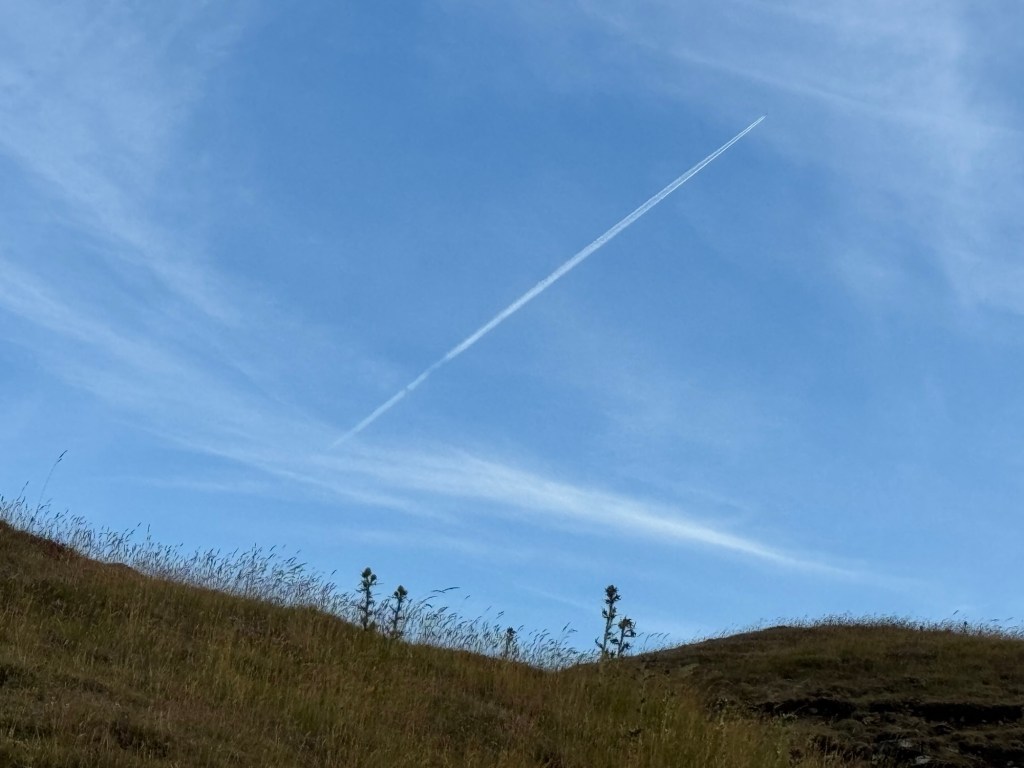
I hear the distant roar of jet engines as another aircraft carves a white stripe across the sky above the mountains. Up there, people will be settling into their flight, sipping their drinks and leafing through the in-flight magazine. Down here on the hills, I’m alone with the wind and the sheep.
I begin the descent. Somewhere along the way I take a wrong turn and end up in the middle of a dense field of bracken. It’s no problem, of course—the sheep have made a neat track for me to follow—but I tread carefully. The rocks beneath the fronds are hidden. One careless step and I could easily twist an ankle. It’s a final nudge from the hill, a reminder that even on the way down, you have to pay attention.
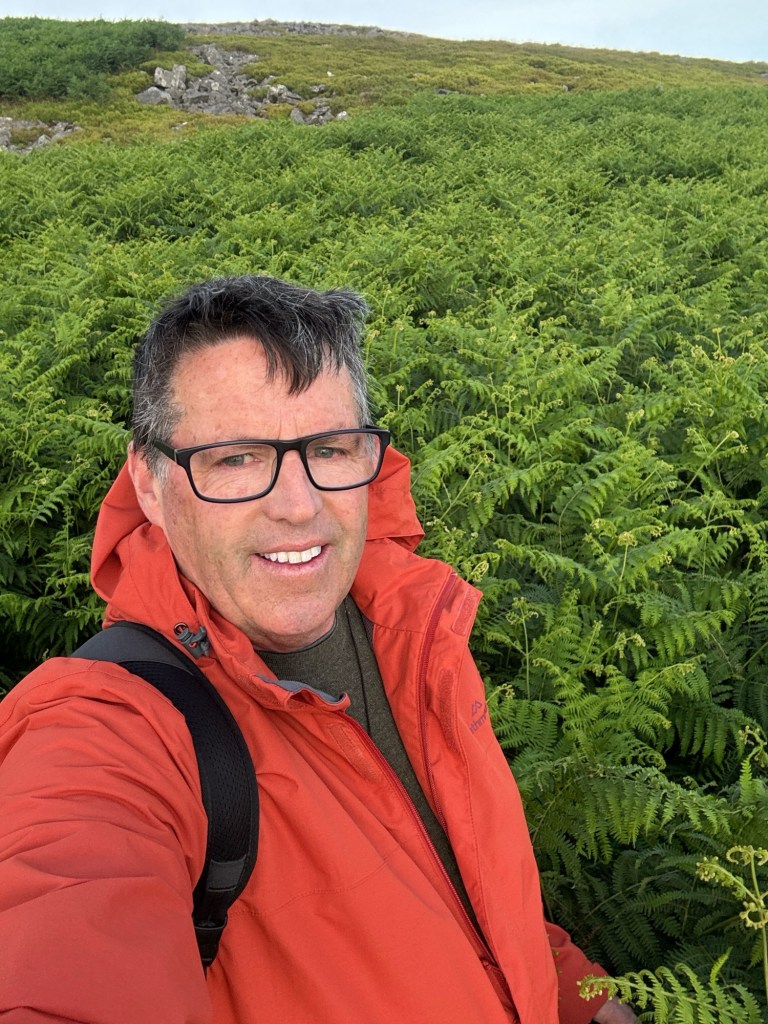
The mist is gone. The sun is higher. The green is brighter. These hills can be brutal. Dangerous. Frigid. They will take their toll on the unprepared, the overconfident, and the unlucky. The weather can turn fast. Paths can vanish in an instant, replaced by opaque mist and freezing rain. Even in summer, the wind can cut through you like a falcon’s talon.
But these hills are beautiful too; gentle and generous in their way, especially in this early light. The grasses are golden. The sky is soft. The air is clean enough to taste. Even now, with the wind still tugging at my coat, I can feel the promise of heat returning: the whisper of a summer day to come.
That’s why I came up here this morning while Abergavenny was sleeping. For the contrast. For the clarity. For the thrill of standing on the edge between cold and warmth, silence and stridence. I keep moving, warm inside my coat, the path unwinding slowly back toward the valley.


 TravelWriterLife