It is just after five in the morning. The room is cool and silent, cloaked in that dense, velvety darkness that belongs only to the hours before dawn. The city has not yet stirred. Even the pigeons that haunt the rooftops of Seville are still folded into themselves, dreaming in the eaves.
Then, across the stillness, it comes. A single, low toll from the cathedral bell. It rolls through the silence like a slow wave — sonorous, ancient, deliberate. The first note is deep, almost mournful, and seems to rise from the bowels of the earth rather than the belfry of the Giralda. It echoes faintly off the old stone walls of the city, bouncing down narrow alleys, across courtyards, and through half-open shutters. Then, a second toll — equally grave — and then a third.
Each strike is measured, spaced just far enough apart that time feels suspended between them. I lie still in bed, barely breathing. There is no other sound. No cars, no footsteps, no birds. Just this slow, ceremonial marking of the hour, as though the cathedral itself is pausing to remember something solemn and forgotten.
By the fifth toll, I feel it in my chest: not just as sound, but as presence. And then silence returns. Heavy and complete. But different now, as though the bell has altered something in the air.
This is Seville before daybreak. A city with centuries in its bones, whispering them to anyone awake enough to listen.

I doze until I hear the bells chime again: six AM. I let myself out of the apartment and onto the silent, empty alley outside. It is only a few minutes walk up to the great square. The moon, a delicate silver crescent, hangs in a velvet sky above the silent plazas. The buildings are still sleeping—shutters drawn, doors closed tight—and the cobbled street glistens faintly under the glow of old streetlamps. Orange trees, planted in careful symmetry, hold their dark green leaves in hushed stillness.
Crimson banners hang from the balconies across the square, catching the lamplight like ceremonial robes. Their gold emblems suggest some kind of brotherhood or celebration: Semana Santa, perhaps, or the feast of a local saint.
There’s no one here but me and the moon.
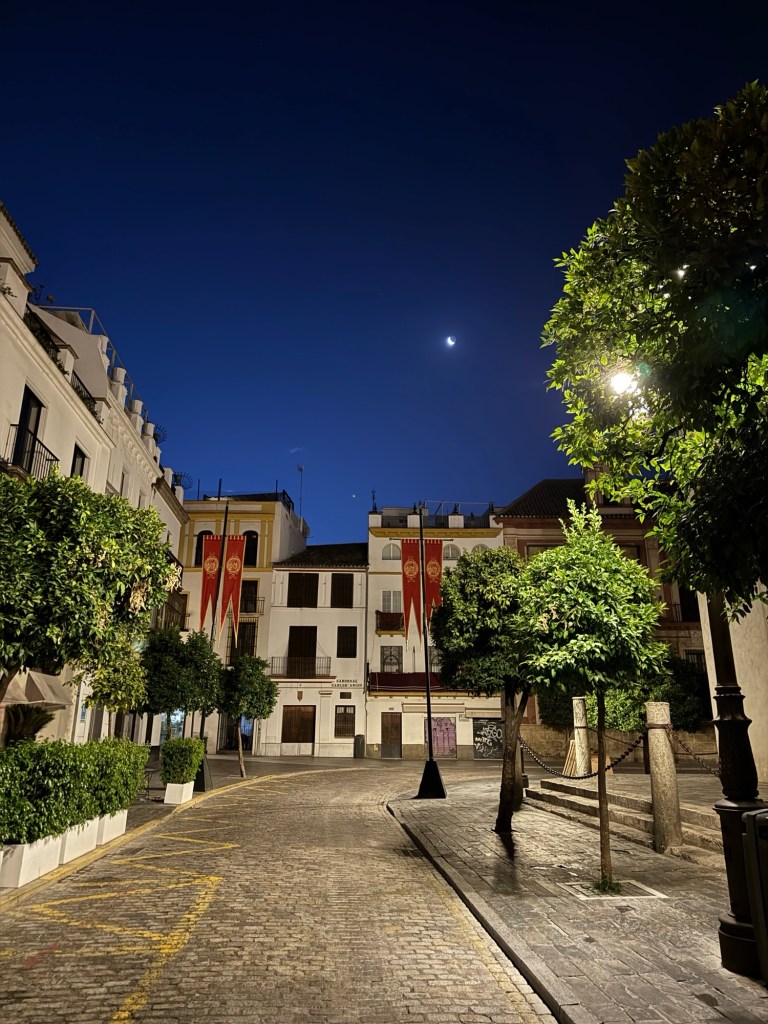
The silence is absolute, except for the distant clatter of a mop or the soft hum of a fridge motor somewhere behind one of those shuttered windows. The city is holding its breath. Even the moon seems to be listening.
This is the Seville (or any city) I love most: before the heat, before the crowds, before the day begins. A place still woven with shadows and secrets.
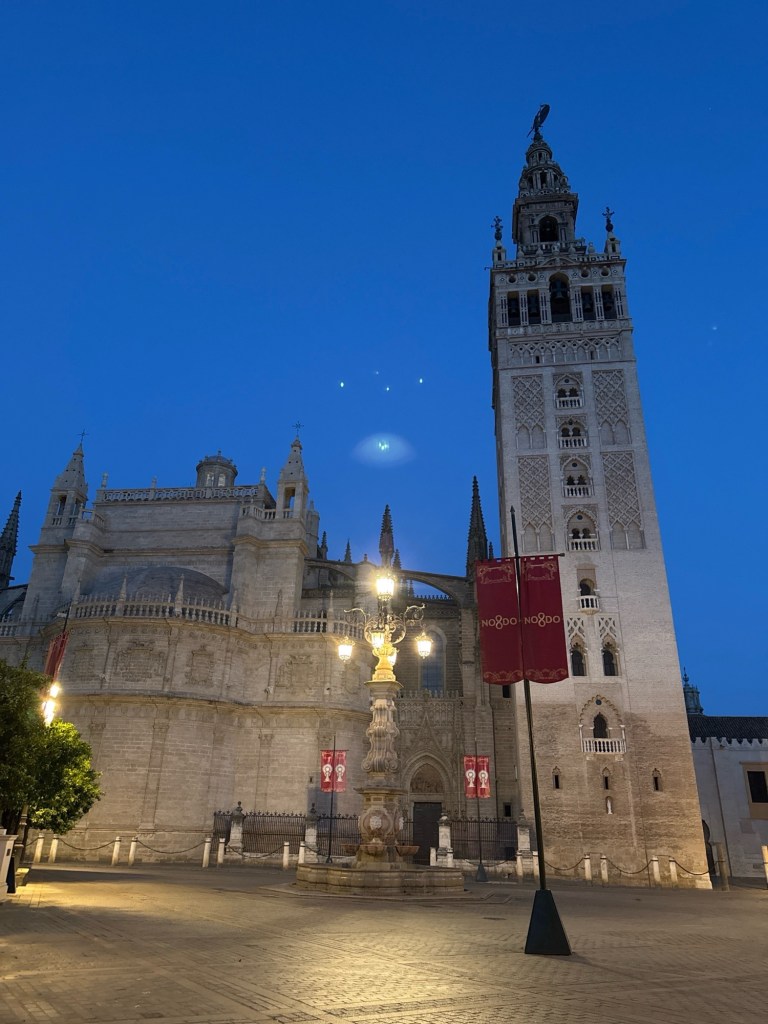
The Cathedral broods above the great square as the dawn slowly turns the sky from indigo velvet to pale porcelain blue, soft as fabric. The stars have faded, but the lamps still burn brightly beneath the watchful gaze of La Giralda. Even the fountain—usually chattering with the sound of falling water—stands mute at this hour, its carved faces expressionless in the half-light.
A trio of people drift across the flagstones beneath the façade of the cathedral: two young men in dark suits, ties loose, shoes scuffed from dancing, and a woman in a red dress that still catches a shimmer of the night.
Seville, or Sevilla in Spanish, is a city layered in history, legend, and light. Standing on the banks of the Guadalquivir River, it was once the farthest navigable inland port in Spain, a fact that would shape its destiny forever.
Its origins stretch back over 2,000 years. The Phoenicians and Tartessians settled early here, but it was under the Romans that the city truly flourished as Hispalis, a key commercial centre of the Roman Empire. Traces of this era linger still — in crumbling columns, ancient roads, and the nearby ruins of Italica, birthplace of emperors Trajan and Hadrian.
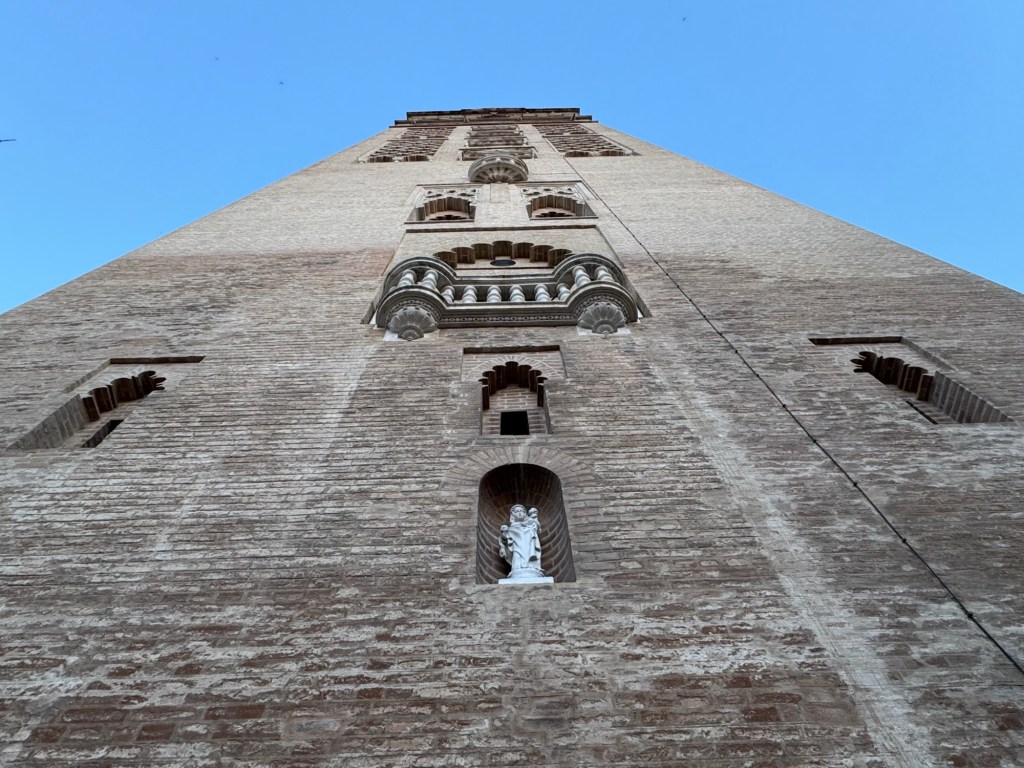
In the 8th century, the Moors swept across the Iberian Peninsula, and Seville became Ishbiliya, one of the jewels of Al-Andalus. The city blossomed under Islamic rule. Its palaces, gardens, and irrigation systems echoed the architectural brilliance of Damascus and Baghdad. The Giralda, now the bell tower of Seville Cathedral, began life as a minaret. The Alcázar, a royal palace, still glows with the intricate geometry of Mudéjar design.
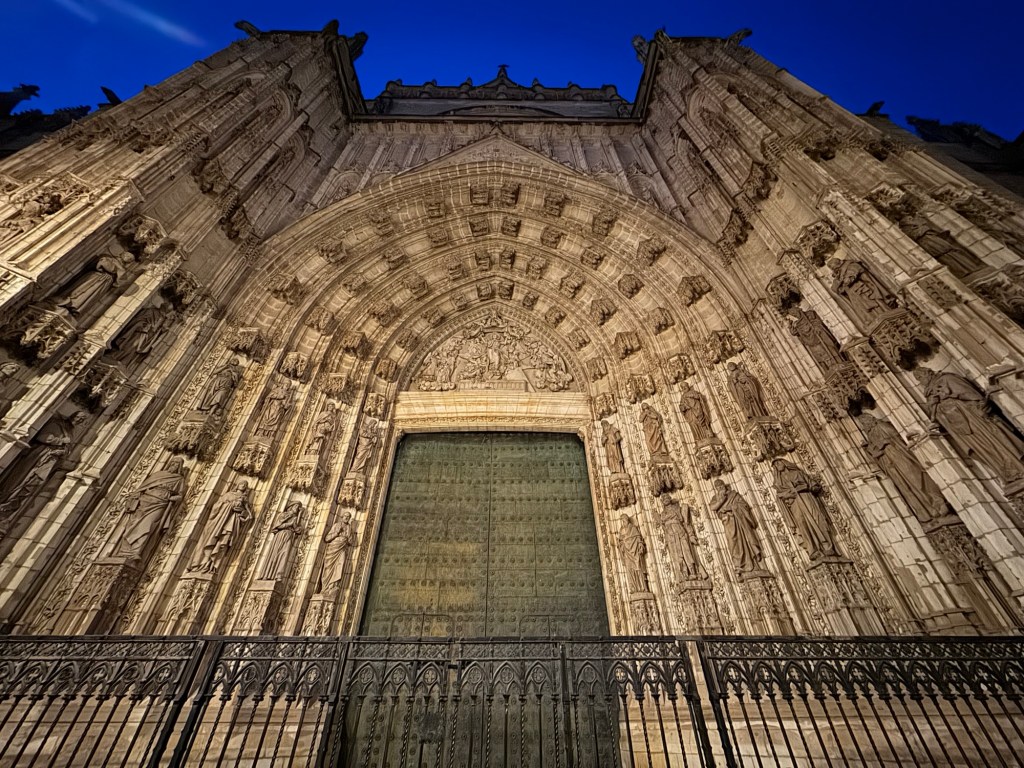
The city changed hands again in 1248 when Ferdinand III of Castile reclaimed it for Christendom. Seville became a symbol of Reconquista glory and was soon a launchpad for Spain’s global ambitions.
The 15th and 16th centuries marked Seville’s golden age. After Columbus’s voyage in 1492, all goods from the Americas had to pass through Seville. The Casa de Contratación controlled colonial trade, and the city swelled with silver, silk, spices, and secrets. Painters like Murillo and Velázquez rose here, alongside a vibrant flamenco tradition born of Andalusian, Romani, and Moorish roots.
Eventually, however, the Guadalquivir silted up, and Cádiz took over the transatlantic trade. Seville faded — gently — into an elegant grandeur. But nothing is permanent in the long history of Spain. Today, Seville is a city of resurrection and ritual. From the solemn processions of Semana Santa and the cadence of Andalusian guitars to the click of castanets and the joyful whirl of feria, the city’s history is not just remembered — it’s lived.
From a side alley, hidden deep in shadow, a hotel door clicks open and three young women emerge, backpacks slung across sleep-creased hoodies. Australians, I guess, from their accents as they murmur about coffee and trains. One yawns. Another organises an Uber.
There is no wind. No splash of fountain water. No traffic. Just the trill of the birds announcing yet another morning in this ancient city, where even the stones remember the empires that have risen and fallen beneath this same sky.
The bell of La Giralda tolls seven. Coffee time. I touch the silent holy water of the fountain and feel—for an instant—as if centuries are running over my fingertips.

 TravelWriterLife