Mid morning on the walls. Swallows flitting and swooping in the hot, torrid, shimmering air, tracing invisible calligraphy across the sky. They dive and rise with a kind of joyful precision, sharp-winged and weightless, playing in the heat that shimmers like glass above the rooftops.
Out beyond the white-painted walls and the terracotta grooves of tile and shadow, the land stretches wide and sun-scorched. The Andalusian hills roll away in quiet undulation, clothed in the muted palette of endurance—brown earth, faded green scrub, olive groves silvering in the wind.
It’s a landscape of restraint, shaped by centuries of sun and scarcity, of stone terraces and dry creeks. But there’s dignity in it too, a beauty not shouted but earned. These hills have witnessed everything: Roman conquest, Moorish gardens, Reconquista battles, and the slow return of silence.
The swallows don’t care. They fly because they can. They stitch the sky to the land with every swoop, reminding you that life here, despite the heat and history, still dances.

I come from a place that is new, relatively speaking, at least in terms of European history. In New Zealand, even our oldest buildings feel provisional, as though they could be lifted off their foundations and carted away at a moment’s notice. Time there is shallow, superficial. The past is visible just below the surface, like pebbles in a clear stream.
But here in Ronda, here in Andalusia, the past feels thick, layered, heavy, immovable. It presses against the present like a second atmosphere or another dimension: dense, substantial, massive. The stones are older than memories. The streets are worn by centuries, not just years.
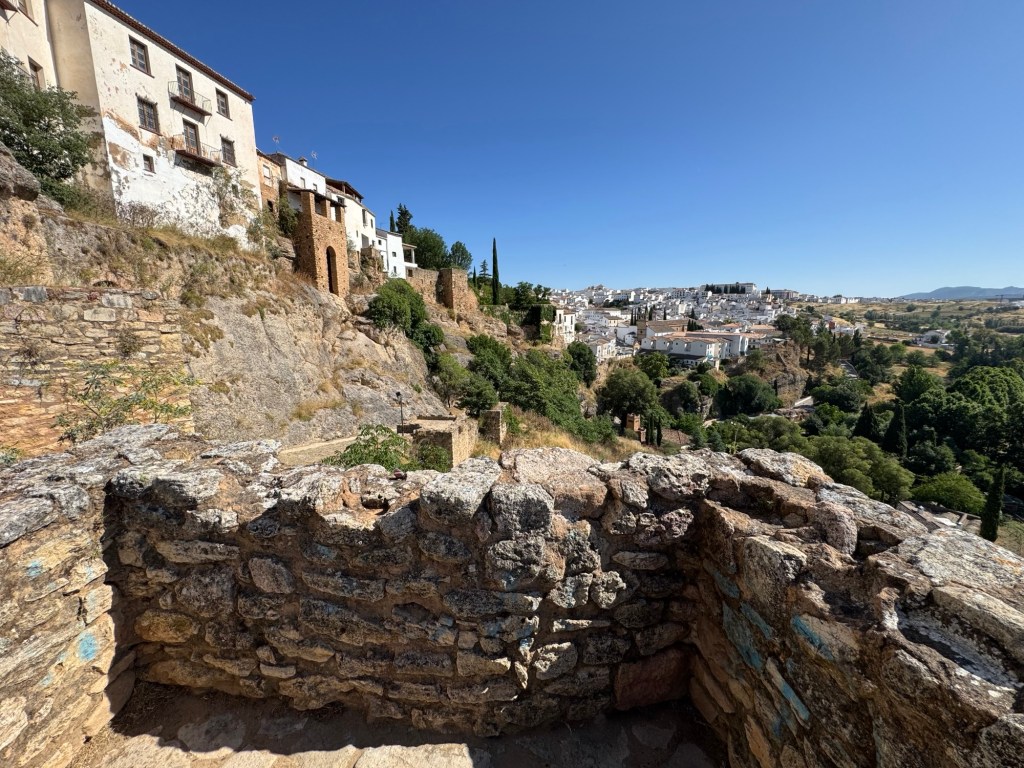
The landscape here was already ancient when people settled here. I can see the layers: in the geology and in the architecture. The stone walls rise like a continuation of the cliffs, as if the town grew out of the rock rather than being built upon it. People didn’t conquer nature here; they collaborated with it, shaping the town’s defences to match the land’s own formidable strength.
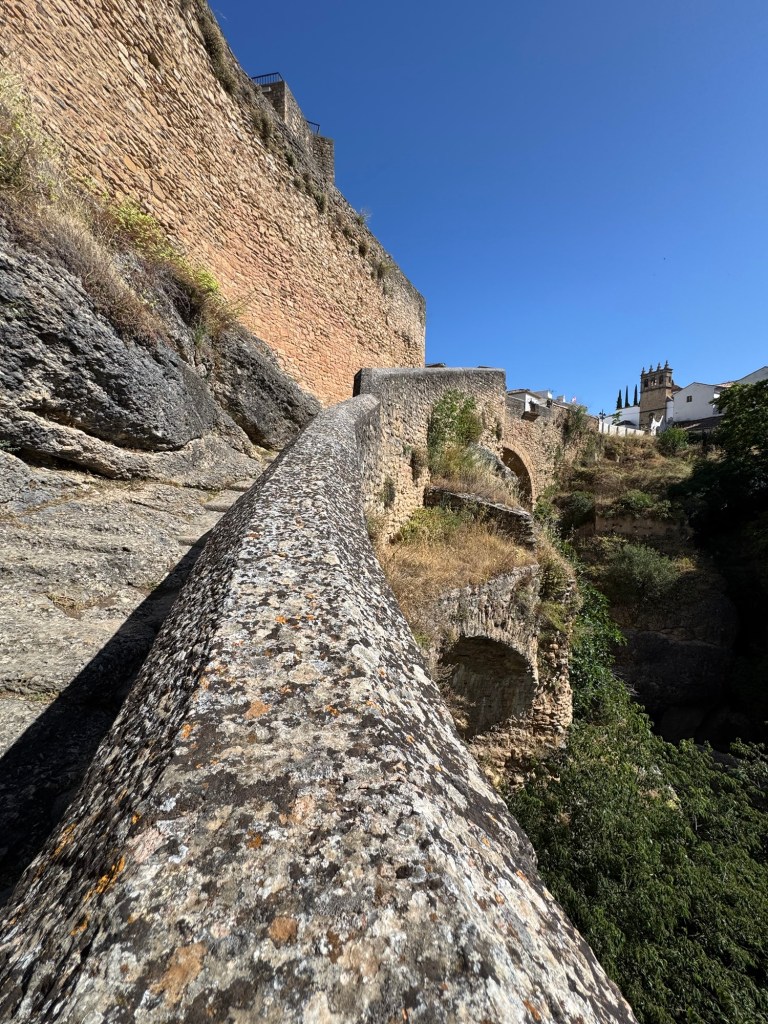
The walls of Ronda run like seams across the plateau sliced by the Guadalevín River. Some of these stones were placed by the Moors over a thousand years ago. Others rest atop Roman foundations. There are arrow slits, and mantlets hastily added by Spanish hands during yet another siege. Nothing matches. Nothing aligns. The walls are a palimpsest: history written, erased, rewritten again and again, each time in different scripts.

There are no tourists here. They’re all up on the main street, being pestered by waiters with laminated menus and tour guides waving red umbrellas like semaphore flags. Up there, it’s performance: tapas made for cameras, flamenco for phones.
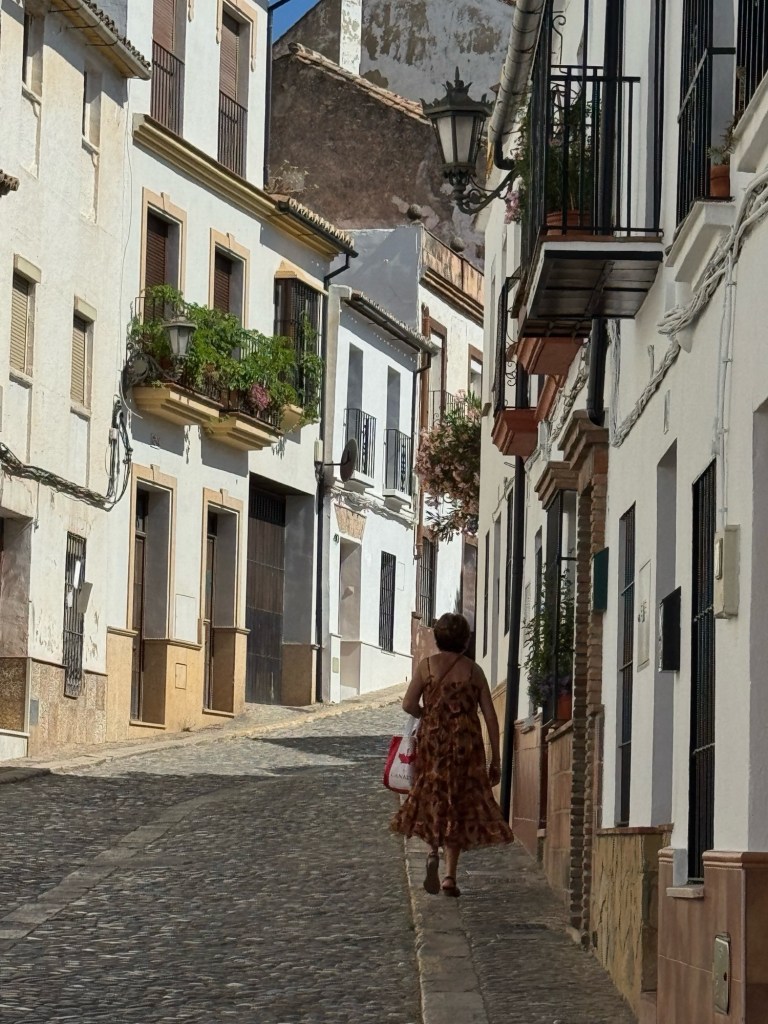
But down here, this is just a street where life is lived and always has been. The shutters are half-closed against the heat. An old woman is sitting on her doorstep shelling broad beans into a bowl. A radio murmurs in a courtyard. Washing flutters on a line strung from balcony to balcony like a signal to the neighbours: We are here. We are ordinary. We endure.
The walls are faded, flaked, beautiful not despite their age but because of it. The iron grilles, the chipped tiles, the flowerpots with their stubborn herbs—they are not decoration. They are part of the rhythm of this place. Evidence of continuity. Of lives layered gently on top of one another.
You can walk for hours down here and not hear a word of English. Only the sound of a scooter buzzing around a corner, a child’s shout, the rustle of oleander in the wind. It’s not much…but it is everything. A quiet testament to the truth that real places are not made for visitors. They are made by the people who never leave.
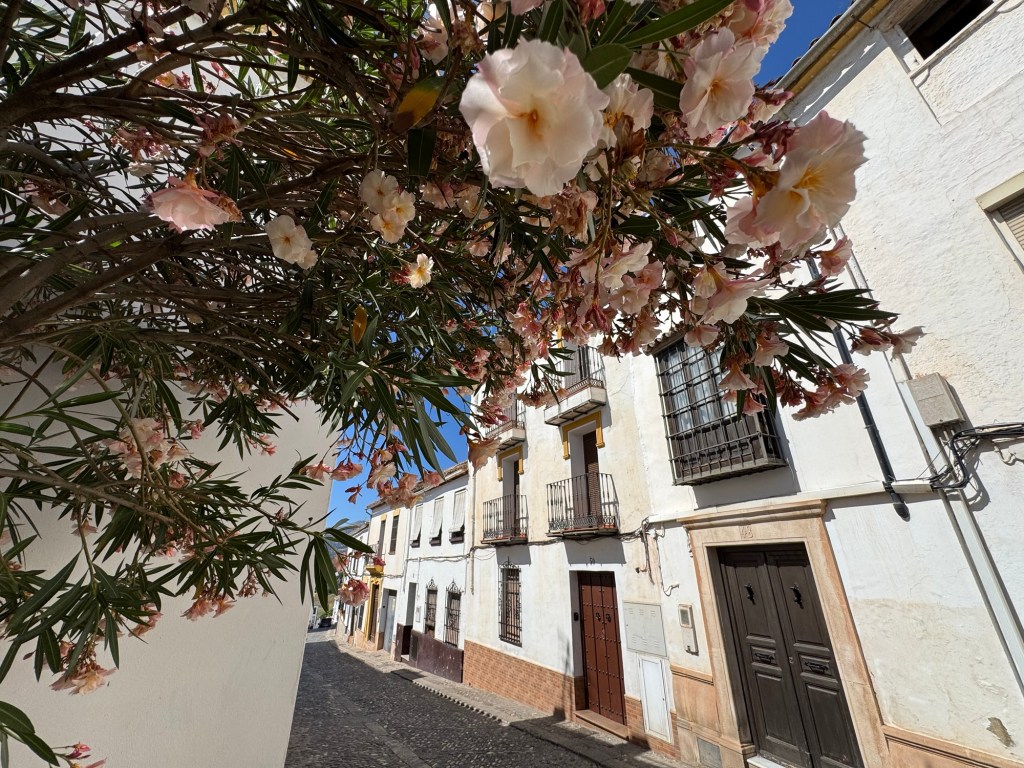
Mint, sage and rosemary, fragrant and colourful, grow in widow pots on the back streets. I pluck a leaf from each and roll them together in my hands. It smells like a kitchen from another century: warm, herbal, elemental. Like a memory half-remembered from childhood, or a garden just after rain. There’s comfort in it. And also a little wildness, a whisper of something older than the houses behind the bars.
These aren’t ornamental plants. They’re practical. Chosen for their usefulness, not just their beauty. Yet the beauty is undeniable. The soft purple flowers spill through the iron grilles like laughter escaping a quiet room. Life insisting on being seen.
In Ronda, even the smallest corner seems to offer something for the senses. Stone and metal, flower and leaf, scent and silence. A back street becomes a place of communion. With the land. With the past. With the self.
And then, almost without warning, I find myself back in the tourist area. The silence evaporates. The streets widen. People appear, clutching paper maps like treasure hunters, pausing at corners to orient themselves. There are queues for gelato, queues for photos, queues for meaning.
Everywhere, cameras dangle from necks and phones are held aloft: new crucifixes of the modern age, icons of capture and control. Snap. Record. Move on. Proof of presence replaces presence itself.
And yet, something timeless endures. I pass a small recess in a wall containing a statue of the Virgin, chipped but serene. Below her, a flickering candle. A cluster of wildflowers in a cracked jam jar. A photo. A ribbon. A quiet prayer tucked between bricks. No plaque, no explanation. Just an act of faith, undisturbed by the digital tide flowing past it.
Even here, in the press and thrum of the modern world, I’m never far from the walls of Ronda. Not really. They’re beneath the cobbles, behind the paint, folded into the silence between footsteps. They wait in the stones, in the shadows, in the scent of herbs drifting from a windowsill. They are what hold this place together. They remind me that time is not something you lose track of. It is something you walk through.

 TravelWriterLife