Late morning in Kensington Gardens. The clouds are playing their usual summer game of theatre and retreat, and the sunlight breaks through in shafts that gild the treetops and cast brief, golden spells across the grass. I walk from the southern path, the Royal Albert Hall behind me, its domed roof like a coppery drumskin, and find myself standing before one of the most extravagant and emotionally-charged monuments in London: the Albert Memorial.
There’s a reverent hush about this place, even though it sits at the edge of one of the busiest parks in the city. Cyclists whirr past on the Broad Walk, and children kick footballs in the distance. But here, in the shadow of this Gothic masterpiece, there is stillness.

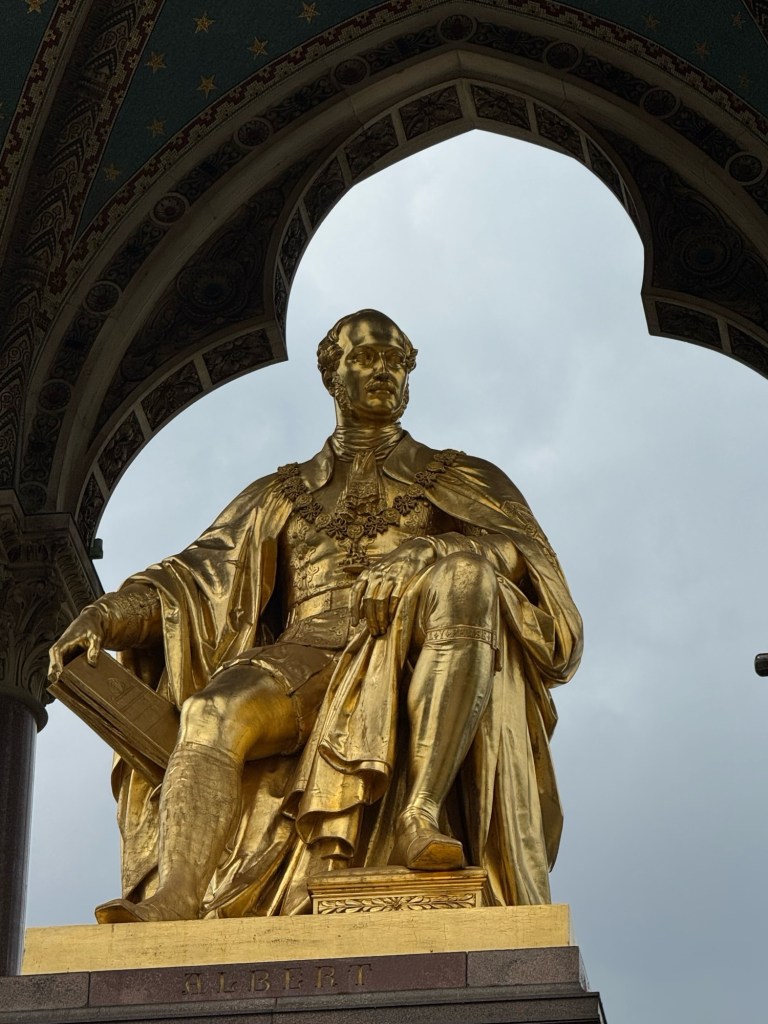
The memorial rises from its stone plinth like something conjured from a dream, or a cathedral that lost its nave and found itself instead housing a single, golden soul. Prince Albert sits at the heart of it all, draped in gold leaf, eternally youthful, staring contemplatively across the gardens, a copy of the Great Exhibition catalogue resting on his lap. He is the very image of Victorian vision and idealism.
I’m always struck by the grandeur of Victorian England. This was a people utterly convinced of their purpose; propelled by steam and soot and belief. They built with unshakable confidence: railway viaducts like flying buttresses, stations as vast as cathedrals, great redbrick institutions and soot-blackened chimneys reaching into the sky. They weren’t afraid of scale, of complexity, or of symbolism. Everything meant something.
And this memorial? It means everything.

Queen Victoria commissioned it after Albert’s death in 1861. He was only 42. Grief-stricken, she mourned him for the rest of her life. The memorial was completed over a decade later, designed by George Gilbert Scott in the Gothic Revival style, and unveiled in 1872. It is not just a statue: it’s a cathedral of mourning, a reliquary of Empire, art, science, and invention: the very spirit of the age cast in stone, bronze, and gold.
All around the central figure are allegories: Asia, Africa, Europe, America. There are bas-reliefs celebrating engineers, artists, architects, scientists: the priesthood of progress. High above Albert, mosaics glint in the sunlight, depicting virtues in delicate Venetian glass. And crowning it all, a soaring spire that wouldn’t look out of place on a Rhineland cathedral.

Standing here, I feel an unexpected sense of personal connection. My father was born in 1899. He was a child of the Victorian era — albeit just — born while the old Queen still ruled and steam still powered the world. He never knew Albert or Victoria, of course. But through him, I have the faintest tether to that time. A sliver of living memory. A bridge, however narrow, across the centuries.
Perhaps that’s why I feel so drawn to this age. The Victorians weren’t always right. They could be repressive, rigid, and infuriatingly sure of themselves. But they believed in improvement, in innovation, education and progress. They built museums, schools, libraries, public parks. They celebrated discovery. They were flawed, yes, but they were also fascinating.
And here, beneath this golden prince, in the quiet between passing clouds, I feel that fascination burn brighter than ever.

I circle the memorial slowly. Tourists wander by, pausing to take photos and move on. But I linger. The gilding glows in the sun. A pigeon alights on the cornice. Somewhere nearby, a distant choir of schoolchildren is rehearsing in the Albert Hall — their voices rising and falling like a requiem for an age long past. For a moment, London seems suspended: caught between then and now. And I, descendant of a Victorian, lover of steam and spires, stand with Albert beneath his canopy, gazing out at a world his vision helped to shape.
A memory of Albert. A memory of an age. And perhaps, a small reminder of my own place within its long, glimmering shadow.

 TravelWriterLife