“And you see the ships ploughing through it, that you may seek of His bounty and that you may give thanks.”
— Qur’an 16:14
I’m sitting on a shady concrete plinth at the edge of Dubai Creek, a small cup of sweet chai in my hand. The taste—carb-heavy, cardamom-laced, thick with sugar—grounds me in the moment. Around me, dock workers crouch on crates eating dhal and tearing off pieces of naan. The air smells of diesel, spices, hot concrete, and cargo.
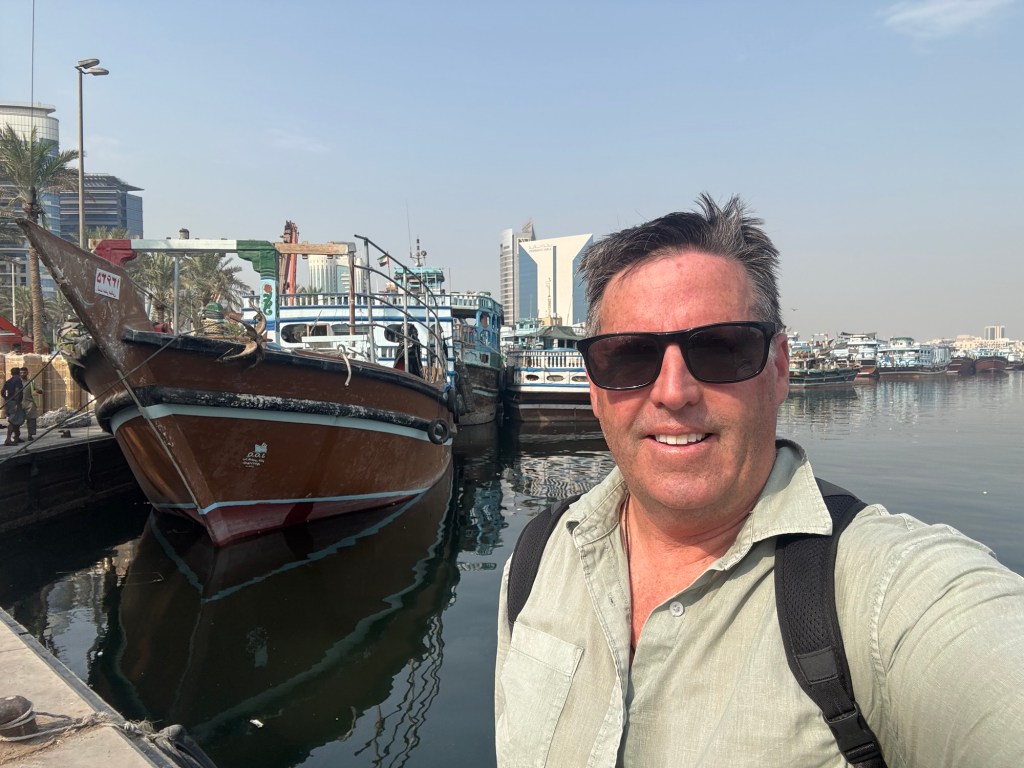
Across the still water, the dhows sit shoulder to shoulder, tethered and patient, their painted hulls faded by sun and time. They’re not museum pieces: these are working boats, loading and unloading goods in a quiet rhythm that’s been going on for centuries. And in this moment, I could be anywhere on the Arabian Sea or the Indian Ocean. Oman. Gujarat. Balochistan. Africa’s Swahili Coast. This corner of Dubai is not the city of glass and towers and tourists. This is the city’s memory.

Stacks of cargo line the quay behind me; bales wrapped in yellow cord, boxes marked with Persian, Urdu, Arabic, and Chinese script. I see tyres wrapped in gold foil. Boxes of air conditioners, made in China. Huge bags of walnuts. Barista coffee makers. Car seats. Tyre inner tubes. It’s not neat or elegant, but it’s beautiful in its own way: like a greasy, dusty bazaar frozen mid-journey, each item destined for somewhere across the sea.
Some of these dhows will sail for Iran. Others will make the long haul to Somalia, Pakistan, or India. I imagine them weaving across the Arabian Sea with cargo piled high, their timbers creaking, their GPS units blinking among coils of rope and oil drums. They are made of steel now, but they still look like old wooden dhows from a thousand years ago. There’s something almost mythical about them: part merchant, part ghost.

A date palm leans overhead, casting a wobbly shadow onto the pavement. Behind it, the city looms. I can see the tops of luxury towers and glinting glass—the other Dubai—but down here by the water, time has its own pace. Men in sandals and safety vests lean against trucks, trade stories, sip tea. It’s all quiet motion. There’s no rush.
I walk past crates stacked shoulder-high. One of them, sealed in plastic with no label, catches my eye. For a moment, in the stillness, I imagine it whispering. Maybe it holds something forgotten: an old story, a scroll, a map. Something not on any manifest. The fantasy doesn’t seem out of place here. This whole place feels like a page from One Thousand and One Nights: if Scheherazade had a shipping license.
And yet, it’s real. It’s morning. It’s Dubai.
And I’m just a traveller, drinking chai beside the oldest part of the city, watching dhows prepare for another journey.

 TravelWriterLife