I sit alone in a church in Ronda. The carved wooden pew beneath me creaks quietly as I shift my weight. Outside, the muted hum of voices floats in from the square, softened by the plastered stone walls. But in here, in this sacred space, there is only stillness. The air is cool, heavy with a scent I can’t quite place: wax, perhaps, or old incense, or the redolence of countless prayers.
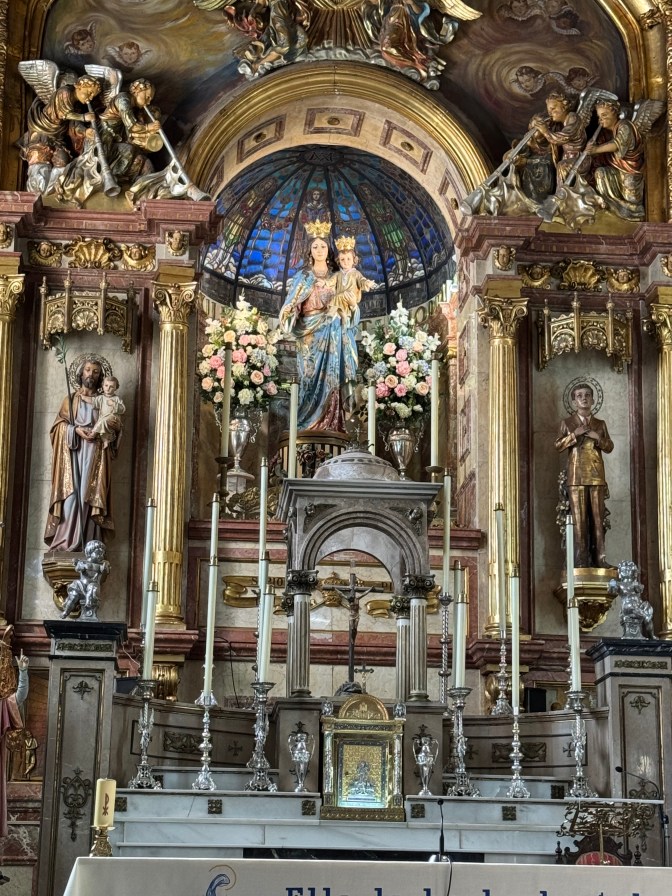
Before me rises the gold and shadow of the retablo. Angels with upturned faces cluster at its summit, their robes frozen in eternal flutter. Mary, radiant beneath a blue-domed canopy of glass, gazes down from the centre, flanked by saints in solemn pose. Everything glows. Candles flicker in the silence, their flames barely daring to move. Gold leaf catches the dim light like fire trapped in wood.

This isn’t an old church. It was built in the nineteen fifties. Yet still, there is a feeling of deep time here. Countless people have knelt on these stone floors, have crossed themselves in the same rhythm, whispered the same Latin liturgies, sought comfort, absolution, miracles. Spanish Catholicism is not a Sunday religion; it is woven into the fabric of life, as present as breath, as enduring as stone.
And here in Ronda, perched high on its rocky outcrop, that presence feels even more concentrated. The churches of this town—each with its own altar, its own Virgin, its own bell tower rising like a prayer into the Andalusian sky—are not just places of worship. They are strongholds of identity, guardians of history, and containers of memory.
Catholicism is, at its heart, a religion of beauty, ritual, and mystery. It is a faith built on story and symbol; on wine turned into blood, bread into flesh; on saints who became intercessors; and on suffering turned into salvation. It draws on the theatrical: the raising of the chalice, the incense that coils into vaulted domes like spirit made visible, the genuflection and chant.
For believers, these are sacred acts, conduits to grace. For outsiders like me—an atheist, resolute in disbelief—they are still powerful. Not because I expect to be saved, but because I am drawn to the architecture of belief. I do not share the faith, but I cannot deny the fascination.
Here, in this church, Catholicism feels less like dogma and more like presence: layered, quiet, and sure of itself. The architecture at once speaks the language of glory and of humility. Arches soar like outstretched arms. Vaulted ceilings gather the breath of those who enter. Gilded retablos, like the one in front of me, rise behind the altar like the gates of heaven. Every detail seems to have been wrought with reverence: the carved saints with their downcast eyes, the baroque flourishes, the polished marble floor beneath my feet reflecting a dim, holy light.

Gold gleams on wood, not to display wealth, but to evoke the divine. The Virgin Mary is crowned and robed, surrounded by sprays of artificial roses that are no less heartfelt for their imitation. Angels hover in stucco and stone, their trumpets forever poised to sound. Even the wrought iron railings between me and the altar are delicately worked, patterned with crosses and vines, as if no surface should be left unblessed.
This is not a faith of plain walls or empty spaces. Catholic churches are full of symbols, of echoes, of centuries. They are containers of the ineffable, places where stone and light are shaped into testimony. I sit here, unbelieving but not unmoved, aware that something profound has passed through this space and left a residue behind, like the faint smell of incense, or the echo of a hymn long since sung.

But then, the spell breaks. Two cleaning ladies enter from a side door, their mops clattering like swords against the tiled floor, buckets sloshing with water that smells faintly of bleach. They talk loudly, their voices echoing off the high stone walls, casual and unfiltered, as if the sacred silence means nothing to them.
And why should it? This is their workplace, not a sanctuary. The rhythm of their conversation—punctuated by the squeak of mops against marble—feels strangely jarring here, in a place built for prayer. Yet perhaps it is fitting. Even the holiest spaces must be swept clean. The divine must make room for the daily.
The silence returns. Dust motes drift lazily in the shaft of light that filters down from the stained glass dome above the sanctuary. A young family enters: mother, father, two children. The boy rolls a scooter along the tiled floor, its wheels ticking gently over the seams in the marble. And yet, when they reach the front of the church, the playfulness gives way to reverence. All four of them genuflect, almost in unison, and touch the feet of the statue of Jesus to the right of the altar. No one instructs them: it is muscle memory, tradition passed down in silence.
Then, they climb the steps to the sanctuary behind the altar, up into the dome where the Madonna and Child reign in painted robes and golden crowns. There they stand, heads bowed, the boy resting one hand on his mother’s arm, the little girl holding her father’s hand. I watch them from the pews below: something old and beautiful and deeply human unfolding in front of me.

When they leave, I climb the marble steps slowly, uncertainly. The sanctuary feels like a place set apart, not just physically, but spiritually. I am not supposed to be here; not by any rule, but by the quiet weight of tradition. And yet I go, drawn by the same mystery that pulled me into this church in the first place.
Now I stand before the Madonna, her robes painted in blue and gold, her child perched on her arm, one hand extended in gentle blessing. Her gaze is soft, almost maternal, though her eyes do not meet mine. I reach out and touch the edge of her foot, just lightly. The cold of the paint is startling, a jolt back into the material world. I am an atheist, a doubter, a watcher from the margins. And yet this moment feels real: human, sacred, inexplicable.

On a scroll at her feet, the words Ella lo ha hecho todo are inscribed: “She has done everything.” It’s a devotional phrase, expressing the idea that the Virgin Mary has interceded, provided, or been the guiding force behind all blessings or graces received. It reflects the deep Marian devotion common in Spanish Catholicism, where Mary is often seen not just as a holy figure, but as the ultimate spiritual mother and protector.
The church is silent again. The echo of footsteps fades. The scooter, the whispered prayers, the shuffling of worn shoes, the cleaning ladies and their buckets. All gone. Now there is only me. And her.

 TravelWriterLife