At the foot of the hill, I park the car and take Tui for a run in the fields. It is a hot, oppressive day here in South Wales. The clouds sit on the top of Table Mountain and Pen Cerrig-calch like an oven glove, holding the heat in the valleys. The air is as still as the surface of Llyn y Fan on a windless day, heavy and unmoving, as if the whole landscape is holding its breath. The indifferent sun glides in and out of the clouds: furtive, uncertain, unwilling to commit.
Tui chases a stick and bounds around in the long grass until her tongue is hanging out and her breath is coming in ragged pants. Time for a swim in the river. I put her on the leash, press the button on the pedestrian crossing beside the A4077, and wait for the green light.
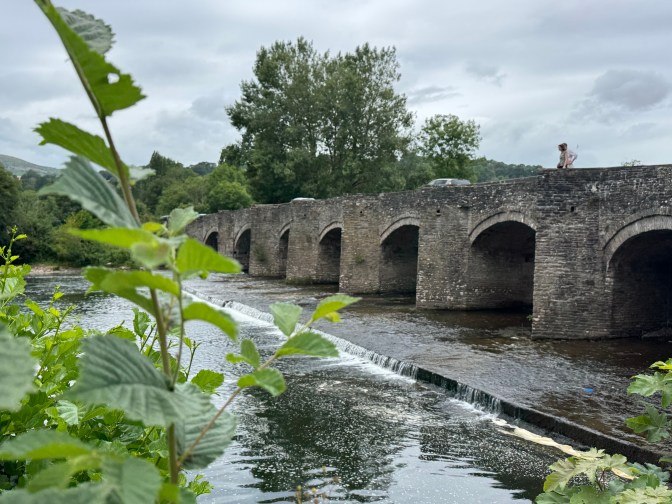
The bridge at Crickhowell is stretched over the River Usk like a thread in an old embroidery. While Tui cavorts in the cool water with two other dogs, I stand beneath the spans looking up. This is no ordinary bridge. This is a statement in stone, a survivor of centuries, a spine across the river, carrying the memory of hooves and wheels, boots and bare feet.
Crickhowell Bridge is one of the finest old crossings in Britain, and also one of the most debated. Locals like to argue about how many arches it has. Thirteen? Fourteen? It depends on which side of the river you count from, because the riverbank obscures an additional arch on the north side and can’t be seen from the southern approach. It’s the sort of gentle confusion you only get with old stonework that’s been altered, adapted, and absorbed into the landscape over time.
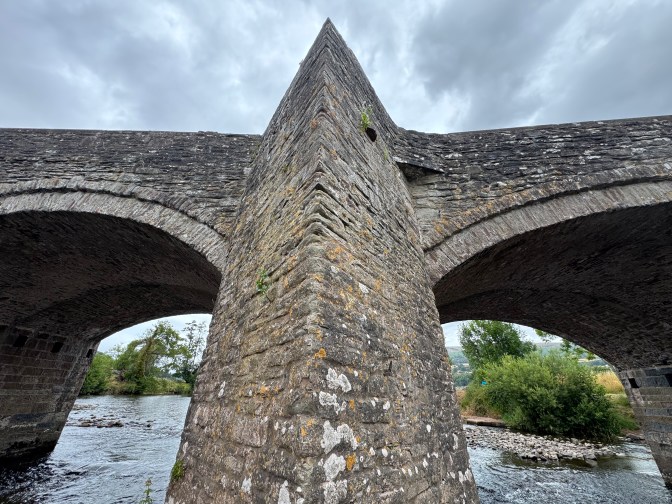
The bridge was first recorded in 1538, but what I stand under today mostly dates from the early 1700s. Then in 1828, it was widened on the upstream side, an elegant extension in matching stone that preserved the original structure. The widening was done so well that the bridge looks like it was built this way all along. It’s made of rubble stone—rough, local chips and fragments—and each arch is slightly different, adjusted to the quirks of the river beneath. No false symmetry here. Just honest building.
Moss creeps between the stones, and a thick cluster of nettles and valerian pushes up against the low parapet. The cutwaters that break the flow also provide little triangular refuges for pedestrians crossing above: a thoughtful detail from the age of horses and carts. The view upriver is all softness: trees bowing to the flow, sheep on the far bank, and the distant shadow of the Black Mountains beneath a sky that can’t quite decide what to do.

The Usk here is broad and smooth. Standing in the shallows above the weir, I can see the real character of the bridge. Its proud, uneven footing; the scars of flood and frost; the places where plants have rooted into the lime mortar. The bridge wears its age and its character for all to see: weathered, work-worn, and resolute. It’s one of the oldest road bridges still in use in Wales. And one of the longest of its kind too, stretching across the water with a quiet dignity that doesn’t ask for admiration but earns it anyway.
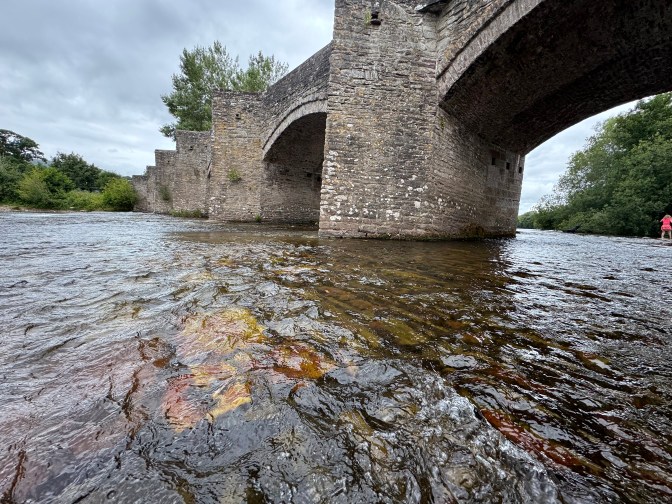
There’s no grandeur to it. No lions, no heraldic plaques. Just arch after arch of good stone laid true. This bridge is a working thing—or was, once—and even now it carries cars across, though traffic has slowed to single-file. I can imagine wagons loaded with hay, sheep trotting in flocks, soldiers on the march. The bridge has seen it all. The uprisings and the Union, the toll collectors and the Sunday best.
It’s listed now, Grade I, and rightly so. But even before the plaque and paperwork, the bridge was part of the soul of this place. I think of other bridges like it across Britain: the clapper bridges of Somerset, the hump-backed packhorse crossings of the Wylye Valley, the single-track wonders of Snowdonia. Each one is a witness to centuries of passage. Each one gives a promise that even in wild weather or rising waters, there would be a way across.
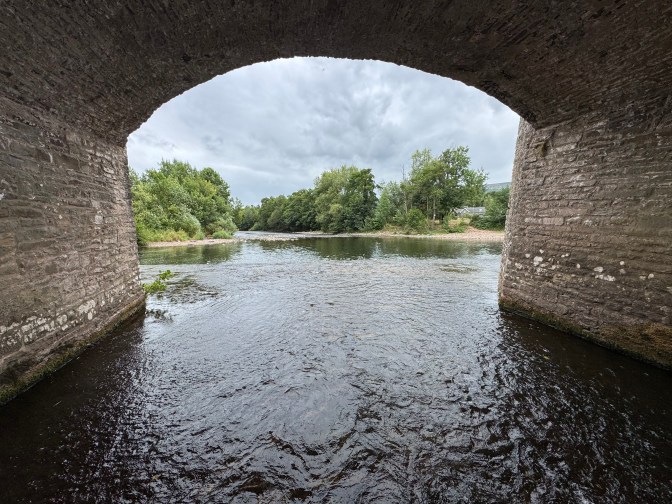
I step back and take one last look. The arches ripple in the water like ancient reflections, each one a portal to somewhere else. I think about all the bridges I’ve crossed in this land: the ones I remember, the ones I’ve forgotten, the ones still waiting down quiet lanes. There’s a kind of trust built into these bridges… or any bridge. They invite you to keep going. To step out across the water, knowing the stones will hold. Listening, always, to the sound of the river as it slips by underneath.


 TravelWriterLife
Nice shots. Do you know how old the bridge is? Looks like from the 17th.
LikeLiked by 1 person
Read the post. 1500s, 1700s, and 1800s.
LikeLike