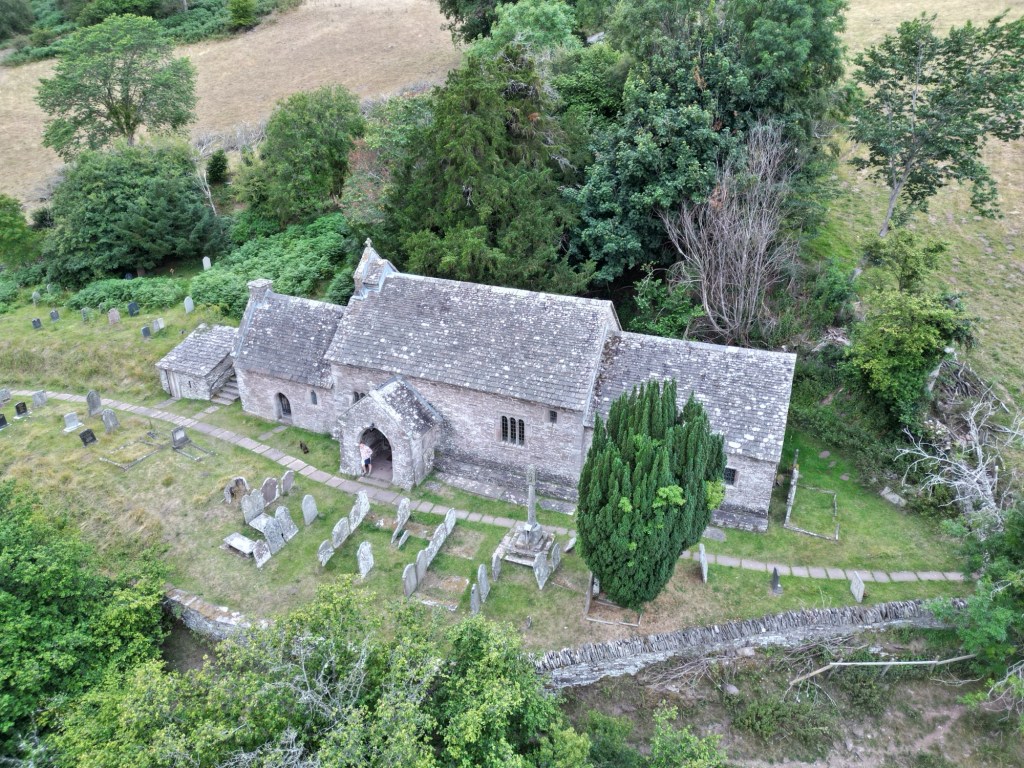
At the end of a dusty sheep walk, just beyond the bramble-pricked hedges and the scatterings of wool snagged on hawthorn bushes, I come to a crooked timber gate. It swings open with a soft clack, and there, tucked into the hillside as if trying not to be noticed, is the chapel.
Patrishow Church. St Issui’s. A place of pilgrimage once, and still: though now the pilgrims are walkers in muddy boots, not barefoot penitents. Evening has settled into the folds of the Grwyne Fawr valley. The last light is catching in the grass, and the sheep are moving to their night camps, a soft bleating chorus drifting across the hill.
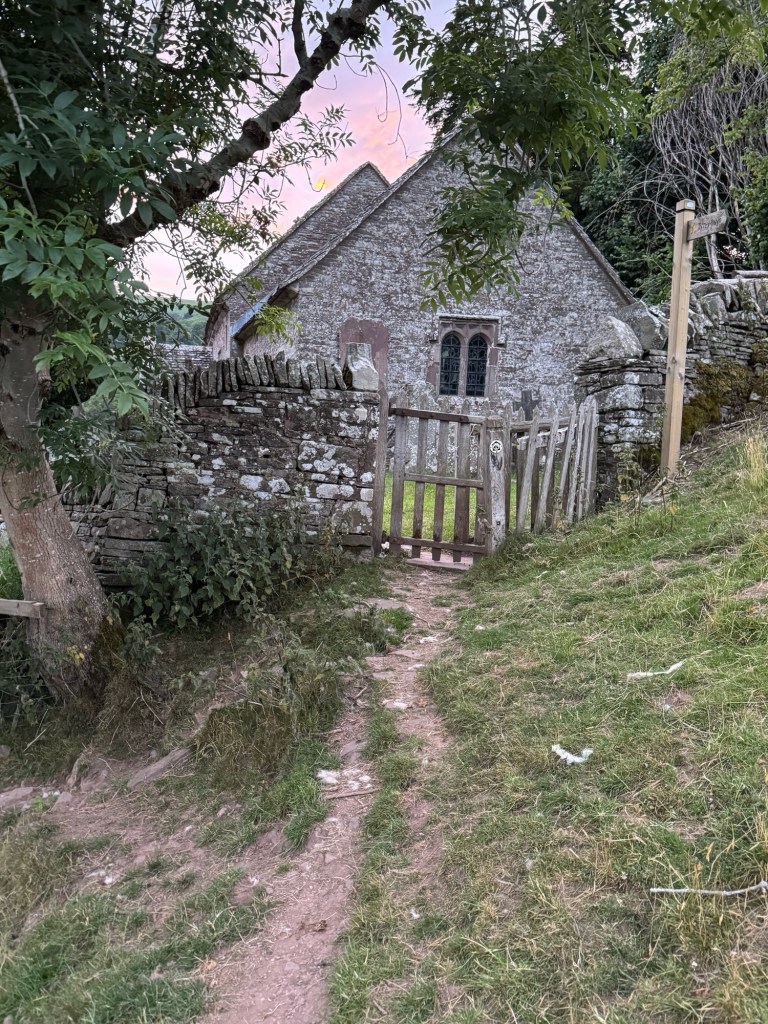
There is something uncanny here. Not in a ghostly way exactly, but in that deep-bone sense that you’ve arrived somewhere that time hasn’t quite let go of. The chapel is small, squat, and solid, built from stone quarried close by, its roof low-slung, its porch thick with shadow.
The yew trees are twisted and ancient, and the grass in the churchyard leans in the way of grass that’s grown up alongside the dead. Scattered piles of sheep droppings mark this not as a place apart from the rural world, but woven into it.
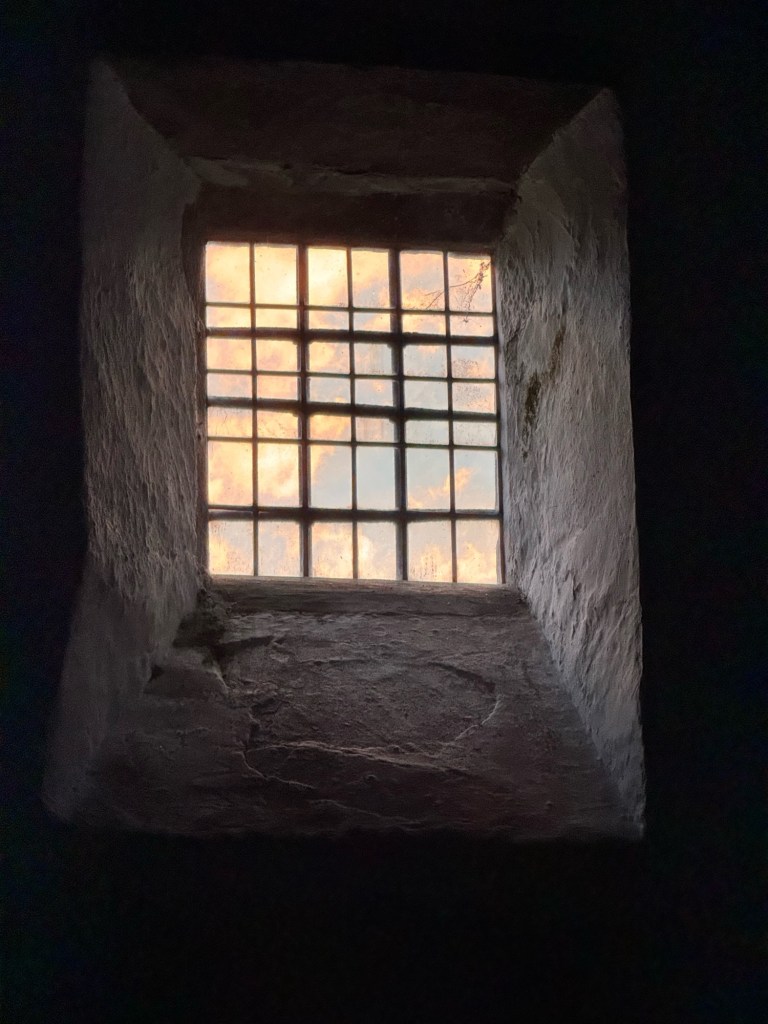
Inside, it’s cool. Still. The stone holds the memory of a thousand winters. There’s no electricity here, just a little natural light filtering through the narrow windows and one or two candles left unlit on the window ledges. I close the door behind me, and the sound is swallowed.
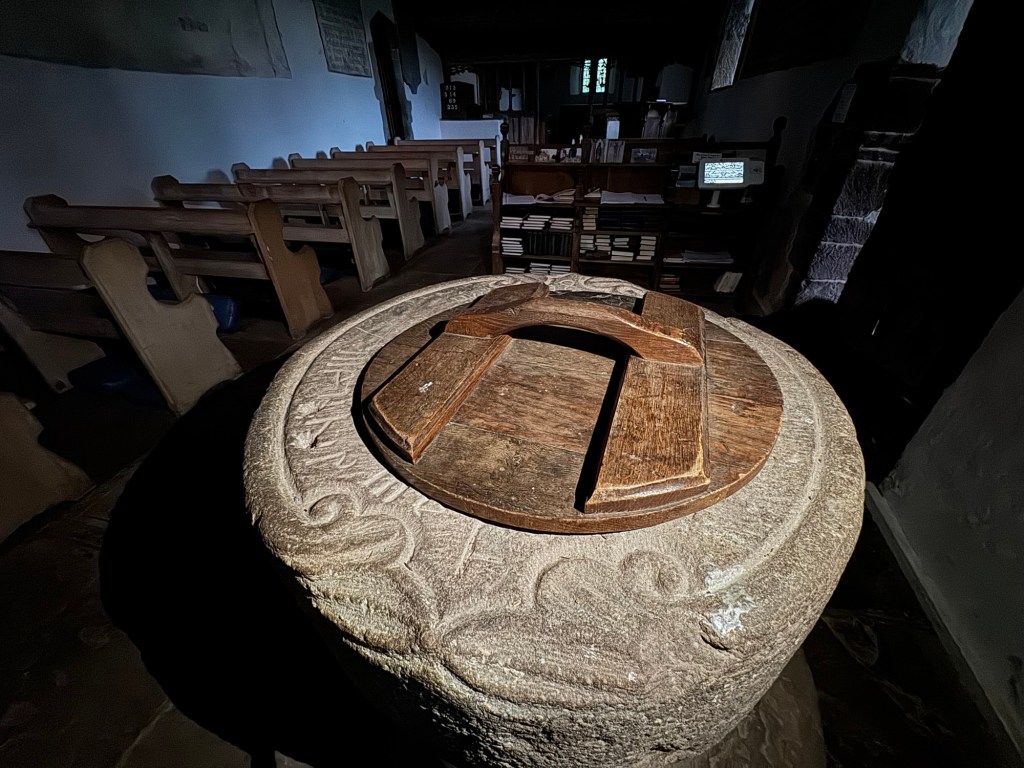
The first thing I notice is the font: massive, round, beautifully carved, with a wooden lid shaped like a wheel. The Latin inscription winds round the rim. It starts with: “I was made in the year…” and then, as if time shrugged its shoulders, the date is barely legible, lost to centuries of touch and reverence.
But it’s the wall painting that stops me. A red-ochre skeleton, arms raised, one hand holding what looks like a spade, the other a scroll or perhaps a bell. The figure is tall, almost cheerful in its defiant gesture: like Death himself has popped in for Evensong. He’s not threatening, exactly. More… present. A reminder. Memento mori, of course. But also something older, wilder. As if the chalk hills outside gave him form and the chapel gave him shelter.

I sit for a moment in one of the pews and listen. Outside, the breeze is tugging at the trees. A sheep coughs. Something thuds gently against the gate. Inside, the air feels ancient and kind.
There’s no show here. No attempt to tidy history into an easy story. This is a lived-in, prayed-in, weathered place. A few hymn books on the benches, a visitors’ book with thin pages, the names of walkers, cyclists, and believers scrawled in different hands.
Incongruously, a Bluetooth QR code reader glows on the hymnal, like a will-o’-the-wisp or a tiny electric votive, flickering in the half-dark. Digital offerings can be made even in this remote fold of the hills: contactless alms for a contactless age. But it is the only nod to the modern world.
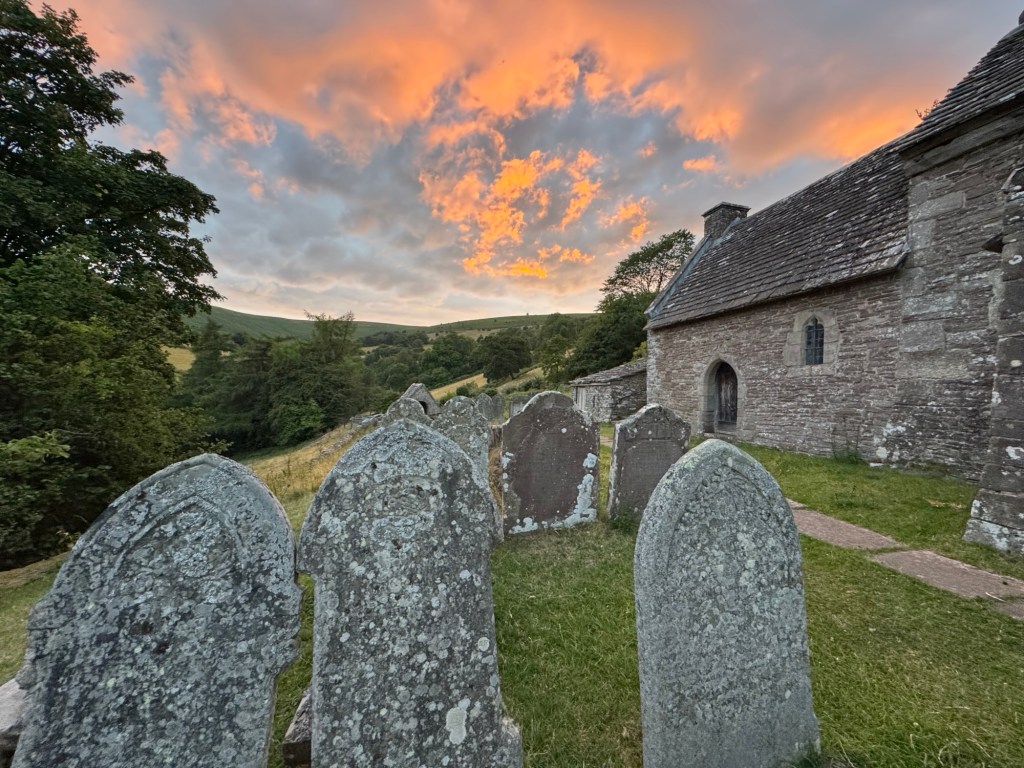
This place feels old. I imagine it after I have left, after I have closed the door behind me. The latch settling with a soft clunk. No footsteps, no voices. Just the hush of stone, the thick breath of wood and plaster, and the presence of time. Outside, the wind moving through the grass. A lamb calling once across the valley. Somewhere in the distance, a raven croaking. And inside, the skeleton standing at the back of the chapel, arm raised, as if blessing the silence.
There are few places left in the world like this. Places that haven’t been repackaged or restored into sterility. Patrishow isn’t trying to impress you. It doesn’t need to. It is simply there. Rooted. Honest. A chapel in the hills, waiting quietly for whoever comes next.

 TravelWriterLife