I love not Man the less, but Nature more,
From these our interviews, in which I steal
From all I may be, or have been before,
To mingle with the Universe, and feel
What I can ne’er express, yet cannot all conceal.
– Lord Byron, Childe Harold’s Pilgrimage
(Canto IV)
At Bwlch y Moch, we leave the Cambrian Way and turn west onto the lower slopes of Crib Goch. At this hour — 7:30 AM — there are already a few hikers on the main trails up to Snowden’s summit. But we seem to be the only people tackling Crib Goch this morning. Bwlch y Moch is a small col (pass) notched into the long ridge that forms the northern rim of the great cirque that lies on Snowden’s north-eastern side. Far below, on the Miner’s Track which runs along the shore of Llyn Llydaw, groups of hikers make their way doggedly along the path. Up here on the flanks of Crib Goch, we are alone.
The hillside is steep and rounded, scattered with boulders and covered with a skein of stunted grasses and herbage. A few scraggy, windswept sheep — Welsh Blackface sheep, bred to survive and thrive on the sparse vegetation of these hills — stare dolefully at us as we climb. The trail is indistinct and hard to follow: more a collection of intertwining sheep walks than an actual path. But, of course, the only way is up, so we each follow our own route up the ridge towards the foot of the first bluff.

Snowden — or Yr Wyddfa, to use its Welsh name — has a complex geological history that dates back hundreds of millions of years. Its geology consists predominantly of volcanic rocks that originated during the Ordovician period. At 1,085 metres, it is a modest mountain by world standards. However, the forces of glaciation and erosion have created a series of jagged peaks, razor-edged spurs, and deep cirques that give Snowden a raw and dramatic profile.
The mountain itself is composed of a series of volcanic and sedimentary layers. The core of Snowdon, and much of the surrounding area, is made up of rhyolite, a type of volcanic rock that forms from highly viscous lava. Rhyolite is a hard, impervious rock that is generally resistant to erosion due to its high silica content. When it does erode, however, it does so unevenly, cleaving and shattering into shards and fragments that give Snowdon its steep and craggy landscape.
Surrounding the rhyolite are layers of tuff, a rock formed from volcanic ash, and sedimentary slates, which were originally deposited as muds and silts in ancient sea beds and later transformed under intense heat and pressure.
Snowdon’s iconic horseshoe shape is the result of glaciation during what is commonly, if erroneously, referred to as “the last ice age.” Massive glaciers formed in the cwms (cirques) beneath the summit of the mountain. As these glaciers flowed downhill, they sharpened the ridges — including the long, knife-edge arête of Crib Goch — and ground the landscape of Snowdonia into its dramatic topography of sharp peaks, deep lakes, scree-slopes, troughs, and scattered boulders geographers call “erratics.”

The proper geological term for the “Last Ice Age” is the Last Glacial Maximum (LGM), which occurred approximately 26,500 years ago during the Pleistocene Epoch (2.6 mya – 0.0117mya). The LGM is the point at which the world’s ice sheets were at their greatest extent, covering large parts of North America, Northern Europe, and other regions globally.
Currently, Earth is in an interglacial period known as the Holocene Epoch. In geological terms, an Epoch is a smaller division of a longer Period. Epochs are often marked by significant events in the planet’s geology or climate. The Holocene is the second (and current) Epoch of the Quaternary Period of geological history. It follows on from the Pleistocene Epoch which was dominated by long glaciation events. Several species of Mammuthus (including the well-known Mammuthus primigenius or Woolly Mammoth) and Smilodons (sabre-toothed cats) roamed the icy wastes of Earth during the Pleistocene; its seas teemed with sharks, whales, and invertebrates.
The transformation from the icy Pleistocene to the warmer Holocene involved significant climatic changes over a relatively short geological timespan. Around 11,700 years ago, as the last glacial period of the Pleistocene ended, global temperatures began to rise. This led to the melting of the massive ice sheets that had covered much of North America, Europe, and Asia. Sea levels rose, reshaping coastlines and creating new habitats along the edges of the continents. The hinterlands and uplands which had, until recently, geologically speaking, been encased in ice, sprang into life once again.
With the retreat of the ice, vegetation zones shifted, allowing forests and grasslands to expand into areas previously dominated by tundra and ice. This period also saw significant biodiversity changes as some Pleistocene megafauna — such as the aforementioned mammoths and the sabre-toothed cats — went extinct, while other species adapted to the new environmental conditions. The warmer, more stable climate of the Holocene fostered the development of human agriculture and the rise of complex societies.
These conditions have persisted through the Holocene, right up to the present day. The relatively stable climates (anthropogenic climate change notwithstanding) and the development and expansion of human civilizations, created the conditions that have led to Lydia, Charlie and I being here at the foot of the first difficult step on the ascent of Crib Goch. In a way, the very forces that shaped the landscape of Snowdonia are the same ones that created us.

As we pause to consider the route up the face, two other climbers appear from around on the north side of the ridge. They are descending. We ask what they encountered to make them turn back and they tell us that the first rock step seemed too tricky and that they weren’t prepared to risk it. We wish them well and they continue on down towards Bwlch y Moch.
The rock step towers above us. It is very steep, almost vertical, but doesn’t look impossible. We clamber up to the base of a narrow crack between two buttresses. The rock is sound and there are good hand- and footholds in the crack. I volunteer to lead the pitch. Placing my feet against each side of the crack, I reach up past an overhang and feel for a handhold. There is a notch that I can fit my hand into. I make a fist and squeeze tightly, creating a friction hold in the notch. This is the point of no return. Once I commit to this move there will be no going back. I tense my legs against the rock wall and pull myself up and over the outcrop.

The path from the car park at Pen Y Pass up to Bwlch y Moch has been smooth and easy: a long slow gradient of flat flagstones placed over the last couple of centuries by followers of the painters, poets, and writers who immortalised and romanticised Snowden and the peaks of Wales in their works. The tradition of climbing Snowdon for enjoyment is closely intertwined with the broader British cultural fascination with the sublime and picturesque in nature, which became particularly popular during the Romantic period in the late 18th and early 19th centuries.
The Romantic movement, which emphasised a deep emotional and spiritual engagement with nature, significantly boosted the popularity of mountain climbing and visiting dramatic landscapes. Poets such as William Wordsworth, George Gorden Byron (later Lord Byron), and Sir Walter Scott celebrated the beauty of the British landscape, including its mountains, in their works. This inspired the general public to seek out these experiences for themselves. Snowdon, with its majestic presence and panoramic views, became a symbol of this sublime natural beauty.
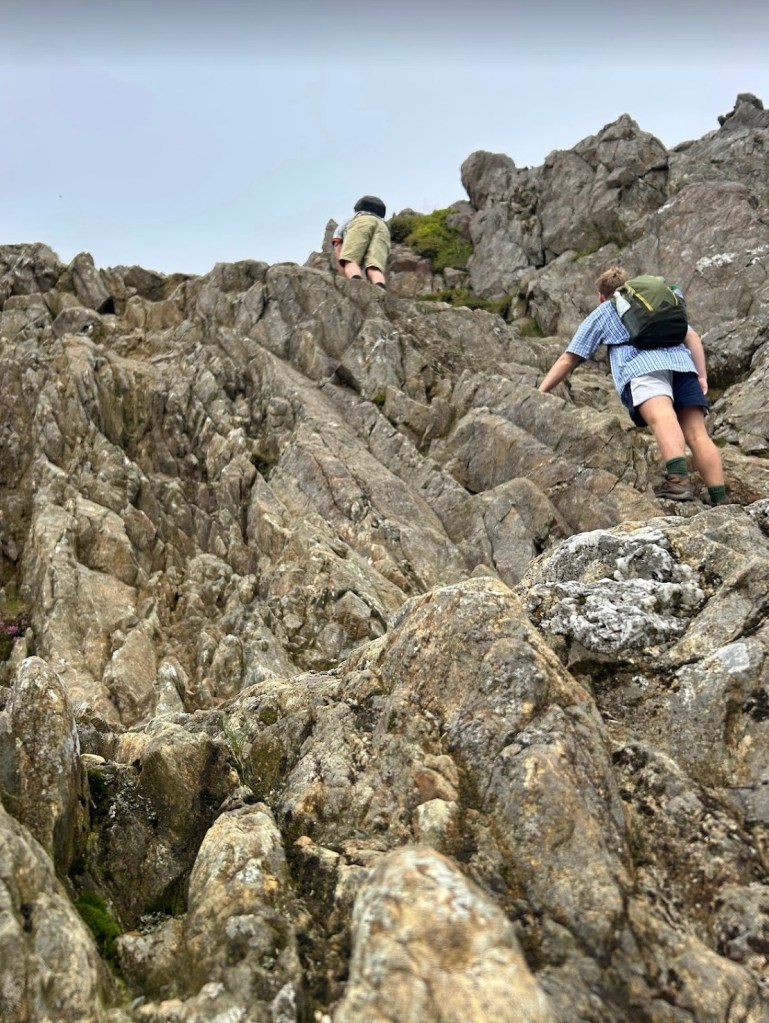
There is also a sublime beauty in overcoming fear and negotiating a tricky situation that has proved too dangerous for others. Above the rock step, the ridge ascends at 50° towards a skyline bluff of shattered rock. A scree of boulders and rubble lies beneath it. Lydia and Charlie climb the step to join me: it proved to be easy once the crux of the pitch – that handy, fist-sized notch — had been found.
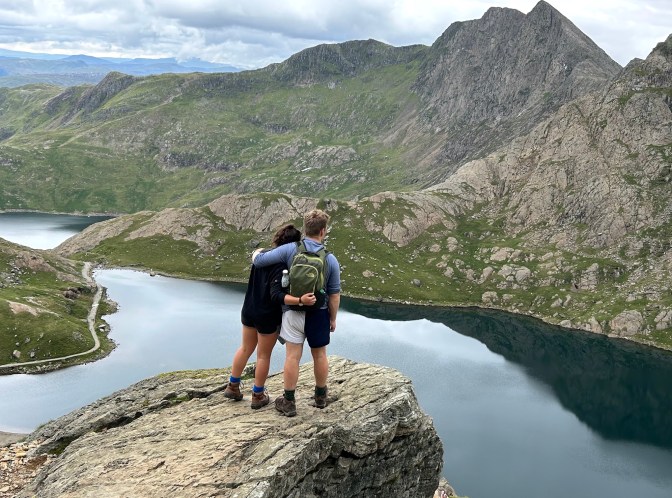
To our right, the edge of Crib Goch drops vertically to a steep meadow where a few sheep are dotted. Out across the steely-green, hazy horizon of rumpled hills, the Irish Sea gleams. An evanescent pool of mist has coalesced in the great cirque beneath the summit of Snowden. We continue upwards as the mist swirls back and forth, sometimes enveloping us completely, sometimes rolling back to reveal a sky of pure azure.
I am breathing hard as we climb; the sting of sweat occasionally fills my eyes. We climb over the skyline bluff and follow the ridge, which has now flattened to a mere 30° and find a spot to sit down for a break. As we do so, the mist rolls in and shuts us up in a world of shimmering alabaster white.
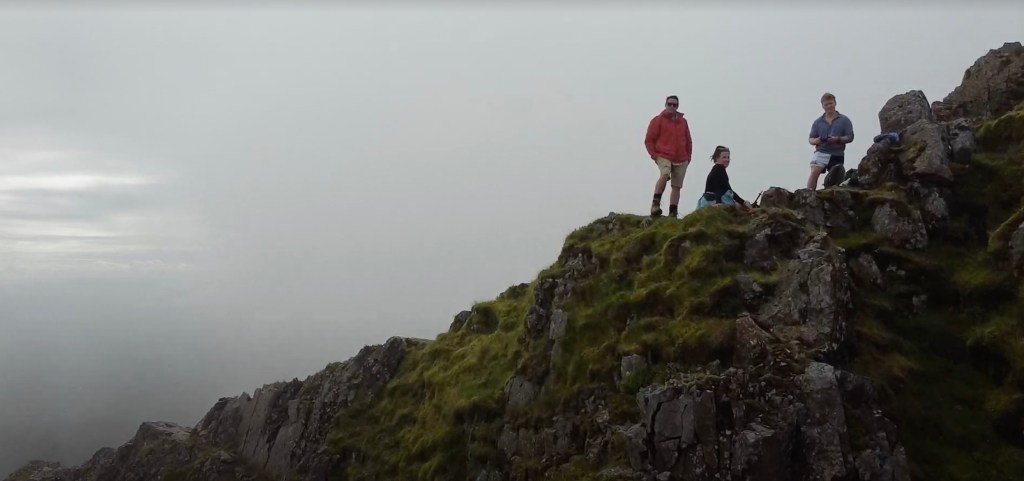
Flying a drone in a white-out is never a good idea. Flying a small drone, with damaged rotors, on a rocky mountainside where updrafts, downdrafts, and sudden currents of air continually change the flight parameters, brings all sorts of extra challenges to the would-be drone pilot. Nevertheless, I haven’t hauled my DJI Mini across the world and halfway up Crib Goch for it to lie unused in my pack. So after we have finished our cold roast beef sandwiches, I unfold the rotors and send the drone out into the cloud.
It is immediately grabbed by a downdraft which pushes it dangerously close to a bluff of jagged rock. I wrestle with the controls, trying desperately to regain command. With a combination of luck and frantic maneuvering, I manage to steer the drone back to stability, narrowly avoiding a crash-landing that would have ended the drone’s life as effectively as the impact with the surface of Mars destroyed the Beagle 2 probe in 2015.
The footage I obtain, however, is nothing short of spectacular. The three of us stand on a lonely bluff above a precipitous declivity, wrapped in a fine gauze of mist, with glimpses of the heights of Crib Goch and the summit of Snowden beyond. It is a dramatic, hauntingly beautiful scene that captures our place in this raw, unyielding landscape; a fulcrum in time upon which balances the mountain’s long past and unyielding future.
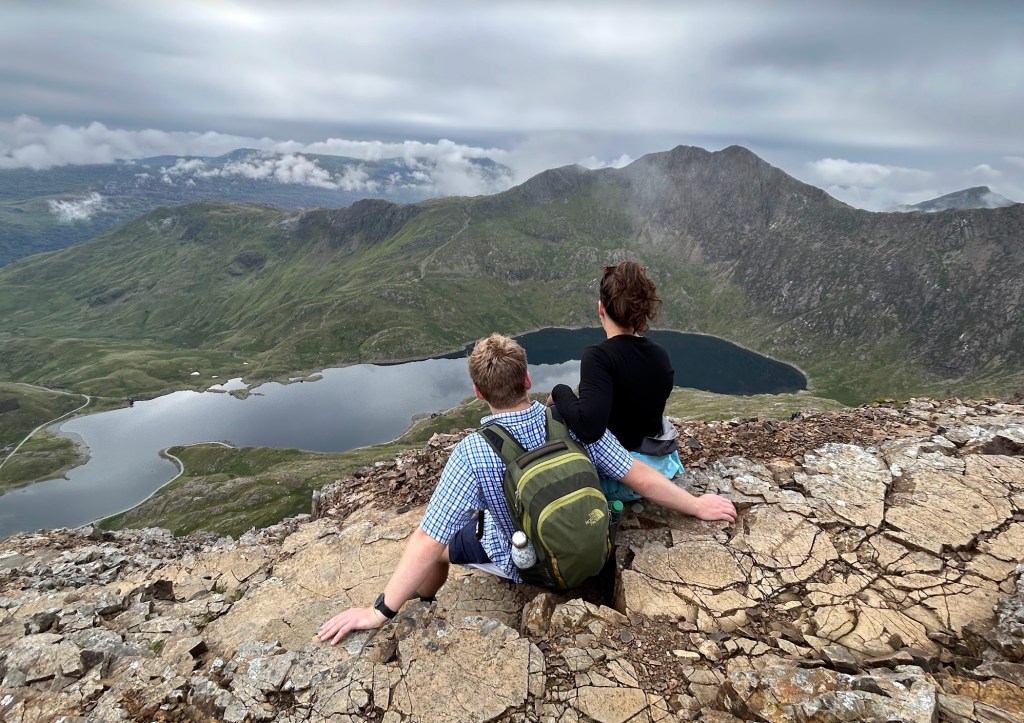
The ridge now levels out into a knife-edge arete, the top edge of which is broken and slanted. On our right, it drops vertically for a hundred metres to scree slopes and small patches of grass. To the left, boulder fields canted at 80° descend to the lower part of the ridge. A fall here would be disastrous and possibly fatal. Each year, Snowden’s mountain rescue teams are called to save the lives of hikers who have fallen or become “cragfast”: frozen with fear on one of Crib Goch’s trickier sections.
Occasionally, people fall to their deaths while attempting the ridge. The more lurid blog posts floating around on the internet claim that “8-10 people per year” die on Crib Goch. This is nonsense, of course. Nevertheless, the ridge is dangerous and requires a good head for heights and
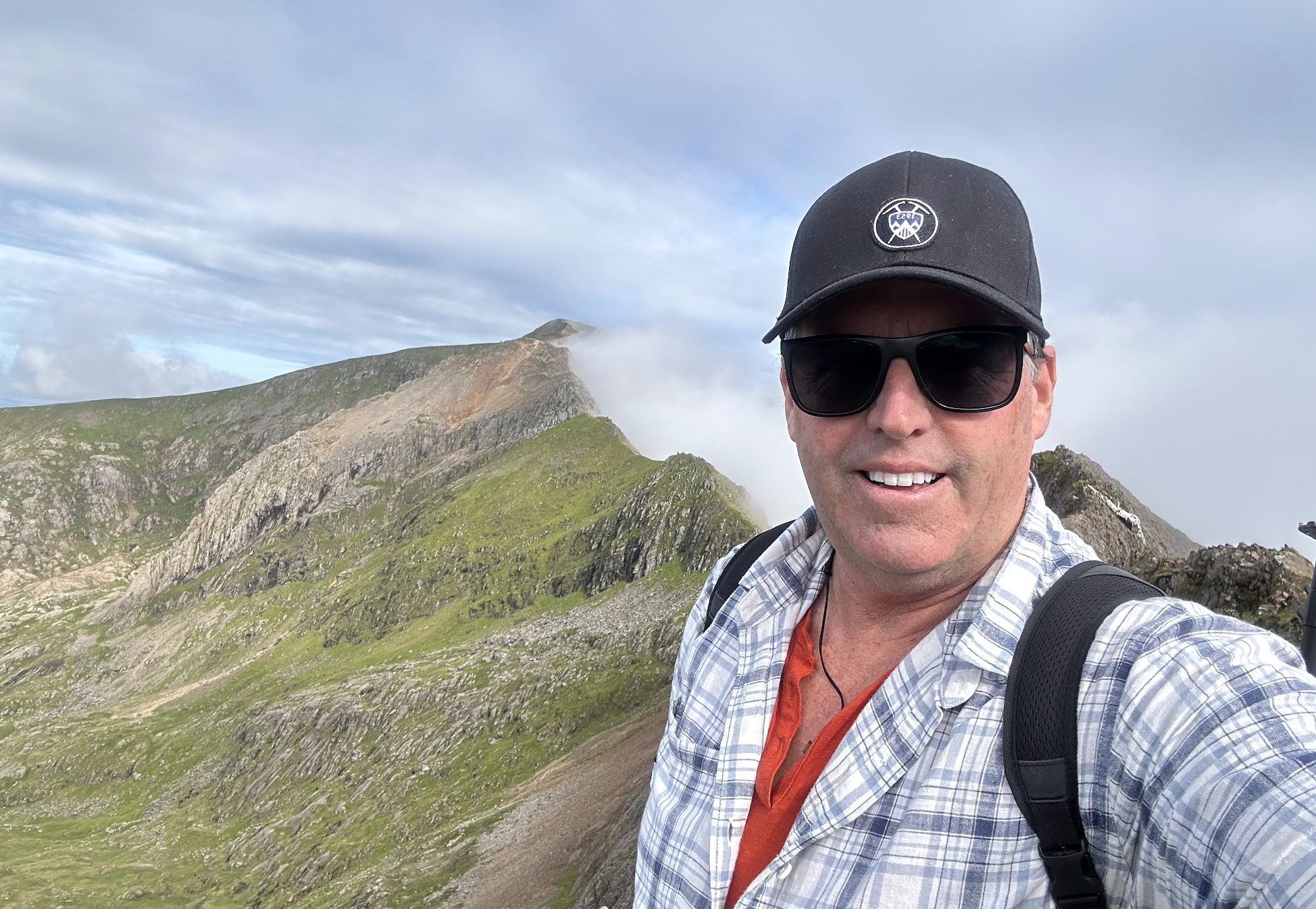
But as a former high country shepherd, clambering over bluff country holds no fear for me. Indeed, up here on this high, exposed ridge, I feel exhilarated and confident. I have my 360 camera recording atop a pole protruding from my backpack; I have my iPhone in my hand. The views are astounding: a heady combination of rock, air and sky. The mist lies like a pool against the inside edge of Crib Goch; on its outer edge, the views stretch away into a blue infinity of rolling hills and the distant, glittering ocean.

A few other climbers are on the ridge by now. They are hurrying along, seemingly oblivious to the surreal setting we are all in. For our part, we are content to dawdle along, enjoying the utter pleasure of being in this high, untrespassed place of light and space. I wonder what Wordsworth or Byron would have made of this place. Perhaps the sublimity of Crib Goch would have inspired them to compose a few couplets along the lines of “Upon Crib Goch’s crest, ‘neath heaven’s boundless dome; Sublime the heart soars, amidst the clouds’ wild roam” or some such bollocks!
The inner end of the ridge is guarded by a pair of pinnacles that have to be negotiated to reach the col at the base of Bwlch Goch: the second phase of Crib Goch. We have decided in advance that we are going to traverse around into the basin and complete the climb via the Miner’s Track instead of up and over Bwlch Goch. But before we can begin our traverse, we need to tackle these twin pinnacles.
Charlie leads the first one which begins with a tricky step down a vertical face then a sideways creep around onto the front edge of the pinnacle. It is very exposed with quite a fall on three of its sides. I follow and Lydia brings up the rear. There is a tricky, hard-to-find foothold halfway down and I pause to guide her boot onto it. Meanwhile, Charlie skylarks on the top of the pinnacle. Like me, that boy has no fears of heights!
In the small col beneath the lower slope of Bwlch Goch, we stop for another snack. The mist has swirled in again, shutting out any remaining views of the route up Bwlch Goch and confirming our earlier decision to sidle around into the basin beneath the summit of Snowden. There is no point in scrambling up over Bwlch Goch if it is encased in mist. Besides, the most spectacular and difficult sections of the climb are now behind us; getting to the top will be much faster if we simply sidle around onto the main path to the summit.
We leave the col and set off along an indistinct sheep track leading across a series of steep, almost vertical meadows beneath beetling bluffs of dripping rock. The track meanders up and down across the face, sometimes disappearing completely where winter avalanches have swept the slope. Tiny runnels of crystalline water exude from the slope, quietly tracing silvery paths through the ancient stone and moss as they begin their journey to the sea. The mist curls around us like some primordial phantom.
Below us, a steady stream of colourful hikers make their way up the Miner’s Track towards us. Our paths gradually draw together like tangents plotted on an axis, converging at a point where the gradient of our respective trajectories approaches zero, forming a node of human activity within the three-dimensional plane of the mountain.
It takes another hour to reach the summit. Although I trained for this climb for two months before I left New Zealand, my age and fitness level – compared to Charlie and Lydia who are hill-climbing machines — make the last hundred metres to the top hard going. As I struggle up the flagstones leading to the apex of Snowden, a steam train laden with sightseers chugs contentedly upwards beside the path. Rosie-faced day-trippers peer out at the climbers taking the last few steps to the top. Once again, I try to imagine what Byron or Wordsworth would have made of this spectacle:
Lo! How the summit’s grandeur is unmanned; By those who scale its heights by rail, not land.
There is a queue to stand on the cairn that marks the highest point in Wales. Charlie wanders off to order cups of tea in the nearby Visitor Centre. Lydia and I join the summit selfie queue. There is a good deal of muttering among the assembled hikers about having to line up to stand on the top. But really, all of us have chosen to walk up here knowing full well that it will be crowded. Besides, the top of the mountain is so shrouded in mist that we could be anywhere.

The obligatory selfies taken — and posted on Instagram, of course — we descend to the café where we sip our tea and warm up. Groups of wiry women and gear-bedecked men throng the visitor centre. We pick up snippets of conversations about various routes of ascent and descent. The cash-till ring of success echoes from the souvenir and gift shop. Outside the big windows, the world is opaque and invisible. We could be beside the sea, in a rainforest, or deep in the desert.
We finish our teas and swing up our packs. Back outside, a cold wind is swirling across the summit of Yr Wyddfa. The train departs with its load of rosy-faced day trippers. The queue for the summit is now even longer. We step onto the flagstones leading back down the ridge and descend into the sublime.


 TravelWriterLife