Earth has not anything to show more fair:
Dull would he be of soul who could pass by a site so touching in its majesty:
This City now doth, like a garment, wear the beauty of the morning; silent, bare…
– William Wordsworth, Composed Upon Westminster Bridge, September 3, 1802.
Bridges tell stories. They span time and history as well as the waterways of the world.
At six a.m., I let myself out of the hotel and make my way up Westminster Bridge Road. It is a cool, blue-sky morning in London. The air is fresh, and the gentle hum of the waking city accompanies me. I walk through my old neighbourhood in Lambeth. Past Lambeth North tube station. Past Lower Marsh Road. Past the Red Lion, where we worked during the winter of 1989-90 and now called The Walrus. Beneath the dank steel railway bridge that is already screeching and shrieking with the resonant, freeeeeshhhhinnnnninggggggg, steely-wheel sound of the train carriages as early services from Clapham and Portsmouth arrive at Waterloo Station.
A few red buses and delivery cyclists whirl around the junction where Westminster Bridge Road, Lambeth Palace Road and Addington Street converge. Then I am in the grey shadow of County Hall, with the green of St. Thomas’ Riverside Garden on my left, the Coade Lion, rampant on its pedestal on my right, and the bridge before me. The great pageant of the River Thames comes into view. It feels like a homecoming.
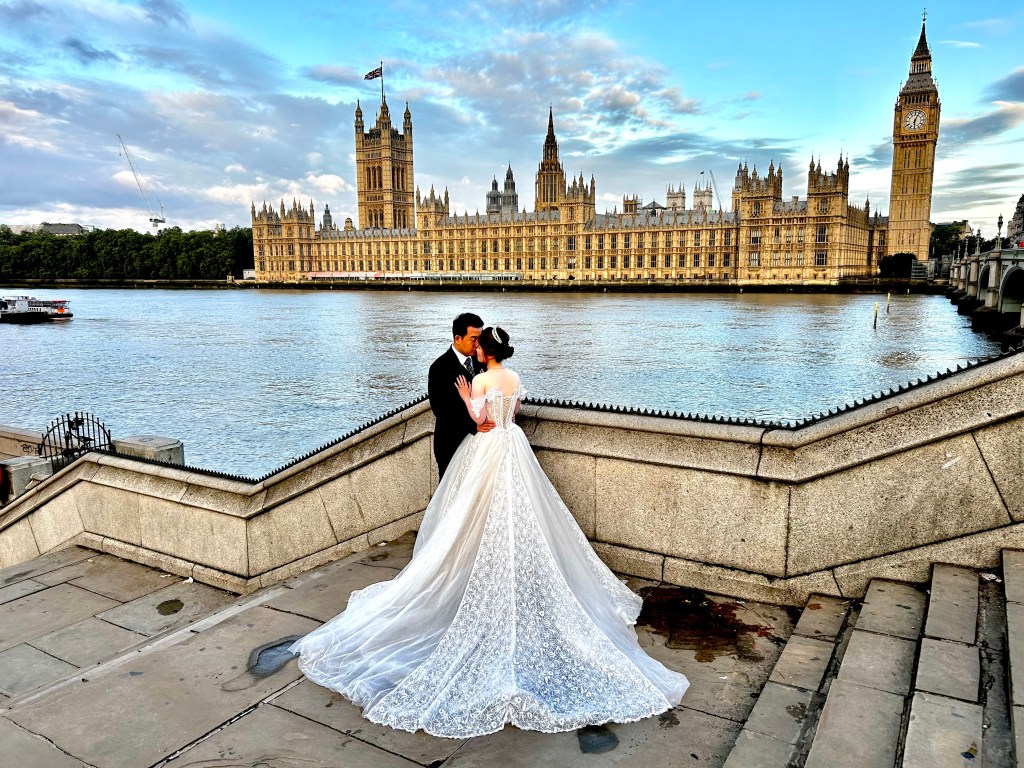
A bride and groom are capturing their new beginning, on the steps leading down to the Albert Embankment. The Palace of Westminster stands grandly behind them on the far side of the river. The groom is stern-faced and rigid in a black suit; the bride, graceful and willowy in a cascade of pure white silk, wears a tiara of shimmering diamonds. I ask if I may take their photo. The groom smiles and nods; the photographer seems annoyed by my intrusion. I say “congratulations” and walk out onto the bridge.
Like all bridges, Westminster Bridge is more than just a way to cross a river. Bridges tell stories. They span time and history as well as the waterways of the world. Bridges are links to the past and portals to the future. Their piers and girders, balustrades and abutments, handrails and carriageways, connect the countless personal histories they have intersected with.
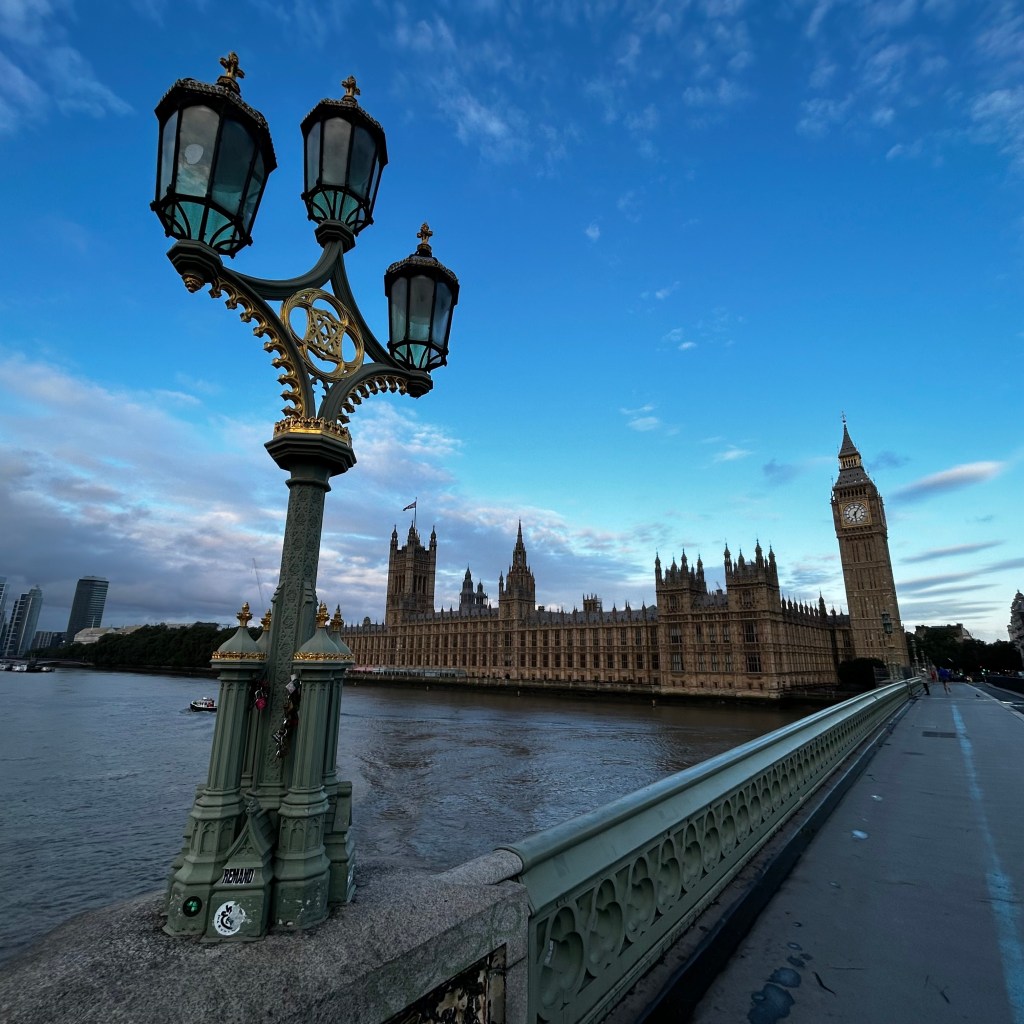
I can feel the current of history swirl around me as I step onto the bridge. It seems far more than just a simple crossing over the Thames. Westminster Bridge is also a testament in stone and iron to the stories it has seen. My ancestors may have crossed this same bridge or, perhaps, traversed the same river beneath as they embarked on their journey to a new life in New Zealand or adventure and death out in the Empire.
Designed by Thomas Page, the bridge was opened in eighteen fifty-nine. It replaced a previous bridge that had been built — despite the objections of Thames Watermen and the owners of London Bridge, whose livelihoods it threatened — in the mid-1700s. Its seven arches are decorated with Gothic detailing by Charles Barry, the architect who designed the Palace of Westminster. The distinctive green of the bridge’s handrails echoes the leather seats of the House of Commons: a subtle yet striking nod to the political heart beating nearby.

For me, the view from Westminster Bridge is more than a postcard scene of London. It is my View of the World. It is to this place that my thoughts always alight whenever I think of London. Here, my story intertwines with the city’s pulse. I lean on the downstream handrail and gaze at the well-remembered scene. To my right, the sentinel facade of County Hall glowers at the river. Beyond it, the London Eye, motionless and unblinking, so to speak, at this hour, stands at the edge of Jubilee Gardens.
The river is full. The making tide pushes the current upstream towards distant Teddington — “tide-end-town” — 13 miles inland. An early Uber boat threads downstream towards Hungerford Bridge and the arched entrance to Charing Cross Station. The twin embankments — The Queen’s Walk on the south bank and the Victoria Embankment on the north — hold the Thames in check. Boadicea rides her bronze chariot into battle against the Romans opposite The Elizabeth Tower, where the iron bell of Big Ben tolls the hour.
I cross back to the upstream side, dodging a red Number 12 bus (Dulwich Library to Oxford Circus), our reliable chariot during our Red Lion days. The windows, towers, crenellations and spires of Westminster Palace (aka The Houses of Parliament) reflect the river and the sky. Upstream, past the green hem of the Victoria Tower Gardens, Lambeth Bridge steps back across the river with the skyscrapers of Vauxhall beyond.

The bridge is nearly empty, a rare moment afforded by the early hour, devoid of the usual throng of tourists. Alone with the Thames and the encircling city, I feel a sense of peace. The solitude is profound, allowing me a moment’s connection with the place that daily routines and crowds often obscure.
The alternating febrile excitement and languor of the city is dormant yet, awaiting a later hour. The lustrous spires of Westminster Palace gleam in the sunrise. The Thames laps against the bridge’s piers with a sibilant hiss. I think of Wordsworth’s sonnet, composed upon the old Westminster Bridge in 1802: “The river glideth at his own sweet will.”
In the silence, I feel a deep connection to this city, to England, and the events woven into the tapestry of my life. From the Victorian adventurers who sallied forth into the Empire to my time spent living near this great bridge: all of them are connected. The panorama of the cityscape swims around me. I feel myself vibrantly alive, alone in this canvas of living memory, wrapped in the tranquillity of a London morning on Westminster Bridge.


 TravelWriterLife