And was Jerusalem builded here
Among these dark Satanic Mills…
- William Blake, Milton.

Deep in Southwark, Borough Market is heaving. As our Uber driver noses his Kia carefully into a space beneath the steel arches, I look out at a scene that could be a modern representation of a Mediaeval street. Stalls brim with artisanal offerings; the air is rich with the mingling scents of freshly baked bread, exotic spices, and sizzling street food. The crowds jostle. There is music and shouting.
I step from the car and disappear into this eclectic symphony of sounds and scents. Vendors call out the day’s specials, their voices weaving through the clatter of footsteps and the murmur of excited conversations. The narrow alleys, lined with stalls overflowing with colour, create a Renoir palette of hues: the vibrant red of fresh tomatoes, the deep greens of leafy vegetables, and the warm golden tones of freshly baked breads. The air is heavy with a collage of aromas: the rich, earthy scent of ground coffee beans, the tangy sweetness of exotic fruits, and the comforting aroma of sizzling sausages.
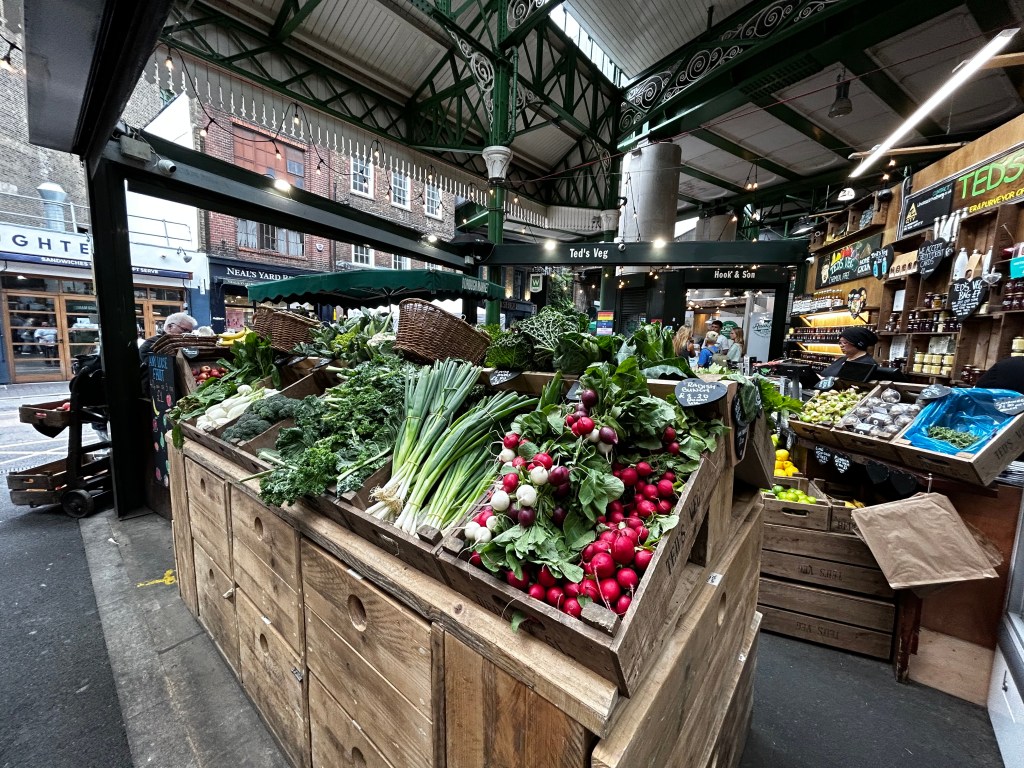
The market is a gallimaufry of cultures and cuisines, each stall offering a glimpse into a different world. I taste artisan cheeses whose flavours tell stories of far-off pastures, and pastries with flaky layers as rich in history as they are in butter. Around me, people from all walks of life are gathered, their faces reflecting the market’s diversity. Tourists with cameras mingle with locals clutching reusable bags, all united in their quest for culinary treasures.
The perceptual overload is exhilarating. The narrow alleys of the market feel like veins through which a bloodflow of sensory experiences runs. Layers of sound, sight, and smell enfold me. It is a place where history and modernity converge and every sense is awakened. This market, standing for over a thousand years, is not just a venue for trade but a coruscating stage, where the past and present perform in a vigorous and unending dance.

One of the things I love most about London is how a single location (wherever it is in the city) can encapsulate a broad spectrum of history and culture. This new iteration of Borough Market is just the latest in a strata of deep layers of history that lie, eroded and worn but still clearly visible, in this part of London. Beneath the hum of modern commerce, the echoes of past centuries linger in the cobbled streets and ancient facades, whispering tales of mediaeval merchants, eighteenth-century rebellion, Victorian-era bustle, post-war decline and twentieth-century brashness.
Borough Market began life as an intersection on the edge of London in the early 11th century. Writing in the 12th century, the Icelandic historian Snorri Sturluson hinted at its ancient roots, referring to Southwark as a “great market town” as early as 1014. The market, which initially hugged the end of London Bridge, had its first documented mention in 1276, before migrating southward to a spot near St Margaret’s church.
By the mid-16th century, the market had caught royal attention. In 1550, Edward VI granted the City of London a charter to govern the markets of Southwark. This privilege was reaffirmed by Charles II over a century later in 1671. Yet, its popularity was not without challenges. The bustling market, teeming with vendors, prostitutes, tricksters, shoppers, performers, animals and beggars, led to such severe traffic congestion on the approach to London Bridge that in 1754 an Act of Parliament disbanded it.
However, the spirit of the market couldn’t be quelled for long. That same year, a second Parliamentary Act empowered the local parishioners to establish a new market. In 1756, Borough Market reemerged, reborn on a spacious 4.5-acre site in Rochester Yard. Throughout the 19th century, its proximity to the Pool of London’s riverside wharves saw it ascend to one of London’s most vital food markets, a legacy that continues to tantalise the taste buds of locals and visitors (like me) alike.
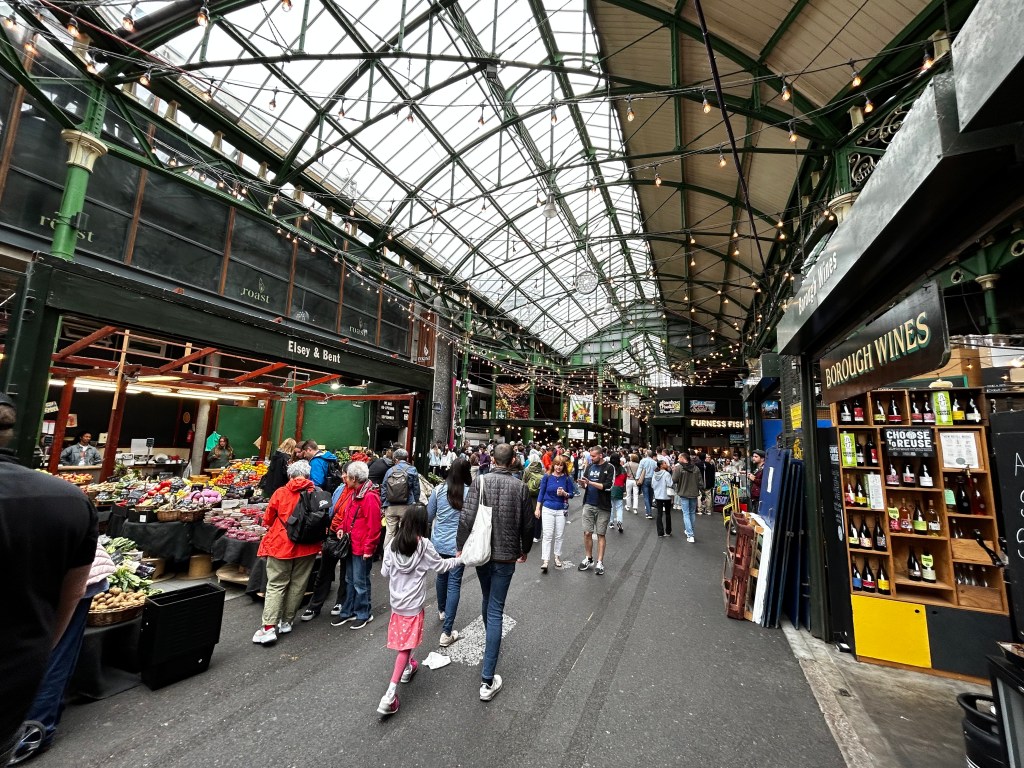
Deep in the market, I elbow my way through throngs of tourists, delivery personnel laden with packages, bustling businesspeople looking for lunch and seedy hucksters on the lookout for a rube to fleece. I pass a giant vat of paella: paprika-red beneath a veil of fragrant steam. Rosettes of fresh fish lie on beds of ice. There are strawberries dipped in chocolate, bread of every kind, dairy products from the hinterland, game pies from the lands of the north and flowers from the Garden of England.
At a corner stall, I buy a corned beef sandwich. Its layers of British beef, pickles, salad, mustard and relish are piled up in a deep stratum between two pieces of thick bread. I lean my back against a wall of Georgian brickwork as I eat. The layers of my sandwich are built up in the same way as the history of Southwark is piled up: veneer upon veneer reaching back into time.

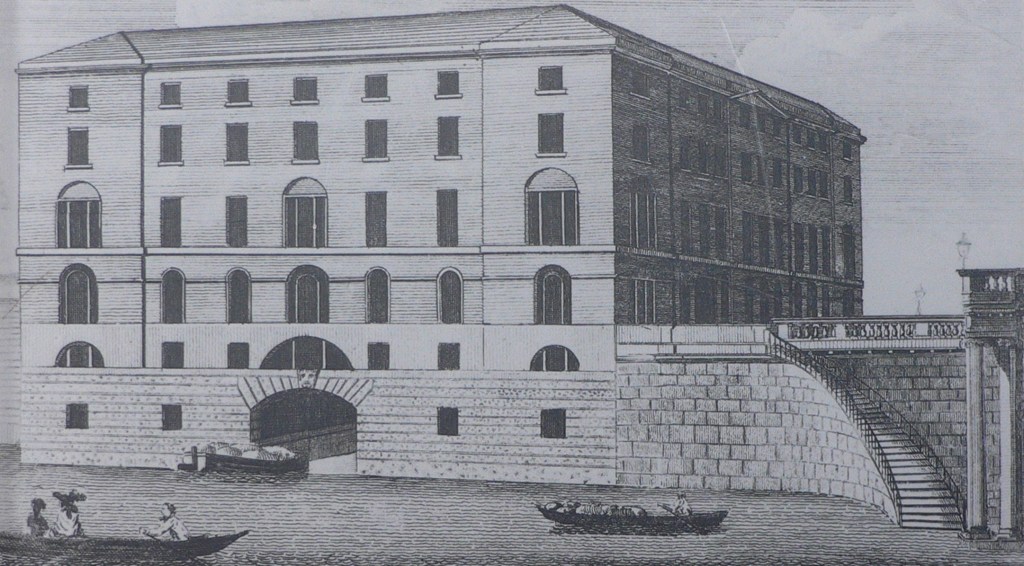
The Industrial Revolution arrived in Southwark in the late eighteenth century in the satanic form of the Albion Flour Mill. The mill stood like a brooding giant on the banks of the Thames, its monolithic bulk casting long shadows that seemed to stretch out and grasp at the cobbled streets. Its massive walls, blackened by soot and smoke, were a stark monument to the inexorable march of industrialisation. The incessant rumble of machinery echoed from within: a relentless, mechanical heartbeat that spoke of progress but also felt like an ominous portent. The air around the mills was heavy with the acrid scent of burning coal, mingling with the subtle, yet ever-present odour of labour, poverty and toil.
Inside, the atmosphere was suffocating. The darkness was broken only by the sporadic flicker of oil lamps, casting eerie shadows that danced across the faces of the workers. Their eyes, hollow from exhaustion, reflected a mix of fear and resignation. The ceaseless clanking of gears and grinding of stones resonated in their bones, a constant reminder of the unyielding demands of the new industrial age. The mill, with its labyrinth of machinery, seemed like a malevolent creature, consuming wheat and men alike with equal indifference.
Outside, the Thames flowed silently, indifferent to the mill’s imposing presence. The night sky, devoid of stars, hung over the mill like a shroud. The building, with its colossal wheels and belching chimneys, stood as a dark testament to human ingenuity and its unintended consequences. It was a place where the dreams of progress clashed with the harsh realities of industrial life, embodying the dark Satanic mills of William Blake’s poem. The Albion Flour Mill stood as a symbol of advancement; an outlier of the coming age of machinery. Yet it was also a harbinger of the disquiet and turmoil that would come to define an era.
Walking the alleys of Borough Market, now gentrified and water-blasted clean, I see parallels in the modern world. In the 21st century, it is the relentless advance of automation and machine learning, epitomised by platforms such as ChatGPT, DALL.E and LLaMA, that stirs a familiar undercurrent of anxiety, reminiscent of the unrest sparked by the Albion Flour Mill centuries ago. Just as the thunderous machinery of the industrial age once signalled a seismic shift in the labour landscape, today’s digital revolution represents a new frontier, equally awe-inspiring and intimidating.
The rapid evolution of technology, while heralding unprecedented efficiency and possibilities, also casts a shadow of uncertainty over traditional roles and industries. Today, in cafés, offices, and workplaces worldwide, conversations echo with both excitement and concern, as society moves towards another monumental transformation, where the digital and the human experience intertwine in ways that are both exhilarating and, for some, unnerving.
In the early twentieth century, for example, blacksmiths found themselves at a similar technological crossroads. The internal combustion engine was rapidly replacing the horse in transport, agriculture and, indeed, almost every facet of life. For blacksmiths, the choice was simple: either learn to embrace the new technology and apply your skills to fixing and maintaining the machines…or go out of business. The ‘smiths who chose to move with the new technologies prospered; those who saw it as a threat disappeared.
I’m fascinated by the way the Albion Flour Mill, which was one of the first British production mills to utilise mechanisation, was burned down by angry workers who saw the machinery as a risk to their livelihoods. In later decades, workers protesting the onrush of machines would call themselves Luddites, after Edward Ludd, who had attacked and broken framework knitting machines in Nottingham.
The mill workers’ response to the machinery at the Albion mill, while predating the Luddite movement, can be seen as an early example of this enduring conflict between man and machine. It is a struggle which continues in different forms today, as modern operatives see machine learning and AI as a risk to their livelihoods. It is a timeless theme: the tension between technological advancement and its impact on traditional jobs and skills.

With my sandwich done, I leave the crowd and noise of Borough Market behind and follow Montague Close down to Southwark Cathedral. The cobbled street follows the flint and limestone west wall of the cathedral, with the ziggurat brick and glass faces of office blocks on the opposing side.
“I walked over the fields to Southwark…,” wrote Samuel Pepys on July 3rd, 1663. “And I spent half an hour in Mary Overy’s Church, where are fine monuments of great antiquity, I believe, and has been a fine church.”
Although the fields across which Pepys walked are now long forgotten, smothered beneath the asphalt and stone labyrinth of South London, the cathedral remains: a spiritual beacon amid the temporal tumult of the city.

Situated near the River Thames’ most ancient crossing, the Cathedral and Collegiate Church of St Saviour and St Mary Overie has long graced what was once the sole gateway across the river to the City of London. Oral traditions compiled by the Elizabethan historian John Stow, hint at the site’s initial sacred roots being a 7th-century nunnery. However, the earliest documented evidence of its religious significance appears in its description as a ‘minster’ in the Domesday Book of 1086.
In 1106, two Norman knights re-founded the church as an Augustinian priory, dedicated to St Mary. It was later renamed as St Mary Overie, meaning ‘over the river’. The priory, under the Winchester Diocese’s oversight, saw powerful bishops influencing its structure and activities.
After the Dissolution of the Monasteries in 1539, the church was renamed St Saviour’s and was rented from Henry VIII. In 1611, the congregation’s merchants bought it for £800. Its location, not far from the Globe Theatre, made it a place of worship for Shakespearean actors. By the 1820s, however, the church had once again fallen into disrepair. Its crumbling facade, leaking roof and grimy interior in some ways echoed the 19th century’s dire living conditions in South London, highlighted by Charles Dickens and Charles Booth.
Criticised for its ‘hole-like’ location amidst warehouses and markets, the church nevertheless became Southwark Cathedral in 1905. Today, it serves a diocese of more than two million people stretching from Kingston-upon-Thames to Thamesmead and Gatwick Airport.
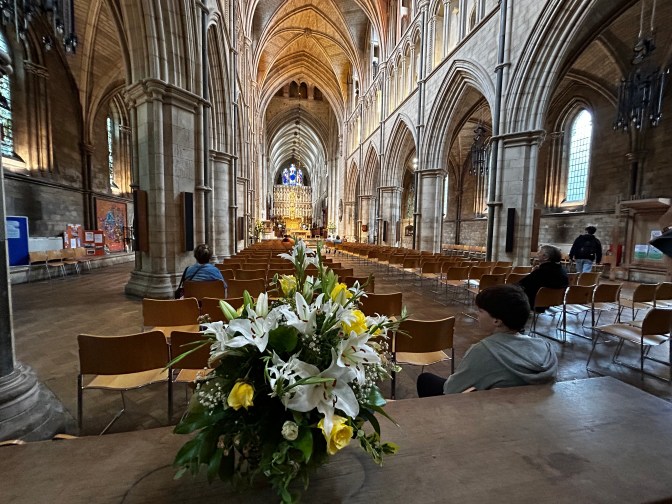
Stepping inside the cathedral I feel as though I have been time-shifted from one reality to another. Outside, the city roars: the sonic background radiation of commerce and cacophony. Inside, the tranquillity is as profound as an anechoic chamber. There are a few people in the nave and from somewhere deep behind the crossing, the gentle chords of an organ weep into the silence.
The vaulted ceiling soars upwards, held aloft by slender pillars of pure white stone. The aisled nave is formed by six bays, each one surmounted by a perfect Gothic arch. Light pours into the space through clerestory windows set into the triforium above the aisles.
To me, churches are living museums of social history. And even though I have no religious beliefs at all myself, I love churches. I am fascinated by the stories they tell, their architecture, and their place in society. But most of all, it is the quietness of churches that captivate me. Churches are places where you step into silence.
I take a seat in the centre of the nave. The tranquillity of the cathedral seems almost tangible. I can hear the whisper of each footstep on the ancient flagstones and the soft rustle of paper from a lone worshipper’s prayer book. The noise of the city outside is nothing more than a low, sibilant hum: part of the cathedral’s tapestry of calm. The silence becomes not just an absence of sound, but a presence in itself. Time itself seems to slow down and I feel myself recharging, re-energising before my next foray into Borough Market.

Back outside, in the cathedral’s close, I turn and look up. The glass and steel spike of The Shard rises like a contemporary steeple behind the cathedral. It is a striking visual metaphor for London. This image of the old and the new, the sacred and the profane, is a poignant reflection on how the city has evolved, continually layering the new upon the old.
Just as the Albion Flour Mills once represented the cutting edge of technology, the Shard now stands as a symbol of modern innovation and progress: a new Jerusalem built close to the place where the dark satanic mills once stood. And although nothing remains of the flour mill, the Southwark Cathedral has endured as a representation of the past, a quieter, more reflective time. In London, these structures can easily coexist with each other: an ongoing fusion of history and modernity, a continual dialogue between past and present.
Here, in the cathedral’s shadow, I am still enveloped in its hallowed calm, a secular pilgrim at the gates of history. In this pause between the old stones and the sky-reaching Shard, it seems as though the burden of the present is perfectly balanced by the gravity of the past. I am standing at a crossroads in time, the very air around me saturated with a sacred stillness. Here, in the shadow of spires, I discover a sanctuary in the stone and stories, a threshold to the new Jerusalem.

 TravelWriterLife