Back in China for the first time in thirty years and everything has changed completely…including myself.
Someone who lives in Istanbul is as much an Asian as someone from Jakarta or Aurangabad, Kobe or Quanzhou. Nearly four and a half billion people walk on the continent of Asia. And now, my two feet are about to join them again.
Midday in Fujian Province. Outside the train window, it is a hot, blue day. The scene spooling past at 305 kilometres per hour is a mixture of tower blocks, factories and farmland. Traceries of motorways and railway lines step across the landscape on tall concrete pillars. Endless geometric rectangles of jewelled rice paddies, viridian and emerald, are spread out beneath them, stretching to a pale rumple of distant ranges.
★★★ = 三星不 ★★★
Travel is a disappearing act. My departure from home, twenty-six hours earlier was the usual heady mix of anticipation and eagerness, tempered with the melancholy of goodbyes. Leaving is, in itself, an adventure: a transition from the mundane to the outlandish, from the ordinary to the extraordinary. The adverts on television, the city bill-boards, the newspaper headlines: these things spoke to other people. I was leaving. I was setting my ordinary life aside for a month and disappearing into the haze of another continent.
Asia is vast. It spans the world from the edge of the Bosphorus in Turkey to the islands of Japan and beyond: a distance of 11,000 kilometres, or 8,000 miles, or 36 million feet. Someone who lives in Istanbul is as much an Asian as someone from Jakarta or Aurangabad or Kobe. Nearly four and a half billion people walk on the continent of Asia. And now, my two feet are about to join them once again.
Awake at 12:30AM the previous morning, I had driven to Christchurch through a nor’ west gale. In the darkness on the empty road, the wind had buffeted my car with the force of an unseen hand. Then takeoff, the flight over water and Sydney. The Charles Kingsford Smith Airport had been crowded: a vast shopping mall attached by aerial tentacles to the world. The Balenciaga, Louis Vitton and Rip Curl stores meant nothing to me. They may have been very demure, very stylish, very mindful, but I was on my way to Asia. I ate a packet of nuts from a vending machine. The flight was delayed by thirty minutes so I went and got a takeaway latte.
Then Australia was behind me. The air above the Banda Sea was hot, unstable and bumpy. Watching the green line of our flight path across the equator was like watching a slow motion video game from the nineteen eighties. As the aircraft crossed the equator, the pilots navigated a series of zig-zag deviations, dog-leg in our route to avoid thunderstorms. Outside my window, the sky was a luminous immensity of white, with towers of cumulus ascending into the stratosphere. The aircraft shivered and wobbled in the turbulent air, occasionally plunging earthward as it encountered patches of low pressure.
My notes, scribbled on an airsick bag for want of a clean page, were similarly rough and uneven. On the seatback screen in front of me, the names of exotic and evocative islands were dotted across the inverted universe of the Molucca, Visayar, and Sulu Seas: Morotai, Solo, Celebes, Zamboanga. And on the conic projection map of the world, night advanced across the Pacific towards Asia like a shroud.

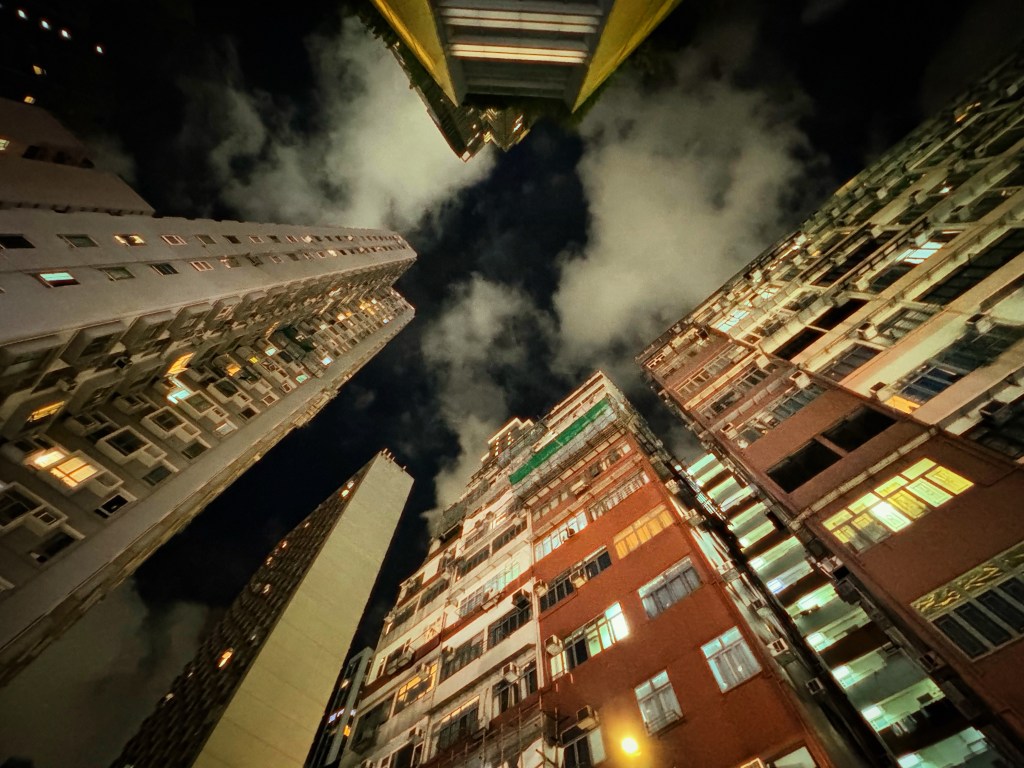
Kowloon. Condensation falling like raindrops from the air conditioning machines high above Nathan Road. The air hot and full of the scent of Asia. Kowloon. The busy streets bright, noisy, and crowded with people as I make my way to my hotel: the first step on my journey to China. Kowloon. Mysterious, feculent, vibrant, overwhelming; at once inscrutable and intense yet also familiar and welcoming. I wander at random beneath the cascades of neon pollen and lattices of bamboo scaffolding stitched onto cliff-face tower blocks hung with draperies of washing. Lost in the sensory overload of food hawkers, alleyways, massage parlours and gleaming shopfronts, I eat spicy Schezwan kebabs of octopus meat at a sidewalk stall, and buy a cold coke from a vending machine.
In the morning, the streets are clean and empty. I leave my damp hotel room early. I have the needle tracks of bed bug bites on my arm. The Metro takes me beneath the harbour to Hong Kong Island. Beneath the perfect blue buildings beside the green apple sea I take the Star Ferry back across Victoria Harbour to Tsim Sha Tsui. This is my favourite ferry ride anywhere in the world. It even beats Sydney’s Manly Ferry. The towers of Hong Kong Island rear up like fangs beneath the steep green mound of Victoria Peak. Once the tallest building in Asia, the Bank of China tower, with its ziggurat frame and knife-sharp apex, stands surrounded by glass and steel skyscrapers of increasing complexity and futuristic design.
From the Star Ferry Terminal, I walk up Canton Road to the Hong Kong West Kowloon Railway Station. In the gleaming concourse, I fill in a departure card, have me Chinese visa inspected and stamped, then board the waiting train, sleek and gleaming, on Platform 2. With barely a shudder the train moves out of the station at precisely 8:45AM, rolls gently through Nam Cheong and Tsuen Wan and on into China.

As the train slides north, I write in my diary:
Train G3006
The Kowloon Xiamen Express
At 244 kilometres per hour, the countryside outside is spooling past at a rate I can barely comprehend. Here on this train speeding north along China’s eastern provinces, I am completely at a loss. My Alipay and WeChat apps don’t seem to work; my few words of Mandarin Chinese are woefully inadequate for even the simplest yes or no conversations. And yet, I am already captivated. China outside the window is green and lush. It looks strikingly different from the gleaming high-tech cities I’ve been watching on TikTok and YouTube. Indeed, it looks vaguely familiar, like the China we knew thirty years ago. The train stops at Lufeng. The doors slide open with a sibilant hiss, then close again just as smoothly thirty seconds later. A few minutes later, rural China is outside the window once again.
★★★ = 三星不 ★★★
A battalion of pylons is marching up and over a row of green, forest-clad hills. Sleek streams meander along the valley bottoms. There are rows of fish farm baskets in the sluggish water and an occasional heron waits patiently to grab a passing minnow. Wind turbines turn ponderously in the hot, turgid air. The sky is a pale duck egg blue blue and hung with fluffy clouds that promise a shower later on. The neatly-kept graves of ancestors peep from the foliage. Everywhere there is rich, fecund life.
Watching the countryside scroll past outside I am struck by the profound realisation that China doesn’t look any different to the way it looked 30 years ago. The rows of traditional tile-roofed houses, the fish ponds and paddy fields, the echelons of orderly vegetable gardens and banana plantations; all of these things, and more, look amazingly familiar in the hazy hot air.
Of course, the China of 2024 bears almost no resemblance — culturally, politically environmentally or societally — to the China we experienced in 1992 and 1994. Lifestyles, life expectancy, education, all have improved immeasurably. But it is gratifying to see that China itself, for all its improvements, still looks the same.
The train crosses a wide flat-bottom valley where rich, healthy crops of rice and vegetables are growing in the rich soil. Motorways and rail way lines – including the one I am riding – meander through the landscape, raised above the farmland on tall concrete pillars. What an elegant solution. Instead of bulldozing wide swathes of land to make way for these infrastructure projects, the Chinese simply elevate them, enabling food to still be grown on the land beneath them.
Distant jagged hills, hung with thunderclouds, stand at the head of the valley and soon, the stony landscape of southern Fujian province begins to flex its muscles. Great outcrops of weathered granite protrude from the ridges and sleek rivers meander down toward the nearby, but as yet unseen, East China Sea.
I offer the man in the seat beside me an Eclipse chewy mint. He has helped me negotiate with the steward — a beautiful and patient young woman — to buy a coffee and a bottle of water. I think about the incongruity of how some chewy sweets, purchased in a Z fuel station in Timaru New Zealand, are now being eaten on a train in Southern China.
★★★ = 三星不 ★★★

Xiamen. The train glides to a stop on the wide, double-sided platform. The doors slide open with a sibilant hiss. I ride an elevator down into the tunnels of the Xiamen Metro. Three stops and I am at Janye Road where my hotel is located. I climb the stairs to the exit. The sun falls on the street with an almost tactile force. I smell the hot breath of the city. The heat and humidity press down on me like a hot, wet blanket: smothering, oppressive, almost suffocating.
But the first part of my journey is complete. I have left the familiar and the predictable behind. From here on, anything is possible. I step out onto the street and into Asia.


 TravelWriterLife