Once the home of foreign traders and merchants, today Gulangyu Island is a green, shady haven from the heat and bustle of Xiamen.
I know a place where I belong
In my extraordinary life…
– Marianas Trench, Haven
North west of Yanweishan, the ferry executes a long turn to port as it enters the sea lane into Xiamenxi Harbour. A massive container ship, like a floating, horizontal skyscraper with the name EVERGREEN stencilled onto its hull in letters higher than the ferry, slips ponderously into is berth beneath the waiting cranes. A flotilla of smaller ships, line astern on the flat, viscid water, make their way north towards the docks of Maulan Bay, invisible in the haze beyond the Haicang Bridge.
Onboard the ferry, I stand with a crowd of families and day trippers on the upper afterdeck. A tiny breeze, barely enough to ripple the surface of the water, blows across the deck, wilfully everting the sun umbrellas some of the passengers are sheltering under. The shore of Gulangyu Island, its green and gold canopy of forest lush beneath the incandescent sky, slips gently by, fine on the larboard beam.

The engines throb beneath the deck plates as the skipper comes astern, bringing the ferry into its berth on the eastern side of the island. A deckhand nimbly throws the eye of a mooring line around a shore bollard, making it fast to an aft bitt and bringing the vessel to a stop. The gangway clatters. The passengers descend the wooden stairway to the main deck and disembark. I wait till the crowd disperses, and step ashore into the green, shaded haven of Gulangyu.

From Colonial Outpost to Cosmopolitan Oasis
Gulangyu Island sits a few hundred metres off the shore of Xiamen, the large, circular island upon which most of the eponymous city is built. Gulangyu has a long history of European inhabitation. Indeed, for a time it was the only place in China outside of Shanghai where European traders, hustlers, men of business, savers of souls, smugglers of opium, adventures, explorers and wanderers in the blue rooms could live. But for centuries before these foreigners arrived, the people of Gulangyu lived in harmony with the sea, fishing the rich waters of the bay and maintaining a quiet, self-sustaining lifestyle amid its hills and beaches.
An island in the stream of history
Prior to the Opium Wars of 1839-1842 and 1856-1860, Gulangyu Island’s economy was predominantly based on agriculture and fishing. The island was home to approximately 100 families of Minnan people — also known as Hoklo or Southern Min — a subgroup of Han Chinese predominantly found in the southern Fujian province of China. The ancestors of these people began migrating to Fujian during the Han Dynasty (202 BCE-9CE and 25CE-220CE), intermingling with the local Yue tribes to gradually form the Minnan identity.
During the Tang Dynasty (618-907 CE), the cultural identity of the Minnan people began to solidify with their language, customs, and social structures taking a shape that was distinctly different from the central plains of China. Further development of Minnan culture, arts, and trade, continued during the Song Dynasty (960-1279 CE). The significant growth in maritime activities during this period took advantage of Gulangyu’s strategic location The revenue from shipping and trade created a robust economy that enabled the inhabitants of the island to finance the building of a series of temples dedicated to Buddhism, Taoism, and Confucianism.

This economic and cultural prosperity, however, also made the island a focal point for the growing trade tensions between China and various western powers — most notably the British — who were aggressively expanding their influence in the region. And the flash point for this conflict was an insidious drug that the British grew in India: opium.
The Opium Wars
The Opium Wars were two pivotal conflicts in the 19th century between China and several Western powers triggered by disputes over trade and diplomatic relations. The First Opium War (1839-1842) began when China sought to suppress the opium trade which was being spearheaded by British merchants who were importing opium into China in exchange for tea. The trade imbalance caused by this one-sided exchange was draining China of silver, and the widespread addiction to opium was having devastating social and economic effects.
This war was primarily a naval conflict between the British Empire, with its modern, steam-powered warships and the small, outdated junks of the Chinese navy. The flashpoint came in 1839, when the Chinese government, determined to curb the rampant opium addiction affecting its population, took decisive action under the leadership of the imperial commissioner Lin Zexu. Lin orchestrated a massive crackdown on opium in Canton (Guangzhou), where he seized and destroyed over 20,000 chests of opium.
This bold move also involved the confinement of foreign traders and insisting they surrender their opium stocks under threat of death. This culminated in the public destruction of the opium at Humen, where it was dissolved in lime and salt and flushed into the sea. This act not only symbolised China’s firm stand against the opium trade but also directly challenged British economic hegemony, setting the stage for the British retaliation that escalated into the First Opium War.
The British were naturally a bit miffed by this loss and initiated military action to protect their commercial interests. Major battles occurred primarily along coastal regions, with significant engagements at places like Guangzhou and the Pearl River.
The conflict ended with the Treaty of Nanjing in 1842, the first of the “unequal treaties” that ceded extensive concessions to the British. Under this treaty, China was forced to cede Hong Kong to Britain, providing a crucial base for British operations in Asia. The Treaty of Nanjing marked the beginning of the era known as the “Century of Humiliation” for China, characterised by increasing foreign control and influence on the mainland. It paved the way for further encroachments by other Western powers and Japan, each seeking their own spheres of influence within China, significantly weakening the Qing Dynasty and altering the course of Chinese history. It also provided for the opening of four additional treaty ports to foreign trade and residence, breaking the monopoly of the Canton System, under which all trade with China had been controlled.

The Canton System
The so-called Canton System was a trade policy enforced by the Qing Dynasty from the late 18th century to the mid-19th century. It was specifically designed to regulate the power and reach of Western traders in China. Under this system, all foreign trade was confined to the port of Canton (now Guangzhou). Western merchants could only do business through Chinese trade guilds known as hongs.
These guilds were authorised by the Chinese government to act as intermediaries in trade, essentially holding a monopoly over all commerce between China and the West. This arrangement was meant to limit foreign access to Chinese society and control the types of goods that entered and exited China, keeping the Western traders at a regulated distance from the broader Chinese society and government.
Jardine and Matheson
Founded in 1832 by Scotsmen William Jardine and James Matheson, Jardine Matheson emerged as one of the key players in the opium trade. Their operation, which involved importing opium into China from India, paralleled that of the Sassoon family, prominent opium traders based in Mumbai. Like the Sassoons, who had a significant impact on the trade landscapes of Mumbai and Shanghai, Jardine Matheson played a critical role in escalating the tensions that led to the First Opium War. Their aggressive advocacy for the opium trade was instrumental in pushing the British towards a military response to Chinese enforcement of their anti-opium laws.

The Arrow War
The Second Opium War (1856-1860), also known as the Arrow War, saw Britain and France fighting against the Qing dynasty. It started over the boarding of the Arrow, a Chinese-owned but British-registered ship by Chinese forces. This seemingly innocuous beginning quickly escalated into a broader conflict over trade rights and diplomatic respect: something that the self-righteous Brits and flouncing French took very seriously.
Key battles during the second conflict included the capture of the Taku Forts in Northern China and the subsequent occupation of Beijing. This conflict extended deeper into China’s interior and concluded with the Convention of Peking, which further expanded foreign privileges established by earlier treaties. The treaty also required that China pay a large indemnity to Britain for the loss of opium stocks and the costs of the war. It granted extraterritorial rights to British subjects, meaning they were subject only to British law and not Chinese law.
And, finally, the Convention of Peking ceded Kowloon to Britain. This gave Britain complete command of both sides of Victoria Harbour, enabling them to monitor, control, and tax all maritime activities and trade routes through and around the southern tip of China. As I had walked along Nathan Road in Kowloon and crossed Victoria Harbour on the Star Ferry a few days before, I was treading on the very soil that had witnessed these historical shifts of power. Now, with Kowloon and Hong Kong firmly back in the hands of the Chinese, these areas are examples of the ever-turning gears of history; the ongoing narrative of loss, reclamation and self-determination that characterises the entirety of Chinese culture.
The Gulangyu International Settlement
Gulangyu Island’s history as a European settlement began shortly after the First Opium War. In the negotiations that followed the end of the conflict, the city of Xiamen was designated a treaty port by the Treaty of Nanking. This designation led to the formation of the Gulangyu International Settlement, which was formally established when land regulations were approved in May 1902. This settlement emerged as a haven for thirteen countries, including Great Britain, France, The Netherlands, and Japan, which were granted extraterritorial rights there.
Initially, Gulangyu was a largely residential area, with the European population contributing significantly to its architectural landscape, characterised by Victorian-era buildings. This area thrived as a peaceful enclave amidst the political turmoils affecting mainland China, particularly as it provided refuge during the Japanese occupation in World War II, beginning in 1942. The island was known for its absence of vehicles, preserving its quiet character, which was highly valued by both foreigners and local Chinese elites.
After the establishment of the People’s Republic of China, Gulangyu continued to be administered as part of Xiamen, retaining much of its historical charm and transforming into a significant cultural and tourist site. As a UNESCO World Heritage Site, it attracts millions of visitors each year. But on this day in early September, the place is almost deserted.

Ri Guan Yan Si
日光岩寺
From the dock, I set off to walk clockwise around the island. The neat concrete path weaves in and out of shady groves, then bends round to a small strip of sandy beach. A group of visitors stand on the lip of the sand, their open sun umbrellas framing a distant industrial vista of container cranes, slender smokestacks, the twin grey domes of an LPG terminal and endless Lego-block stacks of containers.
A lone paddle-boarder, upright on a blue board, creates a stark vertical juxtaposition against the sprawling industrial backdrop. The figure of the boarder, isolated and minimalistic, contrasts sharply with the dense array of colourful shipping containers and the massive industrial structures of the port.

I stop for a refreshing tub of sliced màngguō (mango) from a stall beside a sweep of yellow-sand beach, then follow a stone causeway around a granite headland. Offshore, another 20,000 TEU Evergreen Line container ship makes its way through the choppy haze towards a berth hidden somewhere in the maze of terminals and steel latticeworks of cranes somewhere to the east. People pose for selfies under their sun umbrellas and wander in and out of the Shell Dream Market. I feel utterly alone and anonymous here on this tiny, shaded island. There is a café at the entrance to the cave where the market is situated. I order a latte and take a seat.

Coffee Shop, Shell Dream Market, Gulangyu Island, Xiamen, 11:21am, 01/09/24
I have slowed right down. On this hot humid Sunday morning, I have decided that trying to do too much is counter-productive. Awake at 6am I had eaten breakfast at the hotel then walked down to the Metro station on Jiangye Road. With some trial and error—and some help from a police officer—I made my way to Xiamen Railway Station where I caught the BRT to the ferry terminal. What a simple and practical idea: just elevate the bus lanes—one in each direction—to eliminate congestion and minimise disruption below.
A continuous flow of shipping moves in and out of Xiamen Bay. On the opposite shore, just visible through the haze of heat and pollution, a row of container cranes stand poised like predatory birds on the edge of the water. Beyond them, a range of hills form an indistinct skyline.
A gigantic Evergreen container ship makes its way ponderously into the bay, moving from left to right, behind a foreground of Sunday locals. Tankers and tugs lie at anchor in the road, hanging on their chains as the hot wind pushes in from the west.
The torrid air presses down on Xiamen, with its myriad islands and bays, like a burlap sack filled with hot water. Passes-by cool their faces with paper fans and little battery-powered windmills. But nothing provides any relief from the oppressive heat.

The Sunlight Rock Temple
I enter the courtyard of the Ri Guan Yan Si Buddhist Temple through the north gate. This is my first Chinese temple and I am instantly captivated. The gate is a classic paifang structure, characterised by a large, rectangular frame topped with a sweeping curved roof adorned with intricate flying eave ridge decorations. The roof is elaborately decorated with dragon motifs and phoenixes, symbolising protection and good fortune. Flanking the gate are stone lion statues, grimacing guardians to ward off evil spirits.
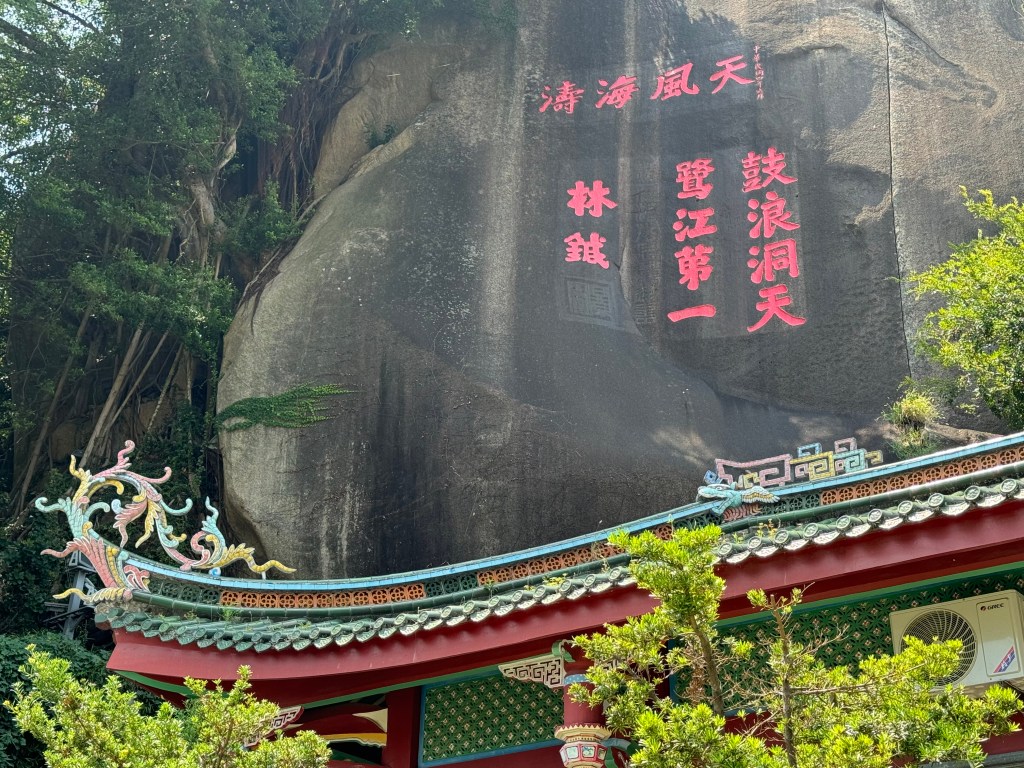
A flight of of wide stone stairs leads upwards to the central courtyard which stands beneath a pair of giant boulders, inscribed with red Chinese characters. The Buddhist chant of OM MANI PADME OM resonates across the temple courtyard, each syllable lingering in the air like a gentle caress. The sonorous tones emanate from somewhere within the temple, spilling out into the open space where they blend with the ambient sounds of rustling leaves, the murmurs of devotees and the tap of shoes on the flagstones. The chant, a powerful invocation of compassion embodied by the bodhisattva Avalokiteshvara, fills the courtyard with a sense of peace and sanctity.

The repeating mantra seems to weave through the incense-infused air, enveloping everything in a cloak of meditative tranquillity. I take a seat on a stone bench at the entrance to the cave that forms the temple’s main focus of worship. I am momentarily overcome by a wave of helplessness and disorientation and burst into tears. The combination of the heat, the difficulty communicating, the distance from home, and my sheer disbelief that I am actually China again, juxtaposed with the calmness and tranquillity of the temple is overwhelming. But it is only a passing phase: I am too hot and too thirsty to cry.
I sit for half an hour beside the temple entrance beneath the beneficent gaze of the three golden Buddhas within, drinking water from a tap set into a mossy grotto and letting my jangling nerves and knotted muscles relax and defray. The calming sound of the mantra, the scent of the joss sticks and the quiet devotions of the people coming to pray at the altar seem to revive and re-energise me. Eventually, feeling more in control of my situation, I set off up the narrow stone stairways that lead upwards to the open-sky Nirvana of Sunlight Rock.
A boulder falling from the sky
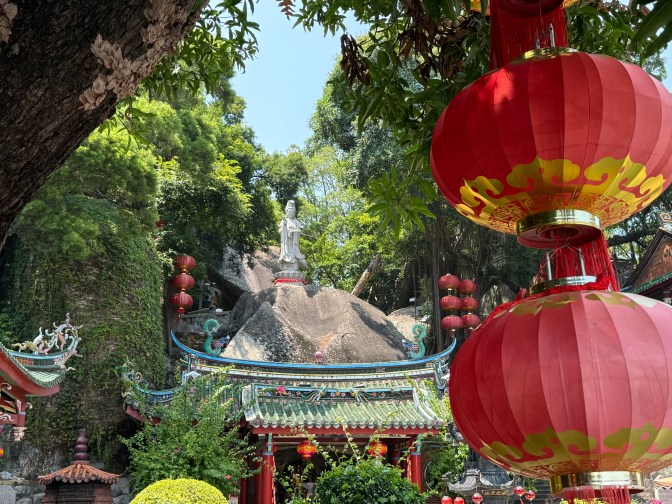
The way lies through a series of gigantic boulders, stacked like a stupa on the north eastern side of Gulangyu. Huge fig trees, like movie-set monsters from a sci-fi fantasy, have entwined their roots deep into the cracks and fissures. Small side paths lead to tiny secluded platforms and landings where contemplative inscriptions are chiselled into the living rock and etched in gold and red. Each one of these hidden places provides a glimpse of a different part of the island, framed by branches and leaves.

The Chinese aesthetic deeply appreciates the art of framing views. For thousands of years they have been perfecting the art of placing buildings and shrines within canopies of leafy bowers or nested between rocky outcrops, meticulously crafting each vista to harmonise architecture and nature. As I climb, pausing frequently to wipe the sweat from my eyes, I catch glimpses of the island’s old European buildings with their ornate balconies, tall windows, and elegant stone facades. The harsh tropical climate has imparted a distinctive patina to the stonework, where the grey hues are softly muted by the marks of time and weather, giving the structures an aura of antiquated grace. Tall palm trees and dense greenery provide a counterpoint to the rigid formality of the buildings, softening their outlines and echoing the strong verticals, angular capitals and forests of Corinthian columns.

Near the summit of the rock I stop for a rest beneath a gigantic granite boulder. Perched atop two equally massive rock pillars to form a spacious cave, open at both ends, the passage funnels a cool breeze through from the western side of the hill. I am dripping with sweat but the breeze helps me to cool down quickly and I swallow the last of my water before I take on the final climb to the top.

A series of steel ladders zig-zags up to the top of the peak. As I step onto summit of Sunlight Rock, I am suddenly at the centre 360-degree panorama that captures Gulangyu in all its diversity. Below me, the European architecture blends seamlessly with the island’s cloak of jungle. The encircling sea laps gently at the shore; the colossal ships glide silently in and out of the bay. Beyond, the expansive cityscape of Xiamen stretches into the distance.
This convergence of nature and history, of sea and city, serves as a metaphor for my own transformative journey. In the elevated solitude of the peak — I am, briefly, alone on the top — I realise that this island haven, with its storied past and dynamic present, is gradually anchoring my spirits. I feel some of the angst and worry begin to slip away, replaced by a certainty that climbing to this extraordinary place is the first step towards finding my footing on my journey in China. From now on, each step I take in this foreign land will bring me closer to something familiar, to a sense of belonging that I have begun to experience here on Gulangyu Island.


 TravelWriterLife