How experiencing a Buddhist ceremony helped me to become more relaxed and centred in the confusing, chaotic world of modern China.
One should enter a temple
with a heart as pure as the lotus
– Buddhist aphorism
Early evening on Huandao South Road. The heat of the day is slowly evaporating as the sun begins its slow descent into the South China Sea. The pavements and walls still radiate ambient warmth. The air is thick with humidity, the kind of enveloping warmth that marks a September evening in Xiamen. On the southern side of the street, the red-roofed towers of Xiamen University stand framed by geometrically precise rows of tall, graceful palm trees. A river cars, almost all of them EVs, slips noiselessly to and fro along the four lanes. On my left, beyond a delicately carved fence of latticed stone, the Nanputuo Buddhist Temple steps up the slope in a cascading series of terraces.

Buddhism arrived in China from India during the Han Dynasty around the 1st century AD. This transformative religion, which stresses enlightenment and the cessation of suffering, has created a syncretic mosaic within Chinese culture, intertwining with the native philosophies of Confucianism and Taoism to form a uniquely Chinese spiritual landscape. Unlike the ethical and familial focus of Confucianism or the mystical naturalism of Taoism, Buddhism brought with it doctrines of karma, rebirth, and the discontinuance of worldly suffering through enlightenment. This melding of ideas, beliefs, observances and practices deeply influenced Chinese thought and culture. Over the ensuing centuries, it morphed into forms that were distinctly Chinese, such as Chan (Zen) Buddhism, which emphasises meditation and intuition over ritual and scripture.
But despite its deep integration into Chinese society, Buddhism faced severe repression during the Cultural Revolution (1966-1976), when religious institutions were dismantled, and religious practices were prohibited as part of Mao Zedong’s campaign to enforce atheism and stamp out old beliefs and practices. However, following the end of the Cultural Revolution, Buddhism experienced a significant resurgence. The liberalisation policies of the late 20th century allowed for a revival of religious practices, and Buddhism once again began to flourish. Temples and monasteries were restored, and Buddhism regained its place as a prominent spiritual and cultural force in China.
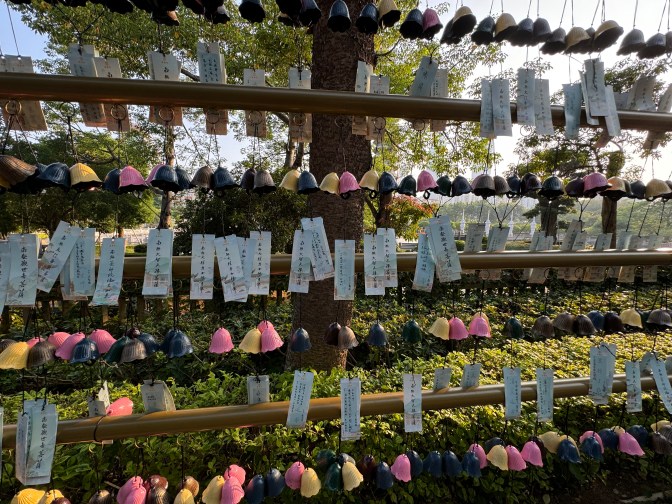
A place of pilgrimage
The Nanputuo Temple in Xiamen is a living representation of this enduring presence and revival. Originally founded in the Tang Dynasty (618-907 AD), the temple was rebuilt in the late Ming (1638-1644 AD) and received its current name during the Qing Dynasty (1644-1912 AD) due to its devotion to Guanyin, the Bodhisattva of Compassion. Nestled at the foot of the Wulao Peaks, the Nanputuo Temple is a place of active religious worship and pilgrimage, as well as being a centre of Buddhist learning and culture. It houses the South Fujian Buddhist Institute, a prestigious institution for the study of Buddhism. The temple has a large permanent community of monks, scholars and laypeople who are deeply engaged in the spiritual and educational pursuits of Buddhism.
The temple’s rich history and its continuing (and growing) role in the contemporary religious environment of Eastern China, encapsulate the remarkable journey of Buddhism through these centuries of upheaval and change. Indeed, the Nanputuo temple is a symbol of the enduring appeal and relevance of Buddhist teachings in helping people to navigate the complexities of modern Chinese life.
Digital devotions
Life moves fast in Chinese cities. And it is digital technology that has become a vital bridge across which people can connect with the ancient wisdom of Buddhism. This union of tradition and innovation allows followers to integrate spiritual practices seamlessly into their daily lives. From virtual meditation sessions that calm the mind amidst chaos, to digital prayer wheels and scriptures, the sacred strands of Buddhist worship and teachings are now accessible with a simple tap on a screen.
Temples and monasteries now often feature QR codes for donations and even virtual reality experiences that simulate pilgrimages, making spiritual practices more accessible for everyone, especially the younger generation. As a digital mantra might declare, these days urban adherents of Buddhism can “Swipe gently to unfold peace, click thoughtfully to cultivate compassion.”
These technologies act as modern vessels for the conveyance of ancient and timeless lessons, proving that even in an era of rapid technological advancement, the serene principles of Buddhism remain a steadfast sanctuary in an often confusing and chaotic world.

Stairway to Heaven
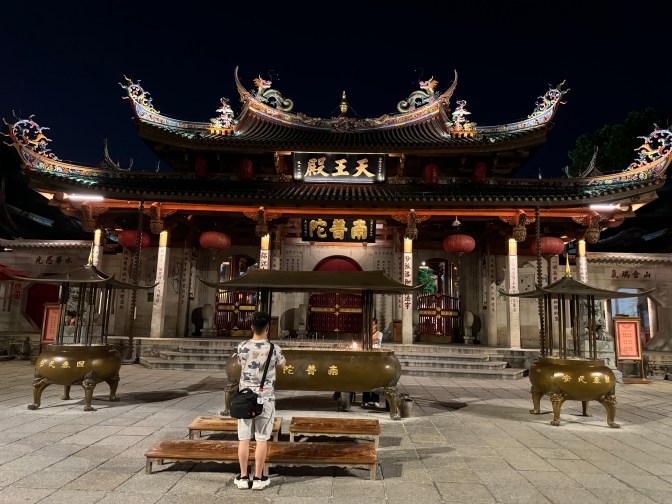
Beyond the temple gate — an angel in the form of a young worshipper had passed me in for free using her entry card — I ascend a path of stone cobbles to the entrance of the Tianwang Hall. Inside, four Devarajas, ranged on each side of the hall, glower down at me. The fierce stares of these god-kings, whose role is the maintenance of cosmic order on Earth, is mollified by the beneficent gaze of the hall’s centrepiece, a smiling Maitreya Buddha.
The future enlightened
The Maitreya Buddha, often referred to as the “Future Buddha,” is a significant figure in Buddhist eschatology. He is prophesied to appear on Earth, achieve complete enlightenment, and teach the lessons of pure dharma. Maitreya is regarded as the successor to the current Buddha, Siddhartha Gautama, and his coming is expected to occur in a future world era when the teachings of the Gautama Buddha have been forgotten.
The belief in Maitreya reflects the Buddhist cycle of rebirth and renewal, promising a time of peace and wisdom. It is said that Maitreya will be born in the human world and will achieve enlightenment quickly, teaching a compassionate and true dharma that will reintroduce the ideals of Buddhism to a world that has lost touch with its spiritual roots. The figure of Maitreya embodies hope for the future — a powerful symbol in modern China — and the ultimate potential for enlightenment that lies within all beings.
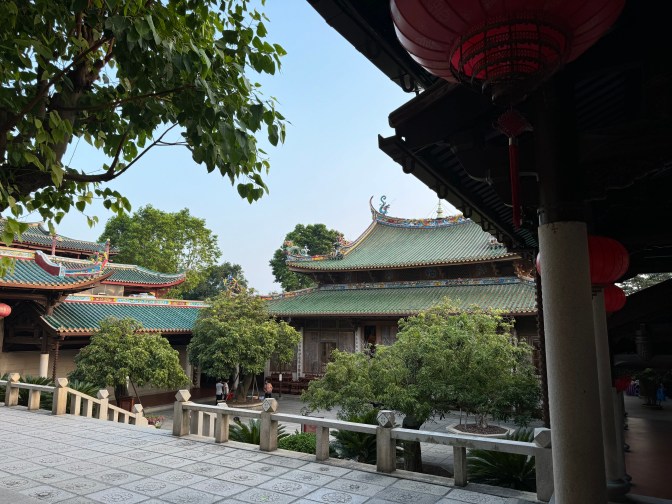
The Daxiong Hall
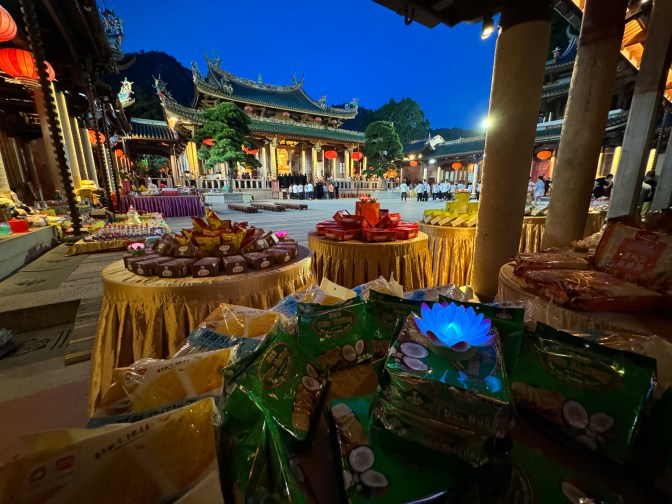
Stepping from the Tianwang Hall, I walk out into a large tiled square crowded with people. On three sides of the square, tables laden with offerings — food, water, fruit, paper money, flowers, candles, water — are set. For this is the Buddha’s birthday, and a great ceremony is about to begin. Ladies in white tee-shirts fuss over the tables, arranging the offerings in perfectly geometric shapes.
On the far side of the square, in the vast wooden sanctuary of the Daxiong Hall, a throng of monks in brown robes and nuns in charcoal robes are gathered. The sunlit courtyard is heavy with portent and anticipation. But, as yet, it seems that nothing is happening, so I ascend the thirty stone steps beside the hall to shrine of Thousand-Hand Kwan-yin.
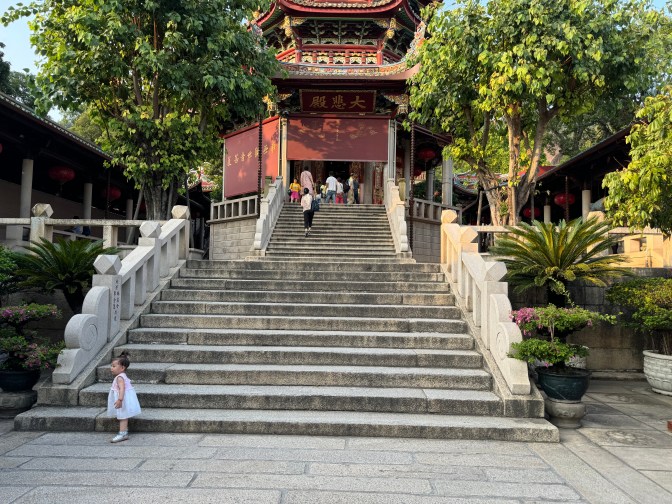
The thousand hands
Thousand-Hand Guanyin, also known as the Thousand-Armed Avalokiteshvara, is a depiction of the bodhisattva Avalokiteshvara (Guanyin in Chinese), who embodies the compassion of all Buddhas. This form is especially revered in Mahayana Buddhism for its representation of Guanyin’s ability to provide assistance to all who need it. The thousand arms symbolise the bodhisattva’s immense capacity to reach out and respond to the suffering of sentient beings in countless ways simultaneously.
Each hand often holds a different symbolic tool or weapon, amplifying Guanyin’s powers to intervene in various circumstances. Sometimes, the hands are depicted with an eye in each palm, symbolising the bodhisattva’s omnipresent awareness of the needs of beings and the vastness of her compassion. This form (once considered to be male but nowadays represented as female) is highly venerated for its profound symbolism of mercy, multiple capabilities, and omnipresence.
The Thousand-Hand Guanyin is not just a figure of worship but also a source of inspiration and reassurance for devotees, emphasising the boundless compassion and readiness of the bodhisattva to assist all beings at any time. The imagery is a powerful reminder of the virtues of compassion and vigilance in the practice of Mahayana Buddhism.
The heights of Wulao
Behind the Thousand-Hand shrine, a labyrinth of paths and stairways lead upwards onto the lower slopes of Wulao. I can see the summit of the mountain, framed by arcs of foliage and indistinct in the hazy, shimmering air. I momentarily contemplate ascending to the lofty heights of Wulao. But in this torrid heat, I feel that my spiritual wellbeing — not to mention my fragile physical state of dehydration — might be better served if I wander back down into the temple complex. Besides, each path I choose ends in a pipe-and-wire barrier or a coil of razor wire. So deciding that the Buddhist’s observance of patience and acceptance might be more appropriate, I turn and walk back down to the temple’s main courtyard.

The Eaves of Daxiong
The sun is setting behind the Thousand-Hand Guanyin temple as I descend, its orange orb framed by the complex ridge lines and flying eaves of the temple. The eaves of Chinese temples represent a pinnacle of architectural sophistication and artistic expression, encapsulating a blend of functionality and symbolic significance. Temple eaves are not merely architectural elements: they are imbued with cultural and religious meanings that often reflects the temple’s spiritual purpose and the broader cosmological views of Chinese culture.
Typically, temple eaves are characterised by their upward-curving tips, known as “flying eaves.” This distinctive feature serves to project the roof outwards, protecting the temple’s wooden structure from rainwater and enhancing its visual grandeur. The curvature also symbolically wards off evil spirits, which are traditionally believed to travel in straight lines.
A complexity of timber
The structure of these eaves is complex, involving multiple layers of beams and brackets, collectively known as dougong. This bracketing system is a hallmark of traditional Chinese architecture, consisting of interlocking wooden couplings that multiply the eave’s width and support the heavy, tiled roof above. Each set of dougong increases in complexity as it ascends, adding ornamental value while distributing the roof’s weight effectively.
The underside of these eaves is often richly decorated with intricate carvings and brightly-coloured paintings. These decorations frequently depict historical legends and auspicious symbols, along with Daoist or Buddhist motifs, serving both to educate and inspire awe. The choice of colours and figures are deeply symbolic. For instance, dragons are used to symbolise power and authority, while phoenixes denote rebirth and immortality.
The eaves of Chinese temples are much more than structural necessities. They are a canvas for expression and an essential component of the temple’s architectural integrity and spiritual efficacy. Their elaborate design not only enhances the temple’s aesthetic appeal but also serves as a protective, weather-tight embrace for the sacred space within.

A forest of pillars
Along the western side of the Daxiong Hall, I walk down a narrow, stepped verandah supported by pillars of lacquered timber. It is like walking through a stand of tall, perfectly aligned trees. The polished and lacquered surface of each pillar reflects the delicacy and precision of a master carpenter’s touch. They hold aloft the intricately layered roof with an effortless grace that belies their strength, embodying the Buddhist ethos of enduring stability paired with ethereal lightness.
The air feels charged with a serene energy, as if these wooden sentinels are channelling the essence of the Dharma — its teachings, laws and protection — and turning the temporal architecture into a silent sermon on the beauty of balance and harmony.

At the bottom end of the verandah, I join a throng of worshippers waiting for the ceremony to begin. One of the attendants offers me a chair to sit on. There are more tables heaped with offerings in the recesses of the vestibule on the western corner of the courtyard. The air is heavy with anticipation and there is a palpable sense of reverence in the gathered crowd. Up in the temple, the rows of monks and nuns fall silent as the moment of commencement approaches.
A Prayer to the Buddha
A low, sonorous chart begins from deep within the temple. Layers of other voices join to form a growing volume of sound. The many voices — an ultravox of devotion — are amplified and relayed by speakers ranged around the courtyard. Their sound, at once melodic and discordant, grows to a crescendo then subsides to a low murmur that slowly grows again in volume. This cycle of reverent chanting continues for ten minutes, accompanied by clanging bells and the tinkle of cymbals. The assembled crowd stands silent, their hands clasped in prayer.
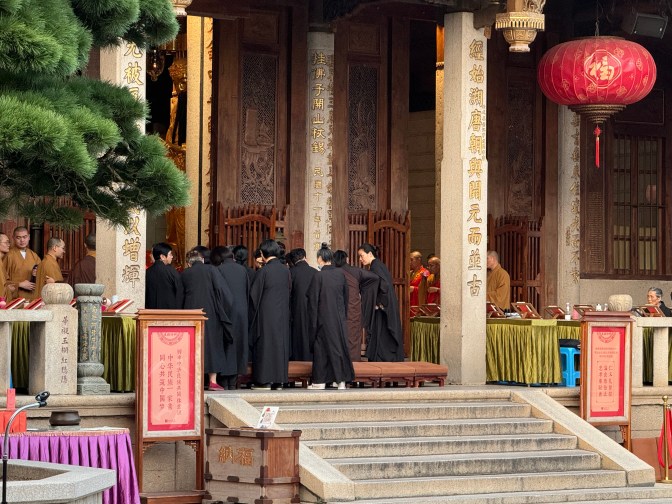
The harmony of the sangha
From my position in the corner of the courtyard I have a perfect view of the proceedings. As the daylight fades to a blue twilight, the red lanterns begin to glow and bright vapour lights illuminate the scene. From the far side of the courtyard, another phalanx of monks and nuns begin to chant, their voices harmonising with those of the sangha (clergy and attendants) inside the temple.
The chanting climbs to another crescendo then abruptly ends. Silence descends on the courtyard. The assembled sangha stand motionless as a priest reads aloud from a sacred text. Incense smoke drifts upward into the indigo sky. Two ancient cypress trees frame the temple’s entrance space. The verandah is supported by slender stone pillars inscribed in golden characters that speak of tranquillity and enlightenment, anchoring the temple in the temporal realm.
The massed sangha now begin a perambulation of the courtyard’s four corners. At each point, they stand in their serried rows while solemn incantations are read by the senior monks. I feel intimately connected to these arcane rites, even though I have no idea about what is being intoned or even what is going on. But the serenity of the proceedings makes me feel a deep connection to this place. I feel my weariness and confusion begin to dissolve as the wisdom of the Dhama seeps into me. It is a relaxing and enlightening feeling.

A prayer to the Buddha
Roy Prime and his Chinese wife Sǔn are standing on the edge of the courtyard as the ceremony comes to a close. Roy, originally from Ireland, is a project engineer. Sǔn is an electrician from Suzhou. I chat to them as we wait in the line to step forward and offer an incantation to the Buddha. Sǔn, a devout Buddhist, is excited for the opportunity to pay homage to the deities of the temple.
Roy, although not a Buddhist, knows how much importance his wife places on this event. For my part, I had been unsure about whether or not to participate. But one of the temple attendants, a charming, middle-aged woman wearing a white tee shirt, had led me gently forward to join the line. And I have always found that any chance to experience a religious ceremony — whether it is Buddhist, Hindu, Christian, Muslim, or any other faith — is always rewarding, even to an unbeliever like me.
As we approach the altar in front of the temple, Roy explains the prostrations that I will be expected to perform. I should kneel with my palms flat and touch my forehead to the ground. I will then turn my palms upwards and touch my forehead to the ground once again. After that, I will be given a small stick of lit incense which is to be clasped between the palms and pressed to my forehead while I bow to the Buddha.
When my turn comes, I feel a little awkward and self-conscious performing these genuflections. But the atmosphere is so reverent and tranquil that I quickly become enveloped in the solemnity of the moment. The rhythmic chants and the sweet scent of incense fill the air, easing my initial discomfort and allowing me to feel a part of this ancient and sacred ritual.
Frome tranquillity into chaos
As I leave the Nanputuo Temple, and begin my journey back to the temporal world in a DiDi — the Chinese version of Uber — I feel a quiet sense of balance settle over me. In the midst of the bustling, chaotic, often bewildering world of modern China that I have immersed myself in, this experience has given me a glimpse of a deeper harmony lying just beneath the surface.
The blend of ancient tradition and present-day Chinese life now feels more accessible, more understandable. I feel a renewed sense of connection to the culture unfolding around me: a gift that I can take away from these celebrations of the Buddha’s birthday.


 TravelWriterLife