In Quanzhou I wander through temples veiled in incense, cross an ancient bridge, and immerse myself in a chaotic dreamworld of history and culture.
She brings me tea and oranges
that come all the way from China…
– Leonard Cohen, Suzanne
Morning in Quanzhou. In the park along the north bank of the Jinjiang River, a family is busy harvesting dragon eyes from a laden tree. The men are high in the spreading branches with long poles, knocking the tight clusters of fruit to the ground. Their wives are busy collecting the fallen bunches, stripping the leaves away and piling them into baskets. Seeing me watching them — a curious-looking foreigner, something that is at least novel and, perhaps, unheard of — one of the women brings me over a bunch. The fruit are the size of small plums, with a hard, brown rind that has the texture of sandpaper. Inside, translucent flesh surrounds a large, black seed. They do, indeed, look like the eyes of a dragon.
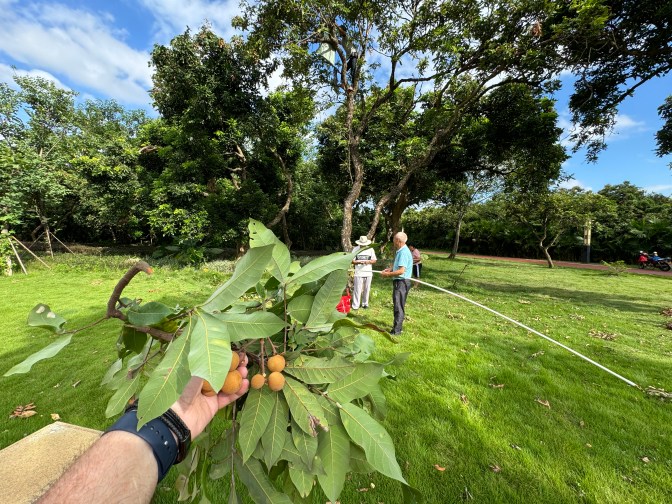
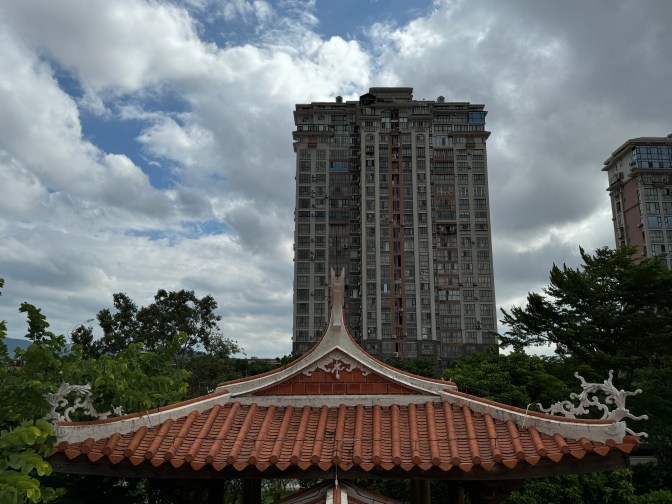
I find a seat overlooking the river and sit eating the longans. The fruit is juicy and slightly sweet: a curious taste akin to dates. Dragonflies hover and flit above the rushes growing along the riverbank. Groups of women, cheerful and chatting beneath colourful umbrellas, walk along the path. The river is low and sluggish, a grey ribbon drifting slowly through the city to fall, eventually into the South China Sea. On the far bank, a collection of Lego-block apartment buildings, brown and gray against a backdrop of low, rolling hills, stand in stoic clusters overlooking the water.
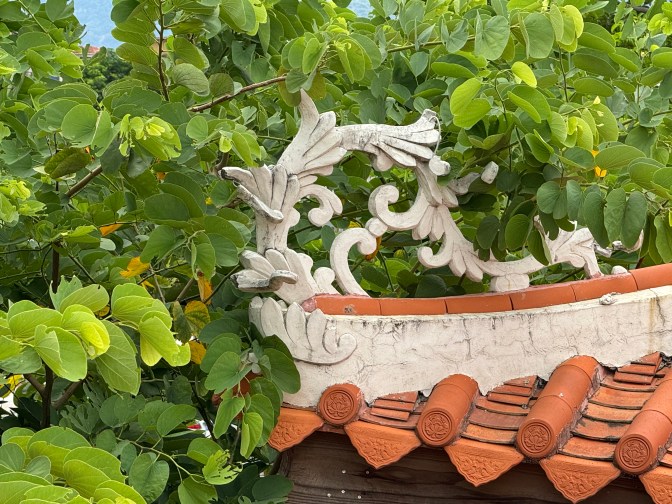
At this hour (it is only 7:30 AM), the park is almost deserted. I stroll along its tidy concrete paths until I arrive at an exit guarded by a traditional two-story pavilion, elevated on a robust stone platform that forms part of the old city wall. Its architecture reflects the elegance of classical Chinese design, with tiered roofs and upturned eaves curving gracefully towards the sky, crowned by ornamental ridge tiles and finials. The pavilion’s wooden framework is a study in symmetry, with intricately carved brackets and beams supporting the overhanging roofs. Its balconies, enclosed by delicately latticed railings, once housed officials and soldiers who collected tolls and watched over the city in its heyday as the eastern terminus of the Maritime Silk Route.

Technicolour history
As I stand waiting for the pedestrian crossing light to turn green, it occurs to me that there is something about Chinese history that lives in technicolour. It is vibrant and dynamic, bursting with hues that seem to leap from ancient scrolls and glow on the walls of temples and pagodas. Unlike the monochromatic and sepia tones often associated with European history — defined by castles shrouded in mist and faded portraits of stoic figures — China’s past feels alive with the vivid reds of imperial robes, the golden glow of temple lanterns, and the rich greens of terraced rice fields. It’s a history that doesn’t merely recount events but paints them on a grand canvas, where every dynasty, every rebellion, and every cultural flourish adds another brilliant stroke to an ever-evolving masterpiece.
I step through the archway beneath the pavilion and out into the bustling streets beyond. I have already decided that I will find my way on foot to the nearby Kaiyuan Temple. After all, I have come to China to lose myself in its back streets and hidden rhythms. But I need something more than the multi-hued echoes of history to guide me; modern navigation is going to be essential in the maze of ancient alleys and thoroughfares that lie across the street. Luckily, like Marco Polo and Ibn Battuta before me, I have the latest technology to help me plot a course through this unfamiliar urban terrain.
My digital Dragoman
A few days before, hunkered down in my 26th floor hotel room in Xiamen, I had downloaded and activated my Chinese SIM card along with a VPN app that enabled me to use Google Maps and Instagram. All things Google and Zuckerberg are banned in China, because apparently, China doesn’t trust Silicon Valley’s data-harvesting prowess. Snapchat, for some reason, still works via my new Chinese connection, whereas TikTok (supposedly a nefarious Chinese trojan designed to gather the data of its users) is completely inoperable.
But despite the fact that my FYP isn’t available (呜呜呜 “wū wū wū – ironic sobbing), my digital Dragoman in the form of Google Maps, fully operable via the VPN’s link to a server in some distant foreign country, is ready and waiting to guide me through the back streets of the Licheng District to the Kaiyuan Temple.
The Kaiyuan Temple
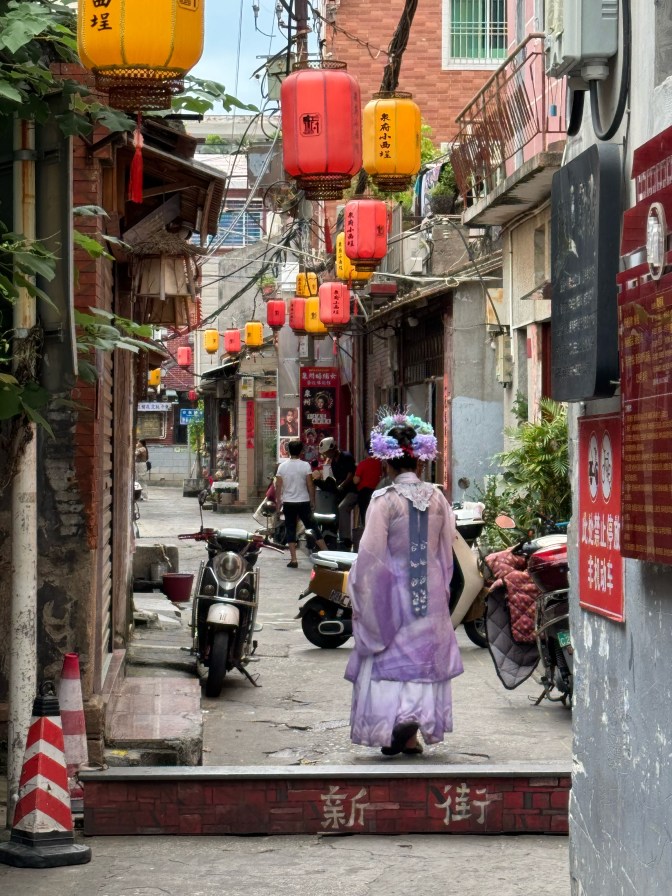
On the far side of Jiangbin North Road, I step into a different world: a world of tiny alleys, poles slung with a spiderweb tracery of wires, courtyards, cats, the hum of scooters, and the occasional clatter of bowls from small kitchens tucked behind faded doors. Red lanterns hang outside shopfronts, some brightly-painted, others dulled by weathering and age. Drying laundry flutters in the breeze above. The air smells faintly of cooking oil and flowers. I can hear distant snippets of conversation and the occasional bark of a dog. Every corner reveals a mix of the old and new: traditional brick facades beside colourful signs, an electric moped parked beside an antique doorway.
My digital Dragoman directs me left and right down increasingly narrow lanes, pungent with the aromas of life. I feel at once like an intruder in the locals’ private world but at the same time, virtually invisible. No one takes the least bit of notice of me. I am just another face in the crowd: a fleeting passerby in a labyrinth that has seen countless strangers come and go. The rhythm of daily life continues undisturbed around me — children laughing, a vendor calling out prices, the clink of cups in a teahouse — all flowing by as if I were never there.
Drums on Xiejie Liu
The narrow lane that I am following suddenly opens onto a wide street, like a stream debouching into a river valley. As I walk up the street — it is called Xiejie Liu — I hear the beating of drums and the discordant blare of suona (Chinese double-reed trumpets) and sheng (polyphonic bamboo mouth organs) ahead of me. A great parade is making its way up the street towards the Kaiyuan Temple.
I join the crowd of onlookers following the parade. The traffic is motionless but nobody seems to mind. It seems that even in modern, frenetic, febrile China, where business and commerce hold sway over almost everything, the solemnity and tradition of a procession of monks and their attendants takes precedence. At a crossroads, the procession turns left up a street lined with pagoda trees. I wait in the crowd until the crossing light appears (urban pedestrians and drivers in China are assiduous followers of road rules) then walk diagonally across to a crimson gateway set into a long stone wall surmounted by ornamental tiles and carved lintels. In the vast entrance hall, hoisted on tall pillars of smooth, lacquered wood, incense swirls and painted characters adorn the dim walls. I set through an archway and into the serene realm of the Kaiyuan Temple.

The ripples of faith
The Kaiyuan Temple was originally constructed in 686 AD during the Tang Dynasty (618-907) by a wealthy local benefactor named Huang Shougong. Initially known as the Lotus Temple, it was renamed Kaiyuan Si (开元寺) in 738 AD, during the 26th year of the Kaiyuan reign, a period marked by prosperity and cultural flourishing. Over the centuries, the temple has undergone numerous reconstructions, with the current structures dating back to the Ming (1368–1644) and Qing (1644–1911) dynasties.
I cross the wide, tree-shaded courtyard and climb a stone staircase to the Mahavira Hall. Inside, the Five Tathāgathas — Akshobhya, Amoghasiddhi, Vairocana, Amitābha, and Ratnasambhava — of Buddhism are rendered in gilded copper. Although the statues are huge and imposing — indeed, there is a very slight malevolence in their monumental grandeur — they exude a strange, serene majesty, which seems to embody the spiritual essence of the temple. I walk slow clockwise around the interior of the hall, touching the prayer wheels and smooth, worship-worn surfaces.
I can feel the weight and depth of people’s belief flowing around and through me even though I do not believe myself. It is a curious feeling to be an observer and not a participant in a reverent space such as this: carried along by the silent prayers and whispered hopes of countless others who have stood here before me. Centuries of faith have etched themselves into every beam, pillar and stone of the hall and the energy of these devotions seem to still seem to ripple through the air now.

The great pagoda
Behind the great hall, I follow a path through a geometrically exact garden to the Zhenguo Pagoda. Initially constructed as a five-story wooden pagoda in 865 AD, it was later rebuilt in stone in 1238 AD during the Song Dynasty. The limestone façade is rough and weathered, its texture pitted with the history of centuries. Dark streaks and pale patches mark where rain, wind, and time have left their imprint, softening the sharpness of the original carvings.
Each facet of the octagonal tiers has an arched doorway, flanked on each side by chubby figures carved in stone. Their robes flow in carefully etched folds, and their stances exude authority and calm. They gaze out from the pagoda with timeless and watchful expressions, as if they are guarding not just the pagoda but the stories it holds. The figures, plucked from Chinese history and mythology, seem alive in the shifting light and shade, their features alternately fading into shadow and emerging into sharper relief as the clouds pass overhead.
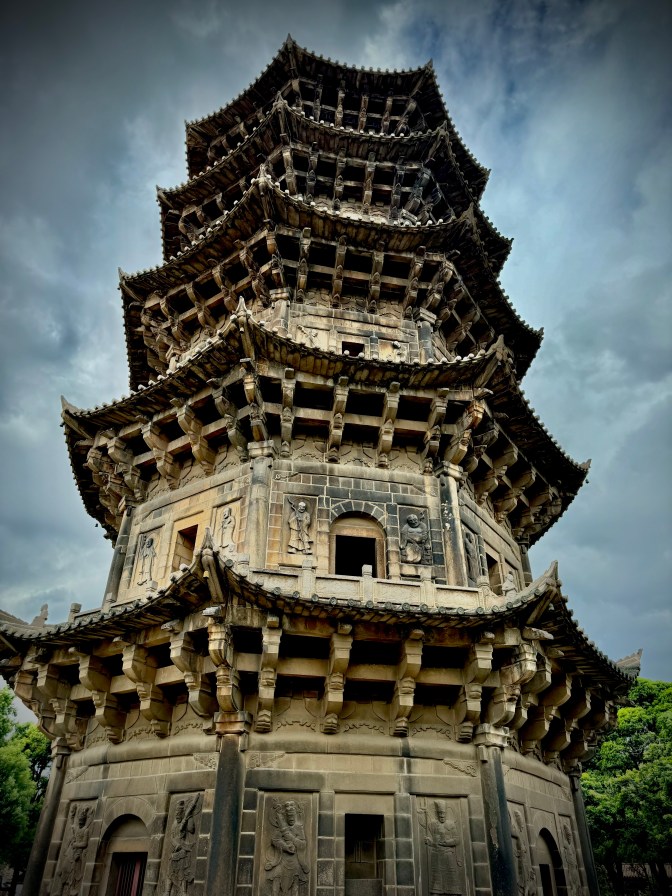
The pagoda’s tiers rise in a harmonious rhythm as if its builders were working to some celestial blueprint. Each tier is capped by gracefully upturned eaves with edges curled up like the tips of calligraphy strokes, precise and elegant. Their surfaces are adorned with intricate tiles that glint faintly in the changing light. The interlocking stone beams and brackets beneath the eaves are dense with detail and seem to defy gravity thanks to the ingenuity of the craftsmen who carved and assembled them.
I follow the pathways and lanes of the temple, past grassy verges where beautifully made-up women clad in traditional dresses of crimson, yellow or white pose for photographs. The temple is crowded now: alive with incantations, lustrations, chatter and the ubiquitous beep and click of digital shutters. I make my way back across the main courtyard to the gatehouse and step back out into the streets of Quanzhou.
The Guandi Temple
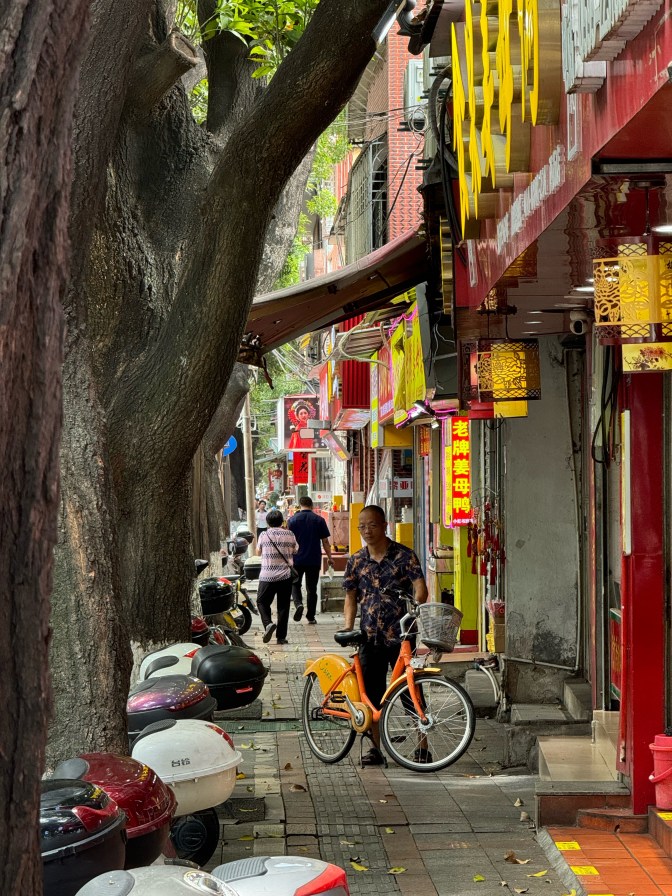
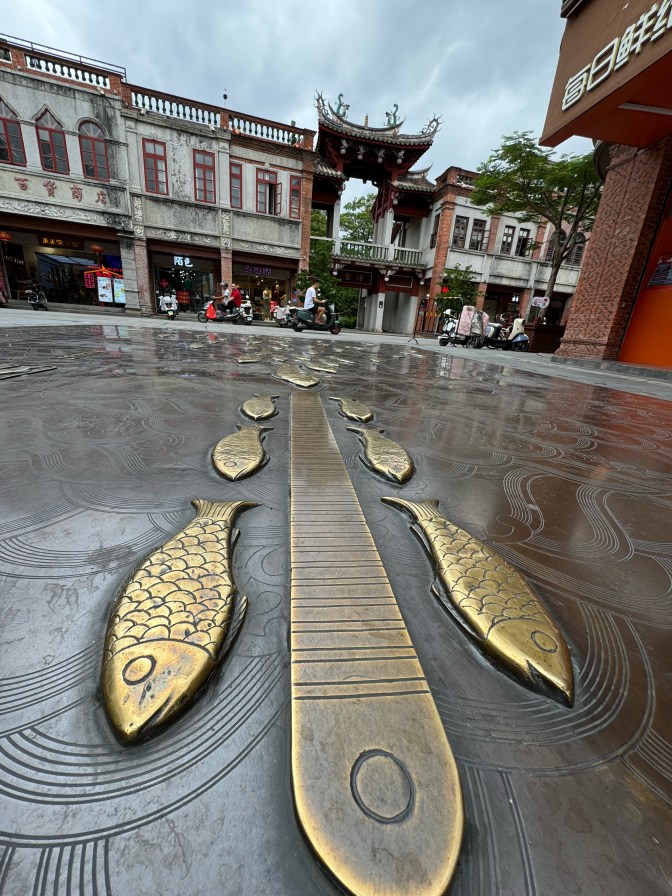
The colonnaded shops along Xiaocai Lane lead me back down towards Tumen Street. I am in no hurry and I dawdle along, looking into the shops and saying “Zaoshanghao” (Good Morning) to the locals. At a small square, a school of polished bronze fish, swimming in a bronze sea etched with swirls and eddies are set into the footpath. Further on, forty-two yellow lanterns hang on a wall of chevroned red brick. My daughter video calls me and we chat as I walk. Before I know it, I emerge onto Tumen Street opposite the Guandi Temple.
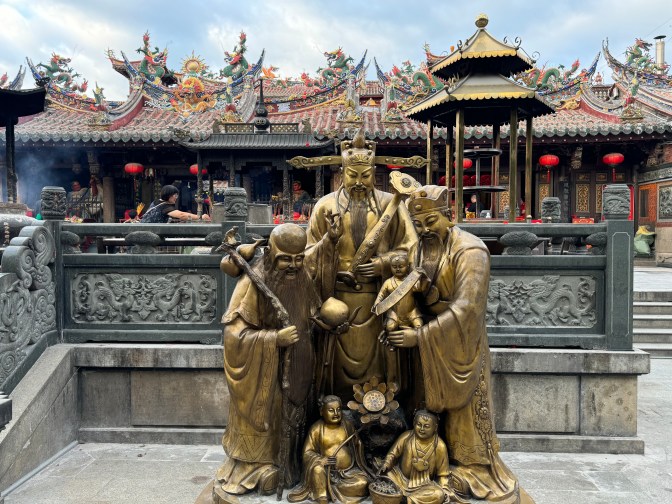
The temple courtyard is as chaotic as it was yesterday when I passed through it on the way to the Qingjing Mosque. The air is threaded with trails of sandalwood and incense smoke, heady and fragrant. It fills my lungs and wreaths the plane trees growing along the edge of the street. Before me, a cast iron incense burner the size of a small clawfoot bath, bristles with hundreds of red and gold joss sticks planted in a bed of grey ash. Thin tendrils of smoke curl upward, twisting and dissipating into the humid air, carrying whispered prayers to the heavens.
People move purposefully around me, some bowing their heads in reverence, others chatting and snapping photos. A woman in a vivid pink top carefully lights a fresh bundle of incense, her face calm but intent as she entrusts her thoughts to the sacred flames. Nearby, a man with a straw hat dangles it casually from his hand as he observes the scene with the same quiet curiosity as mine.

Red lanterns sway gently under the temple’s ornate roof, their bright colours glowing faintly through the haze. The carved stone pillars supporting the incense burner are dark with years of soot, their intricate dragon patterns nearly obscured. I hear the rhythmic clanging of a small brass bell somewhere deeper in the temple, punctuating the murmur of voices and adding a rhythmic, hypnotic note to the moment.
I step closer to the incense burner and feel the warmth emanating from its smouldering core. The carpet of ash surrounding it shifts slightly underfoot as I move, a soft reminder of the countless feet that have come here before mine. The sacred and the everyday collide in this space: prayers rising alongside casual conversations, reverence mixed with the mundane. It’s chaotic yet harmonious, a perfect reflection of life itself.
The inner sanctum
Inside the main altar chamber, the air is thick with incense and the murmured prayers of devoted worshippers. Kneeling on red cushions, men and women bow their heads in reverence before the an altar of crimson velvet and shining brass. Although photography is not permitted inside, a few people are holding up their phones to capture the scene. Not wanting to offend or transgress, I surreptitiously capture a short video to help me remember the intricate details and subdued energy of the space later on.
At an altar of polished teak in a side room, a man casts wooden prayer tablets onto the cobbled floor. Worshippers use these crescent-shaped blocks, known as moon blocks or jiaobei (筊杯), as a form of divination to seek guidance from the gods. Holding the blocks in pairs, they silently pose a question or seek advice before casting them onto the temple floor. The way the blocks land reveals the gods’ response. One flat side up and one curved side up signals affirmation, both curved sides up suggests divine laughter or ambiguity, and both flat sides up conveys disapproval. The act embodies the yin-yang philosophy of balance and duality, connecting worshippers to the divine and offering a sense of clarity, reassurance, or reflection.

These humble rituals reflect the profound spirituality and enduring traditions of Chinese temple life. The man has a cell phone in the back pocket of his jeans, Adidas trainers on his feet, and an NYC cap on his head. Yet he bows deeply, his hands clasped in prayer, as if the mantle of both ancient and modern worlds rests harmoniously on his shoulders. Around him, others light incense, leave offerings, and murmur prayers: actions that feel timeless, unchanged for centuries, even as the rhythms of modern life hum quietly in the background.
This blending of the old and the new is seamless here. The smartphone in the man’s pocket is as much a part of his daily life as his reverence for the temple gods. In China, I am coming to realise, tradition and modernity coexist, not in opposition, but in a fluid, unbroken dance. These rituals serve as an anchor, grounding people in something eternal amidst the dizzying pace of modernity.
I walk back out into the temple courtyard. The aroma of incense still infuses the air as I step through the gate and back onto the bustling streets of Quanzhou. The frenetic motion of the city whirls around me: electric scooters zipping past and vendors calling out their wares. Pulling out my phone, I open the DiDi app and book a ride to the Luoyang Bridge, feeling a curious sense of continuity between the ancient temple I have just left and the modern tools guiding my journey forward.
The Luoyang Bridge
By the time my Didi deposits me on the Southern bank of the Luoyang River it is late afternoon The sun is fierce; the air torrid and still. The tide has withdrawn from the river, leaving the roots of the mangroves along the edge of the river fully exposed, jutting from the grey mud like millions of upturned fangs. The trees themselves sit motionless in the hot air and shimmering light, awaiting the turn of the tide and the return of the brackish water that sustains them.
The water world of Mangrovia
I love mangroves. Their mysterious realm — half water, half air — is like another country: shadowed, labyrinthine, and primeval. The water world of Mangrovia. The empty channels of mud that weave between the tangled groves are like veins and arteries carrying the diurnal pulse of the river. The inscrutable canopies conceal all manner of beauty and horror: eyes, teeth, coiled serpents, darting crabs, and silent shadows. Walking along the riverbank, I imagine centuries of fishermen threading their boats through these channels and backwaters, their oars dipping silently as if paying respects to the spirits of Mangrovia.

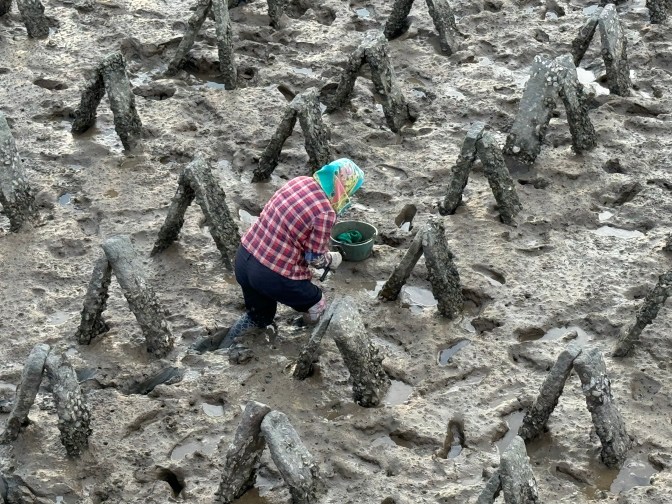
I stop at a ramshackle stall and buy a sunhat to shield my head from the sun. It isn’t exactly stylish but it does the trick. The southern side of the bridge connects the riverbank to a small island where a stone temple with a roof of terracotta tiles stands guard beneath a gnarled cypress. A group of businesspeople are gathered beside the temple for a photo op; a man sings a tremulous ballad while his wife videos him. There are small fishing punts tethered to a crooked wooden jetty surrounded by mudbanks. Clusters of oysters cling to low stone piles protruding from the mire.

The oyster-bed bridge
The Luoyang Bridge is a masterpiece of ancient Chinese engineering and one of the oldest stone beam bridges in China. Construction of the bridge began in 1053 during the Northern Song Dynasty under the direction of the prefect Cai Xiang, a renowned scholar, calligrapher, and engineer. At the time, the river presented significant challenges with its tidal flows and silty conditions, which made conventional bridge-building techniques impractical. To overcome these difficulties, Cai Xiang introduced oyster cultivation to the river in order to strengthen the underwater foundations. The oysters helped to bind the substrate of mud and stones together, creating a stable base that could withstand the river’s currents.
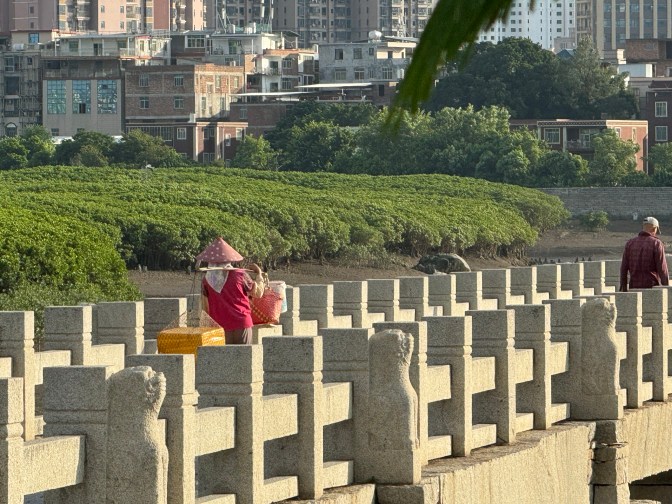
The bridge is just over 731 meters in length and is supported by 46 piers, each constructed from massive granite slabs. The piers are pointed at each end — resembling ship prows — to effectively break the flow of water and reduce the erosional impact of the currents. This design element design exemplifies the advanced hydrological understanding possessed by the Song Dynasty engineers. The bridge deck itself is constructed from long beams of carved stone, rough and uneven but fitted perfectly together.
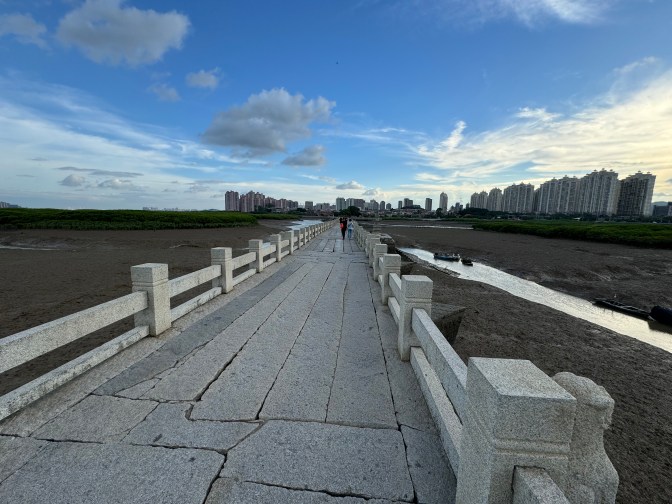
The scene at Luoyang Bridge
I walk slowly across the bridge, mingling with the locals and tourists out for a stroll. Down in the riverbed, a pageant of small everyday scenes are playing out. Dragonflies flit in the hot air. The small boats are at rest on the mud or floating motionless on the still channels of remaining water. A few fisherpeople are preparing for the evening’s excursion downriver to the bay. A women sits beneath a pink and polka dot conical hat mending a diaphanous cluster of nets. Her friend, also under a conical hat, sits on the gunwale of the punt chatting.
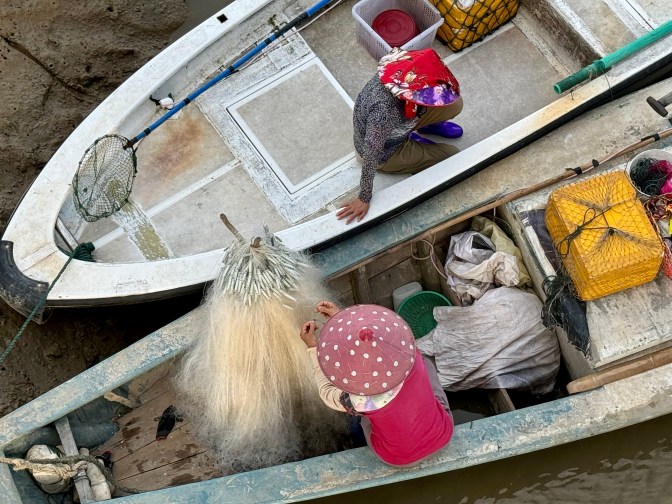
A DJ has a massive speaker mounted on his boat. It sits, aground in the mud, waiting for the incoming tide. He tests few beats which thud out over the mudflats. A Chinese flag, bright red against the viridian backdrop of the mangroves, flaps idly on a timber pole.

On the northern bank of the river, groups of old men have gathered for their evening chat and games of Mahjong. A few families eat ice creams as the sun sinks towards the mangrove horizon. I walk up the street that leads uphill from the bridge. A carpenter is building a deck at the front of a shop. I pause to watch him deftly measuring and cutting slats of smooth pine that might easily been grown in a New Zealand forest.
The sun sets as it always does here in Eastern China. I walk back across the bridge. A few of the fishing boats are making their way languidly downstream on the last of the ebb. It is still hot but with the disappearing sun, the air begins to cool. My phone’s battery is getting low. I will need it to find my way back.
Tea and oranges
Back on the southern side of the bridge, I choose a shop that sells coffee and tea. While my phone charges I drink delicious iced tea flavoured with lime, lemon, and oranges. It puts me in mind of the Leonard Cohen song, Suzanne:
“She brings me tea and oranges that come all the way from China…”
The woman who owns the shop is beautiful. She has a lovely smile and friendly eyes. Her son is eating a pizza while his mother runs her shop. They laugh at a joke together. He sings a song he learned at school today. It is a very relaxing place to sit.
The breeze moves the hanging paper lights and signs in the trees. I order another fruit tea as it grows dark. I feel as though I could sit here forever.
Smoke, shadows and dragon’s eyes
Later, I wander once again through the crowds of worshippers thronging the courtyard outside the Guandi Temple. The rhythmic beating of drums, the clatter of the jiaobei and the clang of cymbals from inside the temple create a hypnotic cadence, blending with the murmur of prayers and the occasional burst of laughter from the crowd.
Lanterns sway gently in the evening breeze, their warm light casting fleeting, flickering patterns across the flagstones. Shadows dance in the trees along Tumen Street. The smoke from the temple weaves upwards into the night, and the tips of the burning joss sticks glow like a thousand dragon eyes.

 TravelWriterLife