By train from Quanzhou to Nanjing.
Travel is a vanishing act, a solitary trip down a pinched line of geography to oblivion.
– Paul Theroux
I almost missed my train to Nanjing. Leaving the Vienna Hotel on Quanxiu Liu, I had taken a Didi to the station in pouring rain. Outside the streaming window, Quanzhou lay grey and dripping, the foliage limp and dangling, the water of the Jinjiang River dimpled and pockmarked by the thrumming drops. At the station, I showed my passport and my Alipay reservation — everything is booked digitally in modern China — to a friendly but professionally stern woman in a crisp, blue security guard’s uniform. She checked the computer screen in front of her, handed my passport back and reached for her phone. With her translation app she wrote: “you must go to Quanzhou East Station.”
It was eight o’clock in the morning; my train to Nanjing — the Q3487 Express — left at nine o’clock. And it would be precisely nine o’clock. Chinese trains run with a precision that puts the cold, clinical, time-obsessed Swiss to shame. There was no possibility that the train would be held up while a lost, confused and stupid foreigner made his way to the correct station. But there was time for me to reach Quanzhou East…just. I ordered my second Didi of the morning and set off across the city as the rain cleared and a watery sun burst out.

Tracks Through Time
China’s railway history began in the late 19th century during the Qing Dynasty. The Shanghai-Wusong Railway, opened in 1876, was the country’s first railway line. Built by British engineers, this 14.5-kilometre line faced local resistance and was eventually dismantled by the Qing government, which viewed it as a foreign imposition.
The Kaiping Tramway, constructed in 1881 in Hebei Province, marked the first successful railway project with Chinese involvement. Initially designed to transport coal, it expanded into the Imperial Railways of North China, setting the stage for future rail development. And by the early 20th century, railways had become critical to China’s economy and military strategy.
A key milestone was the Beijing-Zhangjiakou Railway, completed in 1909 under the leadership of Chinese engineer Zhan Tianyou. Zhan is widely regarded as “Father of China’s Railways.” He tackled significant geographical challenges, including the rugged terrain of the Badaling Great Wall section, using innovative techniques such as zigzag switchbacks to navigate steep gradients.
The Iron Thread
The mid-20th century saw substantial growth in China’s railway network, despite interruptions from war and political instability. During the Republic of China era (1912–1949), railways were central to national development, though progress was hindered by the Second Sino-Japanese War (1937–1945) and the Chinese Civil War.
After the establishment of the People’s Republic of China in 1949, the government prioritised railway construction to unify the country and drive economic growth. The Chengdu-Chongqing Railway, completed in 1952, was the first major project of this era. Over the following decades, the network expanded rapidly, linking remote regions and improving the transportation of goods and people.
One of the most ambitious projects was the Qinghai-Tibet Railway, which began construction in the 1950s but wasn’t fully operational until 2006. This engineering feat crosses some of the most challenging terrain on Earth, including the Kunlun Mountains and the Tibetan Plateau. Engineers had to devise solutions for combatting permafrost, high altitudes, and extreme weather.
But the Chinese are tenacious and adaptable and they pushed the line through the thin air, across the crumbling mountain sides and over the vast, frozen tundra. They built elevated tracks to stabilise the ground, installed cooling systems to prevent the permafrost from thawing, and designed oxygen-enriched carriages to protect passengers from the effects of altitude sickness. The result is a railway that not only defies nature but also connects remote communities, fosters economic growth, and stands as a symbol of Chinese ingenuity and perseverance. And they were only just getting started.

The Mountains of Fujian
Beyond the outer suburbs of Quanzhou, the line dives headlong into a landscape of rumpled hills, interspersed with fertile floodplains of viridian rice fields. The hills rise and fall like the folds of a crumpled emerald blanket, their slopes dotted with clusters of dark green trees. The rice fields, a mosaic of vibrant greens and flooded silver, shimmer in the sunlight.
As the train slips smoothly forward, the rural idyll gives way to sudden bursts of industrial activity. Tall, slender chimneys rise in the distance, their indistinct fingers of white and gray smoke curling into the sky. Factories with corrugated metal roofs sprawl across the land, their walls painted in faded blues and rust-streaked reds. Trucks laden with goods rumble along narrow roads that wind between the fields, their dusty trails lingering in the air.
The contrast is striking: on one side of the tracks, a farmer guides a smoking diesel cultivator through a flooded paddy. On the other, a row of solar panels glints like a silver river, their perfect symmetry clashing with the organic curves of the landscape. Power lines stretch across the horizon, hung on steel towers marching like echelons of soldiers over the patchwork of fields and factories.
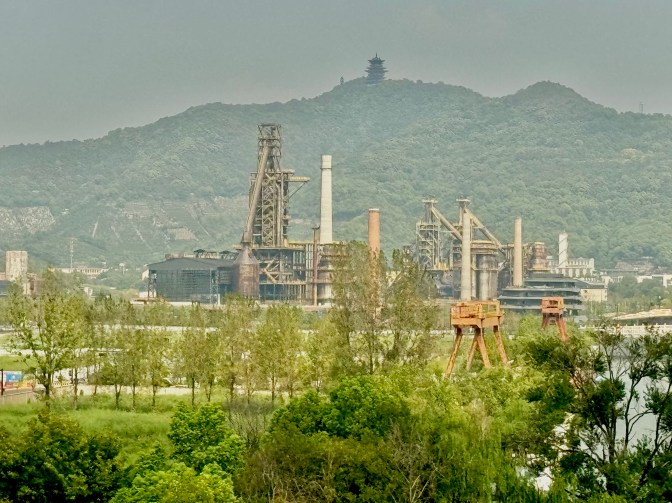
Clusters of small villages appear and vanish in a blur, their tiled roofs glowing in shades of terracotta and ochre. Washing hangs on lines strung between bamboo poles: splashes of red, blue and yellow against the muted earth tones of the buildings.
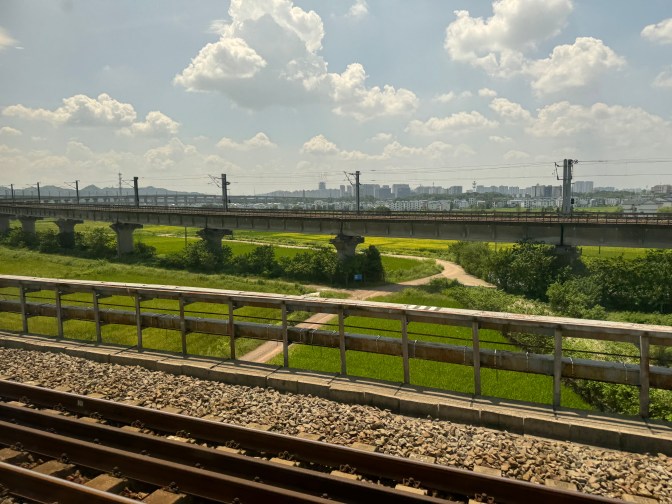
The hills grow steeper, their slopes scarred by quarries where machinery gnaws at the rock, leaving behind raw patches of gray and brown. Yet even here, nature persists. Wildflowers cling to the edges of the quarries, their petals a defiant burst of purple and gold. Rivers snake through the valleys, their waters reflecting the sky’s pale blue, while bridges of steel and concrete span their widths, carrying the train ever forward.
The Iron Rooster in Yorkshire
One of the key moments that set me on the path to becoming a travel writer was reading Paul Theroux’s travel story Riding the Iron Rooster. I picked up the book in 1990 while staying with my wife’s family in a grand, centuries-old house in North Yorkshire. Sutton House itself was a place of quiet elegance, with creaking wooden floors and windows that framed the escarpment of Sutton-under-Whitestonecliffe and the rolling green hills of the Yorkshire Dales outside. But within the pages of Theroux’s book, I was transported far away: to the crowded train stations, bustling cities, and remote villages of China in the mid-1980s.
Theroux’s journey by train across China captivated me. His sharp, acerbic prose painted a vivid picture of a country in transition, where ancient traditions were colliding headlong with the rapid changes of modernisation. He didn’t romanticise his experiences. Instead, he captured the grit, humour, and humanity of life on the rails. I was drawn to his ability to find stories in the mundane: the conversations with fellow passengers, the fleeting glimpses of landscapes, the quirks of train travel itself.
Reading Riding the Iron Rooster felt like peering through a scratched perspex window at a world I longed to explore. It wasn’t just about the destinations. It was about the journey: the people you meet, the unexpected detours, the small moments that stay with you long after the trip is over. Theroux’s writing showed me that travel isn’t just about seeing new places: it’s about understanding them, questioning them, and finding your own voice in the process.

We would visit China twice in the coming years, in 1992 and again in 1994. Indeed, in October 1994 we would ride the eponymous Iron Rooster train from Urümqi, in Xinjiang Province to Lanzhou, a smokey city on the Yangtze River. And Theroux’s book stayed with me, its influence weaving into my own travels and, eventually, my writing. Theroux’s unflinching honesty and keen observations became a model for how I wanted to tell my own stories. Whenever I board a train now, especially in China, I think of him, and of that quiet Yorkshire house where my journey as a travel writer began.
The Teascape
As the forested hills of western Fujian Province fly by at almost three hundred kilometers per hour outside the window, I leave my seat in Car 13 and walk down to train’s dining car. Despite the speed at which we are travelling, the aisle is as steady as the entrance to the dumpling joint I had frequented every lunch time in Quanzhou. The scenery spools past outside like a loop playing on a row of high-definition TVs.
I find a table in the dining car and buy a can of Coke. The landscape through which we are passing is hilly, green, and, in the valley bottoms at least, closely farmed. Spread out across the tiny valleys, and pressed tightly against the hummocky hills, the farms form a mosaic of colours and shapes, like the individual facets of a stained glass window. A concrete dam holds back a lake of aquamarine and cyan water. Simple, weathered villages, their houses roofed with black tiles, squat amid the fields.

The lake narrows into a calm river dotted with sandbanks. Bridges span the waterway as the line cuts its way cleanly through the landscape. The stark, linear context of the railway — twin horizontal lines in a rounded, sensual landscape — contrasts sharply with the natural curves and hollows, and the gentle flow of the water. This rigid intrusion of steel and concrete seems at odds with the tranquil and timeless quality of rural China: modernity intersecting with tradition. And then, suddenly, there are tea plantations passing by.

Beyond the ranges of rumpled hills, we enter the wide plains of Eastern Jiangxi. The rich red soil is fecund and fertile, with beans, onions, corn, and cabbage growing in profuse, geometrically precise rows. Rice paddies blanket the valley in rich, green-pile carpets. Factories begin to dot the wide valleys, and a haze of pollution fades the distant hills to blue-grey.
A new friend
An English teacher called Avid comes to sit at my table. He and his wife are taking his daughter to Nanjing to begin her university studies. He is dubious about her choice of major — food science — but I reassure him that it is a very sensible and transferable subject to study. We eat lunch as we talk. Avid tells me about the difficulties of learning English in the 1990s when very few people spoke the language and foreigners were few and far between. I tell him about our travels in China in the early nineties and how we would often meet people who wanted to practise their English.
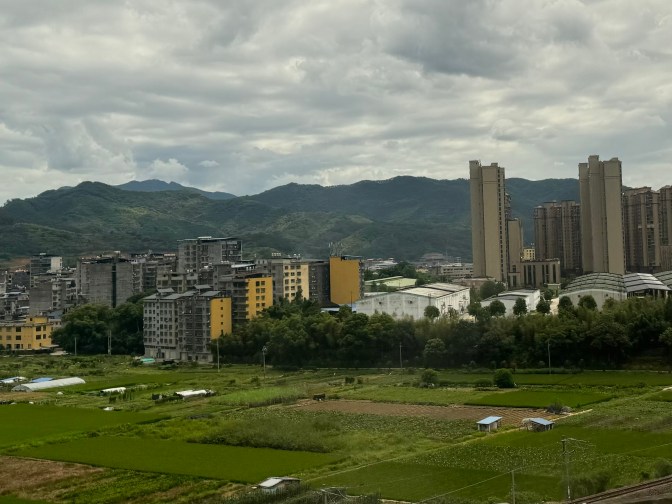
Along the tracks, there are scrapyards, fish ponds, shacks, sugarcane, and spiderweb tracery of power lines slung from pylons and poles, taking electricity to the legions of squat, four-storey apartment buildings. A locomotive drags a long line of empty bulk wagons out of a tunnel; we dive into the darkness of the parallel cavern. The train slows from 276 km/h as we arrive in Yiwu Station. The long, red proboscis of a concrete pump, like a steel preying mantis, feeds concrete into a pit dug into the clay.
Rails of Progress
The first two decades of the 21st century marked a new phase in China’s railway development, defined by the rapid expansion of high-speed rail (HSR). In 2008, the Beijing-Tianjin Intercity Railway, China’s first HSR line, began operations. The trains attained speeds of up to 350 km/h and initiated a high-speed rail revolution that has reshaped the country’s transportation infrastructure.
Today, China’s high-speed rail network spans over 40,000 kilometers, connecting nearly every major city. The Beijing-Shanghai High-Speed Railway, opened in 2011, is one of the busiest and most advanced lines, reducing travel time between the two cities from ten hours to four and a half hours. The network incorporates cutting-edge technologies, including advanced signaling systems, energy-efficient designs, and earthquake-resistant structures.
The Iron Backbone
China’s railways have also become a platform for global influence. The Belt and Road Initiative has extended the reach of Chinese rail technology, with projects like the China-Europe Railway Express linking cities such as Yiwu and Chengdu to destinations as far as Madrid and London.
Railways remain central to the Chinese government’s vision of sustainable development and global connectivity. Innovations such as maglev trains, autonomous rail systems, and green energy-powered trains are under development, aiming to push the boundaries of rail technology.

The Holiday Inn Express
The train glides into Nanjing South Station at 16:20, precisely on time. I gather up my things and join the throngs of people moving along the platform and down the escalators to the arrival concourse. Nanjing South Station is one of China’s largest railway termini, brand new and shiny-clean.
As I have come to expect, whenever I arrive in a new Chinese city I am immediately overwhelmed and confused. The ease with which I have navigated my previous destination — using mental maps built up slowly by trial and error — is suddenly gone. Here in Nanjing I will once again have to rebuild my spatial awareness from scratch.
I have chosen a hotel called the Holiday Inn Express, partly for its clever name — a nod to my train journey — and partly for its location near the Yangtze River. I have come to Nanjing to see the great river for the first time in thirty years. The Yangtze had captivated me on our previous trips to China in the early nineties and I wanted to walk its banks and watch its timeless rhythms once again.
A tall young man in a glass booth gives me directions for the Metro and I ride a few stops to the Rehe South Road Residential District where I order a DiDi for the final leg to the hotel near the Zhongshan Wharf. It is brand new. Indeed, my room on the ninth floor is so pristine it seems as though I’m the first person to stay in it. The young concierge staff are vivacious and helpful: completely at home with using the Alipay translate feature to answer my questions.
Yangtze River sunset
Leaving my gear in the room, I step back out into the hot evening. The sun is burning orange down the length of Zhongshan North Road, filling the air with a neon glow through which EVs and battery scooters glide. I walk a few blocks to the river. People have gathered to watch the sunset and gossip. Children screech and run while their parents natter. Everyone has a phone out to capture the scene, photograph each other and pose for selfies.
The Yangtze lies in a great broad reach, with a hazy skyline of tower blocks against the setting sun on the far shore. A procession of ships and barges, line astern, each one in a geometrical position in relation to those fore and aft, makes its way upstream. An equally precise convoy makes its way downstream. The thrum of their engines provides a background counterpoint to the joyous chatter of the watching locals on the waterfront.
I lean on the balustrade and watch the river slip ponderously by: inexorable, inscrutable, indifferent to the decades that have passed since I first stood on its banks. The Yangtze remains as it always has — vast and unhurried — while the world around it has transformed beyond recognition. Around me, Nanjing gleams with the glass and steel towers of China’s relentless reinvention. And I, too, have changed. The young traveller who once devoured Riding the Iron Rooster in that Yorkshire house, dreaming of distant places, lies upstream in the past, hidden from view on a journey that never truly ends.


 TravelWriterLife
Very interesting..
LikeLike