Exploring the Yangtze River at Nanjing.
Dragonfly breezes
Yangtze River flows beneath
steel arcs frame the sky
– Haiku by CGP Thompson
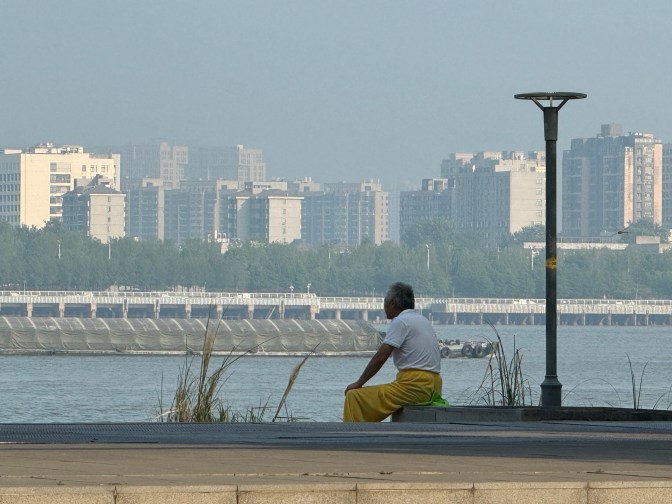
Dawn on the banks of the Yangtze. A cool breeze blows down the river, shivering the summer-green leaves of the weeping willows trailing their branches in the water. Early morning walkers and joggers pass me as I walk downstream along the embankment. A woman in a leotard practices tai chi. A hopeful fisherman casts his line into the opaque water: an image so ancient and evocative that I could be here in 2024 or 2024 BCE. The same processions of ships and cargo barges that I had watched in the sunset last night are making their way upstream and downstream, line astern, each vessel holding its assigned place in the squadron.
Behind me, screened from view by the great stone wall of Nanjing, the city is awakening. The streets are clean, the buses are running and the traffic is gliding to the precise orchestration of perfectly synced traffic lights. The hum of urban life, insistent and febrile, rises beyond the wall as the city stirs into motion. But here beside the river, the world still is hushed.

Rivers Run Through It.
In the course of my travels, I have seen many of the world’s great rivers. In Africa, I have seen the Zambezi River roar over Mosi-o-a-Tunya in Zimbabwe, watched the sun set over the Nile in Egypt, and floated down the Congo River through the jungles of Zaire. I have stood beside the Ganges at Prayagraj and Varanasi, feeling the spiritual weight of the river that has been revered for centuries. I have walked across the great iron bridge that spans the Hooghly at Kolkata, where the city is flamed by the girders and struts of Victorian engineers.
In Pakistan, I have followed the Indus River north into the Karakoram Mountains, battling floods, landslides and the snow flurries of autumn. I have walked the banks of the great European Rivers: the Seine in Paris and the Danube in Austria. I have fished the Bow River in Canada, seen the Hudson River in New York, and spent years watching old Father Thames in London, the great waterway that leads “to the uttermost ends of the Earth.” I have camped beside the Murray River in South Australia and waded in the big rivers of New Zealand’s South Island.
Each river possesses a different facet of human experience and natural beauty. But none of them occupies such a singular place in history and legend as the Yangtze River. Entire Chinese civilisations have been shaped by its currents. Indeed, it is a river that doesn’t just flow through China: it defines it.

Arteries of the Earth
Rivers have always been symbols of journeys and adventures. They are the threads that weave through landscapes, connecting distant places and people, much like the threads of a story weaving through a narrative.
Joseph Conrad once described the Congo River as “an immense snake uncoiled, with its tail in the sea and its head lost in the depths of the land.” To me, this image captures the essence of what a river represents: a journey into the unknown, a path that winds through the heart of the world, both literal and metaphorical. Rivers are the arteries of the earth, carrying life and stories from one place to another. They are the embodiment of movement, of change, and of the relentless passage of time.
In my travels, rivers have always been more than just geographical features; they are the embodiment of adventure. Each river I have encountered on my adventures, from the serene Nile to the roaring Indus, offers a new story, a new journey. They are pathways that lead into the heart of cultures, histories, and, of course, personal discoveries.
The Talisman.
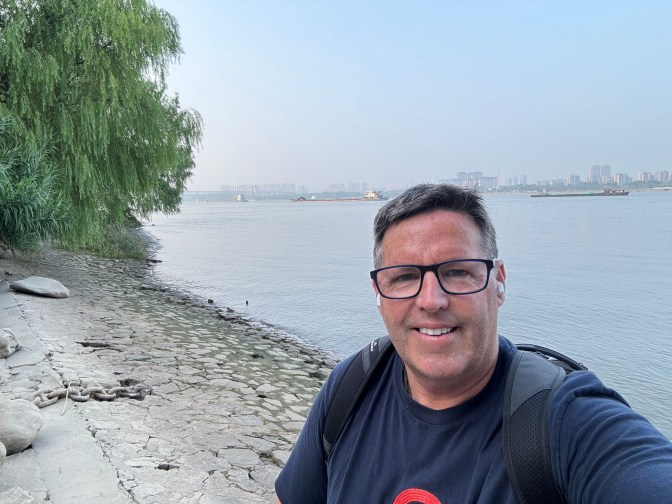
I have a small ritual to complete beside the Yangtze. For more than a decade, I have worn a small green stone around my neck, a keepsake from a shingle beach on the east coast of New Zealand’s South Island. It has been with me through years of travel, upheaval, and change: a talisman to bring me luck (if such a thing exists) as I made my way through the middle years of my life.
But I no longer need it. Around my neck now hangs a silver dog whistle, a gift from my family to mark my years as a shepherd; years that shaped my character, taught me resilience and instilled in me a deep sense of independence.
I have worn the stone for the final time as I journeyed to China, walked the streets of Xiamen and Quanzhou, and made my way by train to Nanjing. Now it is time to return it to the water.
Standing on a narrow strip of river silt framed by weeping willows, I let the stone and its leather cord slip from my fingers. It traces a gentle arc through the air before vanishing into the water with a quiet splash. I picture it drifting down, the leather twisting in the current, until it settles on the riverbed, lost to the depths, merging with the silt of history, exactly where it belongs.
The Bridge Across Forever.
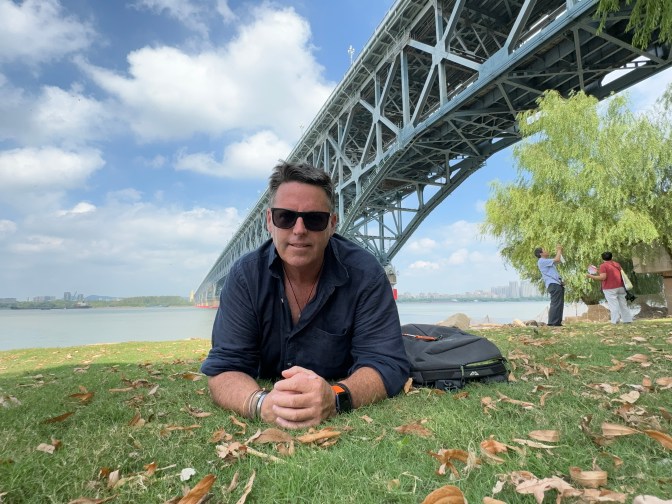
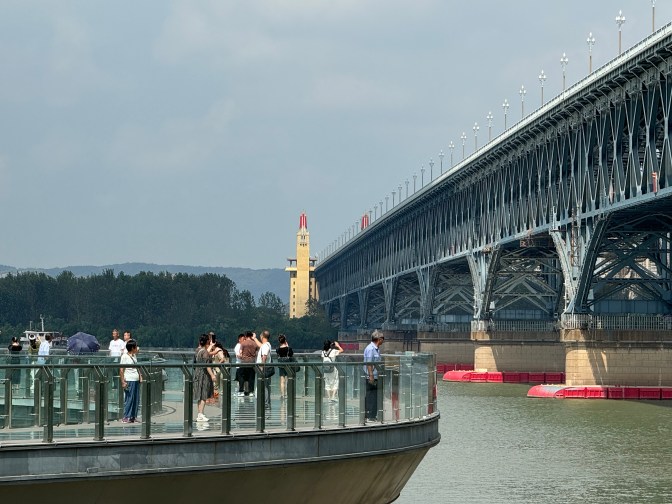
The Nanjing Yangtze River Bridge is a monolith of steel and stone, spanning the river like the ribs of a sleeping dragon. The closer I get, the more immense it becomes. The upper level of its double-decked structure carries six lanes of traffic. The lower deck bears the rattle and hum of trains rolling on four sets of tracks. Red flags flutter from the railings. The stone towers, adorned with revolutionary motifs, rise from their red-painted starlings like sentinels above the water.

I find a patch of grass on a small peninsula beside the bridge and sit down. The air is motionless; the river is a sheet of glass beneath the bridge’s monumental spans. Dragonflies flit on gossamer wings, as light and ephemeral as the bridge is strong and enduring. Ships and barges slip beneath the massive steel trusses as swallows dart through the girders.
The river carries on, as it always has, oblivious to the bridge, the shimmering air, the trailing willows, the small talisman with its trailing leather thong, the ships, the willows, and the shining city along its banks. It is oblivious to me as well. But In this place where history, movement, and memory converge, I feel, for a moment, that I too am part of its flow: another traveller in the current of time.
Landmark Engineering
The Nanjing Yangtze River Bridge is far more than just a river crossing. It is a testament to resilience, self-reliance, and ingenuity. It describes, in stone and steel, the ability of a nation to stand up and build its own future when the rest of the world turns away. Constructed in the 1960s, it was a feat of both engineering and national pride. It was the first major bridge over the Yangtze to be designed and built entirely by Chinese engineers after the Soviet Union withdrew its technical and financial assistance.

China reconstructed
In the late 1950s, China was still finding its footing as a modern state. The plan to build a bridge over the Yangtze at Nanjing had already begun, with Soviet engineers providing technical expertise, blueprints, and funding. But then, the political tides shifted. The Soviet Union withdrew its support, pulling out its engineers, its technology, and its financial backing. The message was clear: without foreign expertise, China would fail.
But history rarely unfolds the way politicians intend. Instead of collapsing under the weight of abandonment, China forged ahead. Engineers, workers, and planners threw themselves into the project, designing and building the bridge from scratch, using homegrown knowledge, sweat, and determination. When the bridge opened in 1968, it stood as a declaration: China did not need anyone’s permission to advance. And now, more than half a century later, I see history repeating itself.

China rises
Today, it is not the Soviets who are withdrawing their technology and investment, but the United States. This (supposedly) once-great power is now grasping at the last threads of its fading supremacy and attempting to demonstrate its ability to dictate terms through coercion rather than innovation. Washington, in its desperation to slow China’s rise, has imposed trade bans, blocked access to semiconductors, sanctioned companies, and waged an economic war on China.
But it is a war that it cannot possibly win. Like the Soviets before them, the US government believes that by cutting China off, they will cripple its progress. And once again, the opposite has happened. Denied foreign chips, China built its own. Blocked from Western markets, China expanded into new ones.
Sanctioned, restricted, excluded: none of it has worked. If anything, the pressure has only accelerated China’s innovation, spurring breakthroughs in AI, quantum computing, high-speed rail, and clean energy. While American infrastructure crumbles and social divisions widen, China has spent the last few decades rebuilding, expanding, and refining. Its cities are safer, its trains faster, its factories more advanced.
The River of Time.
Looking up at the Nanjing Yangtze River Bridge from this tiny hem of green lawn, I see it as a metaphor for what China has always done: taken every obstacle, every setback, every act of foreign condescension, and turned it into an opportunity. Just as in the 1960s, when they built this bridge after the Soviets walked away, China has once again risen in the face of external pressure: this time leaving the United States far behind.
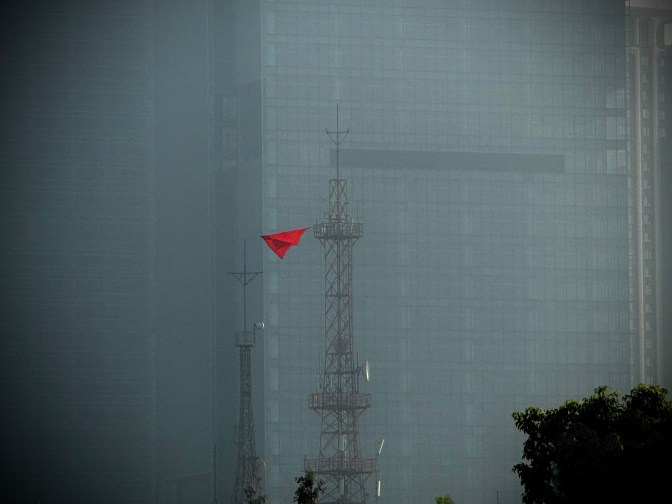
The wind shifts, blowing off the river, carrying the scent of water and the deep reverberant thrum of ship engines. Overhead, a train roars across the bridge, its steel wheels clattering with the resonant drumbeat of momentum. The sun glints off the towers of Nanjing, a city that has been burned, rebuilt, conquered, and reclaimed over millennia: always surviving, always moving forward.
History is not a straight line. It is a river, looping, meandering, but always flowing onward. And here, beneath the towering steel of this bridge, I am reminded once more that no nation, no empire, no era, and no journey lasts forever. But the Yangtze endures. And so does China.


 TravelWriterLife