The narrow spiral staircase winds upward. It is tight. Echoing. A Fibonacci sequence rendered in stone that was never meant for modern feet. The stone is cool to the touch, worn down in the centre by centuries of ascent. I place a hand on the wall for balance and keep climbing, feeling as though I’m being pulled upwards through time as much as space.
At the top, a wooden door creaks open, and I step out onto a timber walkway that circles the upper reaches of Santa María la Mayor. And suddenly, there it is Ronda, spread out before me like a chipped mosaic of terracotta and sun.

The rooftops tumble and cluster below in every direction: curved and crooked, red-tiled and timeworn, some patched with modern skylights, others faded to the soft ochre of Andalusian summers. From up here, the town has a strange stillness, as if it’s holding its breath under the weight of the heat. A pair of white cars sits in a quiet square far below, and narrow cobbled alleys slice between the houses like veins.
To the east, the mountains rise in craggy folds, hazy now in the midday shimmer. To the west, the land stretches out in dusty golds and greens, olive groves and dry fields all basking under a cloudless sky.
The railing is old, but sturdy. I lean on it and take in the view, swept by a mix of awe and vertigo. The wind up here feels purer, less of the earth and more of the sky. It tugs gently at the dry grass growing from cracks in the stone dome beside me, as though even the weeds want a view.

I feel like I’m standing between two worlds again. Below me, the life of the town ticks on: cars, voices, café chairs scraping on stone. Behind me, the hush of the church still lingers, held in timber and incense and marble. Up here, there is just light and space. This is the kind of view that makes you forget doctrine and remember wonder.
I sit on a weathered wooden bench, legs stretched out, backpack beside me, the old stone wall at my back. It’s cool here, a kind of shade the sun can’t touch. The wind is soft, and the world below plays out in full panorama.
I can see everything. The entire tiled sprawl of Ronda fans out beneath me: rust-red roofs, narrow lanes, whitewashed houses in tight formation. I can hear distant conversations drifting up from the cafés and courtyards, the occasional bark of a dog, the clink of cutlery, a motorbike revving somewhere beyond the next hill.
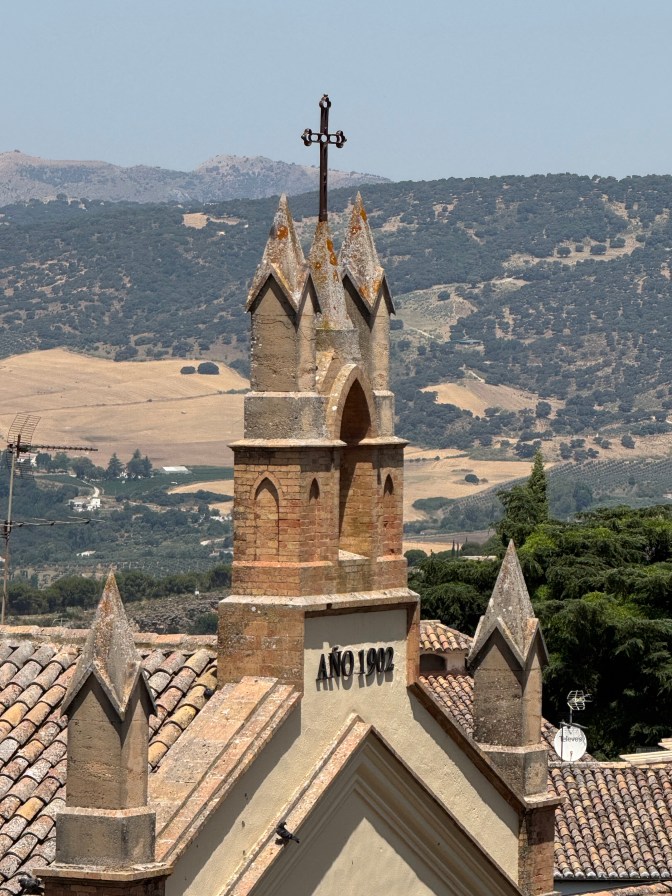
But up here, I am invisible. Untouched. The town continues unaware of the solitary figure perched above, listening in like a silent god or a stowaway in the eaves of heaven. There’s a powerful stillness in this hidden perch. A sense that I’ve stepped out of ordinary time. Below, the day carries on in full Andalusian rhythm. But here, it has paused. And I’ve paused with it.
High on the walls of a church that has seen centuries of belief and pilgrimage, I’ve found a moment of my own. Not religious, but no less sacred for that. This, I think, is what travel is about. Not just movement, but stillness; the kind that catches you off guard and makes the whole world, for a brief shimmering moment, yours alone.

Further along, almost hidden in the stonework, as if not meant to be found, a small wooden door creaks open. I duck through it and emerge onto a narrow balcony suspended high above the nave, clinging to the wall like a quiet observer.
From here, the church opens below me like a vast stone theatre. The columns I had craned my neck to admire now fall away beneath me, their ornate capitals close enough to touch. They no longer tower: they uphold. The pews are rows of silence; the altar a distant island in a sea of marble and light.
Directly across, the richly carved altarpiece glows faintly in the gold light, and the magnificent domed baldachin with its clustered angels looms with even more power from above. The chandelier hangs in the air like a question suspended mid-sentence.

This is not a view granted to many. It feels like a privilege to be here, a place for the unseen, the unspeaking. A place for the watcher.
And yet, being here, I realise that the architecture was meant to be seen this way. The soaring arches, the layered ornament, the perfect symmetry: it wasn’t only designed for those on the floor, looking up. It was built with heaven in mind, of course, but also for this: for the hidden, elevated vantage where the sacred becomes structure, and the structure becomes art.
I stand motionless for a long moment, listening. Below, someone coughs. A shoe clicks softly against stone. And above me, through a sliver of stained glass, the afternoon sun continues its slow descent, casting an angled beam of light across the ancient walls.

Back out on the balcony, I retrace my steps to the head of the stairwell. The perfect stone echo of the Fibonacci sequence, spirals inward with a grace that feels more natural than designed. But of course, it was designed: by a human mind attuned to the harmony of form and function. This staircase isn’t just a means of ascent or descent; it’s a meditation in geometry. A prayer cast in limestone.
Standing above it, the spiral draws my eyes inward like a vortex, a soft spiral that narrows into the dark: almost hypnotic, almost sacred. Fibonacci, that sequence of growth and proportion found in pine cones, seashells, galaxies… and here, quietly holding up the footfalls of centuries.
This staircase may have been carved for monks or sacristans or tower-keepers, but it now feels like something greater: a visual hymn to mathematics, to nature, to the golden ratio hidden in all beautiful things.
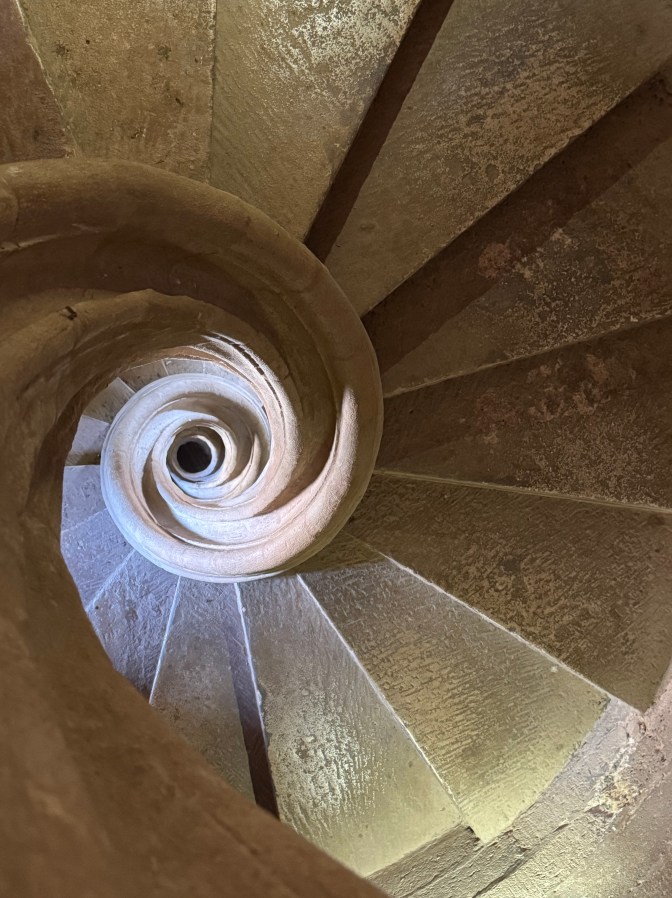
And as I begin my descent, I feel like I’m not just walking down a staircase but being gently unwound. The spiral seems different in reverse; less triumphant, more reflective. The light shifts. The stone glows softly, worn smooth by the passage of countless feet. Each step down feels like a slow return from some elevated state, from the stillness of the high balconies, from the invisible perch above Ronda’s rooftops.
There’s something intimate about descending a staircase like this. The world narrows. The noise fades. You feel the closeness of the stone, the rhythm of your breath, the quiet echo of your footsteps in the coil of centuries.
This isn’t just a staircase. It’s a passage between spaces, but also between ways of seeing. Up there, I was all-seeing, removed. Down here, I am inside the bones of the church again. The sacred is no longer panoramic, but enclosed. I don’t rush. I let the spiral guide me gently back to earth.
Back on solid ground, I find myself in a side chapel, face to face with a mirror. It’s propped casually against the wall, a tall, old thing with a worn wooden frame. It was meant, perhaps, for priests or altar servers to check their vestments, or for some long-gone custodian to straighten a collar. But now it catches me unexpectedly. It reflects not just my face, but the entirety of this quiet room: its checkered floor, its golden saints, its watchful Madonnas.
I see myself standing there, phone in hand, backpack slung over one shoulder, very much a traveller. Not a pilgrim. Not a penitent. Just a man passing through, observing the sacred through the lens of curiosity rather than conviction.
To my right, a statue of Mary holds the infant Christ and a rosary, her gaze serene and distant. Another figure, encased in glass, wears a silver crown and the heavy robes of devotion, surrounded by votive offerings and memories too private to guess at.
The room is quiet, the air still. The floor creaks faintly beneath me. In the mirror, I am not quite part of the scene. And yet I am. A reflection among relics. A secular ghost in a sacred house.
It’s a strange and beautiful thing, to be both inside and outside a moment. To see yourself, quite literally, as a visitor. A witness. A flicker in the grand candlelight of time. And then, just as quietly, I turn away.


 TravelWriterLife