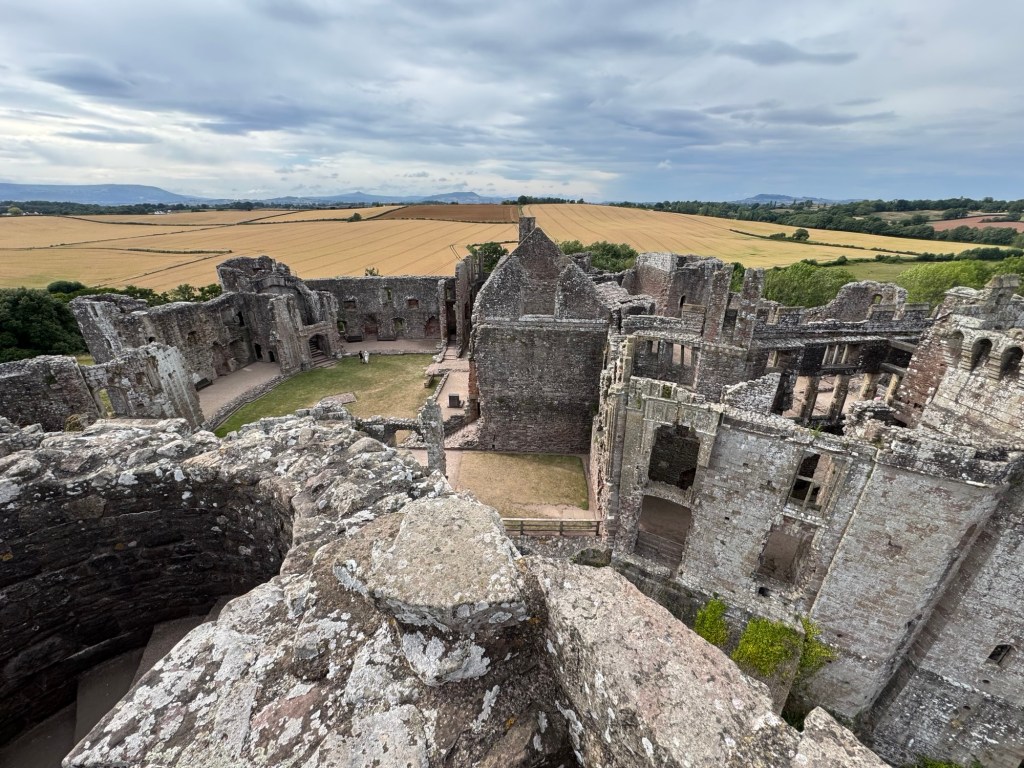
Deep within the walls of Raglan Castle, I climb the spiral stairs to the top of the keep. My footfalls echo down the tower like distant war drums in a hollow chamber. My hand brushes along stone worn smooth by the centuries. Up here, the wind is brisk and unashamed, lifting the hair from my forehead and tugging at my collar. The view opens like a scroll. Monmouthshire laid out in soft, rolling folds, the fields drawn with neat lines of ripened grain, each furrow catching the light like the score on a ploughed sea.
I lean against the battlement and imagine the year is 1646. This castle—the high fastness of Raglan—is under siege. Royalist soldiers stand where I now stand, scanning the horizon for the dust cloud of approaching cavalry, for the long dark column of Cromwell’s men. They have held out for over two months, refusing surrender even as starvation crept into the chambers and cannon tore at the walls.
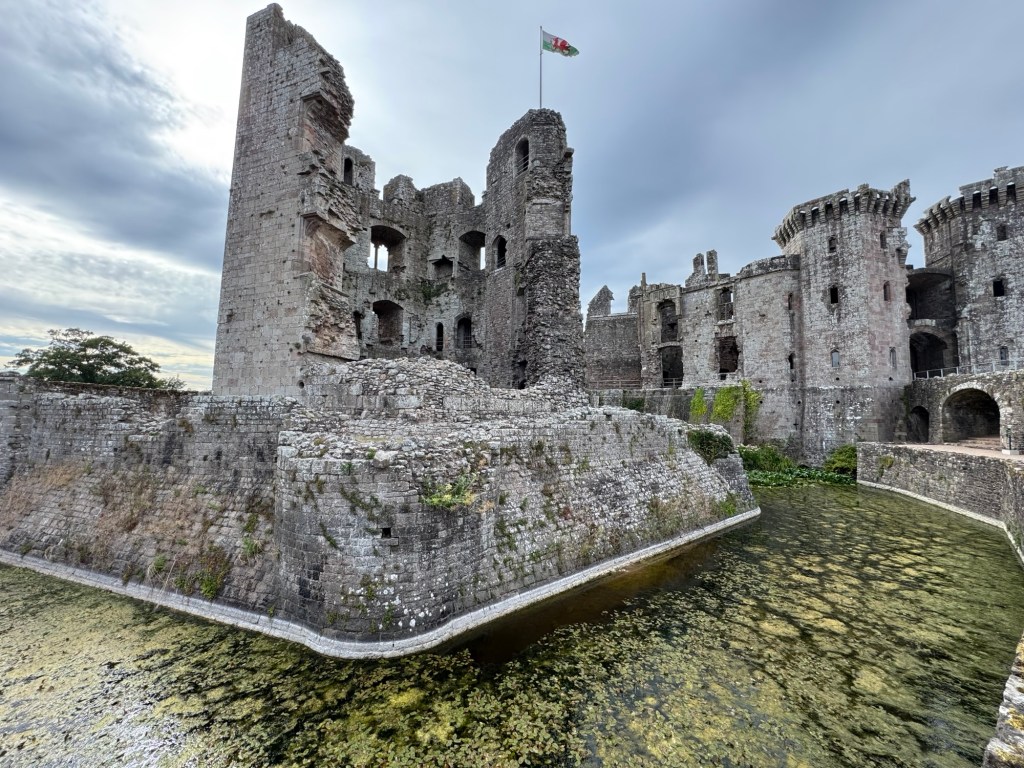
It’s a curious moment for me, personally. One of my ancestors was among Cromwell’s staunchest men: one of the signatories of King Charles I’s death warrant, no less. A regicide, as history would later call them. But standing here now, above the wrecked grandeur of this once-great home, I feel no kinship with Parliament. If I’d been alive then, I know where I’d have stood: right here, musket in hand, ready to defend King and castle, proud to serve the Marquess of Worcester and the Royalist cause.
Because Raglan was no windswept outpost. In the seventeenth century, this was one of the most elegant residences in Britain. Built not just for defence, but for display, comfort, and culture.

I descend from the keep and wander through the bones of the castle. Empty window frames yawn like mouths opened mid-speech. Archways lead into shadowed rooms where rain has etched grooves in the flagstones. I touch the cold edges of a doorway and try to picture it filled with light, colour, movement; lords and ladies in embroidered velvet, the smell of beeswax and fresh bread, the distant echo of a lute from the gallery above.
But it is the Great Tower, the so-called Yellow Tower of Gwent, that really commands my attention. I look across at it from the tower above the Grand Staircase. Detached from the main walls, moated and massive, its six-sided form rises like a ship at anchor. This design—a French innovation, rarely seen in Britain—makes Raglan unique. The tower was once accessible only by twin drawbridges. If the outer walls fell, defenders could retreat here, pull up the bridges, and make a final stand. It was both a military fallback and a symbol of sophistication: the architecture of power.
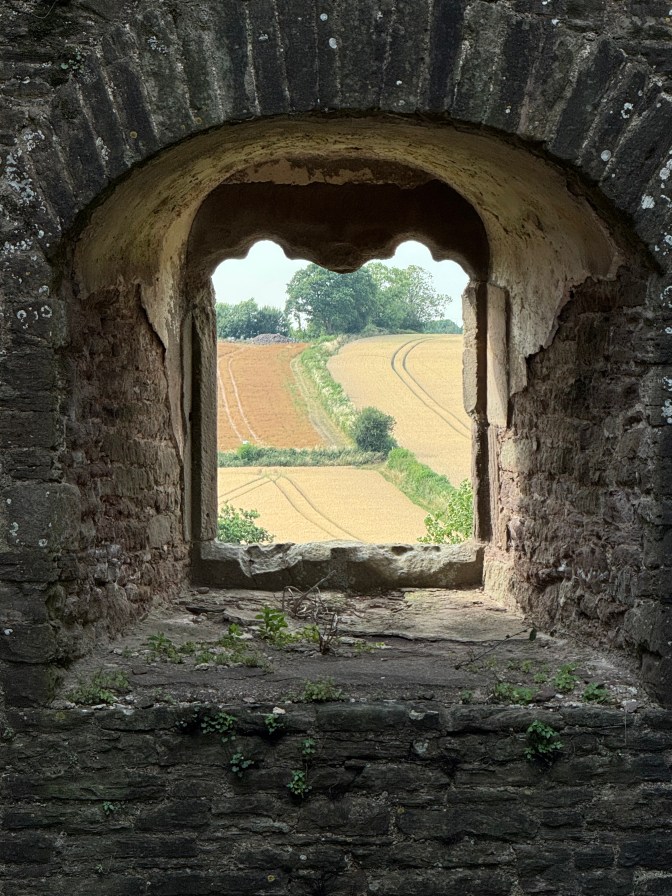
I peer through a narrow slit in the wall. Perhaps, during those months of siege, a soldier once peered along the sights of a crossbow here. Now it’s just a keyhole to the past. Through it, I see the green inner court, and beyond that, the golden furrows of the fields, marked with the same care that once laid out this castle. The landscape feels eternal. The castle, though broken, still holds its dignity.
Later, near what remains of the terrace, I find a signboard with a coloured illustration of Raglan as it was around 1640. The lake is still there in the drawing, ringed with manicured walkways, fountains rising from its surface, and small wooded islands punctuating the water like emeralds.
You can almost hear the laughter of the court, the murmur of poets, the debate of scholars. Raglan was a palace as much as a fortress: a place of ideas as well as arms. Its library was one of the finest in Britain. Its gardens were laid out in the grand, symmetrical fashion of the Renaissance. Its galleries were lined with art and intellect.
And then came the war. Cromwell’s troops brought siege guns and relentless purpose. They starved the Royalists out, shattered the walls, and when the surrender came, they slighted the castle: tearing it down stone by stone so that it could never again serve the Royalist cause. The ornamental lake was drained. The towers were broken. And so Raglan, once princely, became a ruin.
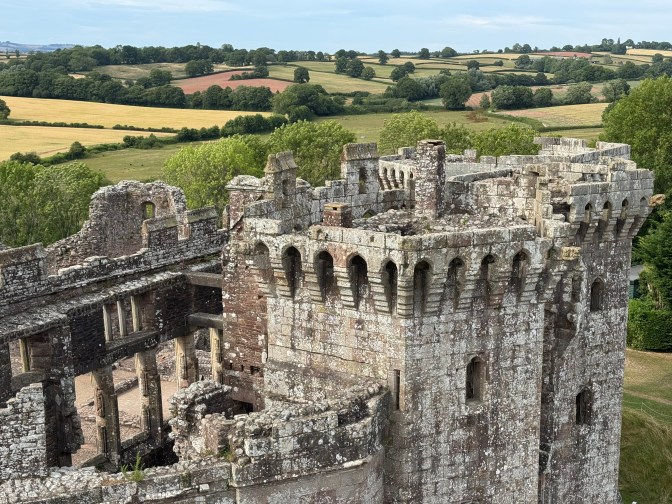
But not a forgotten one. I walk slowly now, letting my hand trail across the warm stone. A crow rises from one of the towers and wheels overhead, its shadow crossing the grass like a stain. A group of children laugh somewhere near the gate. Tourists murmur along the walls, but mostly, it’s quiet. A noble quiet. A silence that remembers.
I take a final look across the landscape. The crops are lined with mathematical beauty, flowing with the shape of the land, golden and still. The Sugar Loaf rises in the distance, a blue wedge of memory and myth. The wind tugs again at my collar again. I stand a little longer, reluctant to leave.
Raglan Castle may be ruined, but it is not gone. Its bones still speak. Its towers still rise. And standing here, with Royalist pride in my chest and regicide in my blood, I feel both the weight of history and the strange comfort of belonging.


 TravelWriterLife
Fantastic writing. My mother is a Raglan, we’ve visited the castle. You’ve told it better than I could.
LikeLiked by 1 person