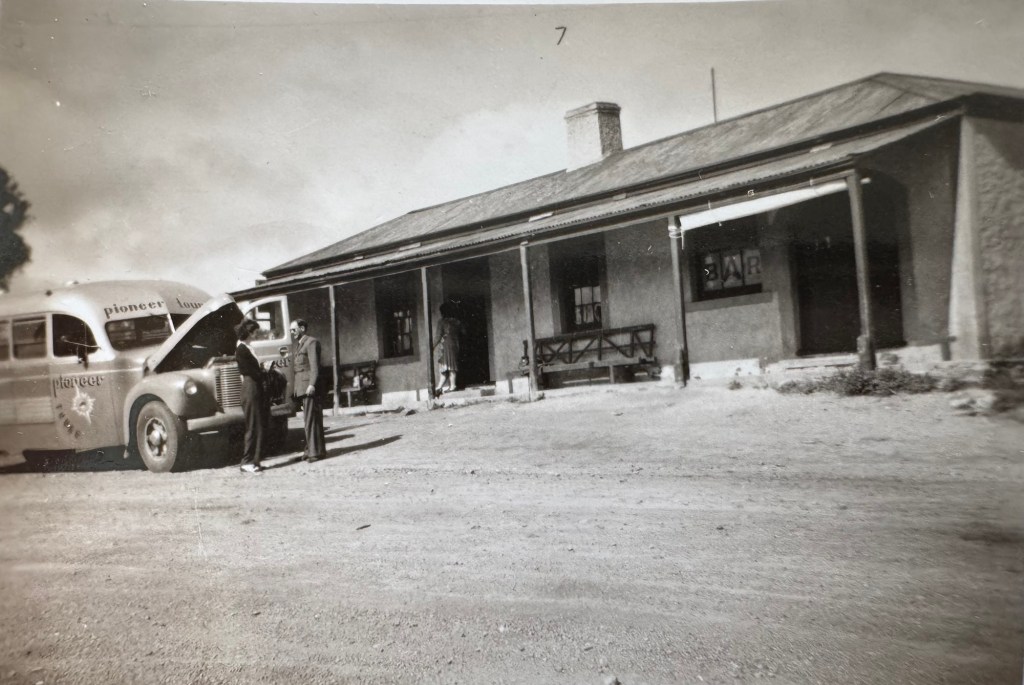
It was at the back of a cupboard, in an album whose pages had curled and yellowed with age. The photograph slipped out and landed face-up on the floor. It is small, black-and-white, and worn soft at the edges. It shows the Blinman Hotel in the mid-1950s, its name painted in block capitals across the verandah fascia.
In the street before it, a bus is pulled up at an angle, its bonnet open; Pioneer Tours emblazoned on the side and above the windscreen. It’s the sort of service that tied the distant towns of the South Australian Outback to the passenger liners in Port Augusta.
A man in a jacket that looks as though it has been shaped by an adze—exact pleats, perfect lapels, as crisp as an airman’s uniform— stands talking to a dark-haired woman in slacks and a cardigan. Claire. My mother’s friend and travelling companion. My mother, Mary Gillingham, is behind the camera: thirty years old and homeward-bound after two years nursing in a London hospital.
There is no movement in the picture. The wide dirt street lies empty apart from the bus, the two figures in front of it and another woman, unknown, in a dress and pinafore, leaning nonchalantly against the hotel’s entrance. Yet I can imagine the scene beyond the frame: the click and clonk of the bus’s engine cooling, the smell of dust and hot metal, the low murmur of voices from inside the bar.
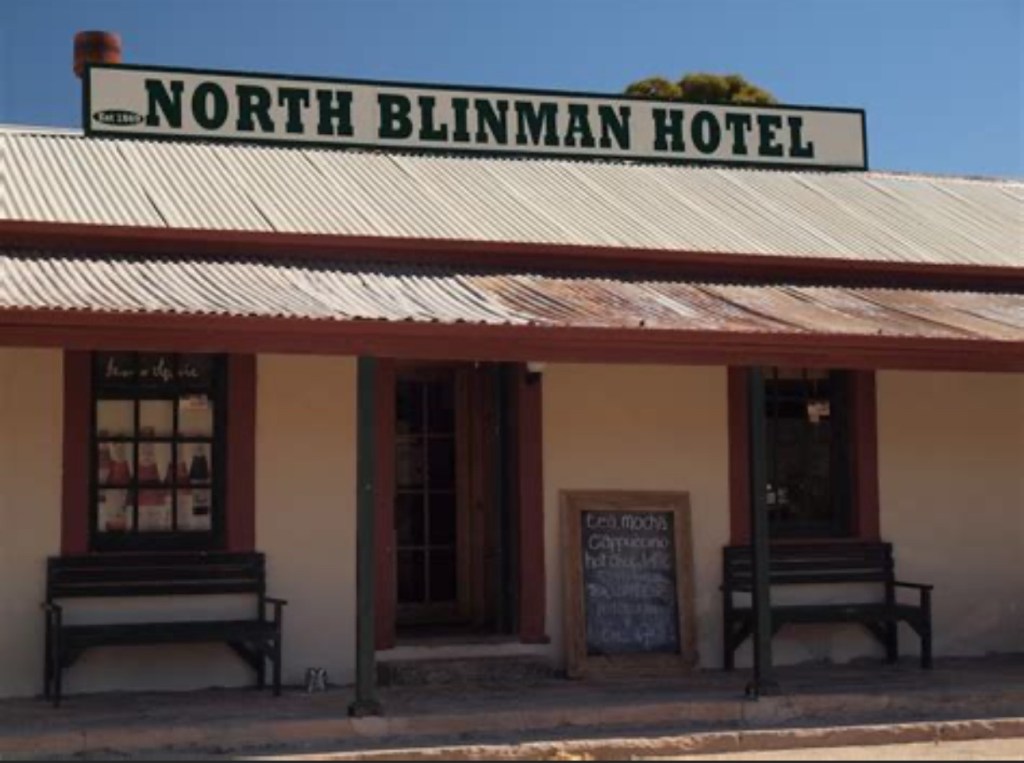
In 2016, I sat on that same verandah, a glass of cold beer beading in my hand. The sign above was freshly painted, although the name had changed to NORTH BLINMAN HOTEL. The corrugated iron roof was less sun-faded, but the shape of the building was unchanged. Outside, four-wheel-drives stood where the bus once did. The air carried the same dry, baked scent, and the street still opened wide to the hills.
Looking at that photograph, taken seventy years before, I thought of Claire, the driver, and my mother laughing perhaps, grateful for the break in the journey, the dust settling on their shoes. I wondered if they too had sat where I did, resting an elbow on the rail, watching the afternoon light stretch across the road.
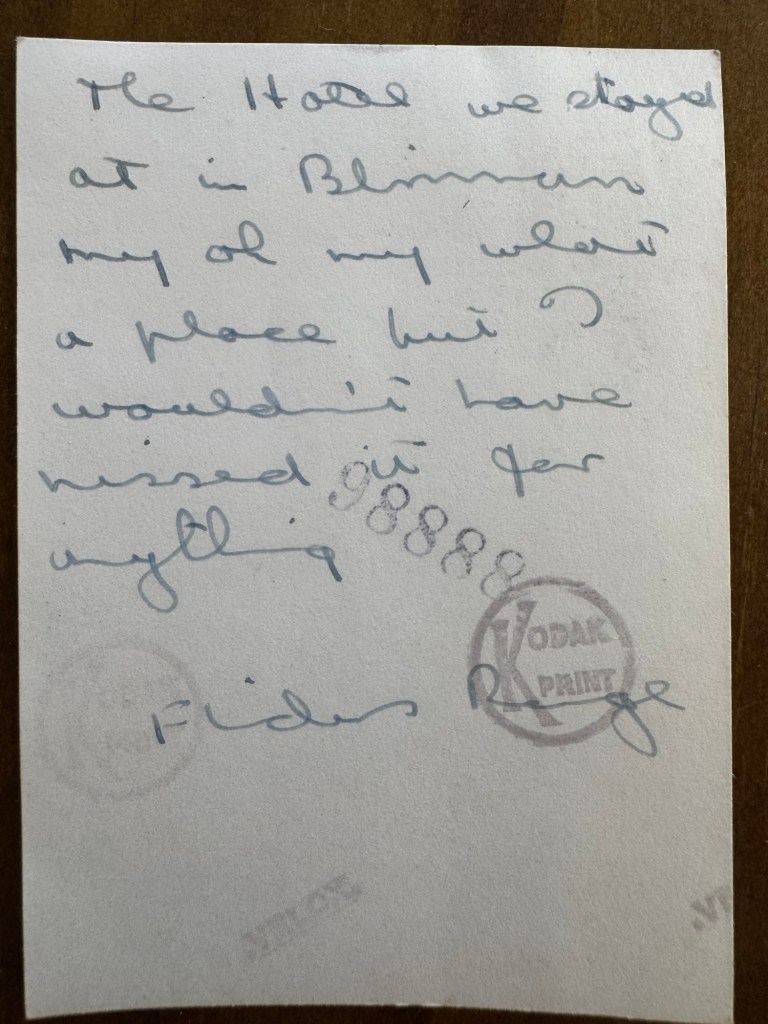
On the reverse side of the photograph, written in my mother’s familiar backward-slanting hand, she had noted: “The hotel we stayed at in Blinman. My, what a place! But I wouldn’t have missed it for the world.”
Time moves slowly in the Flinders Ranges. It trickles like grains of sand in the ancient dunes down in the Parachilna Gorge. Blinman does not change quickly either. It moves in small cycles: buses to four-wheel-drives, drivers’ uniforms to baseball hats, travellers homeward-bound to travellers just passing through. And somewhere between the photograph in my hand and the beer on the barrel table in 2016, seventy years folded in on themselves until it felt, for a moment, as though we were all there at once.