The road into Gaucín winds and doubles back on itself, a coil of tarmac set high above the valleys of Central Andalusia. From a distance, the white village looks as though it has been poured onto the hillside and left to set, its houses clinging to the slope beneath the old Moorish castle. In this incandescent summer light, the walls and tiles seem to shimmer against the deep green of the surrounding sierras. Above it all, the fort stands—silent, sunburnt, and watching—as it has for nearly a thousand years.
I follow the tight whitewashed lanes of the lower town upwards towards the tower. Doors are set deep in thick walls, their lintels shaded by wooden blinds. Wrought iron balconies cast fretwork shadows, and above them, terracotta roof tiles guard the cool interiors from the fierce midday sun. In the stillness, the air smells faintly of limewash and warm stone. The climb is steady, each turn revealing a sliver of sky and, eventually, the hint of the tower.

History here is layered like the mortar between the fort’s scarred and timeworn stones. The castle’s origins stretch back to the Romans, who valued this high perch for its command over the valleys and the approaches to the coast. The Moors rebuilt it in the 8th century, naming it Sair Guazan—the stronghold of the bloodthirsty—its name a warning to anyone tempted to challenge its walls. Later, it passed into Christian hands during the Reconquista, was fought over by rival lords, and eventually faded into slow decline and ruin.
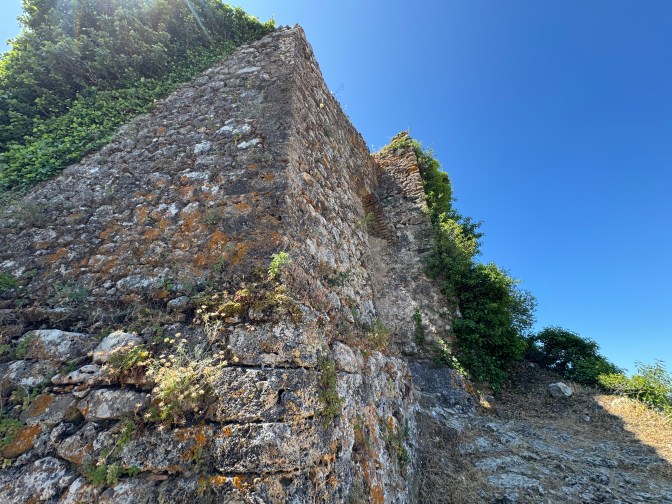
Climbing through the old gate, the heat is instant and enveloping. The stones radiate the morning’s stored warmth; lizards dart along the ramparts. I follow the rough path upward to the bell tower, where a single bronze bell hangs under a weathered brick arch. Through its frame lies a view both vast and improbable. The Rock of Gibraltar, distant in the haze, looks like some ghostly ship under full sail. Beyond it, the faint suggestion of Africa hangs above the sea.
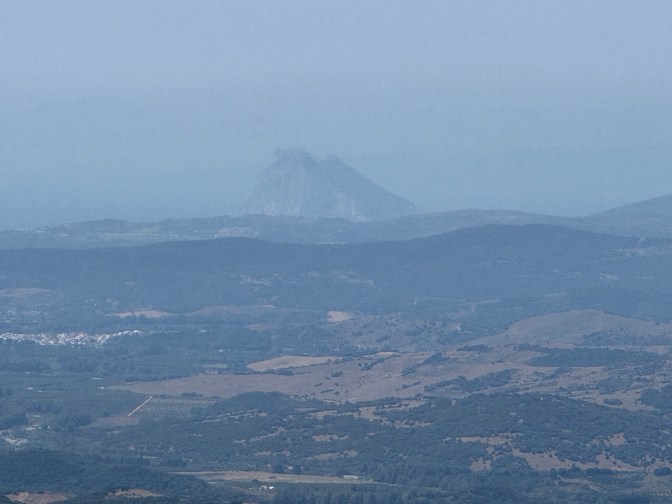
The landscape is a map of history in itself. I can trace the routes of armies, merchants, and wanderers. The green folds of the Sierras give way to the ochre lowlands, and further still, to the glint of the Mediterranean. Standing here, the centuries compress. The bell is still, but it is easy to imagine its peal rolling down through the lanes, calling the town to arms, to worship, or to mark the passing of time.
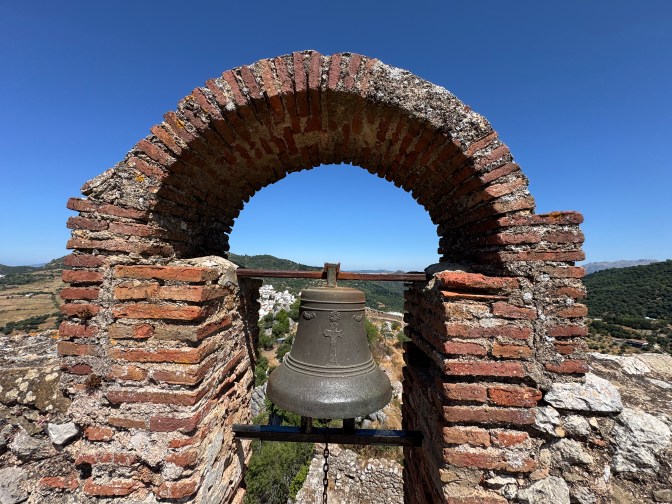
I reach under the arch and swing the clapper. The bell emits a single, sonorous chime that radiates out across the tiled roofs of Gaucín to the olive groves and hills beyond. I let my hand rest on the warm metal, feeling the faint tremor of its voice still lingering, and think of the centuries it has spoken across this same view. Then I turn and make my way down through the fort’s broken walls, the bell’s echo following me into the bright, sunlit lanes of the village.


 TravelWriterLife