The hills rise behind Abergavenny like a wall built by giants, steep, green, and unyielding. They are the town’s backdrop and its boundary, just as the years and centuries are the backdrop and boundary of St. Mary’s Priory. Time presses against the priory’s stones in the same way the wind presses against the flanks of the Blorenge.
It is drizzling, the first rain I’ve seen in weeks, a thin, silvery curtain pulled across the sky after long days of summer heat. Lydia and Charlie’s house is only a few minutes’ walk away, so I came without a coat, brushing past wet leaves in the churchyard.

Inside, the air is unexpectedly warm. I ask the old lady in the nave, fussing over a stack of leaflets, if she’d put the heaters on.
“No,” she says with a smile. “The church is just warm this morning.”
It is true. The great stones have been steeped in July heat and are now releasing it gently, as if the building itself is breathing out a long, slow sigh of relief.
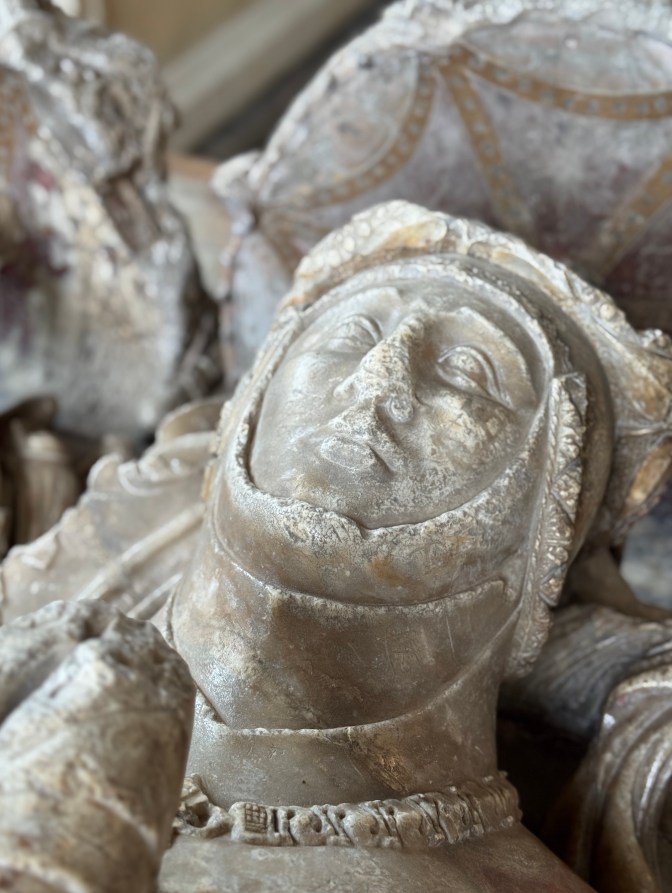
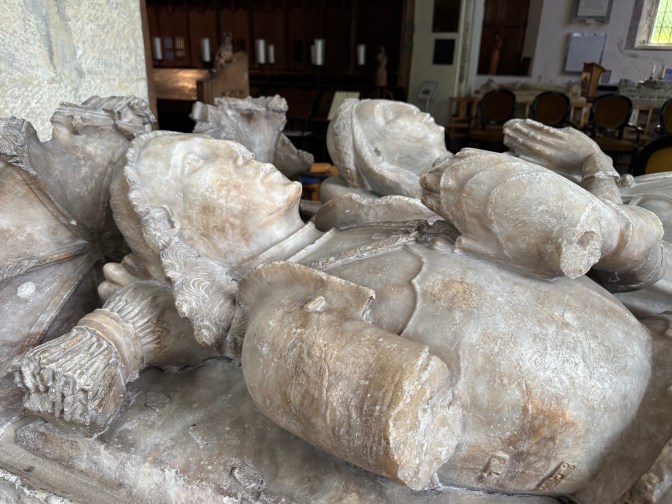
I wander down the nave and into the Herbert Chapel. This was the original—and only remaining—part of the church. It contains the tombs of men and women who had once thought themselves immortal. Knights and ladies lie side by side in chiselled repose: limestone faces blurred by time, swords snapped in half, fingers missing, noses crumbled away. The centuries have worked their quiet vandalism on these effigies. And yet, here they are. The stories they wanted told whisper in riddles from the stone. I stand still and listen.
One knight rests with his head turned slightly towards the north aisle, as if he had been distracted by a sound just before death. His hands are clasped in prayer, his armour smoothed by the passage of countless hands. But there is a faint crease to his lips: the ghost of a smile, or the last trace of defiance. I imagine him as a man who relished risk, was quick to take offence but quicker to forgive, and who perhaps died far from home before being brought back to this quiet place.

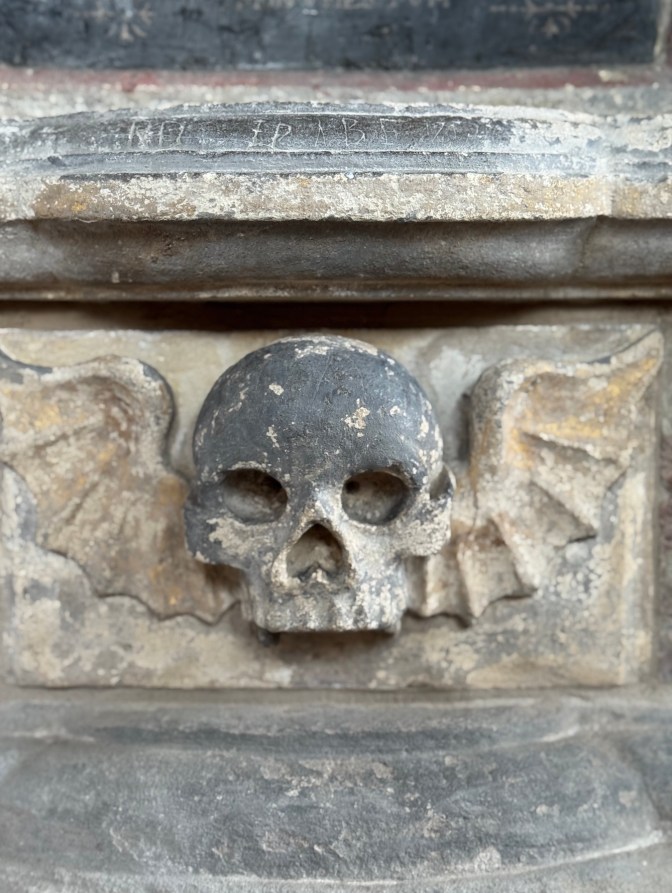
The tomb of William Baker (died 1648) is a mix of piety and macabre realism. It is a grand, almost theatrical monument: two kneeling figures facing each other across a central inscription. William, in his civic robes, is gazing eternally at his wife. She is wrapped in heavy drapery, her head veiled. They are locked in perpetual prayer, their stone eyes never blinking, their hands forever pressed together.
Beneath this formal piety, however, runs a darker current. At the centre of the tomb’s base is a winged skull: the “death’s head” of seventeenth-century funerary art. Its hollow sockets and grinning teeth are flanked by wings that look more like those of a bat than an angel. It is a reminder that even the most virtuous life ends in the same flight into the unknown. Lower still, on the plinth, a skull and crossbones are carved deep into the stone, their weathered edges softened by centuries but still unmistakable in their meaning. Memento mori… remember you must die.
Another knight lies in a narrow alcove, his armour still wrapped about him as if he might rise at any moment. A lion curls at his feet. It’s mane spills into stylised locks; its jaws are parted as if it is still ready to roar on his behalf. Behind him, the wall is alive with figures: flights of angels caught in mid-song, their stone robes hanging in stiff folds, their hands lifting instruments to lips that have never drawn breath.
What brutality did he unleash in his lifetime? Did he hack and slice his way through the Moors on Crusade, his eyes bright under a visor slick with dust and sweat? Did he champion his king at Agincourt, his banner flaring above the mud and slaughter? The effigy is silent, and yet the pose—straight-backed, gauntleted hands pressed together—hints at a man who fought hard and prayed harder, or perhaps prayed hardest when the fighting was done.
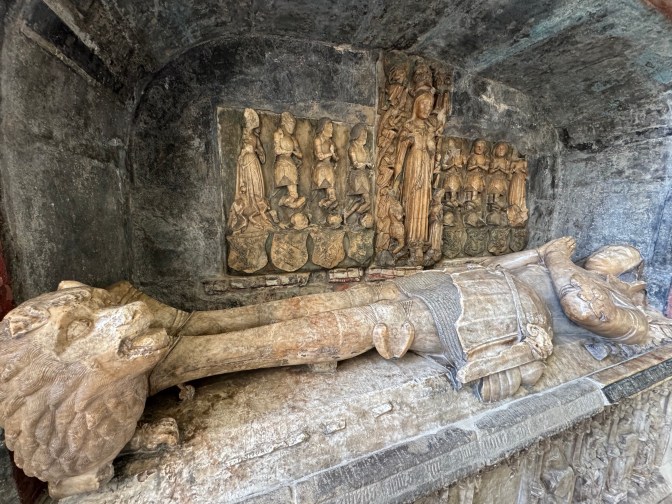
But his sword is broken. The blade and hilt gone, torn from his grasp by Cromwell’s iconoclasts when they ransacked the church, leaving only the ghost of its presence at his side. Whatever victories he claimed, whatever enemies he cut down, the weapon is dust now, and the man reduced to a little figure lying prone in the half-light. His hands are clasped in supplication, or in terror, and the angels above him keep singing. Whether they are welcoming him or warning him is left to the imagination.
I stand in the chapel looking down at these knights with broken swords, these ladies with missing noses, and the couples lying side by side in stone. These tombs were once statements; declarations of power, piety, and permanence. They were built to outlast the weather, the vandals, the centuries. And in a way, they have. But now they are just curiosities, something for wanderers like me to pause over, to imagine the lives they once contained, to feel the faint echo of human ambition and love.
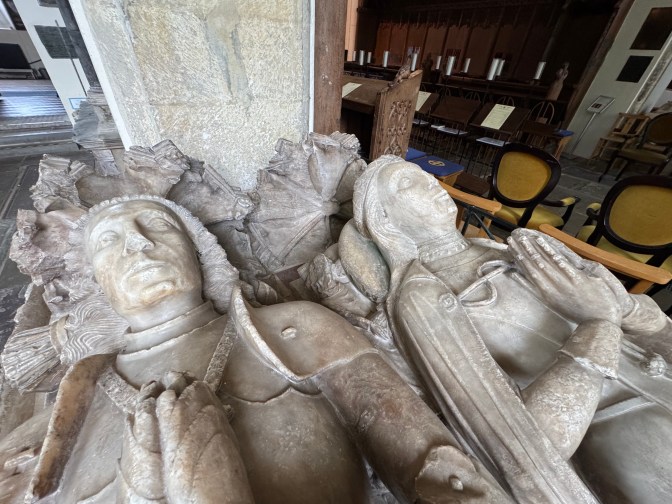
I wonder what will be left of us in five centuries. Our monuments are not carved from oak or alabaster, but built from pixels and code, flickering across servers that will one day be obsolete. Will a traveller in 2525 be able to scroll through our lives? Or will our digital footprints have blown away like dust across a churchyard? Will there be any riddles left to linger over, to puzzle at, to imagine us by?
Perhaps they will find fragments—an image without context, a line of text preserved by chance—and try to piece together who we were. Or perhaps there will be nothing left at all. Our age, like the age of these people, will be as silent as the stone faces here, the colours faded, the meaning forgotten.
But the hills will still be there. Rising behind the town as they always have, catching the rain, holding the light, watching in their patient way as the names change, the stones crumble, and the centuries turn.

 TravelWriterLife