I had not meant to find this place. I had meant to follow a path to the top of a hill. But the path forked when I was not paying attention, or the bamboo closed behind me and refused to give back the way I came, or—more simply—I was lost.
Not badly lost. Not the kind of lost that makes your heart beat faster. Just the gentle lost of a traveller who has walked too far without landmarks, who looks up and realises the sky has shifted and none of the ridges look familiar.
And then, through the trees, a roof curve. A wall. A door. Fànshān Temple.
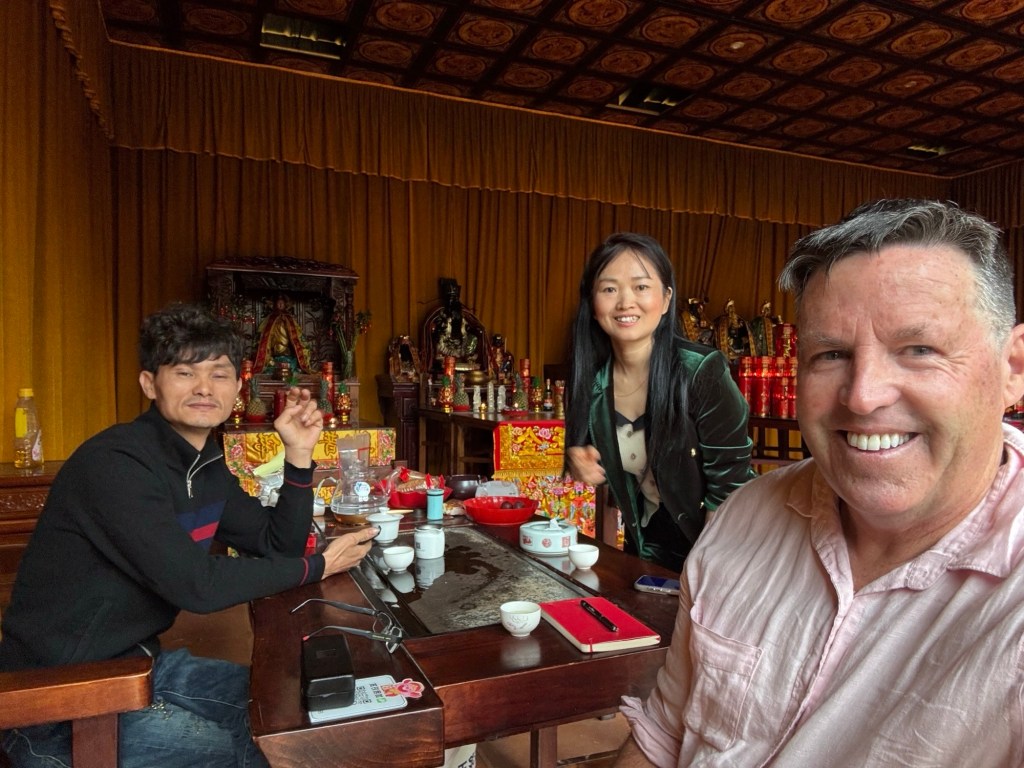
Two people are there. A woman—his wife, perhaps, or a fellow caretaker—and the man. He is the temple attendant. I learned that later, through gestures and the halting sentences of translation apps. He is thin and gaunt, but not old. His face is lined in a way that has nothing to do with age and everything to do with weather, with worry, with the particular strain of a life lived in a small temple in the hills. His cheekbones stand out. His wrists are narrow.
He chain-smokes. The cigarettes are cheap and he lights each new one from the stub of the last. The smoke curls around his fingers, around his face, around the space between us as we sit on plastic stools and try to speak. He does not seem to inhale so much as inhabit the smoke, to become part of its drifting, to let it carry his words where his voice could not.
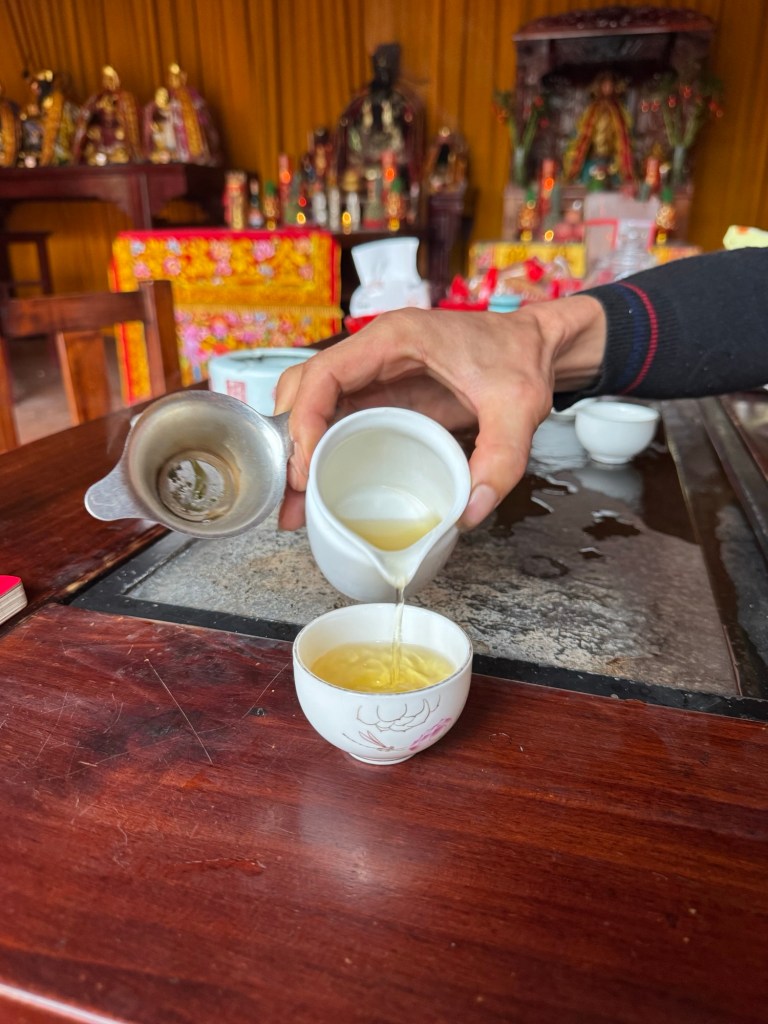
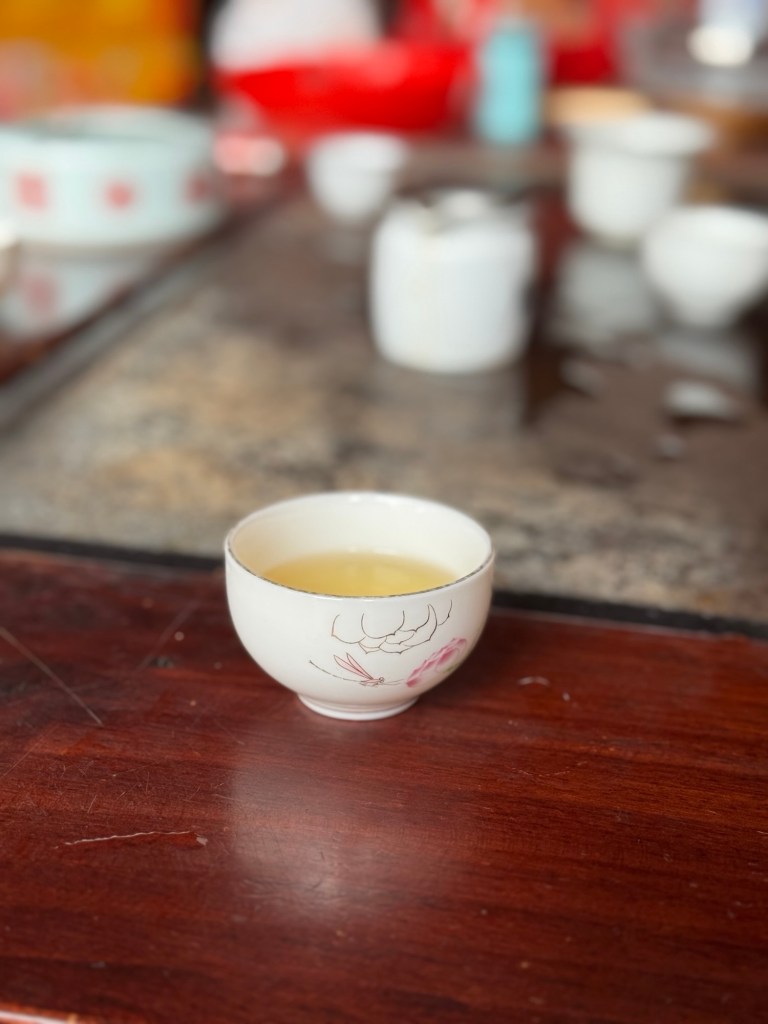
The woman does most of the talking. She is young, made-up, and wears a pant suit of green velvet. On her feet are red stilettos. She pours the tea. It is not special. Or perhaps it was. I cannot tell anymore. In China, every tea is special because every tea is offered. The pot is stained dark with years of use. The cups are small, ceramic, mismatched. The water is hot, poured from a thermos that had once been white but was now the colour of old bone.
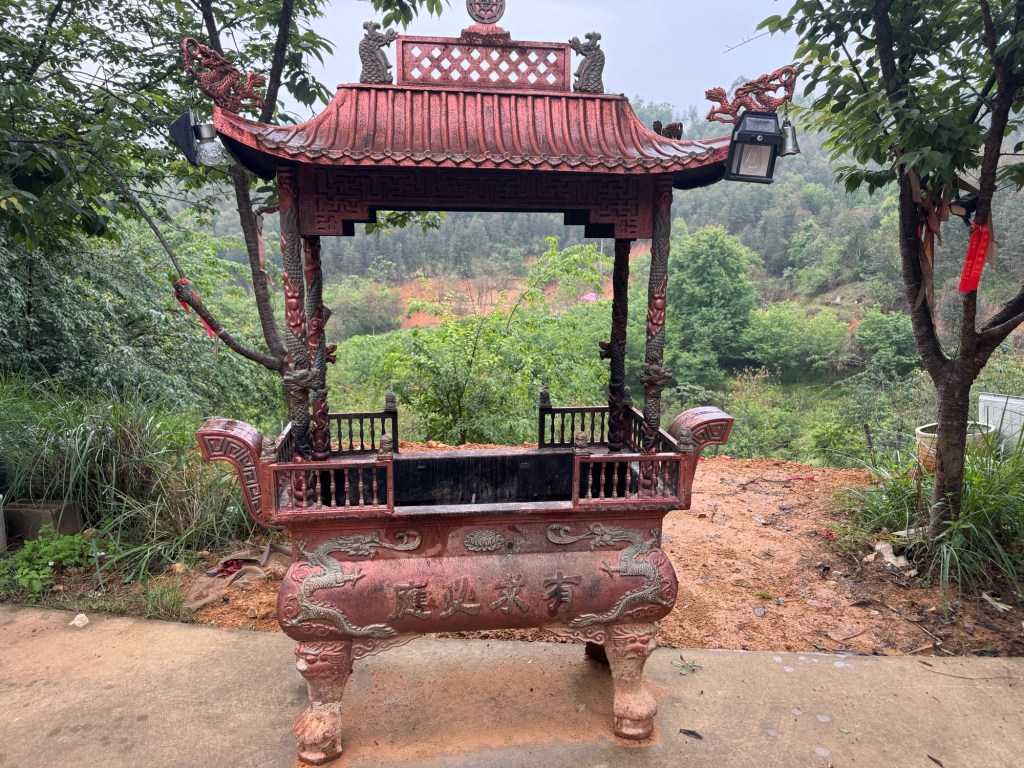
The temple is small: one room, really, with an altar and a few statues. The door is open to the hills. A breeze moves through, carrying the smell of damp earth and something flowering. And smoke. Always the smoke. From the joss sticks smouldering in the censer; from the prayer money burning in the xianglu outside; from the cigarettes.
The temple-keeper lights another cigarette. His hands—those thin, veined hands—strike the lighter, cup the flame, touch it to the tip. He inhales. He exhales. The smoke joins the incense already drifting toward the altar. I wonder if the gods mind. I decide they probably do not. The gods of a small hillside temple have seen everything. A chain-smoking attendant is hardly the strangest devotion they have witnessed.
We talk. Well…we try to talk. I speak my few words of Chinese. Nǐ hǎo. Xièxie. Hěn hǎo hē. They speak their few words of English. Hello. Thank you. Good. Between us, we hold our phones, translation apps open, thumbs moving, screens showing sentences that are mostly right and sometimes wonderfully wrong.
When the apps failed, we use our hands. Pointing. Miming. Laughter: the universal language, the one that needs no translation. The man laughs with his cigarette between his fingers. The smoke curls from his nostrils as he smiles. His teeth are stained. But his eyes are kind.
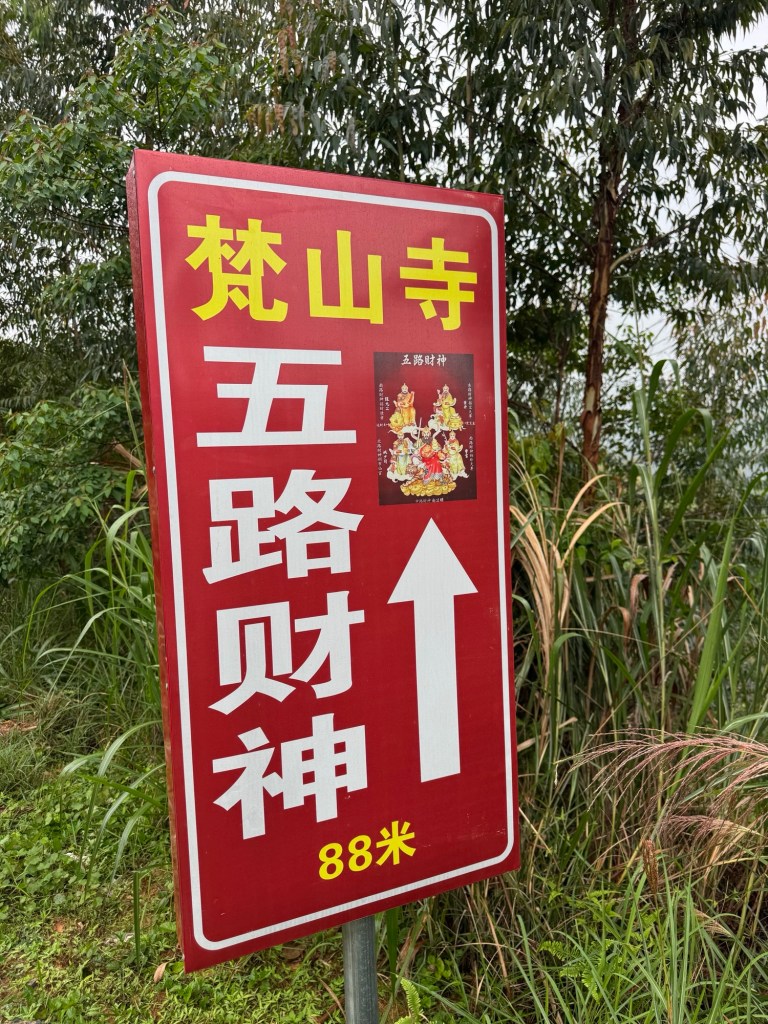
The plaque outside lists three things: 梵山寺, 五路财神, 88米. Fànshān Temple. The Five Road Gods of Wealth. And 88 meters, though I could not tell if that was the elevation, the height of a statue, the distance to something important, or simply a number that mattered to whoever carved the stone.
Inside, the Five Road Gods stand on the altar; five figures, each representing a direction, a kind of wealth, a blessing for those who travel or trade or simply hope for enough. Their painted faces are calm. Their hands hold ingots, scrolls, the tools of fortune.
We finish the tea. The woman gestures for me to follow. We walk together down a track, wet from the rain, the mud sucking at my shoes. She walks ahead, sure-footed, her green pants somehow staying clean. I stumble behind her, the foreigner with the blue umbrella, trying not to fall.
The goats found us first. They are tied to trees along the track: thin ropes, muddy hooves, yellow eyes that watch without interest. When we pass, they bleat, a strange sound, half cry, half complaint, echoing off the wet hills. She laugh. I laugh. The goats do not laugh. Goats do not.
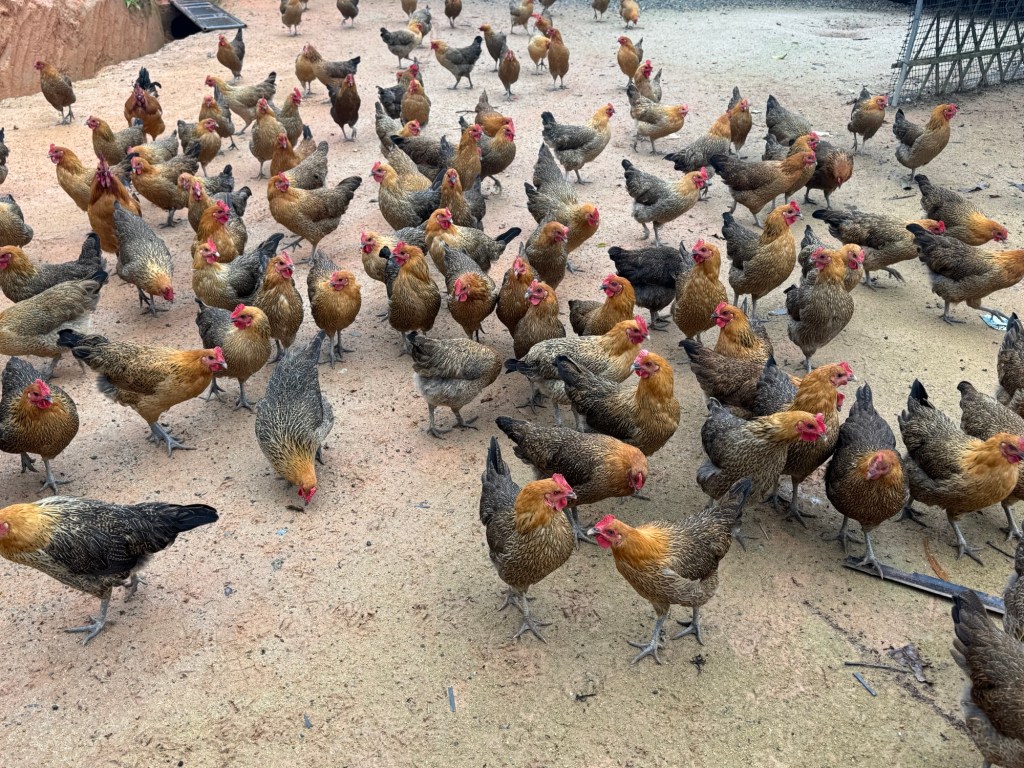
Then the chickens. A yard full of them, scratching, pecking, scattering as we approach. Red combs, brown feathers, the smell of wet earth and something organic. She steps through them as if they are leaves, as if chickens are simply part of the path.
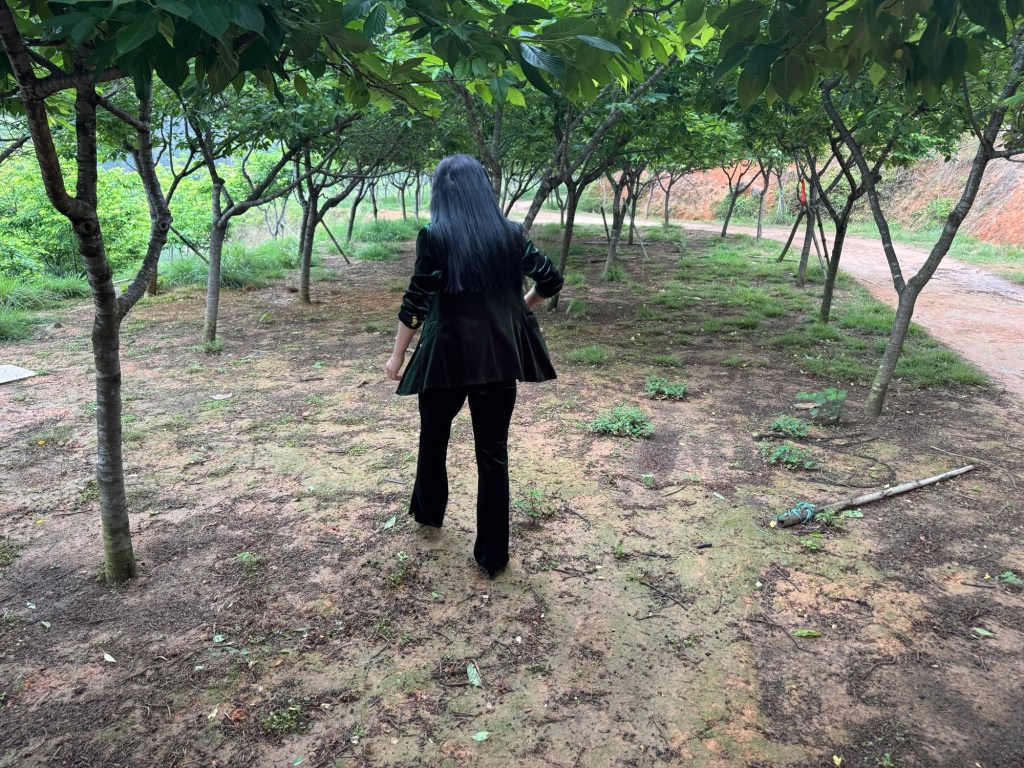
She shows me the fruit trees. She points and names each tree in Chinese: words I could not keep, syllables that slip away as soon as she speaks them. But I understand anyway. She is showing me what she loves. This small orchard, these trees, this muddy track below a temple in the hills. Her world. For ten minutes, she lets me stand inside it.
I look at the trees, the hills, the grey sky, the green velvet of her pant suit.
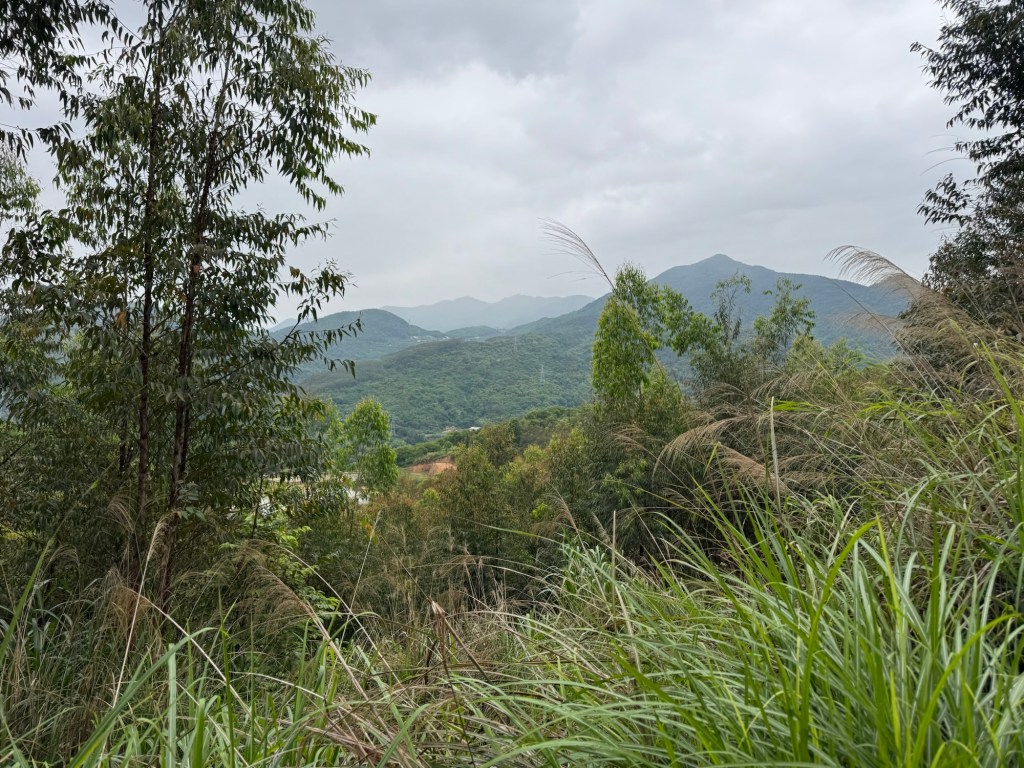
“Páo liàng,” I say. Beautiful. I mean the landscape. I mean the hills, the rain, the wet green of everything. But I could just as easily mean her.
She smiles. She understands. Or she doesn’t. Either way, the smile was enough.
Back at the temple, I say goodbye and set off downhill under my blue umbrella. The path is slippery. The mud is deeper now. The goats have stopped bleating. The chickens have returned to their scratching. The rain drips from the bamboo.
I walk alone. That is fine. I have stories to sort, sentences to shape, the small weight of unexpected beauty to carry.
And then, the girl is there beside me on a scooter. The same green velvet pant suit, now spotted with rain. Her hair damp. Her smile the same quick brightness.

She stops beside me. She gestures. Get on.
It is dangerous. The road is wet. The scooter has no helmet for me. The curves are sharp, the visibility poor, the driver a woman I had known for less than an hour. It is crazy; but I get on.
We ride downhill through the rain. Her back is straight. My hands hold the seat behind me; not her waist, not her shoulders, just the cold metal of the scooter’s frame. The wind pulls at my umbrella, still open, still useless. The rain finds every uncovered inch of me.
But I am not cold. I am not afraid. I am here: fully, completely, ridiculously here. On a scooter in the hills of China, behind a girl in green velvet, while the rain falls in torrents, and the road curves, and somewhere behind us, a chain-smoking temple attendant lights another cigarette, and the goats bleat at nothing.
This is the China that does not appear in guidebooks. This is the China that finds you when you stop looking for it. This is the China I’ll remember for the rest of my life.
We reach the bottom of the hill. The city. The road I know. She stops. I climb off. My legs are unsteady, not from fear, from joy. From the pure unexpected absurd joy of it. I bow and say xièxie: thank you. She swings her scooter into the traffic and is gone.
I do not know her name. I will never see her again. But I know what it feels like to stand on a muddy track in the rain, to say “páo liàng” and mean two things at once, to climb onto a stranger’s scooter and trust the curve of the road and the fall of the water and the small, wild kindness of a girl in green velvet who offered a ride to a foreigner who had lost his way.
This is not a story about China. That is a story about being human. But it happened in China. And that is why I keep coming back.