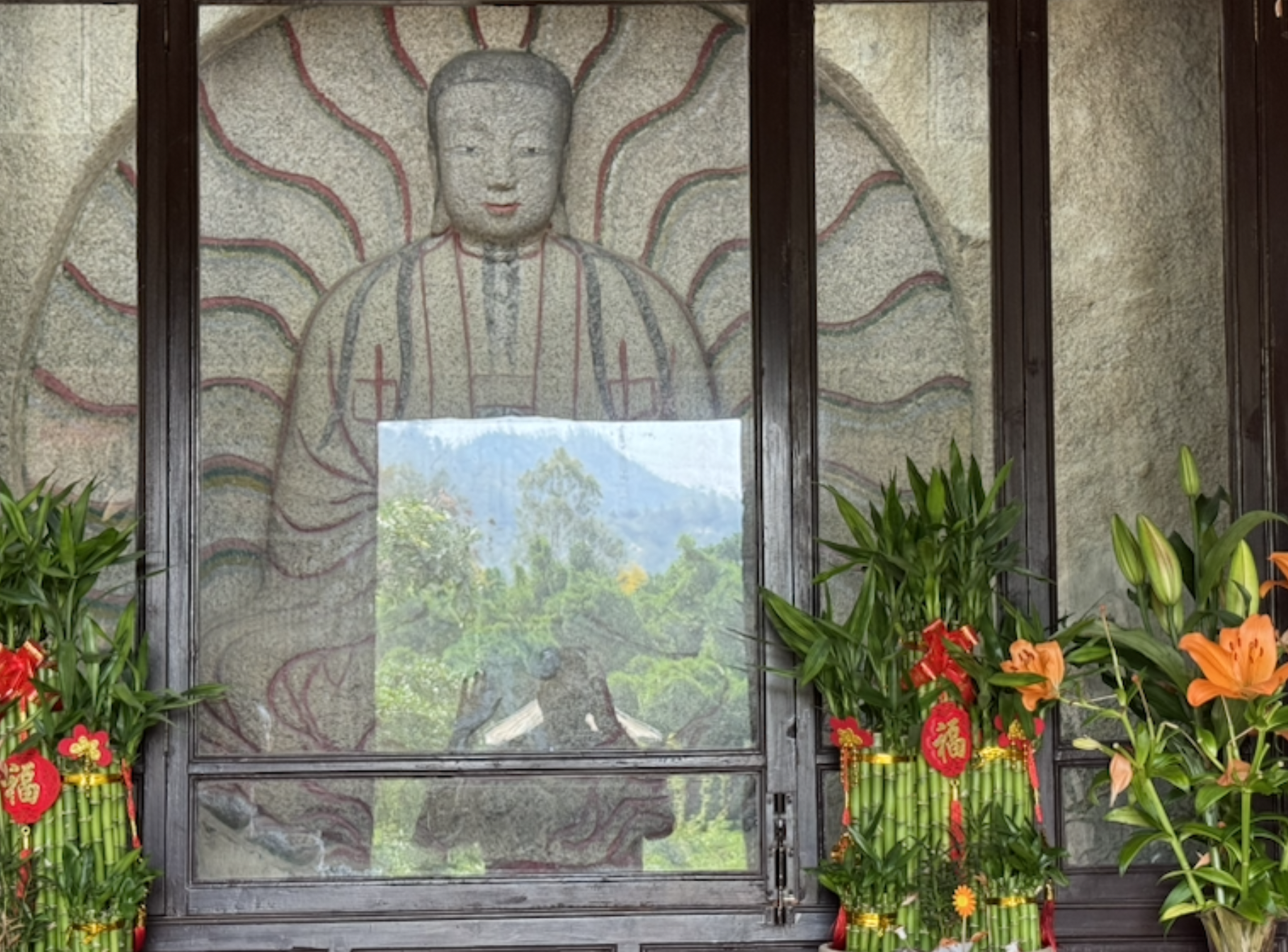
The Light is the first most glorious being,
limited by no number…
– Mani, as recorded in the Fihrist (the Manichaean scripture)
I did not expect to find Persia in the hills of Fujian. But here it is. On a hillside west of Quanzhou, in a small stone temple, a Persian prophet sits cross‑legged and serene, disguised as a Buddha, waiting for someone to recognise him.
The temple is small and nondescript: by Chinese standards, at least. No grand pagodas, no crowds of pilgrims, no gift shops. Just old timber beams, dark with age, and several small side rooms with window frames that time has warped out of shape. The flagstones are worn smooth. The air smells of moss and dust and the faint, sweet residue of incense.
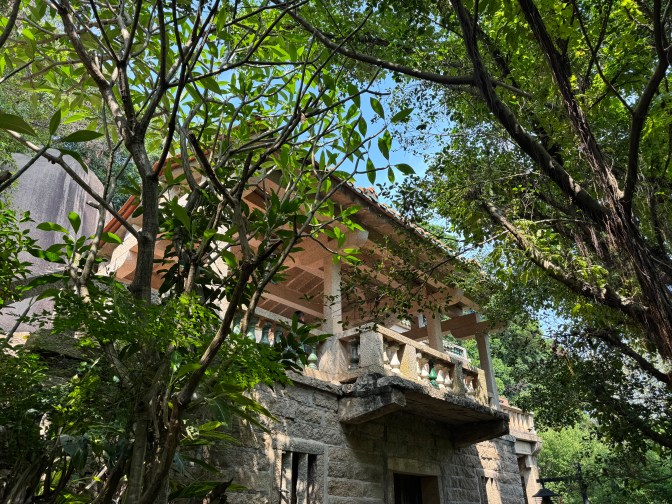
I have climbed to it through a cool forest of juniper and cypress. The trees grew close on either side of the path, their branches interlaced above me, filtering the afternoon sun into soft coins of light. The air was damp and clean, and the only sound was my footsteps on the fallen needles.
Beyond a cypress that has been growing for a thousand years—its trunk wider than my arms could reach, its roots gripping the rocky soil like old hands—the path opened, and the temple appeared.
The temple attendant is a woman in her fifties. Perhaps. It is so hard to tell with faces that have lived so long in this cool, quiet place. Her hair is pulled back. Her clothes are simple. Her eyes are bright and quick. She watches me hesitate at the door, and she smiles, gesturing for me to enter.
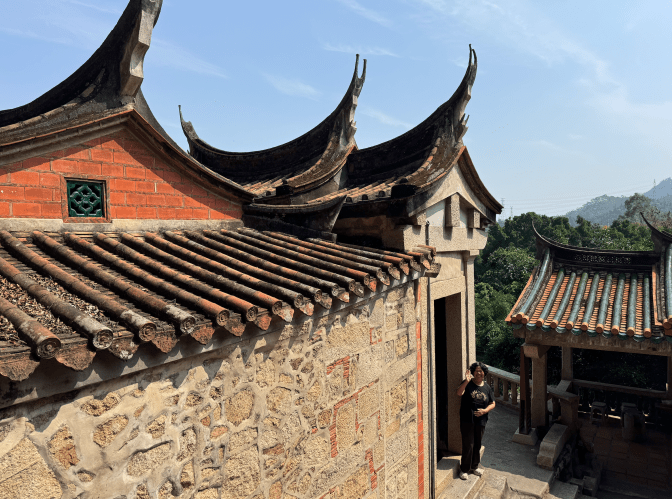
And then, with a passion that surprises me—her hands moving, her voice rising and falling—she explains the story of Mani. She speaks in Chinese, and I understand only fragments, but her meaning is clear. This is a holy place. This man was a prophet. He came from far away, and he found a home here.
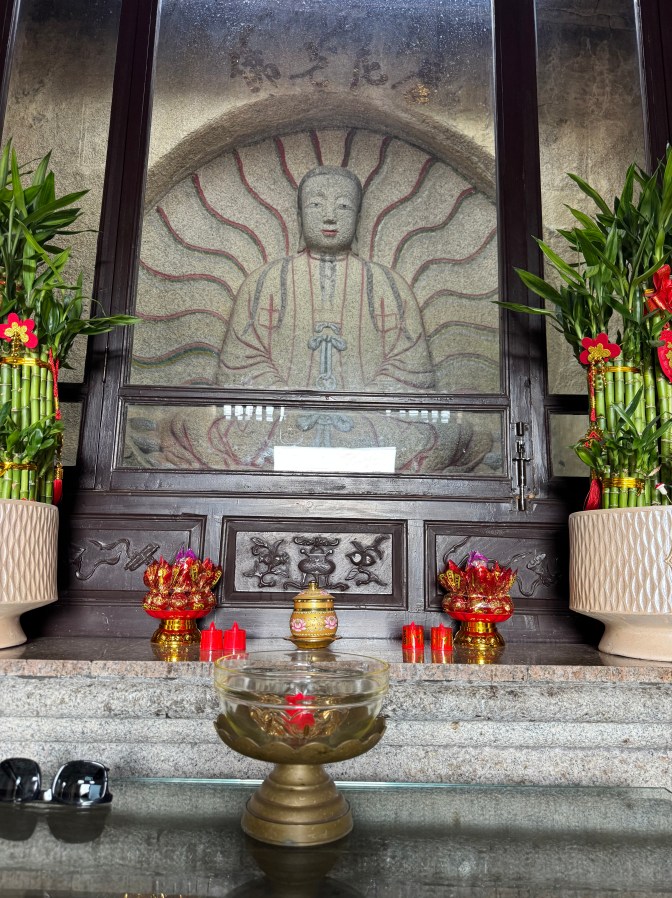
She points to the statue. She touches her own cheek. She wants me to see. The carving itself uses the colours and textures of the granite as a foundation. The sculptor did not paint over the stone. He revealed what was already there.
The face of Mani is pale pink: the natural blush of the granite, warm and soft, almost alive. His expression is radiant and beatific. His eyes are half‑closed, his lips curved in a gentle smile that holds no irony, only peace. The white of his hands is the white of the stone itself, unadorned, pure.
His straight hair falls to his shoulders. A neat beard frames his face. His hands rest in his lap in a gesture that is not quite a Buddhist mudra: close, but different. A secret signal for those who knew how to read it.
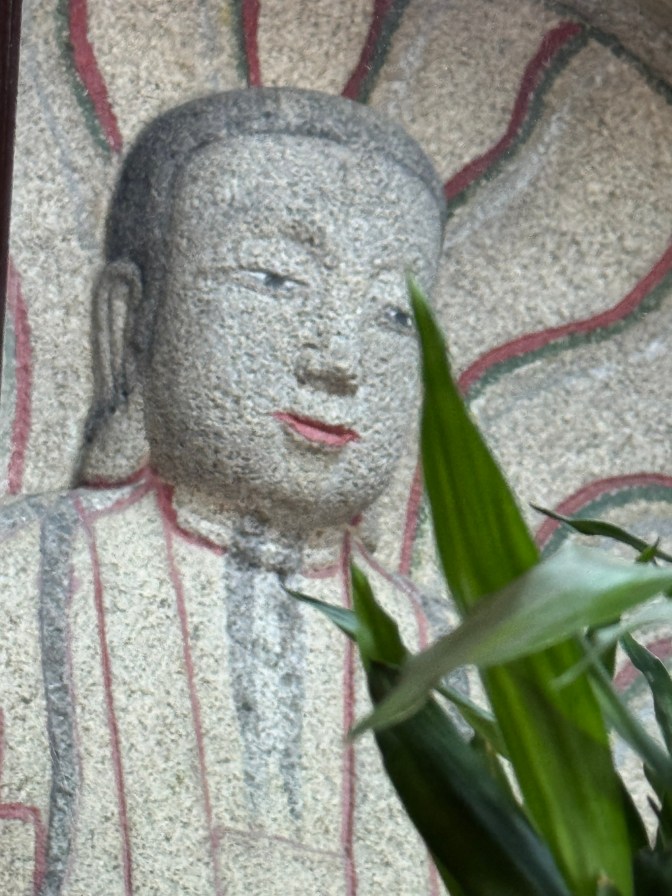
For six hundred years, no one knew. For six hundred years, worshippers lit incense before him, called him by a Buddha’s name, offered him the prayers meant for another god. And he accepted them. Because a god in hiding cannot afford to be particular.
His name is Mani. He lived in the 3rd century. He founded a religion—Manichaeism—that once stretched from Rome to China. And then, almost everywhere except here, it was erased.
Manichaeism was a complex ascetic system built on a very old idea: the world is a battlefield between Light and Darkness, Good and Evil. Mani taught that our souls are made of light, but that light has become trapped in the prison of the material world. The goal of life is to help free that light—through fasting, prayer, and a vegetarian diet—so it can return home to the realm of Light. His followers were divided into two groups: the “Elect,” who lived lives of harsh self‑denial, and the “Hearers,” who supported them and hoped to be reborn as Elect in the next life.
In its own time, Mani’s religion was a real competitor to Christianity. The young Augustine of Hippo was a “Hearer” for nine years before his conversion. Missionaries carried Mani’s message along the Silk Road, all the way to the Tang Dynasty capital of Chang’an, where it was known as the “Religion of Light” (Mingjiao). But it was not welcome everywhere. Mani himself was executed in Persia around 276 CE, and his followers were soon scattered by persecution.
But in China, they survived in a clever disguise. They hid their faith within Buddhism, and hid Mani himself on the altar, dressed as a Buddha, holding his hands in a way that looked like Buddhist mudras. And here, in this lone mountain temple, he stayed hidden for six hundred years.
Today, he is the only one left. The last Mani in the world, carved in granite, sitting in a stone chamber on a mountain in Fujian, while the wind blows through the pines and the sun sets over the valley. He does not seem lonely. He seems patient.
As I am leaving, the temple attendant presses something into my hands. A small bundle wrapped in brown paper: sixteen sticks of sandalwood incense. She smiles and says a few words I do not catch, but her gesture is clear. Take these. Burn them. Remember.
Then she hands me a postcard. Someone had left it as an offering on the side altar: a picture of the temple, faded and slightly curled at the edges. Postcards are not really a thing in China, and I have promised my cousin in England that I would send him one.
The sandalwood waits. The postcard has crossed the ocean. And in a small temple in the hills of Fujian, a woman in her fifties is telling the story of Mani to another pilgrim. The incense sticks came home with me. I have not burned them. Not yet. Some scents are meant to be held, not released. Kept like a promise. Kept like a secret. Kept like the long patience of a Persian prophet who disguised himself as a Buddha and waited six hundred years to be seen.