There is poetry in the old bridges of Wales, England, and Scotland. While castle walls and stately homes draw the tourist crowds to ogle and gasp, bridges are more workaday.
At dawn, I let myself out of the room. I have my gear in a heap by the door with my shoes and clothes. I dress quietly — my family are all sound asleep — and lift the door latch, which opens with a soft click. I step out onto the first-floor landing and descend the stone stairs to the backyard of the Horse Shoe Inn. Llangattock, like my wife and daughter upstairs, is still sound asleep on this Monday morning. I walk under the roof of the old coaching stable out onto Hillside Road and downhill towards the River Usk.
At the foot of Hillside Road, I cross the A4077 to the Crickhowell Bridge. This graceful stone bridge, with its odd-numbered arches — 12 on the upstream side, 13 on the downstream — has spanned the Usk since 1706. Built from rubble masonry, with flat coping stones on the parapets, the bridge replaced an earlier timber structure that had stood on the site since the early 16th century. It is reputedly the longest stone bridge in Wales but, like all such claims, this is a hotly debated notion. But whatever its status lengthwise, as I walk to the bridge’s mid-span I fall in love with it.
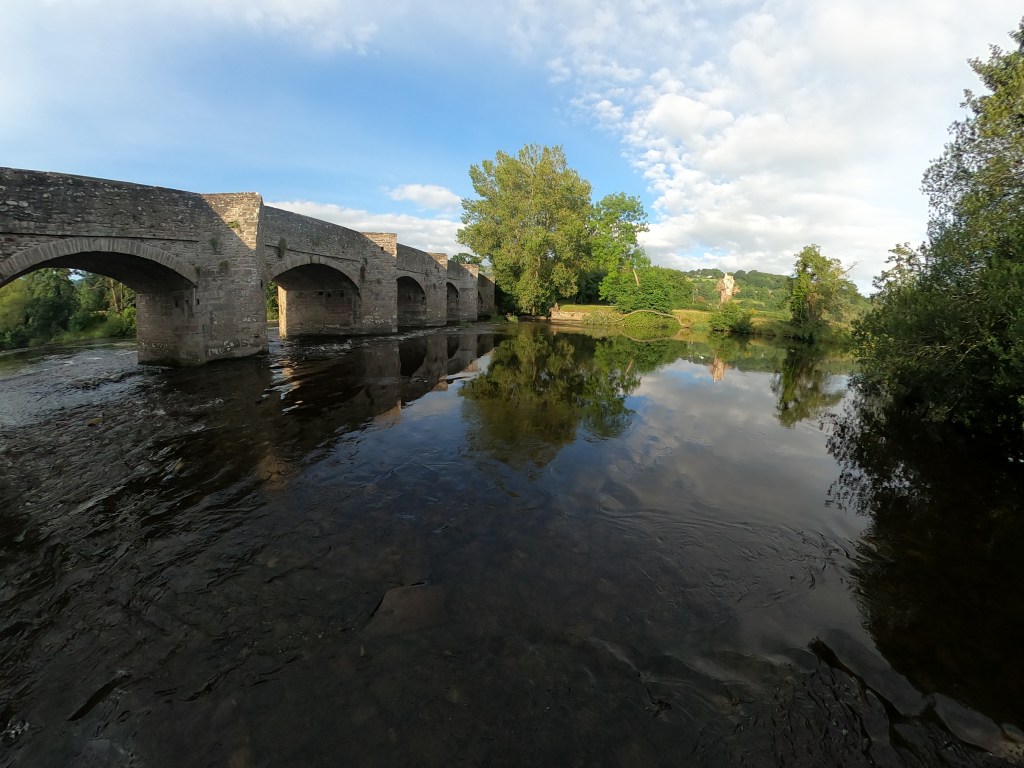
There is poetry in the old bridges of Wales, England, and Scotland. While castle walls and stately homes draw the tourist crowds to ogle and gasp, bridges are more workaday. They have shouldered the burden of horse-drawn carts, six-in-hand coaches, motor cars, flocks of sheep, sluggardly oxen, nobility and quality on high-stepping horses, squeaking bicycles, creaking jalopies, stately draught horses bedecked with ribbons on their way to and from the ploughlands, trucks, omnibuses, and tractors. Their antediluvian arches and cutwaters have stood resolute against the spate of winter floods. Their spans echo down the centuries with the footfalls of generations: farmers, villagers, moonlit lovers, staggering drunks, marching armies…and the occasional Antipodean dreamer.
Bridges tell stories. You only have to listen to the rhythm of their daily crossings, the echoes of hurried steps, the rush and rattle of wheels, the clip-clop of slow treading hooves, and the periodic rush of water around their piers. The Crickhowell Bridge murmurs these tales of the past with every sighing breath of wind that moves through its portals. As I stand midspan, I can hear the gentle rustle of the river as it cascades over the low weir on its downstream side. The sound seems to intertwine with the whispers of history, sweeping me backward and forward through time, with the bridge as a fulcrum upon which I balance. This bridge has not just connected the twin banks of the Usk, but communities and lives. It has witnessed silent farewells, joyful reunions, and the steady pulse of daily existence beneath the southern edge of the Black Mountains.
Upstream, the river lies sleek and glossy in its frame of sycamores and alders. I remember the lines of a poem written on an old ceramic milk jug my mother had: “Smooth is the water where the brook runs deep”. After the briefest of interruptions to its calm flow, as it eddies around the bridge’s footings and tips over the weir, the river regains its composure. It continues sedately eastwards, past Abergavenny and Newport, to fall gently into the Bristol Channel and the Atlantic.

Standing on the bridge at Crickhowell, I am briefly part of this liquid chronicle that takes the rain of the Brecon Beacons and the Black Hills down to the sunlit sea and out into the ocean. But even though the river and the bridge hold me spellbound for a moment, it isn’t what I have set out to see this morning. I leave the river to its reflections and set off up Bridge Street towards the heart of Crickhowell and its beckoning back streets.
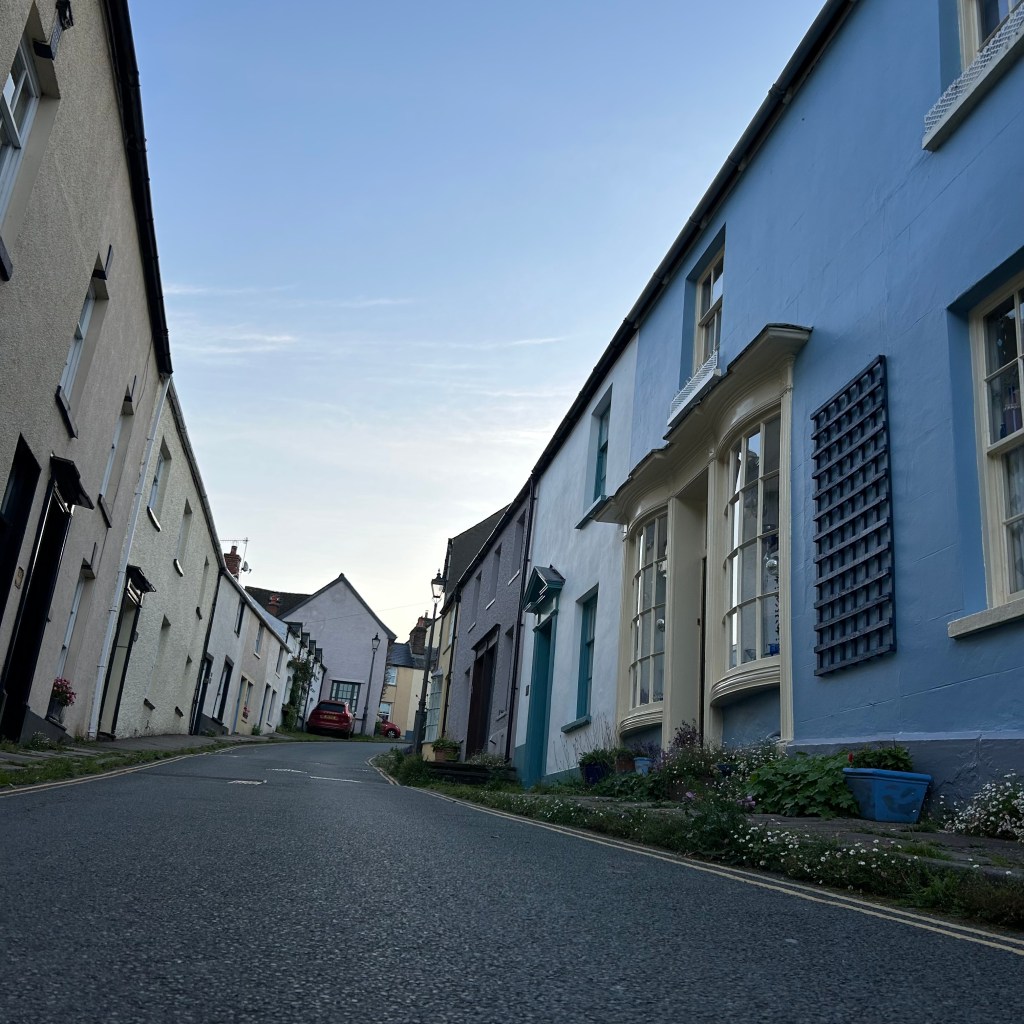
Crickhowell is a town of colourful doors. As a matter of fact, Wales, in general, is a country of colourful doors. People live cheek by jowl in rows of terraced houses on the narrow lanes and streets of the country’s villages, towns, and city centres. And in these rows and rows of homes, it is the doors, which often open directly onto the pavement outside, that people embellish with their personal flair in the form of window boxes, ornaments, and colourful doors.
In New Zealand, where I come from, houses are built on discrete sections, with each home being surrounded by its own grassy moat (so to speak) that separates it from its neighbors. There is a staid, uniform sameness about the houses of New Zealand, a feature that inspired the American travel writer Paul Theroux to describe the country as “a bungaloid sort of place.”
But here in Crickhowell, the rows of terraced houses possess a charm and character that appeals to me. Nestled together along winding streets, each home, although part of a contiguous structure, discreetly displays its unique personality through vibrant doors and elaborately decorated facades. The intimacy of their arrangement, with neighbors just a wall away, fosters a sense of community and belonging that the isolated suburban layouts of New Zealand seldom offer. To a visitor, these terraced houses, with their quaint features and proximity, offer a glimpse into a homely, interconnected lifestyle that is both appealing and novel.

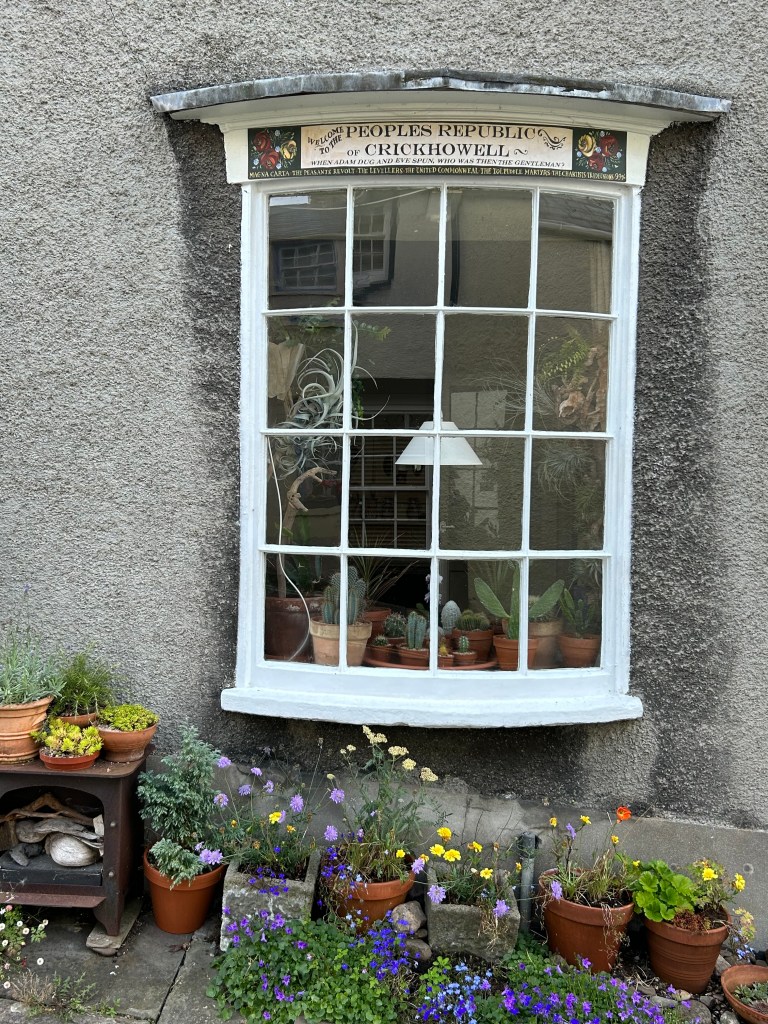
Number 33 has a yellow door with black-painted, wrought iron hinges. Next door, Number 35 has two bottles of fresh milk with red caps sitting in a wire basket beside the step. Further up the street, Number 40 has a bow window behind which sits an array of succulents. A motif across the top of the window reads:
Welcome to the PEOPLE’S REPUBLIC OF CRICKHOWELL
When Adam dug and Eve spun, who was then the gentleman?
MAGNA CARTA THE PEASANT’S REVOLT THE LEVELLERS THE UNITED COMMONWEAL [sic] THE TOLPUDDLE MARTYRS THE CHARTRISTS TRADE UNIONS 99%
Whoever lives there, I’m sure, is great fun at parties.
Queen Anne Cottage, has a pale blue door framed by white-painted Doric columns surmounted by a small pediment. The columns and the pediment are built from wood to imitate the traditional stone of classic architecture. This is also a common architectural detail used in colonial building construction in New Zealand, where wood was plentiful and easy to work while stone was expensive and time-consuming to shape.

I follow Bridge Street up to its junction with Castle Road then turn left onto High Street. Mortimer House, which has pale blue Doric columns framing its white door, is for sale. The Dragon Inn is still closed at this early hour; so is Pete’s Florist and Maison 50. But Grenfell’s and Son’s, greengrocers and off-licence, is already doing a brisk trade. There are boxes of colourful fruits and veggies stacked up on the pavement beneath the shop’s three-storey Tudor-style facade. I buy an orange juice and chat with the shopkeeper for a few minutes.

Outside, the sun is already bright on the street. Bunting, flags, and hanging baskets overflowing with a colourful profusion of flowers hang from every building. Old men stroll to get their morning papers. Tradies roar past in trucks and vans. I stop outside MT Cashell – Family Butchers, to admire the superb meat and vegetables displayed in the window. There are haunches of deep red beef, twirling piles of sausages, blue-stamped lamb legs, gleaming pork pies arranged in rows, stacks of shimmering green and white leeks, pork roasts encircled with yellow rind, boxes of oranges fresh from Mediterranean orchards, rib-eye steaks marbled with pure white fat, spices, pickles, eggs, and oils…a cornucopia of good food for the good life.
(Later, we would return to Cashell’s to buy provisions for our stay in Snowdonia.)

Further along, at the market cross, where the A40, Standard Street, and High Street intersect, a slender monument surmounted with a stone crucifix, commemorates one John Lucas, born in 1873, a local notable of some sort. The nearby Bear Inn is draped with so many baskets of flowers that it looks like a display put together for the Chelsea Flower Show.
With the backdrop of muscular, bracken-clad hills rising behind the town, the sheltering sky draped with random clouds and an ethereal vapor trail, the shimmering sunlight, and the drenching array of colour, I feel as though I am swimming in a Monet or a Renoir. It is one of those moments that I experience occasionally when I am travelling: a feeling of overwhelming disbelief at the sheer wonder of the world and how lucky I am to be able to experience it.
Later today, we will head north into the sublime landscapes of Snowdonia. But for now, I am content to wander the back streets of this lovely Welsh town, caught up in the colour pageant of hanging baskets, blue sky, white walls, and the doors of Crickhowell.


 TravelWriterLife