I love the element of danger
and the ecstasy of flight…
– Chris de Burg, I Love the Night
It’s 21:30 in Sydney, and we’re aligned on runway R16. Beyond the perimeter of Kingsford Smith Airport, the city is sparkling under a crisp winter sky. I am seated in 78D onboard an Emirates Airbus A380. Viewed from windows of the terminal, the A380 had looked like a giant. From here inside, it feels like a cathedral.
The soft whine of the Rolls-Royce engines deepen into a muted roar as they spool up to operating speed. The brakes release and the aircraft begins to move: ponderously at first, then with growing elan and confidence.
Something quietly extraordinary is unfolding on the seatback screen: the aircraft’s Heads-Up Display (HUD). This glowing, green overlay of our flight path is being fed to my screen straight from the flight deck. While most passengers are selecting movies or spreading their blankets, I’ve tuned into the flight’s most hypnotic channel. It feels like eavesdropping on the digital thoughts of the aircraft itself.

On the HUD, the airspeed tape begins to climb: 60 knots, then 80, then 120. VR flashes. Rotation. The nose lifts. I feel it gently, subtly, but on the HUD it’s unmistakable. The pitch ladder dips, the artificial horizon slides downward, and the flight path vector—a small, floating symbol—rises just above the line of the horizon.
We’re airborne. A clean, deliberate ascent into the night.
As we bank left over Botany Bay, the HUD’s horizon line rotates right, which feels counterintuitive until I remember: the HUD shows the world turning around the aircraft, not the aircraft itself moving. It’s the Earth that tips on the display. The aircraft remains centred.
The numbers and symbols on the HUD dance and flutter as we climb. At 13,270 feet, the Vertical Speed (VS) shows a positive climb rate of 689 feet per minute. The wind vector, a pair of arrows at right angles to each other shows 45: a combination of side wind and downdraught. Our heading swings round to 300 degrees, a point under west north-west. The airspeed is at Mach 0.602: just over half the speed of sound. It would be slightly faster if it wasn’t for the headwind, currently reading 34mph.

Hours pass. The cabin darkens, stars appear over the wing, and a soft hush settles in. The A380 slices through the night at 38,000 feet. On the HUD, we are now at Mach 0.84, cruising in a narrow band of deep time and quiet sky.
There’s almost no movement. The pitch stays level, vertical speed holds at zero, and the HUD’s data pulses with a kind of quiet confidence. A steady wind vector indicates a 72-knot headwind, gently slowing us across the vast Australian interior and into the night above the Indian Ocean.
Later, high above the Java Sea, ripples of turbulence briefly interrupt the smoothness of the flight. Outside, lightning flickers as friction and static electricity combine to bounce the aircraft around with the same effortlessness that a storm bounces a raindrop. The HUD shows a slight banking turn to port, bringing our heading to 295*. The VS dips to -180 momentarily, then returns to zero.
The wind vector shows 36, comprising a tailwind of 32 and an updraft of 4. It’s a simple equation for the onboard computer: √(32² + 4²) ≈ 35.6. It is just one of thousands of calculations the aircraft’s digital brains are working on every second, working out the values of drag, the coefficients of motion, and the geometry of lift.
The outside air temperature is a life-hostile -57°C. Inside, protected by a few millimetres of aluminium and high-density glass, it is warm and comfortable. Watching the HUD feels like watching the reassuring heartbeat of a creature designed for the thin blue line between Earth and space.

Most passengers sleep. I sip water, stretch my legs, and return to the HUD: my window into the cockpit’s mind.
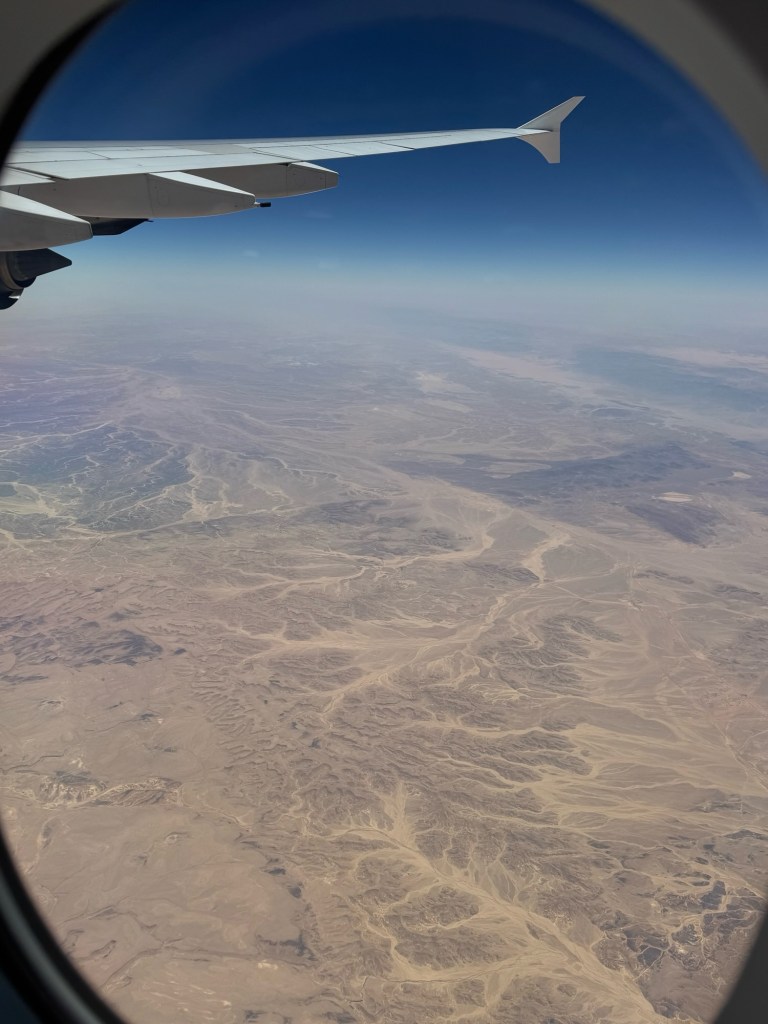
Forteen hours after takeoff, the cabin lights return. Curtains are drawn back. The window shades lifted, seats returned to upright, seatbelts tight. We are descending into morning in Arabia. There’s a faint golden glow seeping into the edges of the window, as if the invisible desert below is evaporating some of its colour into the sky.
The HUD shows VS -1,400 fpm. The flight crew are managing our glidepath with the same precision they maintained at cruise. The pitch drops slightly, and the flight path vector descends just below the horizon. The aircraft lowers itself gradually toward Dubai like a glider made of light and engineering.

Through the screen, I can see the ILS symbology come alive: vertical and lateral indicators guiding us exactly onto the glide slope. Below, the desert emerges in soft ochre hues. The towers of the city shimmer in the haze, their shadows still long in the early light.
Flaps deploy. Speed brakes flutter. The aircraft adjusts its stance like a giant bird preparing to land.
The flight path vector locks onto the runway threshold. There’s no bounce, no drama. Just a gentle kiss of wheels on tarmac. The airspeed numbers race down as we decelerate. And then, we’re taxiing in the morning sun.
Most passengers barely notice the HUD. To them, flying is an experience of movies, meals, naps, and the occasional glance out the window. But for me, it’s also about this quiet stream of information: the hidden language of motion.
It’s beautiful, in a way that numbers can be beautiful. Elegant. Transparent. Honest. Watching the HUD during a flight like this turns the journey into something deeper, more thoughtful. The HUD isn’t just for the pilots. It’s a kind of poetry for those who choose to read it: the shape of motion, rendered in digital light.
This wasn’t just a trip from Sydney to Dubai. It was a lesson in aerodynamics, a quiet conversation with the sky, and a glimpse into the geometry of lift and the precision and grace of modern flight.
While others watched thrillers or slept in reclined seats, I travelled with the aircraft, not just in it. The HUD was my companion across night and desert, longitude and altitude, silence and dawn.
And now, wheels down, I carry with me a memory of the journey itself, seen through the calm green eyes of a machine that never blinked.

 TravelWriterLife