North of Abergavenny, the road winds beside the River Honddu. I am deep in the Black Mountains, following the narrowing lanes of the Vale of Ewyas, where the sky seems to press down low and the hills draw in close. It’s a place that feels removed from the rest of Wales, hidden in the folds of the land as if the monks who came here were seeking not just solitude, but erasure.
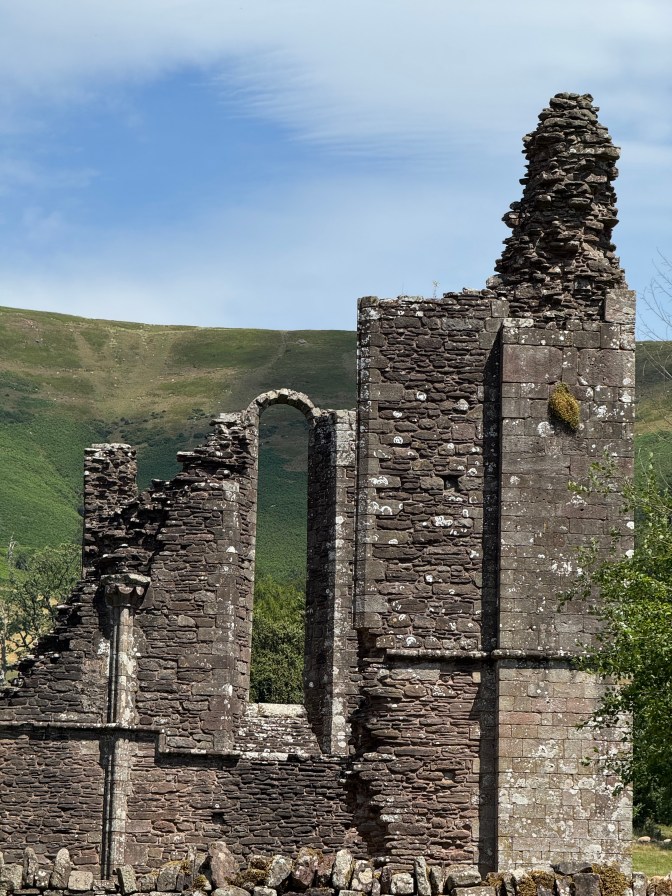
The priory appears suddenly—half in ruin, half in shadow—as though it has risen from the earth itself. The surrounding hills form a vast amphitheatre, each ridge and fold reflecting the broken symmetry of the priory’s arches and towers. These aren’t just hills; they’re a congregation. And Llanthony stands at their centre, the altar to a forgotten order.

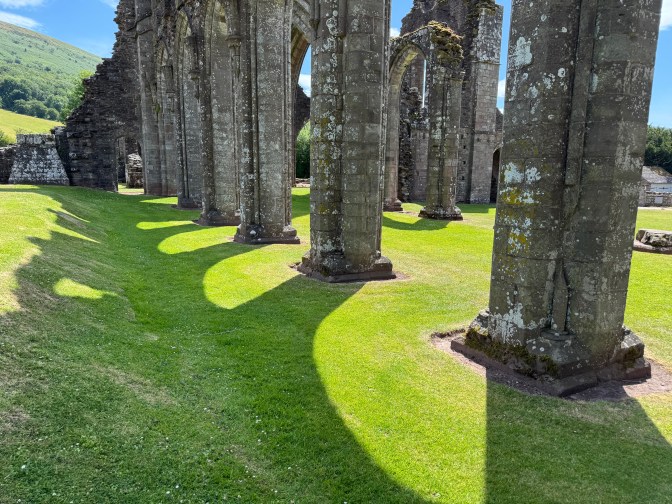
The sun is high, and the air is still. The only sound is the distant bleating of sheep and the whisper of the breeze against the long grass in the field beyond the stone wall. I amble beneath the great stone columns, the grass underfoot soft and impossibly green. The arches cast shadows that fall in perfect curves onto the lawn, mirror-images of the stone itself, like ghosts of a building that once stood whole.
It’s the shadows that strike me most. As the light shifts, they move like the hands of a great sundial, marking the slow passage of time with quiet precision. Each arch throws a crescent of darkness across the grass, a reminder of what was once roofed, vaulted, and occupied by chants and footsteps. Now there is only silence, and the echo of that silence in the contours of the hills around me.
In its heyday, Llanthony Priory was home to several dozen monks, lay brothers, and novices. Their day began early, not with alarms, but with bells. At first light—prima hora—the monks would rise, called from sleep by the tolling of the bell tower, its sound drifting through the cloisters and across the valley like a summons from God himself. No need for phone screens or smartwatches. Time was not a number. It was a rhythm. Light and darkness. Prayer and silence. Work and rest.
I try to imagine it as I stand here, my phone buzzing quietly in my pocket with a message I won’t read. The satellite above my head knows exactly where I am—51.9633° N, 3.0414° W—but I feel more lost than found.

The monks would gather for Matins in the cold hush of morning, their breath clouding in the air, voices rising in chant that echoed through the stone like water finding its level. Then came Lauds, and Prime, and the slow march of the day through Terce, Sext, None. Each hour marked by bells, each interval given to work, reflection, or prayer. The tasks were humble—tending gardens, copying texts, mending roofs—but each carried the weight of devotion.
I check the time: 10:48 a.m., Greenwich Mean Time, synced by atomic oscillations accurate to a fraction of a second. But what, I wonder, is the meaning of time now? I can cross continents in hours, talk to friends in other hemispheres, and check the weather in Patagonia. But here in the shadow of these ruined arches, time feels slower. Truer.

Vespers would come with the falling light. The monks would sing again. Latin harmonies rising toward the beams of the timber ceiling and the arched cornice of the tower. The same one I stand under this morning, running my hand along the carved curve of a medieval truss. At night, under the stars, they would say Compline and sleep. Not just to rest, but to surrender; to give the day back to God.
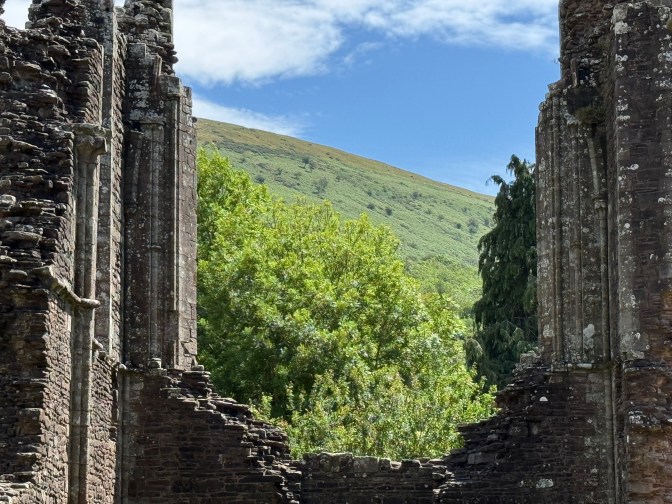
I hold my phone up and take a photo of the archway, framing the hills beyond. The device maps the image with metadata, location, and light values, as though it could capture what this place really is. But it can’t. Llanthony is a memory of time kept by bell and candlelight, where shadows were the only clocks, and the day unfolded like a prayer.
I slip the phone back into my pocket. And listen for a bell that will never ring. Because it wasn’t all silence and sanctity. The monks of Llanthony, for all their vows and visions, were not left in peace.
This was still the borderland, the Marches: a wild, uncertain country where the line between prayer and peril was wafer-thin. Gangs of Welsh bandits roamed these hills like ghosts; godless marauders who saw no holiness in Matins, no sanctity in Lauds. To them, the priory was not a house of God but a convenient storehouse, full of sheep, grain, valuables, and the soft men who kept them.
Time and again, the monks were raided. The priory’s flocks were scattered or driven off under moonlight, the sound of hooves lost in the wind. Chalices, manuscripts, anything that glittered or promised use was stolen. Sometimes it was worse. Sometimes there was blood. Monks beaten or killed, their quiet lives ended in violence that echoed through the arches far longer than any chant.
The hills that now seem so protective—green and embracing—once hid blades and anger and hungry eyes. And the monks, in their wisdom or their weariness, did what others in troubled lands have always done: they fled.
Not all at once. But the heart of the community shifted. A new foundation, safer and more sheltered, grew up near Gloucester Cathedral: Llanthony Secunda, Llanthony Minor. There, the monks could breathe again, closer to the structures of power, behind city walls.
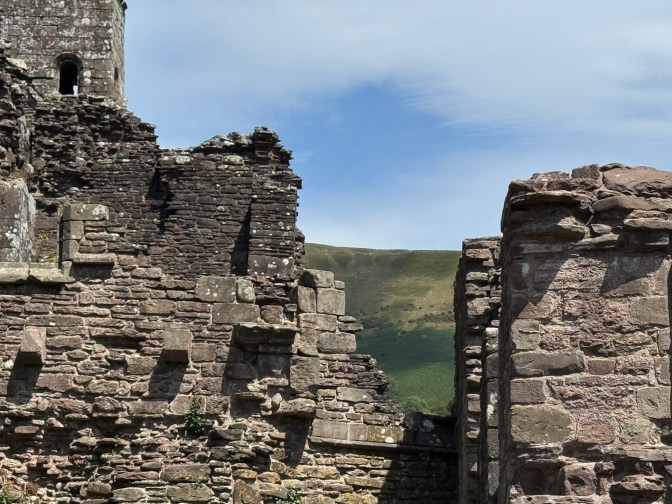
And so the priory here, the original Llanthony, began its slow decay. Some monks stayed behind. A few still prayed in the cold choir, still lit candles, still tilled the gardens. But the great pulse of the place—the full weight of daily liturgy, the shared life of cloister and refectory—diminished. Over centuries, the wind and rain took what the bandits didn’t. The arches remained. The columns. The empty windows staring out across the grass like the sockets of a long-dead saint.
It’s peaceful here now. Almost impossibly so. I stand beside one of the great pillars and try to imagine the moment when hoofbeats thundered through this quiet valley, and the bell in the tower rang not for Terce or Sext… but in warning.

Across the courtyard from the priory, I step inside the tiny church. It’s still in use, preserved and plain, with rough limewashed walls and a wooden ceiling that’s part barrel vault, part truss. The timber ribs curve and criss-cross like the hull of an upturned ship: some medieval carpenter’s vision of heaven, shaped by the tools of the earth. The air inside is cool and thick with dust and silence. Memorial plaques line the walls, and a single thread of light falls from the high window onto the stone floor, illuminating nothing in particular and everything at once.

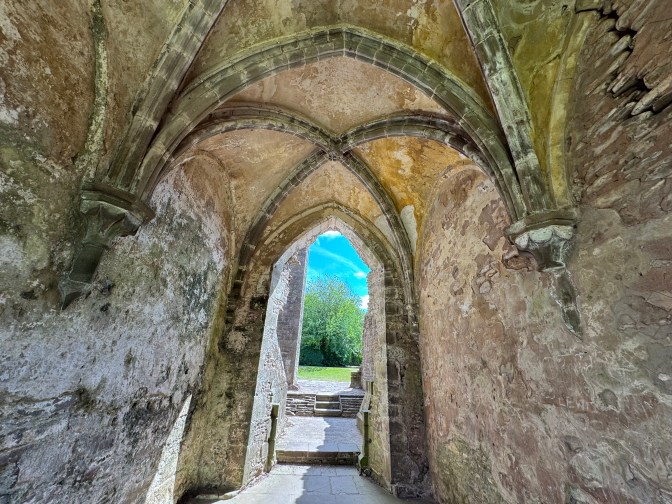
Outside again, I pass through the shadowed corridor where the pointed vaults still hold. The roof above is cracked and weathered, the stonework laced with centuries of lichen and moss. But through the arched opening ahead, the light pours in: a flood of summer brilliance at the threshold. I pause in that half-light, watching the way the priory frames the world beyond it. The ruin doesn’t just sit in the landscape. It speaks to it. The shape of each window and column is echoed in the long curves of the hills behind. The ruin is not ruined. It endures in reflection, in light, in memory.
As I walk back across the grass to my car, I glance behind me once more. The priory stands in silhouette, flanked by hills that seem to lean in protectively. The shadows of the arches stretch out again across the green. They look like wings.

 TravelWriterLife
Beautiful pictures, I’ve never heard of this place. Were there a lot of tourists?
LikeLiked by 1 person
Just a few local visitors. It’s quite out of the way.
LikeLiked by 1 person