As you got higher, the hedges were masses of white blackthorn, the fields greener than green, all backed by the eternal black downs.
— Thomas Hardy, Jude the Obscure
A Tuesday afternoon in July is advancing towards three, and the wide, hot light of the Wiltshire summer lies across the land like a translucent quilt. From Salisbury, the road has wound us past wheat fields the colour of pale honey, running to the lip of the downs. The hedges stand as green ramparts on either side, alive with small rustlings, the occasional flash of a bird’s wing. In the folds of the land, beech, chestnut, and oak sit like quiet witnesses, their leaves heavy with the slow breath of summer.
At Wilton, we turn onto Wishford Road, and in a moment the years fall away: we are in the Wylye Valley again. The lane quickly narrows, folding us into a green tunnel. Nettles and cow parsley spill over the verges; brambles reach into the road as though eager to snag the unwary. The tarmac is patched and sun-bleached, a palimpsest of repairs and reshapings. Above us, branches knit together, casting moving patterns on the bonnet of the car. A scent of cut hay drifts through the open window, mingling with something older: earth warmed by centuries of sun.

Our road to Corton had begun in London, but not in the present day. It stretched back to 1760, when my ancestor, Matthew Blakiston, served as Lord Mayor of London. For his achievements, he was made a Baronet in 1763, a title intended to pass through the generations like a silver thread in the family cloth. The Baronetcy endured, leaping from father to son across the centuries, until it came to Arthur Frederick Blakiston, of Corton, Wiltshire, who became the 7th Baronet.
Sir Arthur died without children. The title passed to my father, Norman Blakiston, and in due course, to me. By the quiet workings of lineage and chance, we found ourselves connected to this small village in the Wylye Valley, a place we had never known, but which seemed to have been waiting for us. Sir Arthur’s widow, Ann, Lady Blakiston, still lived at 42A, and when we came to England in 1990, she took us in with brisk warmth, as if we had simply been away a long while.

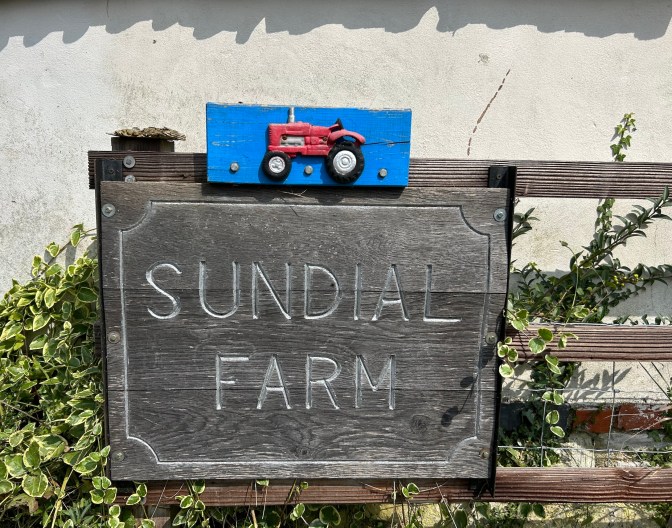
That summer, I stayed with Ann for three weeks while I worked carting hay for the Witt brothers—Richard and Robin—on Sundial Farm. It was hot work under the June sun, the bales prickling through my shirt and the air full of chaff that clung to skin and hair. Evenings brought the relief of tea in Ann’s cool kitchen: lardy cake, bread and jam, homemade lemonade, and endless cups of tea.
She would tell me about her life as a shepherdess during World War Two—or “this war”, as she called it— and hair-raising tales about riding to hounds as groom to Sir Arthur, who was Master of the Wylye Valley Hunt. I remember the slow walk along the lane to Sundial Farm in the mornings, when the scent of hay still hung in the air, and the dew lay bright on the grass while rooks called from the elms beyond the meadows.
When Linda and I moved to Corton in October 1990, it was Ann who arranged for us to live as tenants in the servants’ quarters of Cortington Manor, owned then by Diana, Duchess of Newcastle. And so we became villagers for a time: working in Warminster and at the Dove pub, picking blackberries in the lanes, walking home by starlight. Corton was not just an address then; it was the setting of a chapter in our lives that had arrived by a thread of history stretching back more than two hundred years.
The house at 42A still stands, pale against its climbing greenery. We stop for a photograph: Linda and I in the same place we stood all those years ago, though the decades have altered us far more than they have the house. In 1990, we were strangers welcomed in. Then, we were sure that the valley’s quiet pulse would hold us for a while. And it did.
As the calendar turned to 1991, the world beyond the West Country seemed to be in a state of upheaval. The First Gulf War, a distant conflict, reached us through crackling radio broadcasts and the black and white TV in our flat in Cortington Manor. Life in the West Country during these pre-digital times was marked by a slower, more deliberate pace. The absence of the internet and mobile phones meant that news travelled slowly, often filtered through the lens of local perspectives.
Looking back, it is clear that what was once merely news has now become an indelible part of world history. The events of 1990-1992 have since shaped the course of nations and the lives of countless individuals. The Poll Tax Riot, Margaret Thatcher’s resignation, the fall of the Berlin Wall, the First Gulf War, and the release of Nelson Mandela are no longer just headlines but pivotal moments that defined an era. But for us, living our quiet life as villagers in Corton, they were just an interesting backdrop. We were saving money for our next travel adventure.

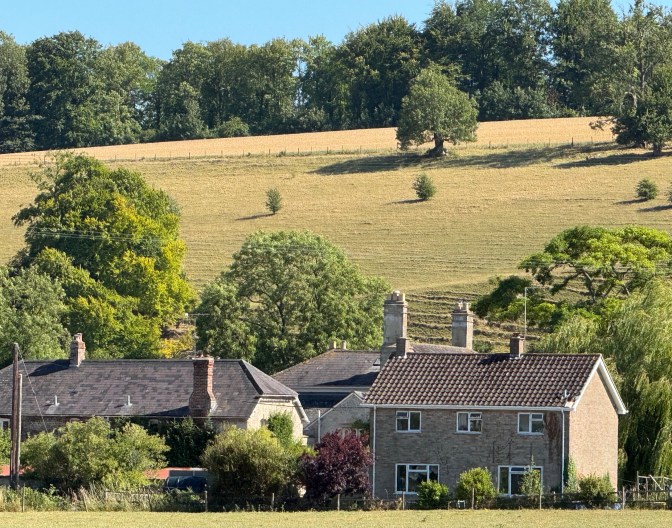
From Corton, we drive over to Upton Lovell. The road lifts and dips with the land, a single-track ribbon between banks thick with campion and scabious. The air hums with insects. In the fields, sheep stand in the shade of hawthorns. At the village green, we pause. The war memorial catches the light, its names sharp against the stone—boys who once played in these lanes, now lying in foreign fields. The sound of the river comes faintly from beyond the houses.
Down by the Wylye, the afternoon light turns the water to beaten bronze. Willows lean across the flow, trailing their fingers. Swallows chase low over the meadows, their wings brushing the surface. The smell of water and woodsmoke is the same as it was on those nights in 1990, when we would walk home after the pub closed. The difference is only in us: we have lived a lifetime in the years between, but here, the valley waits as though we never left.
The sun lowers behind the downs, laying long shadows across the fields. The air cools. Somewhere, a tractor starts up, coughing into the stillness. We turn back towards the car, but slowly. In the Wylye Valley, there is no need to hurry. Time, here, keeps its own counsel.

In Hardy’s reckoning, such a place would be marked not only by the living but by the long dead, each bound to it by threads of love, labour, and loss. The Baronetcy may have been the summons that brought us here, but it is the valley itself—its air, its water, its unyielding downs—that has kept our names written, however faintly, in its enduring ledger of lives.
And as we drive away, I feel that old, quiet truth again; that there are places in the world which do not merely belong to your past. They go on holding you, somewhere in their folds, until you return.


 TravelWriterLife