The Burj Khalifa points into the sky like a Qibla compass, its needle turned upwards towards Allah (Subḥānahu wa taʿālā). Beneath it, four palm trees are strung with fairy lights. They form a loose halo around the tower, with me on the edge: a circle of nature, framing the tallest human-made thing on Earth.
This is Dubai. Sim City made real. A desert dream where even the palm trees are part of the illusion.
There is something unsettling about this city. Not just the scale of it—which is preposterous—or the heat, which feels engineered rather than elemental. It’s the polish. The relentless perfection. Dubai doesn’t feel like a city; it feels like a showroom. And yet, that’s the point.

It wasn’t always like this. Once, Dubai was a creekside village, its wealth drawn from fish and pearls and trade dhows slipping between Persia, India and East Africa. Then came British protection, then the discovery of oil. But oil was never going to be enough. There wasn’t enough of it. So Dubai did what Dubai always does: it reinvented itself.
First came the ports and the free trade zones. Then the hotels, the malls, the skyscrapers. Then came the Emirates airline, the Palm Jumeirah, and the Burj Al Arab. And finally, the Burj Khalifa: a superlative in concrete and glass. The tallest. The most luxurious. The most impossible.

And beneath it all. Sand. Literally. Much of Dubai’s real estate rests on artificial islands or reclaimed dunes. The entire city operates on desalinated water and imported workers. Air-conditioning is not a luxury here; it is a life-support system. Electricity comes from gas or oil, piped in from elsewhere. Nothing about this place should work. And yet it does.
At night, the lights are soft and golden. The air is still and warm. People from every corner of the world flow through the malls and promenades. Shoppers drift from Cartier to Zara, from Balenciaga to buffets. Families pose beneath LED fountains. Influencers perfect their angles in front of wing murals and gold-plated coffees. It’s beautiful. It’s safe. It’s unreal.
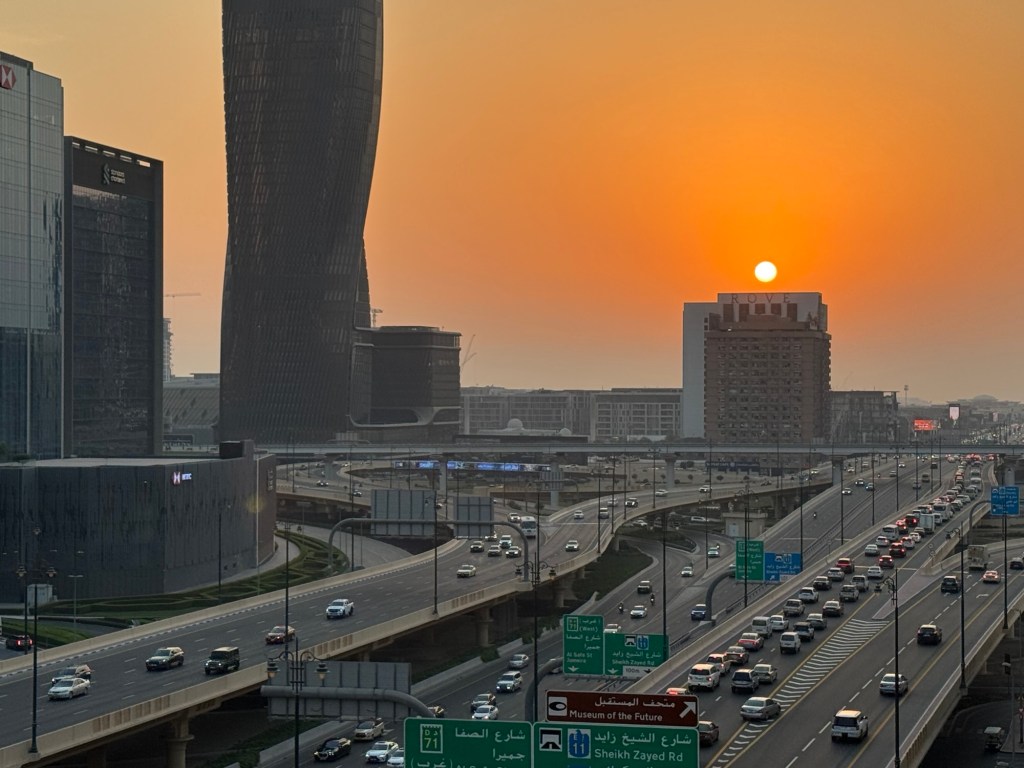
Behind it all, of course, is the invisible army that built this place. The Bangladeshi tilers, riding back to some outskirts apartment in a bus without air conditioning. The Nepalese security guard opening doors for well-heeled tourists. The Sri Lankan steel reinforcing workers, the Sudanese concrete placers, the Punjabi plasterers: all working shifts night and day. The Kenyan cleaner bussing tables in Wingstop, McDonald’s or Five Guys. The barkeeper from Myanmar. The Indian Uber driver who hasn’t seen his wife in five years. They built this city. Literally. And now they service it. Their stories are rarely heard, but they’re etched into every stretch of asphalt and every steel beam.
Dubai is a paradox: part utopia, part exploitation. Ninety-two per cent of its four million inhabitants are expatriates. It is the world’s airport lounge, an air-conditioned limbo where East meets West, where the past is constantly being replaced by the future, where the time is always right now.

It is a city of simulations. A shopping mall with its own indoor ski slope. A museum of the future with no artefacts of the past. A place where you can buy anything except permanence.
But for all its contradictions, it’s impossible not to be impressed. This place shouldn’t exist. And yet it does. Not because of nature, but because of sheer, unrelenting ambition. It is a marvel. A miracle. A mirage with a power supply.
I leave this photograph for last: that shot of me beneath the palms, the Burj streaking upward like a missile. I look like I’m waving. But really, I’m shielding my eyes. Not from the sun, but from the glare of it all.


 TravelWriterLife