Dubai. Mid-July. Forty-three degrees in the shade: not that there is any. The air is thick with heat haze, like I’m looking at the world through a soft-focus lens smeared with sweat. The glass and steel towers along Al Mustaqbal Street dissolve into the shimmering sky, their outlines melting in the white furnace of midday. Everything is vertical, aspirational, impossible, reaching up into the haze as if to escape the heat that pins every living thing to the pavement.
In this shimmering atmospheric furnace, the Burj Khalifa— the tallest structure humans have ever built—barely emerges from the whitewash of the sky. A century ago, this place was sand and salt water, the domain of pearl divers, dhows, and falcons. Now it is air-conditioned silence, elevators that rise faster than thoughts, and iced lattes sipped beneath chandeliers.
On the overpasses, cars crawl through the mirage, each one a sealed bubble of air-conditioned defiance. But the city doesn’t care. The heat is indifferent, eternal. It radiates from the concrete, rises in waves from the road, presses down from above: a three-dimensional sauna of light and dust. Somewhere behind all that sun-glare, the desert waits, unchanged and unimpressed.
This is the heat of Arabia. Not just temperature, but atmosphere. A heat that doesn’t just warm, it defines. It slows the blood, strips the day down to the essentials. Water. Shade. Movement without purpose becomes madness. Even time moves more slowly here, refracted in the haze like a mirage of the future.
And yet, in this blinding inferno, something ancient stirs. The kind of heat that shaped civilisations. That tested prophets. That whispered stories to Bedouin in the stillness between sandstorms.
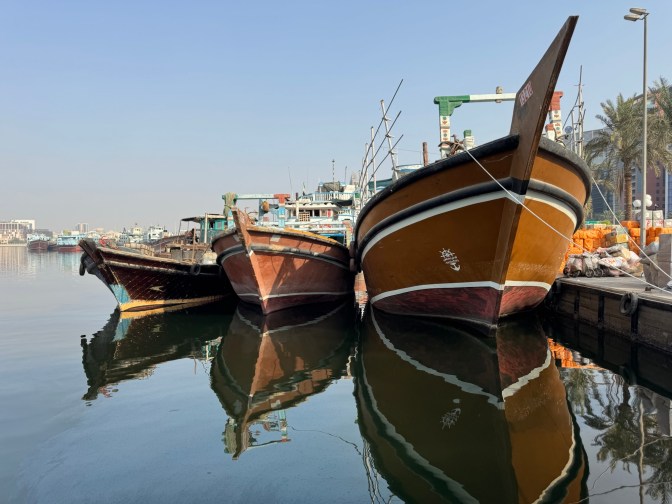
I try to picture it: 1825. Long before Emaar and Emirates and Expo. When the only height was the minaret and the only power came from bloodlines and blades. When every drop of water had to be coaxed from the earth or carried on the back of a camel. When date palms shaded goats and women carried bundles of firewood through the dunes. Dubai Creek, then, was a crooked lifeline: boats from India, spices from Zanzibar, letters from Muscat, weapons from wherever you could find them.
In this world of heat and honour, there were no laws: only loyalties. The only justice was the vendetta. The only stability, an alliance. It is summed up in the Arab proverb: “Me against my brother. My brother and I against our father. My brother, my father and I against our neighbour. All of us against the infidel.”
It’s not just a saying. It’s a worldview. A hierarchy of allegiance; concentric circles of loyalty that spiral outward from the self, collapsing the moment they’re breached.
And yet, amid this fierceness, hospitality flourished. Generosity was currency. Honour was more precious than water. But history does not remain trapped in the past. Those old codes of loyalty and honour, forged in tents beneath the stars, linger beneath the glass of the malls and the steel of the towers. The desert is still there, just beyond the ring roads and shopping arcades, patient as ever, indifferent to the fortunes built on its edge. To step beyond the shadow of the city is to feel that continuity: the same sun, the same heat, the same silence that tested generations before us.
It was this thought—that somewhere behind the skyscrapers the real Arabia still waited—that finally pulled us out of the air-conditioned dream and into the desert.
We had planned, at first, to do the packaged desert safari, the brochure version of Arabia: 4WDs charging over dunes, quad bikes whining through the sand, the obligatory camel ride at sunset. But the thought of it felt artificial, choreographed, unnecessary.
Instead, we descend into the basement of the Dubai Mall and ask at the taxi rank if someone will drive us out of the city. Three drivers cluster around a calculator, their heads bobbing in that unmistakable rhythm of Indian assent: a side-to-side waggle that seems to say no, but really means yes. Two hundred and forty dirhams, agreed with a smile. Our carriage is no sand-dusted Land Cruiser but a Tesla, sealed and humming, its air-conditioning a merciful cocoon.
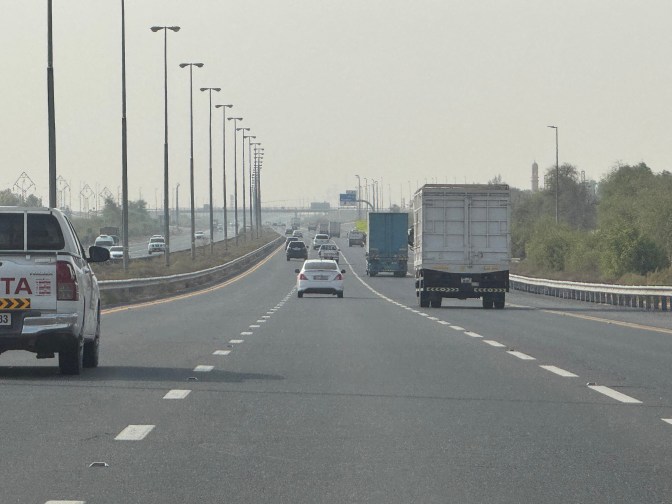
The city dissolves behind us, the six-lane highway stretching east towards Oman. Glass and steel give way to derelict warehouses, half-built villas bleached by the sun, fields buzzing with flies, and farmsteads crumbling back into sand. By the time we turn off at Margham, fifty kilometres west of the city, the driver is looking uneasy. He confesses that he has never been out this far. His domain is the city, the malls, the polished facades. But out here, beyond the shadow of the towers, the desert begins to reclaim what is hers.
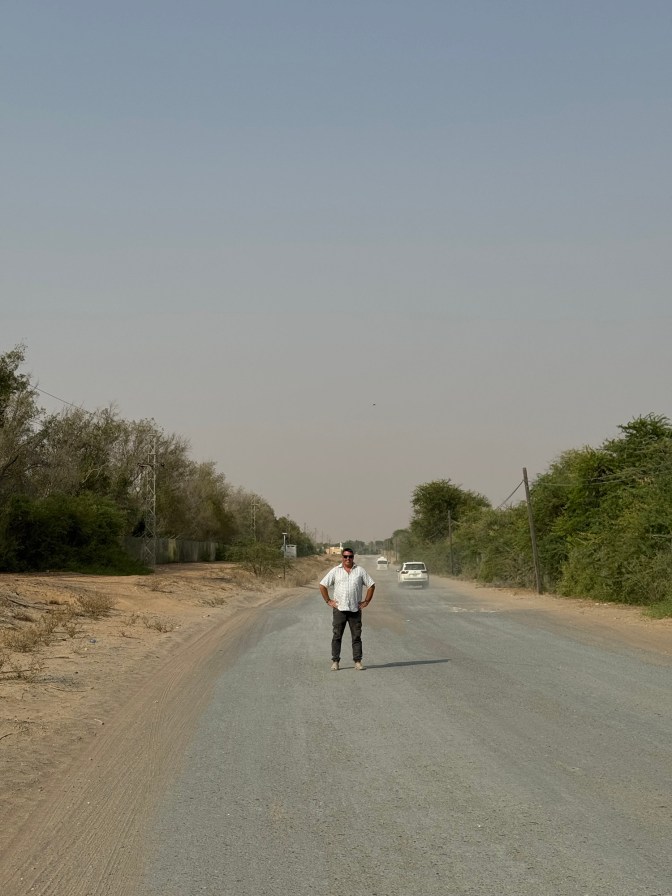
We stop beside a sparse tree and step out. The driver stays in his seat, aghast. The heat is not just a temperature reading. It is a physical presence, a living thing pressing down from above and rising up from below, infiltrating every pore. The sand is the colour of chilli powder and every bit as hot. The road shimmers in the light, a grey ribbon leading nowhere. The silence is absolute, save for the wind that carried grains of dust like sparks from a forge.
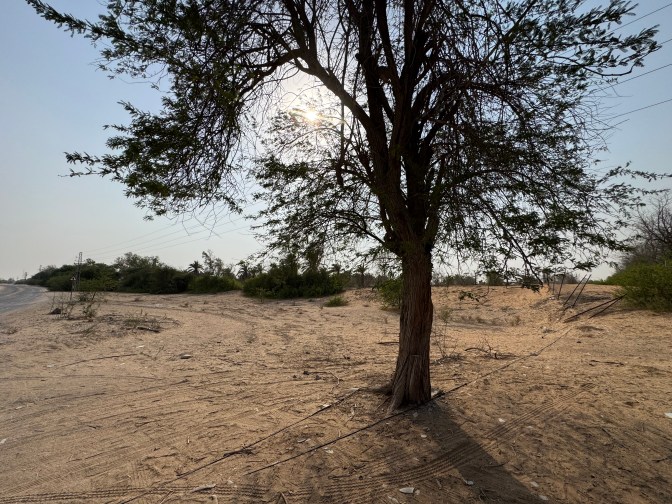
I stand in the middle of that road and feel the weight of it. The sun, the silence, the immensity of the empty horizon. It is a reminder that the skyscrapers are an illusion: a desert mirage. This is the reality. The desert abides.
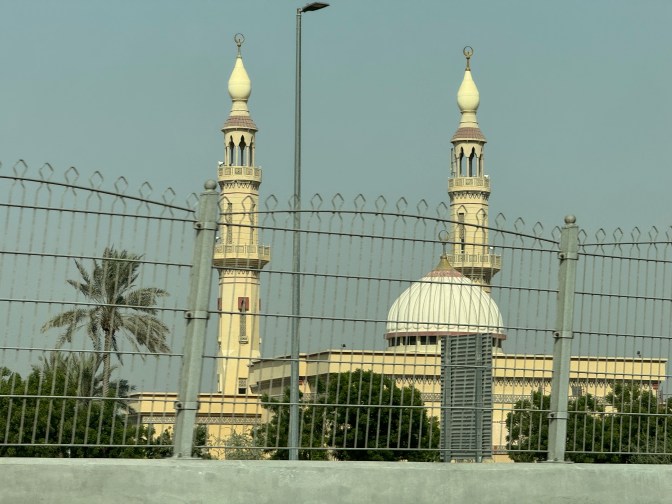
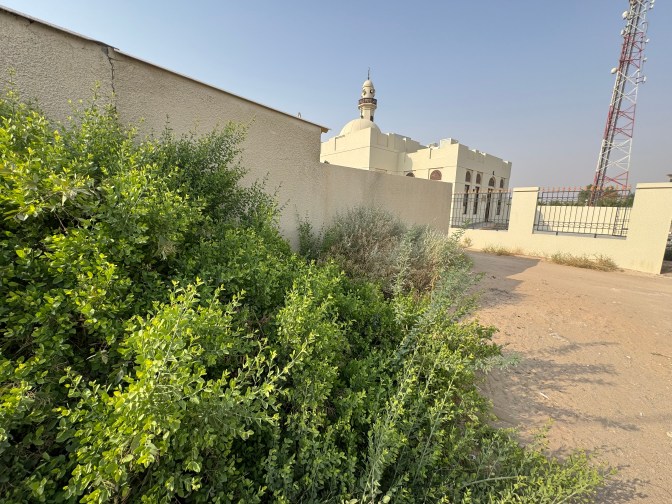
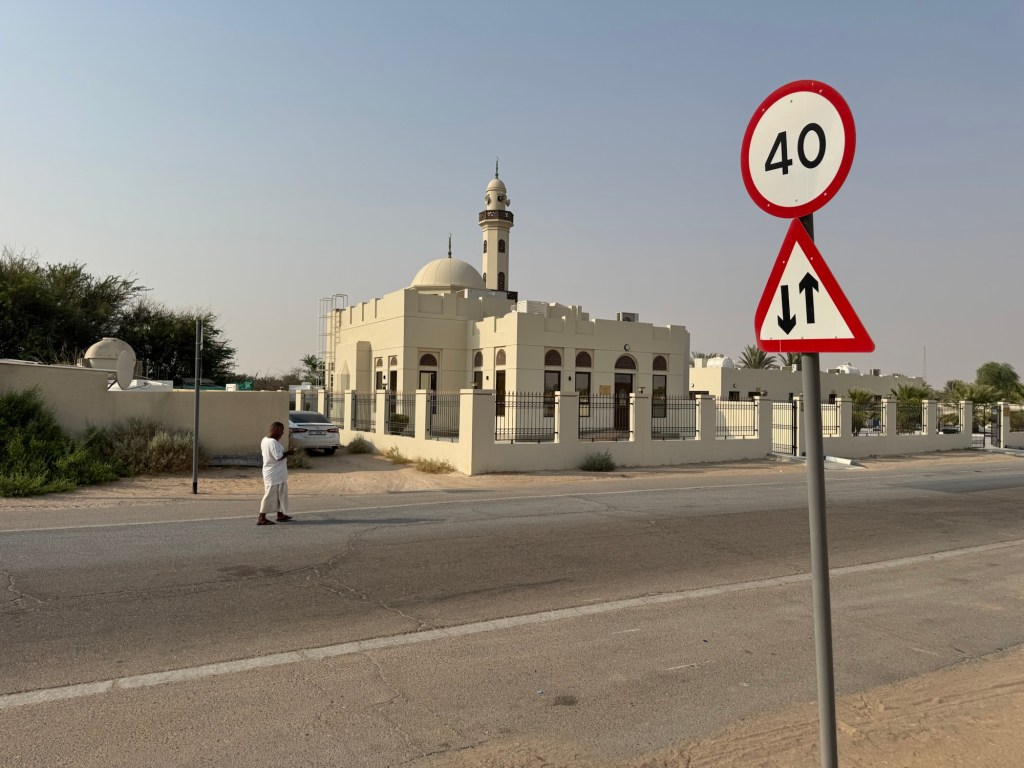
We take our photographs, then retreat to the cool refuge of the car. The driver seems relieved to turn around. On the way back to the highway, we stop at a tiny petrol station. A small mosque stands beside it. Oily trucks stand on the asphalt apron. Inside the dim shop, four men and a boy choreograph my purchase of water and a chocolate bar. One passes my goods to the cashier who rings it up. Another passes it to the boy who bags it and hands it over. Each has a role, however small. I say “shukran” and step back out into the white-hot light.
The highway carries us once more into the orbit of Dubai, where the towers pierce the haze and the malls promise shade and ice. But somewhere behind the glass, I still feel the desert watching. Waiting. Patient, eternal, unimpressed.
After refreshments, we ascend the Burj Khalifa. As the lift rockets up the thousand-metre tower, I wonder what the old sheiks would have made of this. Would they marvel at the engineering? Or would they recoil at the cold sterility of the climate-controlled city? Perhaps both. The same instinct that builds a tent in the desert has built a skyscraper in the sky.
But the heat hasn’t changed. The sun still burns with the same merciless gaze. The desert still waits, just beyond the last mall. And history, though paved over, is not so easily forgotten. It rises, like a mirage, through the haze.