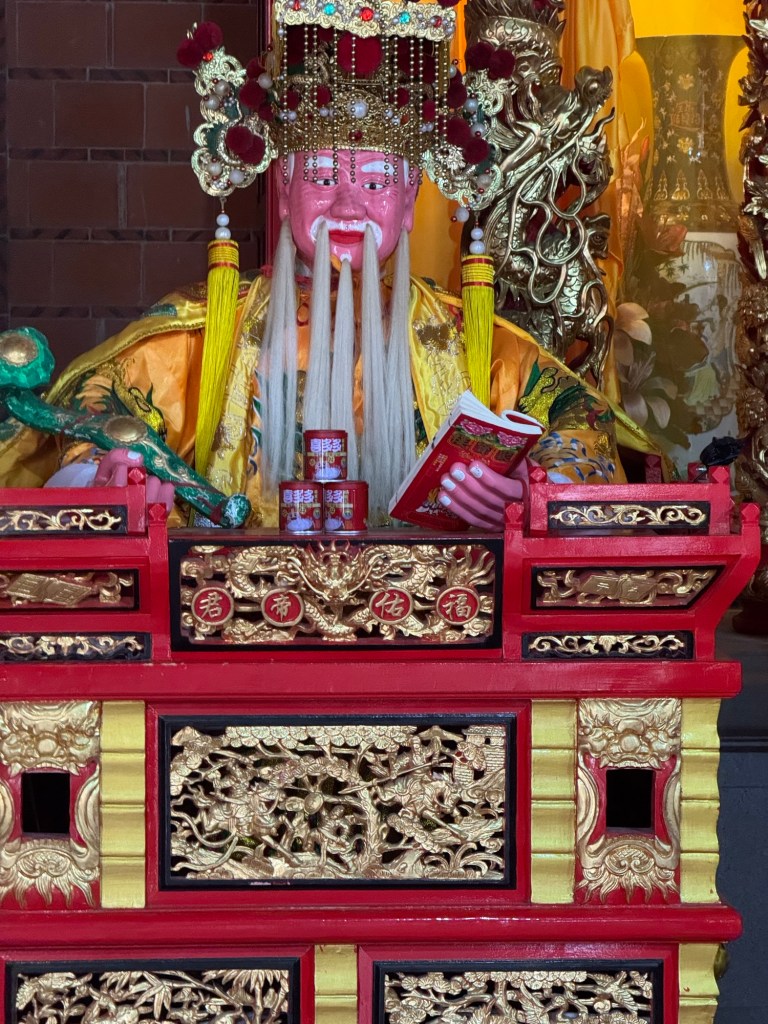
Colour is its own reward…
– Neil Finn, Fingers of Love
The rain has stopped, but the sky holds its breath, a thick, low grey that softens every edge. The temple walls are not the red of fire or blood this afternoon. They are the red of wet clay, of old bricks after a shower, of something that has darkened with age and weather and the touch of a thousand palms.
The light falls evenly, without shadows. The golden characters above the doorway glow dully, as if they have been polished by the grey itself. Incense smoke rises straight—no wind to trouble it—and disappears into the overcast as if the sky is drinking it.
This is not the dramatic light of sunrise or sunset. This is the light of patience. Of waiting. Of a temple that has seen ten thousand days like this one and will see ten thousand more. I walk into this muted world, my shoes silent on the flagstones, and look up.
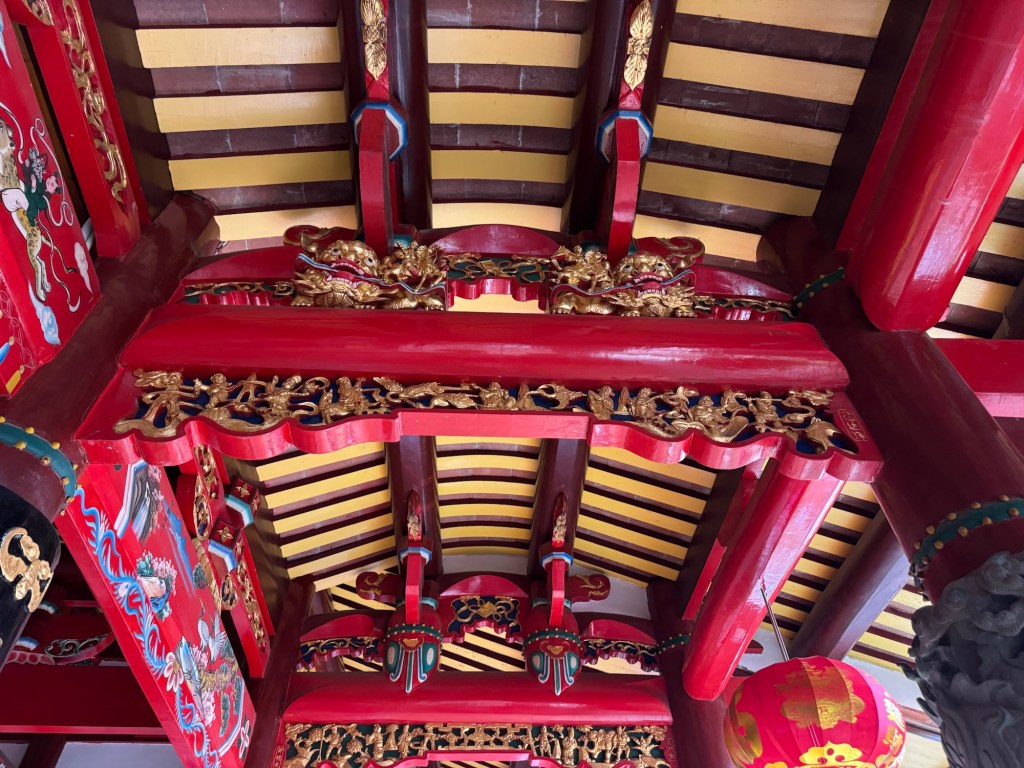
The ceiling is not one thing but many: beams and brackets and struts, each piece cut to fit another, each joint relying on nothing but weight and gravity and the memory of the carpenter’s hands. No nails. No screws. No modern metal binding the old wood together. Just wood against wood, shape against shape, the slow wisdom of interlocking forms.
I try to imagine the men who did this. Not architects with blueprints, not engineers with computers: just craftsmen with axes and saws, with string and ink and a lifetime of looking at trees. They knew which grain would hold. Which angle would bear the load. How to cut a joint so tight that five hundred years of rain and heat and the vibration of passing trucks would not loosen it.
These timbers have outlasted dynasties. They have witnessed prayers for emperors who turned to dust, offerings from merchants whose names no one remembers, the small hopes of ordinary people who knelt here and asked for something: a son, a recovery, a safe journey home.
And still they hold. Still the brackets fit. Still the roof curves toward heaven, lifted by nothing but the patient marriage of wood to wood. That is the shape of devotion, I think. Not dramatic. Not loud. Just well-fitted. Just true.
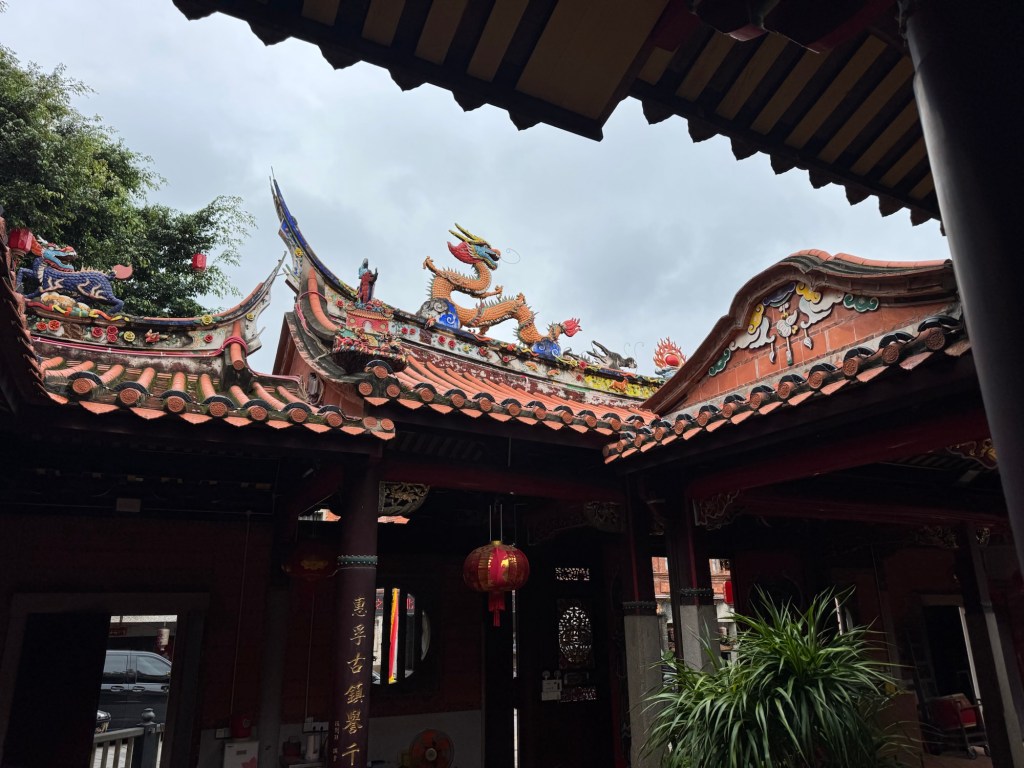
Pillars of grey stone, fluted and worn, rise from the floor to meet the wooden brackets above. At first glance, they seem simple: columns of weathered granite, cool to the touch, spotted with lichen the colour of old moss. But the stone is not smooth. It moves. Dragons coil around each pillar, their scales overlapping like armour, their mouths open in silent roars. Their bodies twist upward—one, two, three times—disappearing into shadow near the ceiling. No two dragons are the same. Some have five claws, some four. Some chase pearls. Some seem to be chasing nothing at all: just the pure joy of being carved into being.
Between the dragons, fish swim upward. Carp, I think, the kind that legend says become dragons if they leap the waterfall at the Dragon Gate. They are half-hidden in the folds of the stone, their fins pressed flat against the column, their mouths open as if gasping for air that has been stone for six hundred years.
My palm touches the cool grey surface. My fingers trace the curve of a dragon’s eye, the fluted edge of a fin. The stone is not cold. Not really. It is the temperature of the temple itself: neither warm nor chilly, just present.
I wonder about the man who carved these. How many months did he spend on a single column? How many chisels did he wear down to stubs? Did he know, as he worked, that strangers would stand here centuries later, running their hands over his dragons, breathing the same damp air, whispering the same small prayers?
The pillars do not answer. They hold up the roof. They coil in silence. They wait. The timbers they support are not merely joined. They are painted.
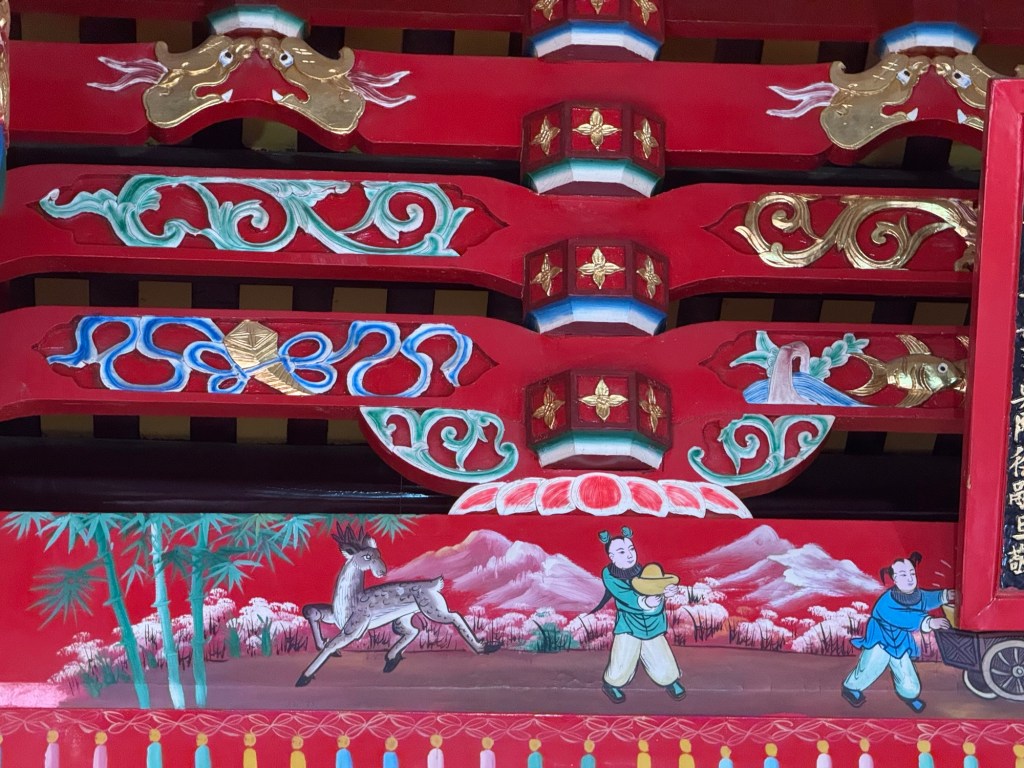
Above the grey stone pillars, below the dark brown brackets, the wood blazes with colour: reds and greens and golds, blues the shade of a deep lake, whites that have yellowed with age but still catch the light. Every surface is covered. Every beam tells a story.
Philosophers ride on horseback, their robes flowing behind them, their faces calm and knowing. Some ride tigers—great striped beasts with open jaws and curling tails—as if taming a wild heart were the most natural thing in the world. Others ride serpents, coiled and scaled, the philosophers’ hands resting lightly on their necks as one might guide a gentle horse.
Between them, calligraphy unfurls across black panels: characters as elegant as birds in flight, each stroke a lifetime of practice. I cannot read them all, but I do not need to. Their meaning is in their shape: confident, ancient, alive.
Geometric shapes interlock—hexagons within circles, squares within diamonds—patterns that feel both mathematical and mystical, as if the carpenters were also astronomers, mapping the stars onto wood.
Mountains rise in blue and green, their peaks lost in clouds. Blossoms—pink and white—are scattered across branches that never lose their petals. Perfect worlds recorded in colour, painted by hands that turned to dust centuries ago, yet still offering their vision of paradise to anyone who looks up.
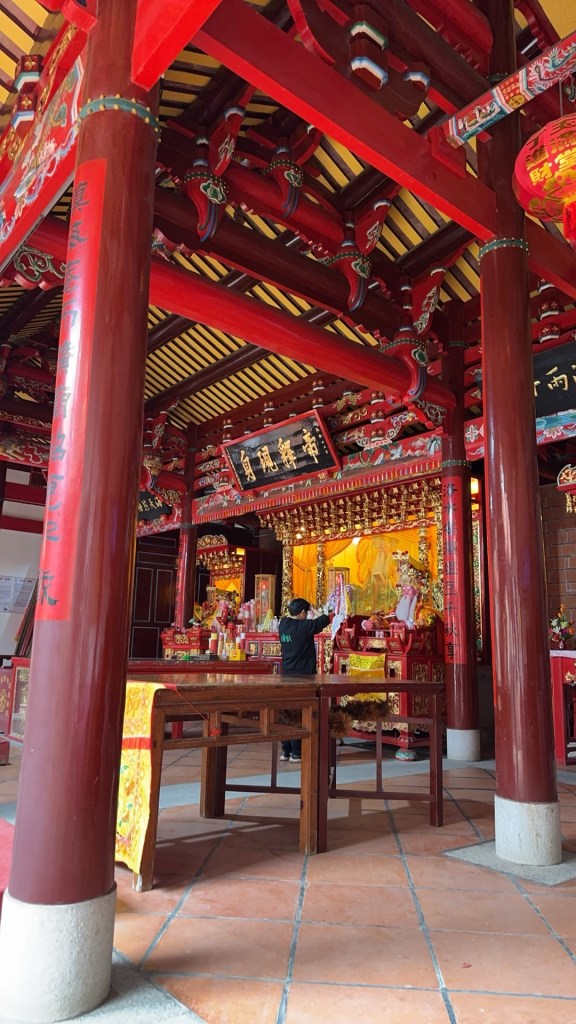
I tilt my head back until my neck aches. A philosopher on a serpent gazes down at me, his brush-stroke eyes neither welcoming nor rejecting. He is simply there: part of the temple, part of the wood, part of the long conversation between heaven and earth that this building has hosted for half a millennium.
The colours do not explain themselves. They simply are. And I, the traveller, the scribbler, the one with the blue umbrella, stand beneath them, grateful.
And there is red everywhere. Not the red of blood, though that is part of it. Not the red of fire, though that too. This red is older than either: the red of cinnabar dug from mountains, of vermilion mixed by monks who ground pigment for days, of lacquer laid down in thin layers until it glows like a slow ember.
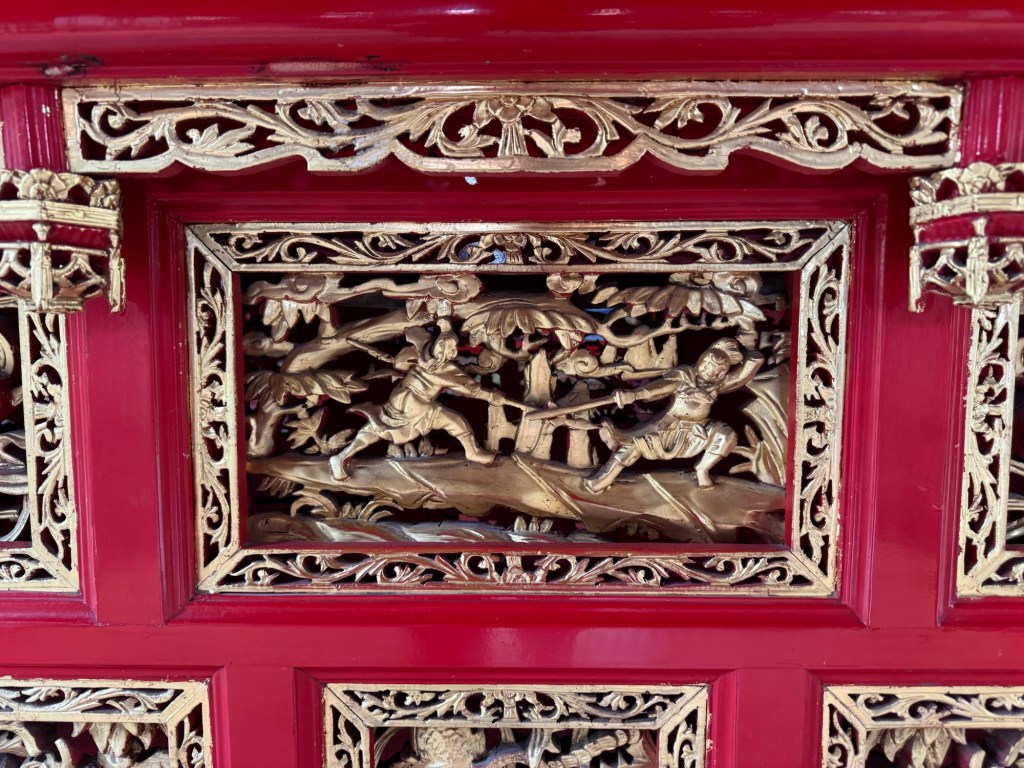
Red on the pillars. Red on the altar cloth. Red on the tablets where names are written in black ink, each character a small bridge between the living and the dead. Red on the lanterns that swing gently in no wind. Red on the envelopes tucked into cracks in the walls: offerings, hopes, debts unpaid.
Red is the colour of luck, the Chinese believe. But here, in this temple, under this grey sky, after the rain has stopped and the light is soft and the dragons coil in stone and the philosophers ride their tigers through painted heavens, red feels like something more.
Red feels like insistence. Like choosing joy in a world that offers no guarantees. Like painting a beam, carving a dragon, lighting a candle, slipping a coin into a wooden box, not because you are certain, but because you are willing.
I walk toward the door. My blue umbrella waits by the red pillar. Outside, the Luoyang Bridge spans the water, grey stone against grey sky. But behind me, the temple holds its colour: holds it against rain, against time, against the slow fade of everything.
And somewhere, a philosopher on a serpent rides forever through a forest that never loses its leaves, in a world that never needed nails to hold it together.