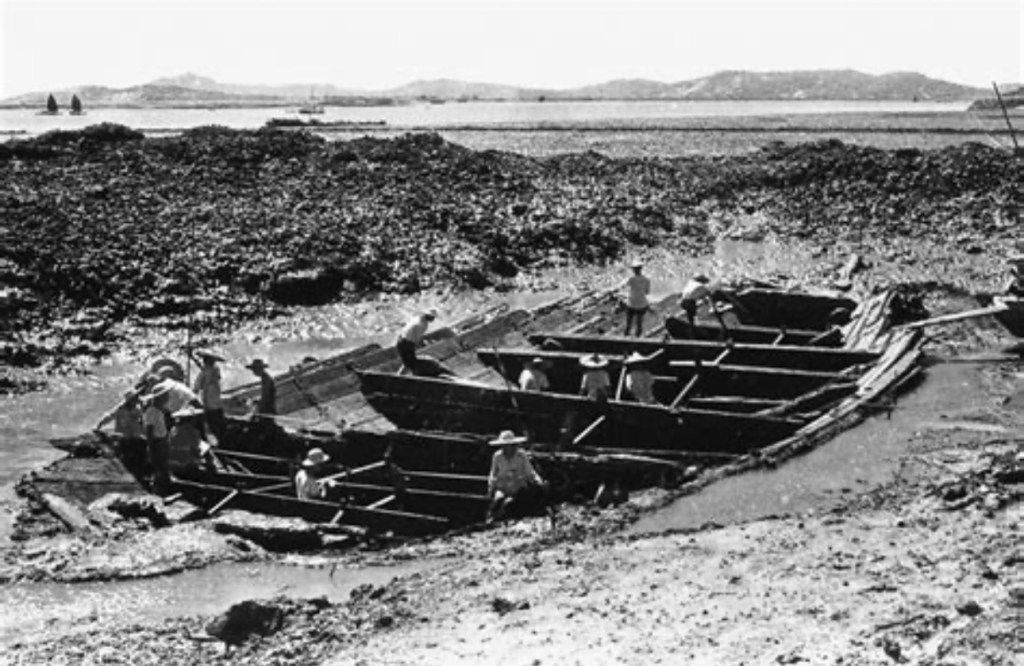
In a quiet hall within the Kaiyuan Temple complex, beneath a roof that has sheltered pilgrims for over a thousand years, lies the hull of a Song Dynasty seagoing junk. Excavated in 1974 from the mud of Quanzhou Bay, it is not a replica. It is not a model. It is the actual bones of a vessel that once carried Chinese goods across the South China Sea.
I had not expected to see the bones of an ancient ship in the middle of a Buddhist temple. But Kaiyuan Temple has held many surprises this afternoon: the twin pagodas, the banyan trees draping their roots over centuries, the gold Buddhas with their silent mudras. And now this: a Song Dynasty junk, lifted from the mud of Quanzhou Bay, resting under a sheltering roof as if it had sailed here and simply decided to stop. The colour of spring still clings to the temple grounds outside—pale yellows, deep olives, viridian, terracotta, honey-yellow stone—but inside the museum hall, the light is dimmer, cooler, more like the bottom of the sea. And here, in the centre of the room, is the ship.
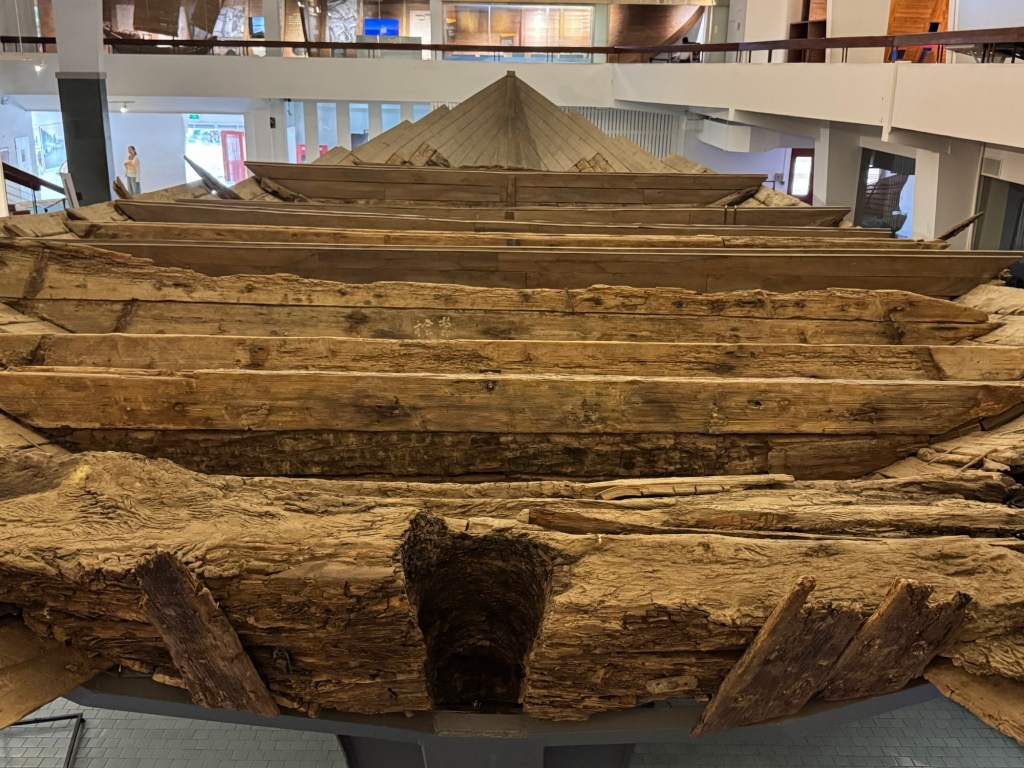
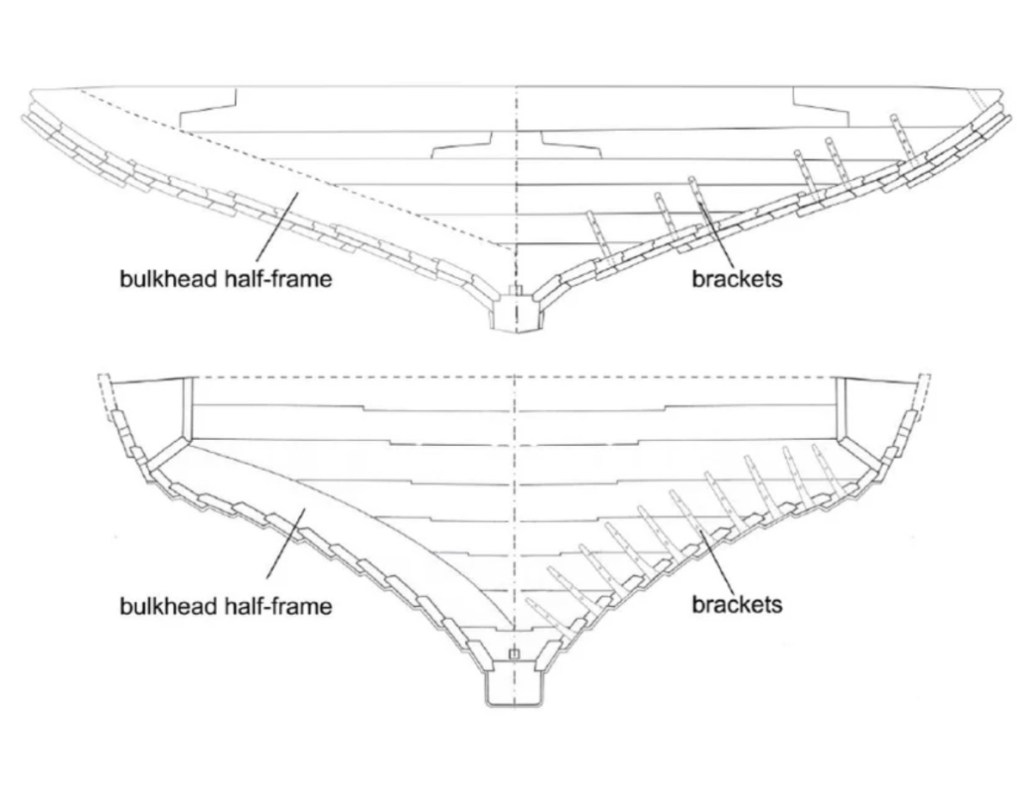
I walk around it slowly, reading the display panels, trying to grasp the scale of what I’m seeing. The ship is smaller than I have always imagined these craft to be. Its wooden planks are dark with age, held together with iron cramps and coconut‑fibre caulking: a watertight seal technology that kept these vessels afloat for months at sea. The thirty-metre-long hull is divided into thirteen compartments, each sealed off from the next by thick bulkheads.
These watertight bulkheads are the key feature that set Chinese shipbuilding apart from every other maritime tradition of the time. China’s shipwrights had perfected this technology by the Tang Dynasty (618–907), and it was in widespread use from the Song onward. The principle is simple but revolutionary: a ship’s interior is divided into sealed chambers by transverse bulkheads. If one compartment is breached, the flooding is contained. The vessel stays afloat. Europe would not adopt this technology until the late 18th century.
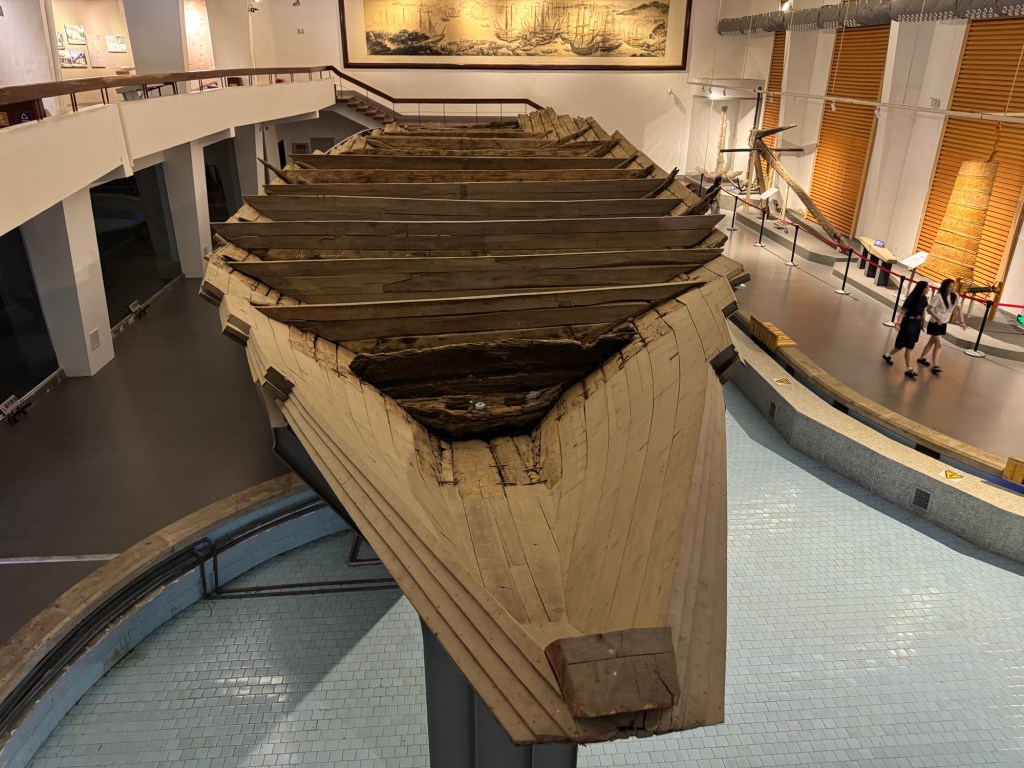
The hull before me is older than Magna Carta, older than the Mongol Empire, older than the first cannon fired in Europe. Marco Polo saw these ships when he passed through Quanzhou—then known to the world as Zayton—which at the time was one of the busiest ports on earth. In, Travels of Marco Polo, his account of his adventures, he described them in precise, awed detail:
“Some of the larger ships,” he wrote, “have thirteen inner compartments, separated by thick boards, used to prevent sea hazards—such as when the hull strikes a reef or a whale, causing seawater to leak in.”
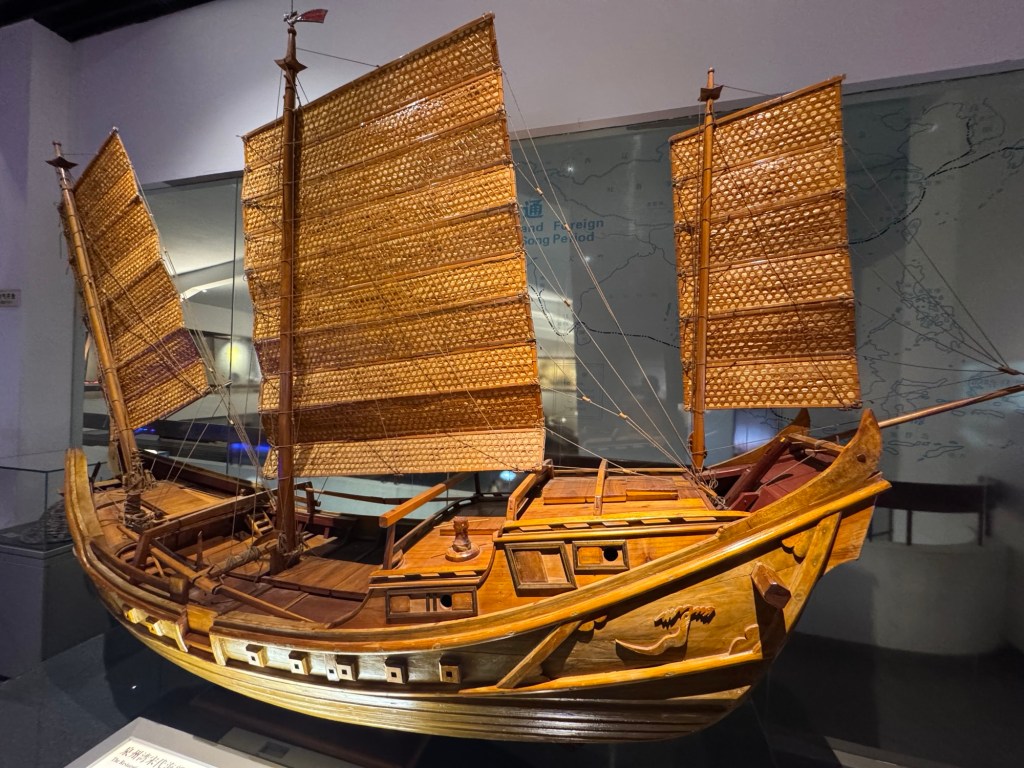
He also noted the multi‑layer hull construction, observing that “the ship’s shell is made of multiple layers of planks.” He described four masts, with two more that could be raised when needed, and square‑rigged sails that concertinaed like Venetian blinds. He claimed that sixty private cabins for merchants could be built on the deck of a large junk.
Western scholars doubted him. The descriptions seemed too advanced, too sophisticated. Then the 1974 excavation proved him right. The ship in the Kaiyuan Temple museum is the physical evidence that silenced the sceptics.
“The discovery of a junk of the 13th‑century confirms much of what Marco Polo reports,” one naval historian concluded. China had mastered watertight‑compartment technology while Europe was still steering its boats with oars.
I stand before the hull and imagine Marco Polo standing here in Quanzhou, seven centuries ago, watching these same ships being loaded with porcelain and silk, ready to sail to Java, to Sumatra, to the Malabar Coast, to Hormuz, to Basra, to the edge of the known world.
In those days, Quanzhou was not merely a port. It was the nerve centre of the world’s most advanced maritime supply chain. During the Song and Yuan dynasties, it was the largest port in the East. Trade linked it to over a hundred countries and regions, stretching from Southeast Asia to Persia, Arabia, and Africa. One medieval chronicler noted a telling comparison: “If Alexandria receives one ship of pepper…, Zayton receives a hundred.”
The logistics were precise. Goods flowed down the Jin River and overland routes through the mountains, converging on Quanzhou’s harbours. Porcelain from the kilns of Dehua. Silk from the looms of the Jiangnan region. Tea from the hills of Fujian. Iron from the foundries of the interior. These were not luxury trinkets. They were bulk commodities, moved in massive quantities, traded for spices, medicinal herbs, pearls, and fragrant woods from across the Indian Ocean.
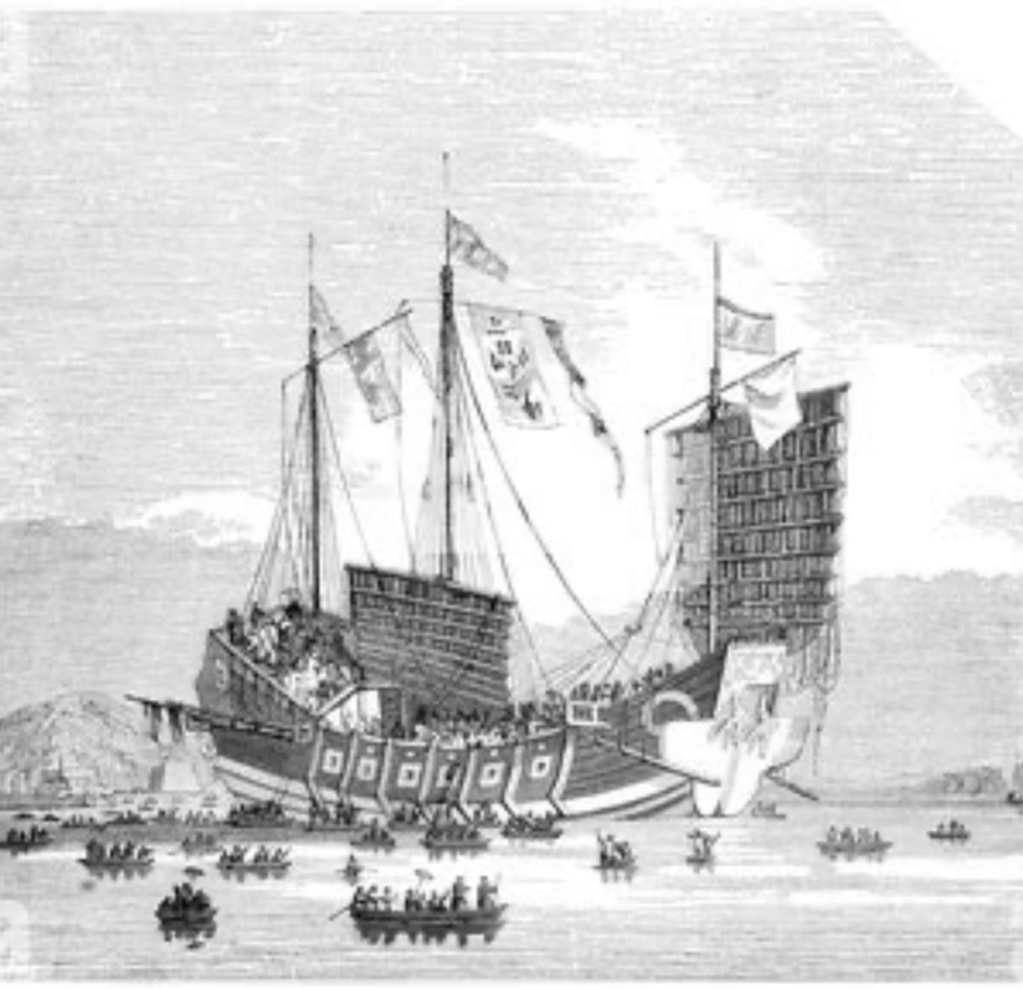
The ships themselves were built in Quanzhou’s own shipyards, which had become the nation’s foremost centre for ocean‑going vessel construction. The keels were robust, cut from durable nanmu wood from southern China. The watertight compartments were installed with precision, each bulkhead fitted by craftsmen who had inherited their skills across generations.
What did it carry, this ship in front of me? Ceramics, most likely, the Song Dynasty’s great export. Perhaps also silk, tea, lacquerware, iron. On the return voyage, it might have brought back pepper from Java, sandalwood from Timor, frankincense from Arabia, and glass from Persia. The cargoes are long gone. Only the hull remains: a single skeleton from an economic system that spanned half the globe.
Quanzhou is still a port. Today, it is a hub of the Belt and Road Initiative, the 21st‑century’s incarnation of the Maritime Silk Road. The modern ships are not made of nanmu wood sealed with coconut fibre. They are steel container vessels, bulk carriers, and roll‑on/roll‑off ships, tracked by GPS, unloaded by automated cranes, and processed through digital customs systems.
The new energy vehicles and lithium batteries, LPG, chemicals, and consumer goods now passing through Quanzhou’s docks would have been unimaginable to the Song merchants. But the pattern is the same: goods in, goods out, ships sailing on the same monsoon winds that carried the junk now resting in the Kaiyuan Temple museum.
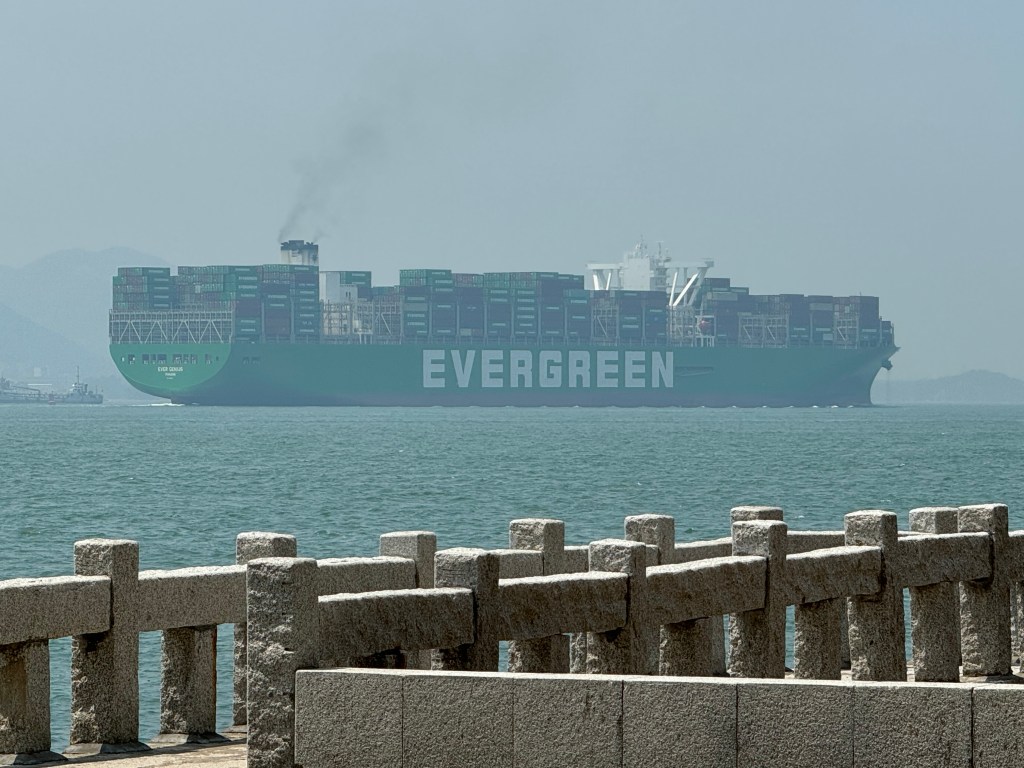
The exports have evolved: from Song‑era porcelain and silk to modern garments, footwear, building materials, and new‑energy vehicles. But the import of raw materials continues: Indonesian kaolin, Southeast Asian rubber, spices from the same Maluku Islands that Marco Polo’s contemporaries sailed to. The supply chain has grown faster, more efficient, more global. But the fundamental principle—moving goods from where they are produced to where they are needed, across the world’s busiest oceans—has not changed in eight hundred years.
The ship at Kaiyuan is quiet now. No cargo. No crew. No monsoon winds filling its sails. But it has done its work. It carried China’s goods across the South China Sea, the Indian Ocean, and beyond. And it returned with the world’s wealth. It survived storms, perhaps pirates, perhaps the simple attrition of the sea. And then, at the end of its working life, it sank in Quanzhou Bay, not in defeat, but in rest. The mud preserved it. Archaeologists raised it.
The ship has not moved for seven hundred years. But in my imagination, it is sailing again: following the monsoon winds south, past Hainan, past Vietnam, past the Philippines, crossing the Indian Ocean to Persia and Africa, and landing “…in ports of which Alexander only heard the names.”
On the wall amidships, a small panel describes the Baoshou Hole: a ritual cavity cut into the keel, where sailors placed coins and offerings for good luck before a voyage. I picture a Song captain kneeling, pressing a copper coin into that hole, asking for safe passage.
We all carry something into the unknown. A coin. A prayer. A number. A scent of sandalwood. I walk out into the spring sunlight. The banyan trees are still there. The pagodas still rise. And behind me, the ship keeps its silence, a link in an unbroken chain that stretches from the Song Dynasty to the modern port of Quanzhou, where container ships now follow the same winds, carrying the same goods, hoping for the same safe return..