Waiting for the colour of spring.
Let me breathe…
– Talk Talk, April 5th.
A hot, pale blue sky arches over the temple. Not the deep blue of winter, not the washed‑out blue of high summer, but the particular blue of a spring afternoon in Fujian. Soft. Thin. A sky that seems to go on forever, without clouds, without drama, just light and warmth and the sense that time has slowed to a pause.
A cool breeze moves through the courtyards. It comes from somewhere else—from the hills, perhaps, or from the sea—and it carries with it the fragrance of spring flowers and incense. The flowers are jasmine and osmanthus and something else I cannot name. The incense is sandalwood and aloeswood and the accumulated smoke of a thousand prayers.
Together, they make a perfume that belongs only to this place, this afternoon, this breeze. I breathe it in. I hold it. I let it go.
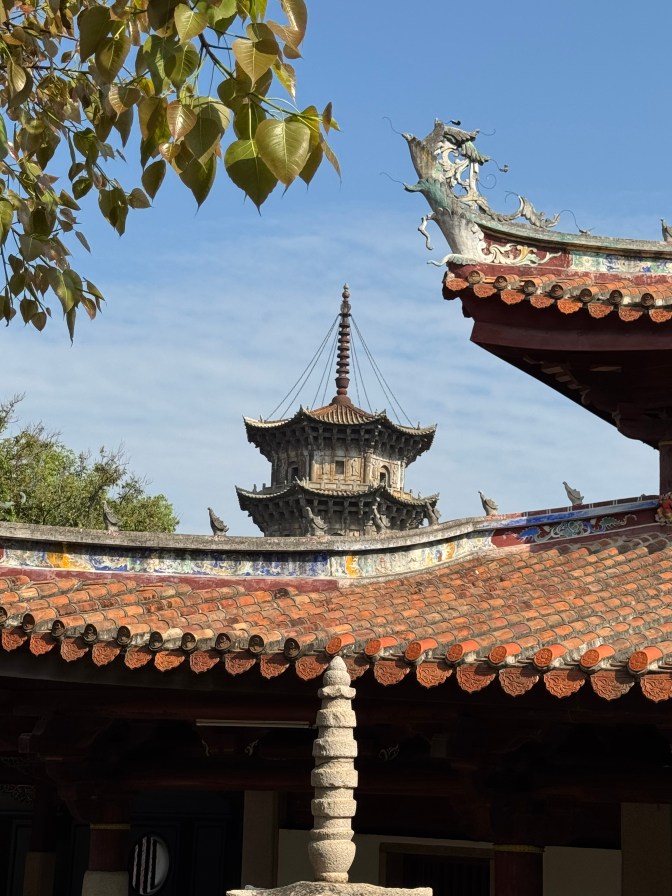
The temple trees are fresh with spring leaves. They are not the uniform green of summer. They are layered and textured, like the tiles on the curved temple roofs. Pale yellows where the new leaves are still unfurling. Dark greens where the old leaves have held through winter. Deep olive in the shadows beneath the canopy. Viridian—that bright, almost electric green—where the sun catches the leaves just right.
The trees are ancient, some of them. The banyans and peepals have been here for centuries, their roots draped over stones, their trunks thick as houses. But their leaves are new, fresh, bright with the energy of spring. The old and the new, growing from the same branches.
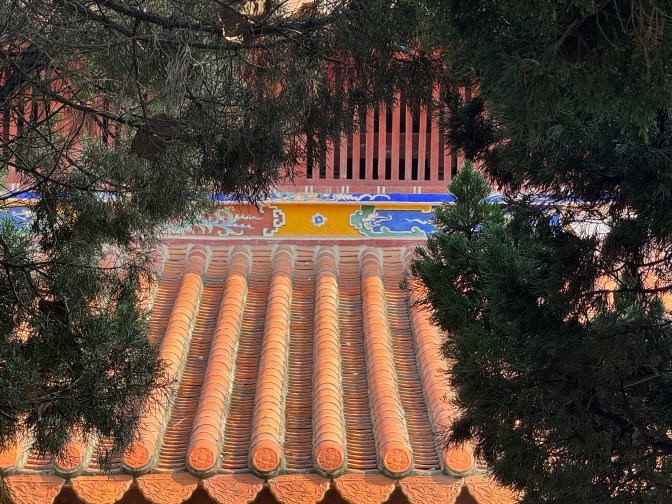
The terracotta roofs curve against the pale blue sky, their tiles the colour of baked earth, of kiln-fired clay. They glow in the afternoon light, warm and solid, anchoring the temple to the ground even as the roofs reach toward heaven.
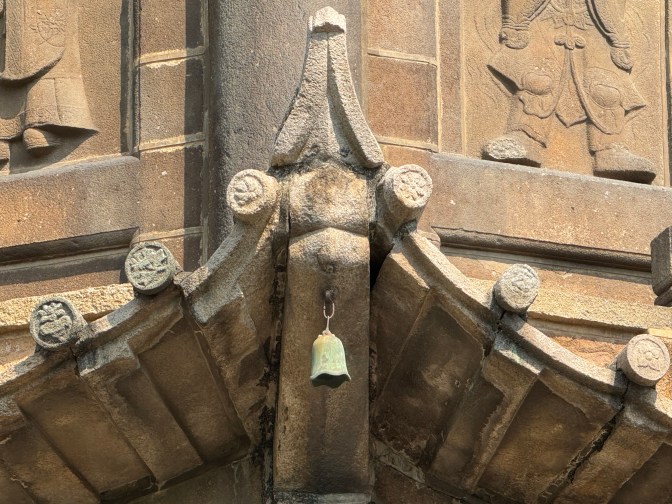
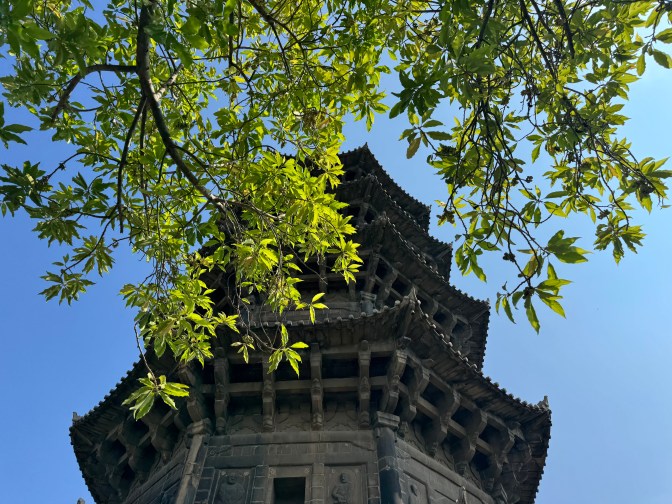
The pagoda stones are pale honey‑yellow: the colour of sandstone, of old parchment, of light held in stone. The bas‑reliefs are darker, shadowed, the warriors and saints emerging from the honey‑yellow like memories emerging from time. The stone is warm to the touch. It has been warmed by a thousand afternoons just like this one.
The crimson lanterns—strung between the trees, hanging from the eaves, glowing in the sunlight—add a splash of red to every scene. The red of luck, of celebration, of the sacred and the profane: the red that ties everything together.
Inside the main hall, a row of five great gold Buddhas sits on a long altar. Each is in a different pose, each hand gesture speaking a silent language.
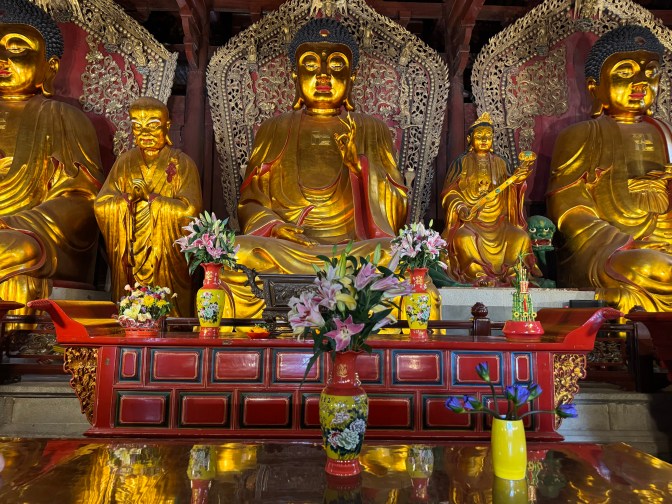
The first: two fingers up, raised toward the sky. Do not be afraid. His face is calm, his eyes half‑closed, his lips curved in the slightest smile. He offers protection to all who enter: to the devout, to the curious, to the foreigner with the notebook who does not know which Buddha he is looking at.
The second: hand flat, thumb holding forefinger. I am teaching. His other hand rests in his lap, palm upward, receiving the world. He is mid‑sermon, explaining the nature of suffering, the path to liberation. The air around him feels still, attentive, as if the temple itself is leaning in to listen.
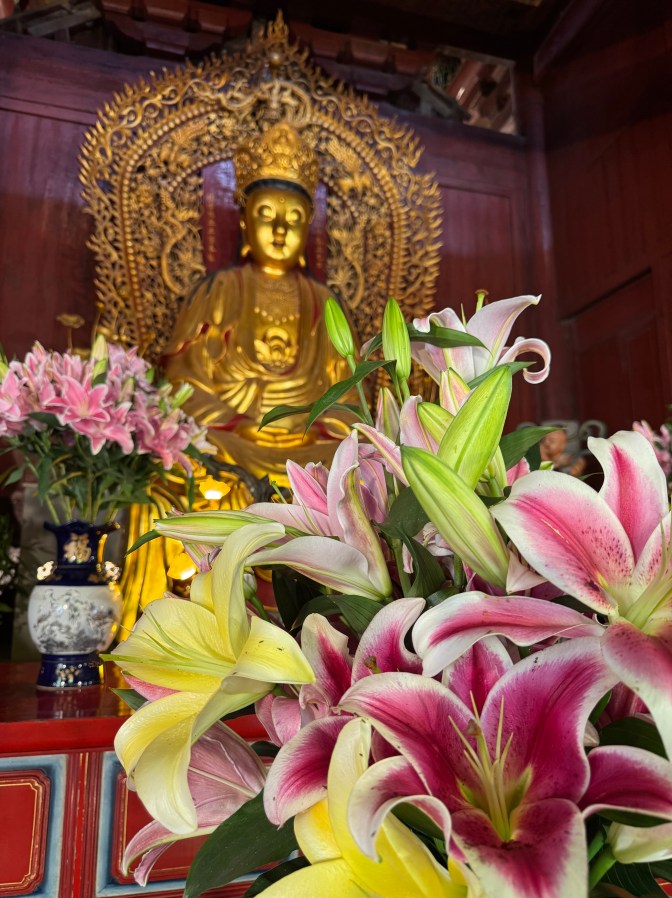
The third: forefinger and pinky finger raised. Evil has no power here. His gesture is fierce, almost confrontational, a sudden sharpness amidst all that gold and calm. He is the protector, the expeller, the one who keeps the temple safe from harm.
Three Buddhas. Three mudras. Three lessons. And beside them, smaller attendants—bodhisattvas, arhats, disciples—their hands pressed together in reverence.
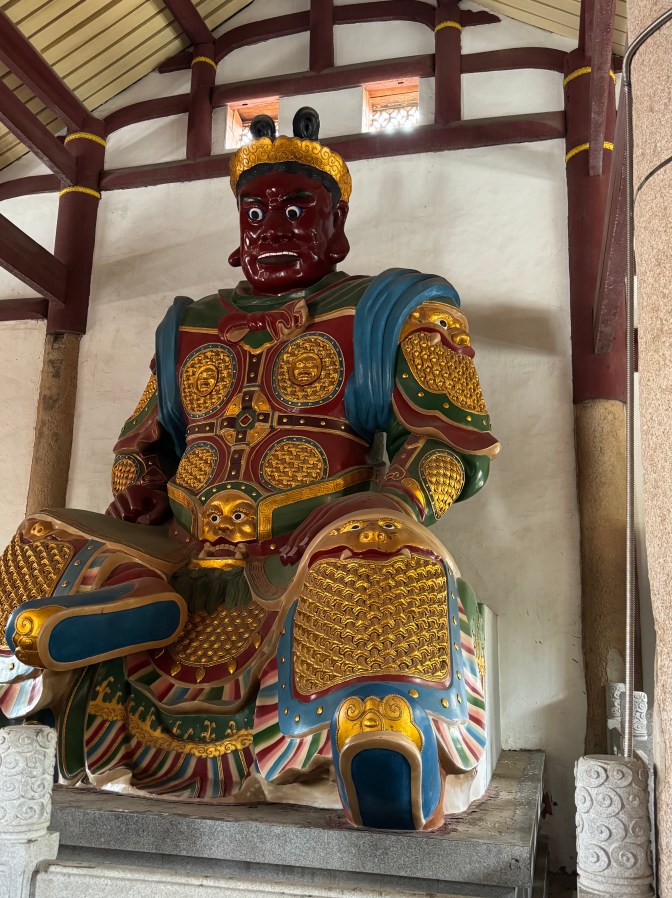
On the left side, red‑faced Guan Yu glowers. I recognise him from the temple on Tumen Street last night, from the divining tablets, the coffee cups, the smouldering incense. The God of War. The Lord of Loyalty. His face is painted a deep, angry red: the red of courage, of righteousness, of blood spilled in a just cause. His beard is long and dark, his eyes wide and fierce, his thick eyebrows drawn together in a permanent scowl. He is not serene. He is not compassionate. He is watching, and he does not seem pleased with what he sees.
On the right side, another warrior—this one benign and avuncular—looks on. His face is not red. It is the colour of warm wood, of old bronze, of skin that has seen the sun but never known anger. His eyes are kind. His lips are curved in a small, knowing smile. He looks like the uncle who sneaks you sweets when your mother isn’t watching.
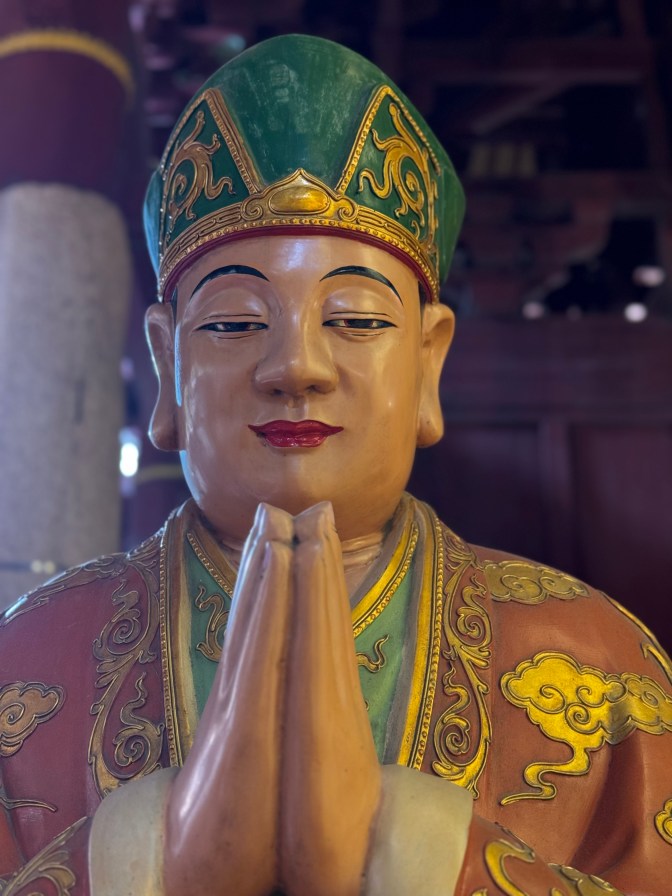
Red‑faced Guan Yu glowers: Do not offend. The benign warrior smiles: Stay awhile. The five gold Buddhas say nothing at all. Their silence is the loudest thing in the temple.
Through a timber lattice, I can see out into the sunlit courtyard. The lattice is old: dark wood, carved in geometric patterns, the edges softened by years of hands and weather. It divides the world into diamonds and squares, each opening a small window onto something larger.
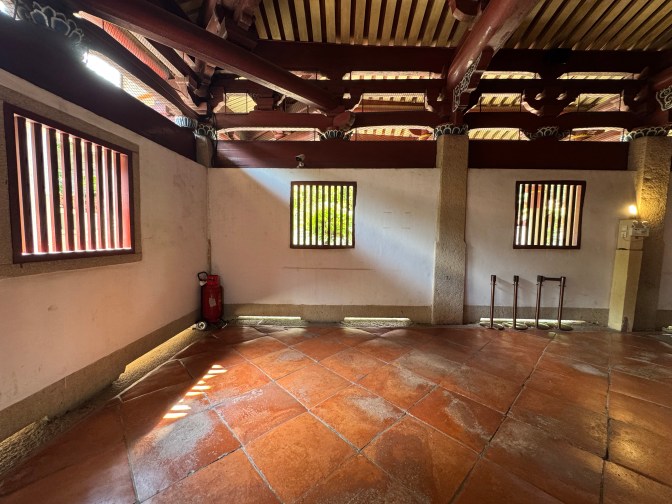
Through it, the courtyard is bright with afternoon sun. The light falls in slanting planes, touching the flagstones, the stone walls, the great iron censer standing at the centre. Clouds of incense smoke curl upward from the censer, thick, grey‑white, almost solid in the still air. They rise slowly, twisting, unraveling, disappearing into the sky.
The banyan trees drape their roots and branches over the centuries. Some roots hang from the branches, reaching for the ground, finding it, becoming new trunks. The trees spread sideways as much as upward, their canopies overlapping, their shade pooling in the corners of the courtyard. The trees have been here longer than anyone alive. They will be here when everyone alive today is gone.
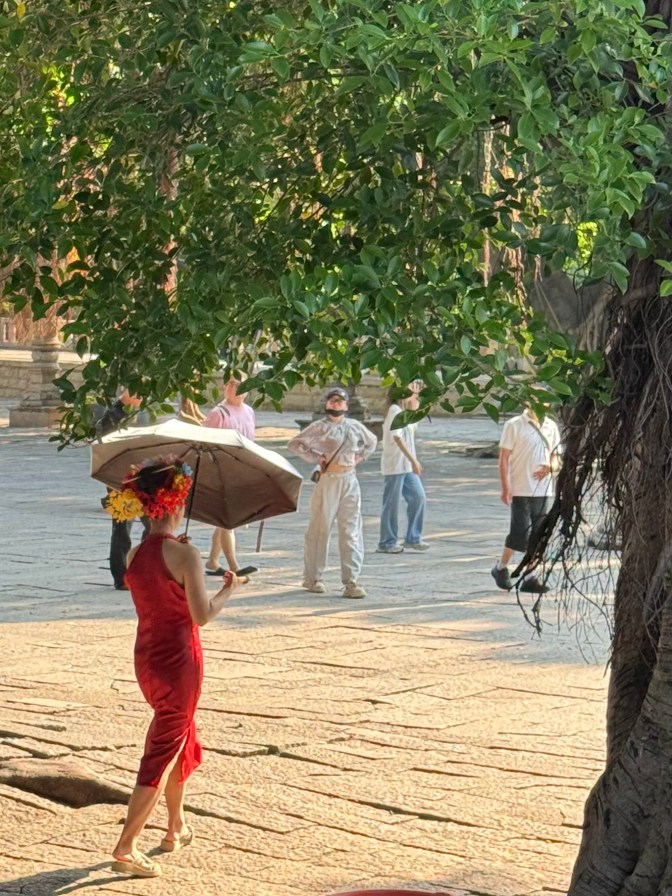
I watch a monk walk slowly across the courtyard. His robes are grey, his head is shaved, his pace is unhurried. He does not look at the incense smoke. He does not look at the banyan trees. He has seen them every day for years. But I have not. And so I watch—through the lattice, through the diamonds and squares—as the incense curls, as the banyan roots drape, as the monk disappears into the shadow of the temple.
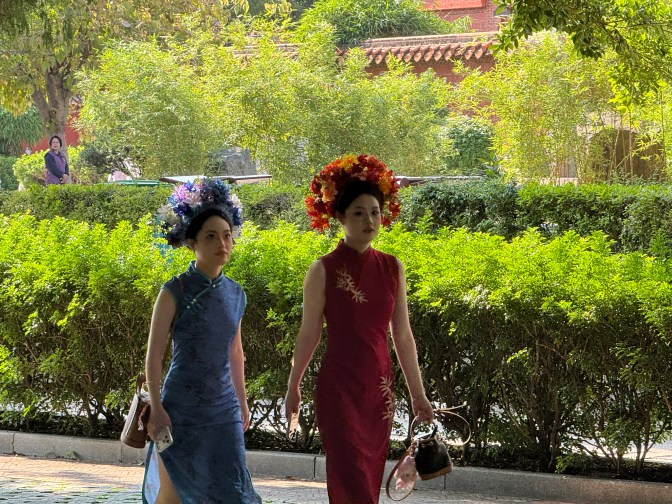
I walk outside. Girls in traditional dress pose for photos beside the East Pagoda. Their dresses are pastel—soft pinks, pale blues, mint greens—the colours of spring blossoms, of candy, of everything delicate and temporary. The fabric flows and gathers, embroidered with flowers and butterflies, cinched at the waist, flowing to the ground.
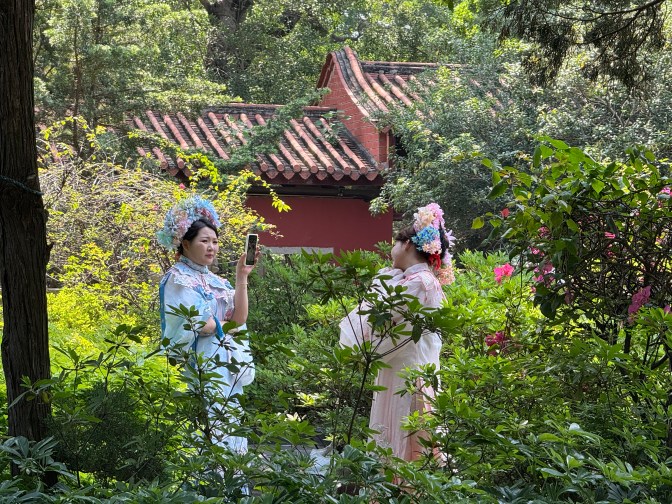
They turn, they tilt their heads, they smile. They cheer at their devices as they do so. A friend holds a phone, crouching, rising, adjusting the angle. Another friend watches, offering advice. Turn this way. Tilt your chin. No, the other side. Perfect. Again.
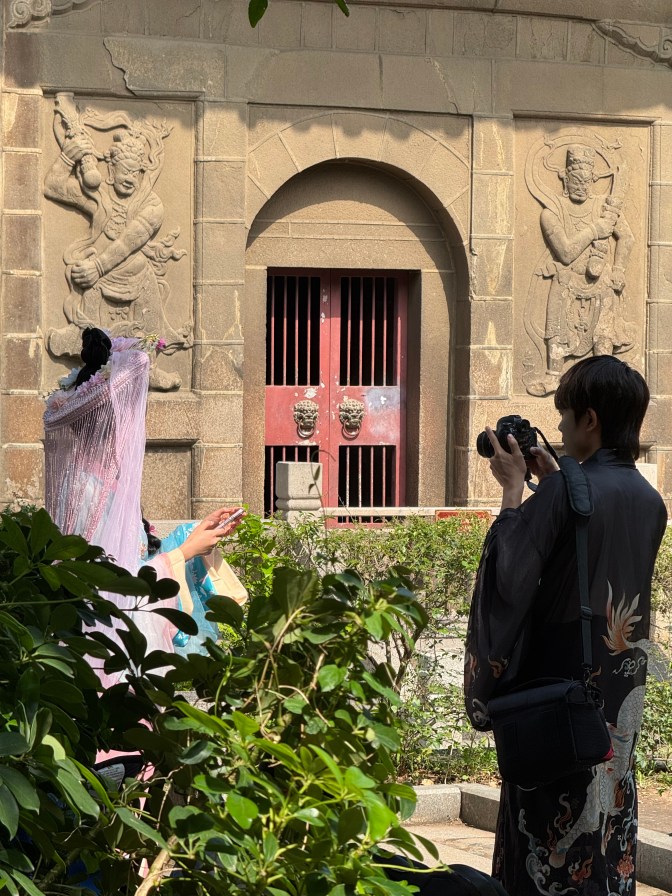
The pagoda rises behind them, grey, weathered, carved with bas‑reliefs of warriors and saints. The pastel dresses—so bright, so new, so deliberately beautiful—form a striking backdrop to the ancient stone. Or perhaps the stone forms a striking backdrop to the dresses. It depends on where you stand, what you are looking for.
The pagoda does not mind. The warriors and saints do not care. They have been here for a thousand years. They have seen a thousand versions of this scene: young women in beautiful clothes, laughing, posing, wanting to be seen. Only the clothes have changed. The desire to be seen, to be beautiful, to stand for a moment in the light and feel seen: that is as old as the pagoda itself.
I remember a line from a song by Talk Talk: “Waiting for the colour of spring. Let me breathe…”
I have not thought of that song for years. Decades, perhaps. But standing here, in Kaiyuan Temple, with the pale blue sky above and the cool breeze moving through the courtyards and the trees fresh with their spring leaves, the line comes back to me, unbidden, perfect.
Waiting for the colour of spring. I did not know I was waiting. I did not know that the cities had left me breathless, that the neon and the traffic and the constant rush had stolen something from my lungs. But now, standing in this temple, with the fragrance of incense and spring flowers heavy in the air, I understand.
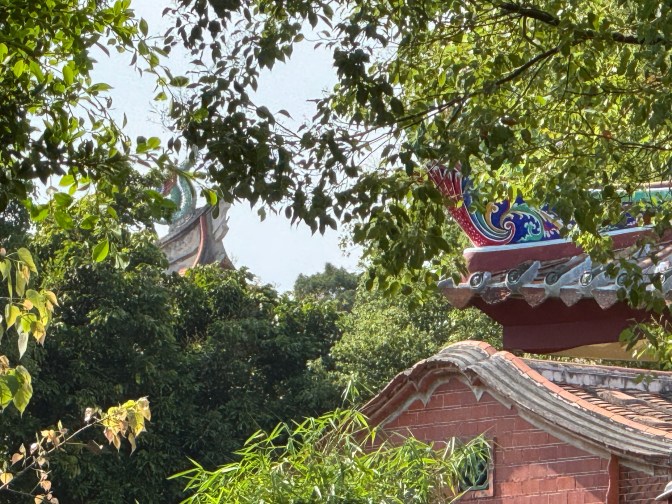
I was waiting. Waiting for this. For the terracotta roofs against the pale blue sky. For the honey‑yellow pagoda stone, warm from the sun. For the pastel dresses of the girls posing beside the ancient carvings. For the crimson lanterns swinging gently in the breeze. Let me breathe.
And I do. I breathe in the incense, the flowers, the cool air. I breathe out the city, the crowds, the tension I did not know I was carrying. I breathe in the temple, the spring, the peace. I breathe out the years, the worries, the weight.
The line fades. The song does not play. But the feeling remains. I am breathing. I am here. I am no longer waiting. The colour of spring is all around me.


Thank you for taking me there with your writing!
LikeLiked by 1 person