The oak trees at Burkes Pass Cemetary have not yet committed themselves to spring. Their branches are still mostly bare, making black cracks against an improbably blue sky. Down on the plains the season is well under way. Lambs are appearing in the paddocks and the willows beside the Opihi are already wearing their new foliage. But up here, winter is reluctant to leave.
Snow lies along the tops of the Two Thumb Range and only two days ago there was enough of it falling to close the highway. A skylark is singing somewhere above me. From one of the trees comes the liquid, slightly ridiculous call of a magpie: quardle ordle ardle wardle doodle. And all around are the hills.
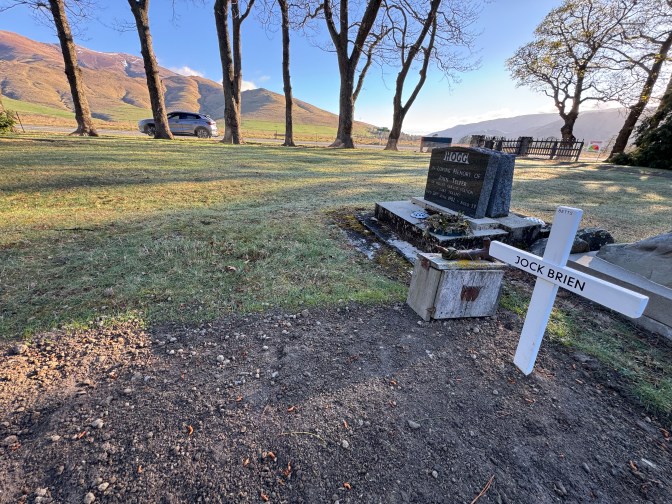
I have come to the little cemetery at Burkes Pass to visit an old friend. Jock Brien is buried near the road. I knew Jock for years before I ever thought of him as a roadman. To me he was simply Jock: shearer, musterer, shepherd and teller of magnificent stories. He belonged to that world of shearing sheds, sheepyards and back-country stations which occupied a considerable part of my younger life. I worked with him often enough that he became one of those people you assume will simply continue to be there. In 1988 he was even the barman at my wife’s twenty-first birthday party. That is how memory works. History records occupations and dates. Memory remembers who was behind the bar.
Jock died in 2026, when he fell from the roof of his house beside State Highway 8 on the outskirts of Fairlie. There is a terrible irony in that. After more than twenty years working as a roadman, keeping the highway open through winter snows and summer floods, Jock died at home, within sight of the road he had worked so tirelessly to maintain. I think he would have appreciated the absurdity of it.
I can imagine him in the candle-light in Andrews Stream Hut on Blue Mountain Station, telling some wildly exaggerated yarn about some silly bugger who climbed onto his roof, fell off and killed himself. With each telling the roof would become higher, the fall more spectacular and the stupidity of the unfortunate victim more profound. Jock was too good a storyteller to allow the facts to get in the way of a decent story.
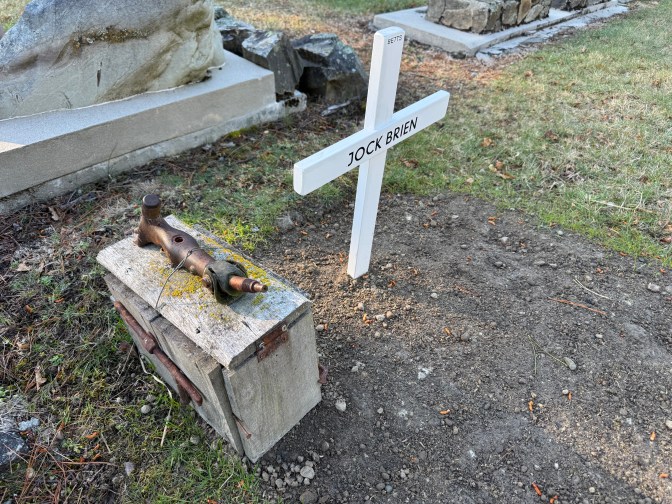
His grave is a modest affair. A white wooden cross bears his name. But beside it sits something far more revealing. It is Jock’s old mailbox. He made it himself from scraps of old gate timber and decorated it with some of the tools of another of his trades: a shearing handpiece, a comb and other bits of shearing gear. For years it stood outside his house in Fairlie doing the thoroughly mundane job of receiving his mail. After he died, some wonderful soul retrieved it and brought it here.
I find that strangely moving. A conventional monument tells you that somebody died. Jock’s mailbox tells you something about how he lived. He shore sheep. He mustered. He told stories. He made things. And for more than twenty years he worked as a roadman on the highway that passes within sight of his grave. I look through the trees towards the road. Cars come and go. Jock lies among the hills.
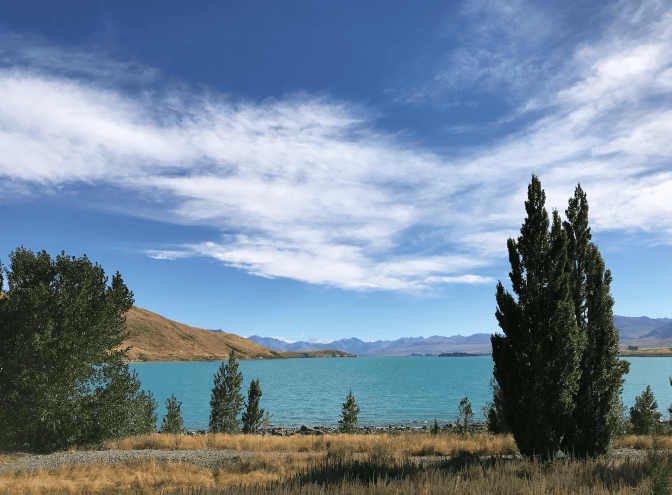
Beyond the pass, the Mackenzie Basin opens suddenly, like a picture book flung open. Ahead, the jagged, snow-encrusted Southern Alps grow steadily larger in the windscreen, their white summits suspended above the tawny immensity of the basin.
I drive through Tekapo without pausing. The carparks are already brimful of tourists. Along the lakeshore, yellow earthmoving machinery crawls over the raw ground of a new subdivision like Lilliputian arthropods, pushing and scraping and rearranging the earth. From a distance they seemed absurdly small, almost insignificant beside the shimmering teal-blue expanse of the lake and the mountains beyond. It is another little assertion of human geometry against an enormous landscape: roads, sections, kerbs and building platforms being scratched into the ground while Lake Tekapo simply lies there, luminous and indifferent.
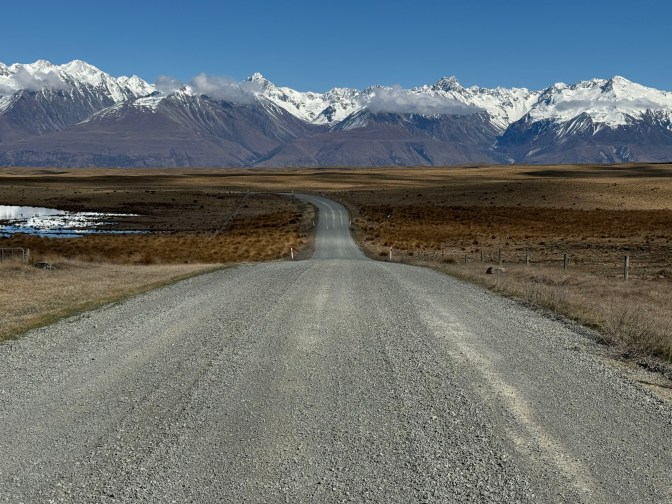
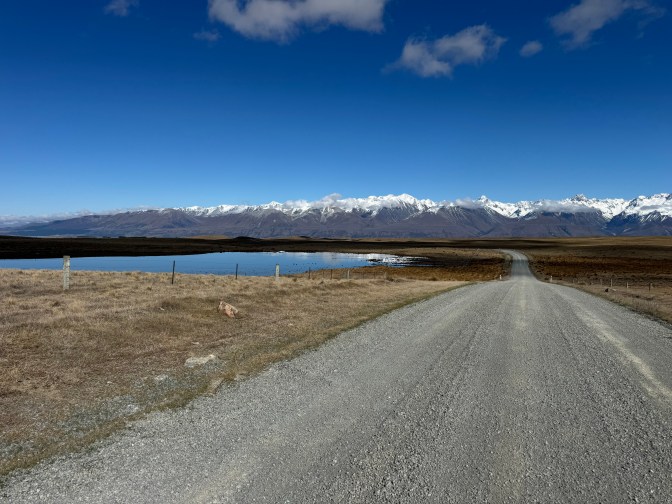
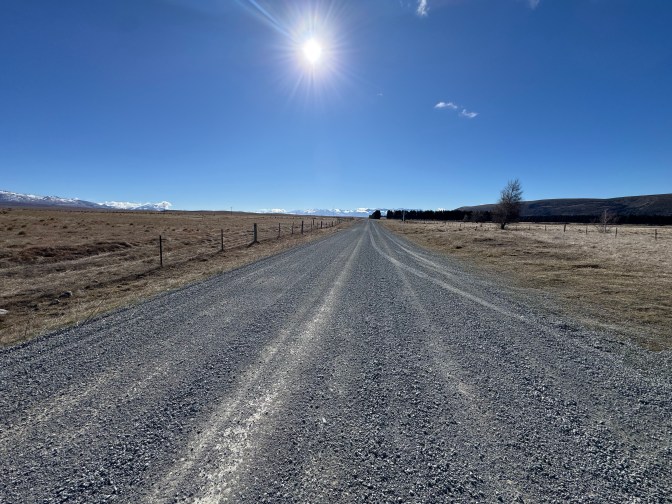
A few kilometres past Tekapo, I turn onto Braemar Road and the tarmac ends. There is no ceremony to it. The black seal simply stops. Ahead, the road changes colour and becomes shingle, a pale grey line running through dun-coloured country towards mountains white with snow. The sound changes immediately.
The tyres begin to hiss against the gravel. Stones ping against the underside of the vehicle. Dust rises behind me. Corrugations make themselves known through the steering wheel. I have always liked that sound. A sealed road separates you from the country beneath you. Shingle announces itself. You become aware again that a road is made of pieces of landscape.
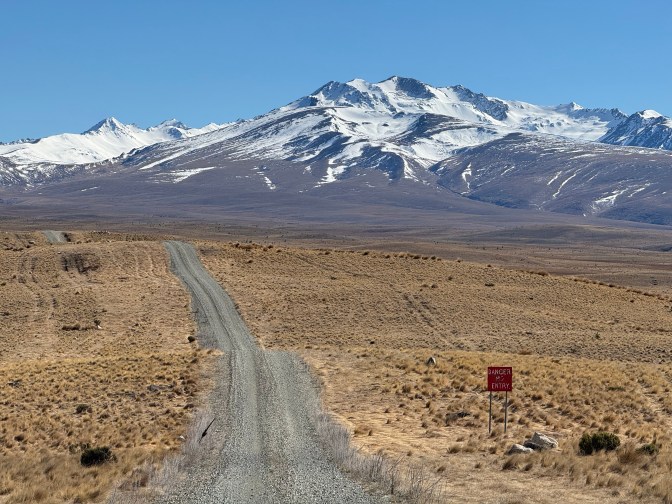
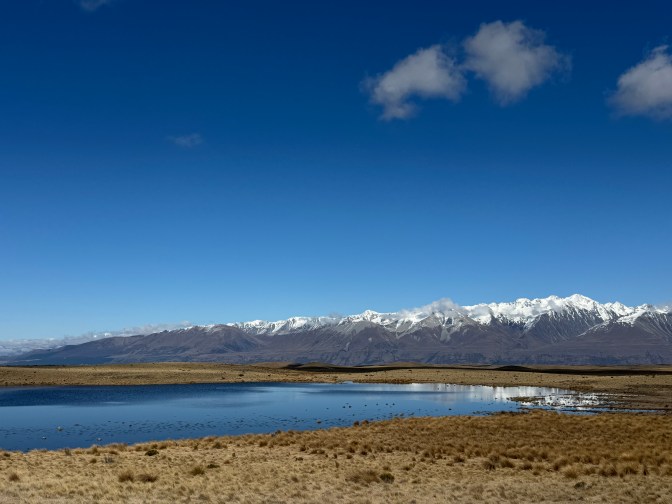
Braemar Road runs through enormous country. But although the word empty is tempting, it is wrong. There are tussocks, streams and wetlands. Fences run away into the distance. Sheep appear as small white marks against the brown. Skylarks hang invisibly in the sky. Beyond everything rise the mountains, a long white wall of peaks stretching across the horizon.
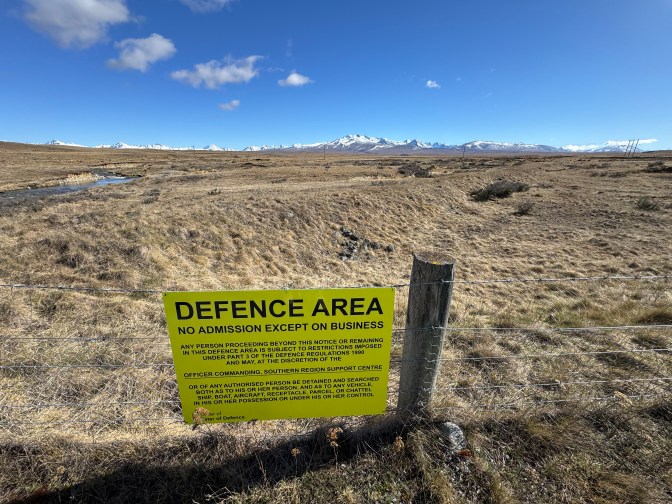
Part of the country beside the road is defence training land. A large yellow sign makes the point with bureaucratic severity: DEFENCE AREA. NO ADMISSION EXCEPT ON BUSINESS. But the overwhelming impression is not military. It is space.
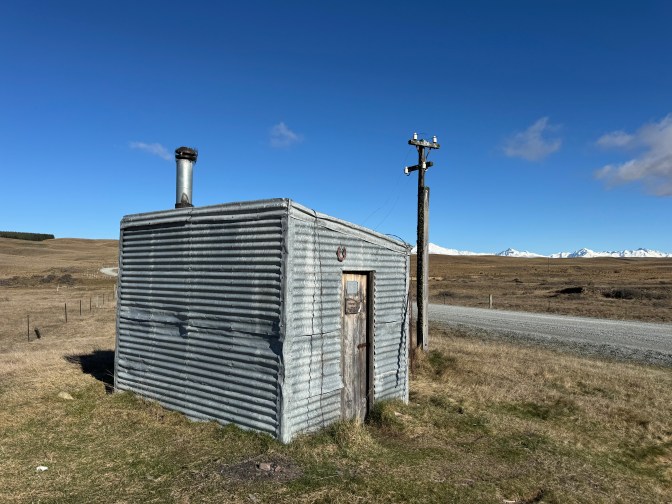
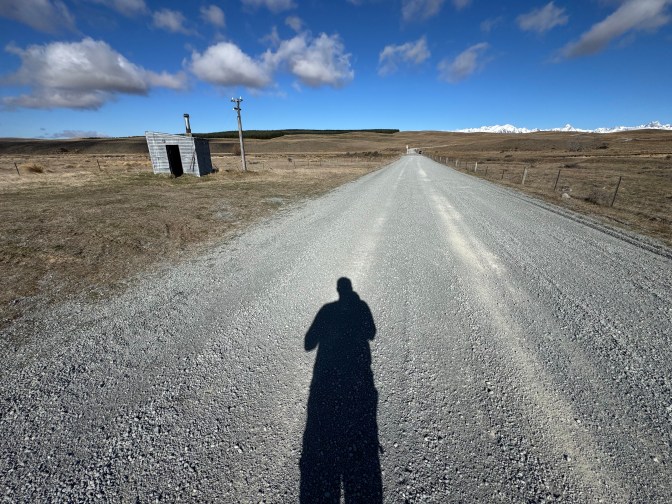
The Mackenzie Country has a talent for reducing human things to their proper dimensions. A vehicle becomes a moving speck. A fence becomes a pencil line. A power pole becomes a matchstick. And beside Braemar Road, surrounded by all that space, stands a tiny corrugated-iron hut.
I have passed it many times. I have stopped there often. From a distance it looks scarcely capable of sheltering a person. It is a little grey box beside the road, with a chimney sticking through the roof and an old telephone pole standing beside it. The corrugated iron has dulled with age. The wooden door is grey and weathered.
Behind it are thousands of hectares of open country. Above it is almost the entire sky. On the door a wooden sign reads: Irishman Creek Roadman’s Hut. 1916 approx. More than a century.
I open the door. Inside, the scale of the world changes abruptly. The mountains disappear. The sky disappears. The horizon vanishes. There is timber, a bunk, a hearth and walls covered in names. Hundreds of them. Some are written in pen. Some scratched into timber. Some are accompanied by dates. Chris. Dawne. Julia Monson. Mandy and Sandy Wick. Pvt. Samuel U. Builders. Travellers. Lovers. Cyclists. People who stopped for ten minutes and people who may have slept here through storms.
Human beings have a peculiar need to announce that they existed. “I was here.” The impulse is ancient. We scratched animals onto cave walls. We carved initials into trees. We write names in hut books and spray them onto bridges. But the graffiti in this hut is merely the latest layer.
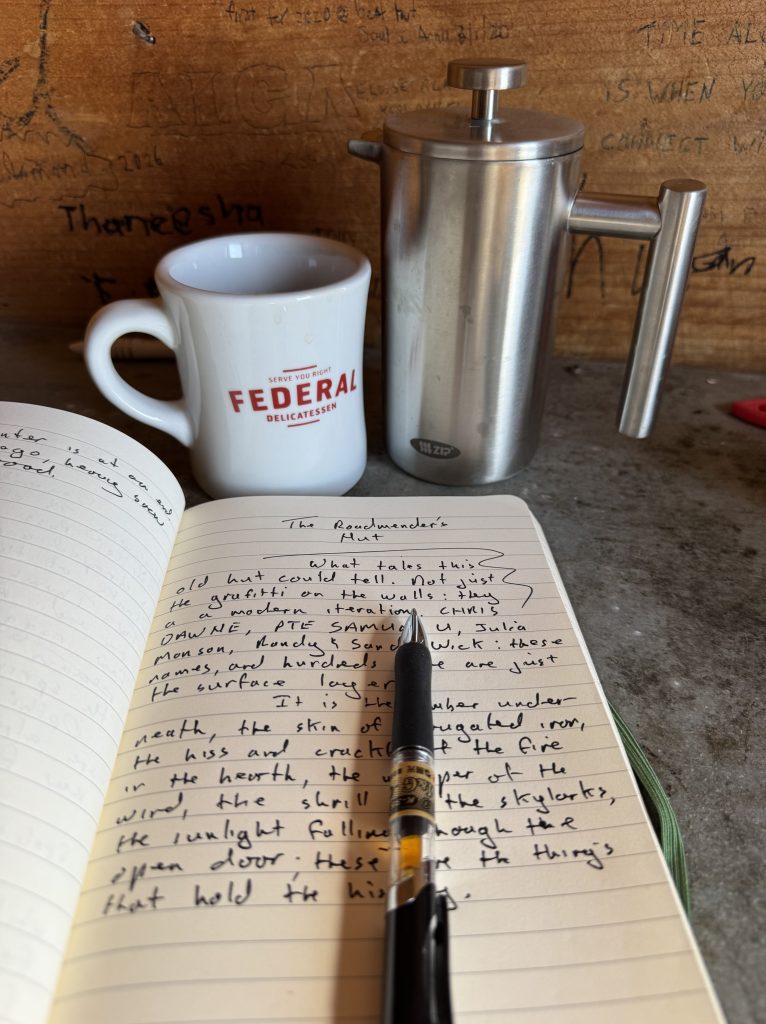
What tales this old hut could tell. Not just the graffiti on the walls. That is a modern iteration. Those names, and hundreds more, are only the surface layer. It is the timber underneath, the skin of corrugated iron, the hiss and crackle of the fire in the hearth, the whisper of the wind, the shrill call of the skylarks and the sunlight falling through the open door that hold the history.
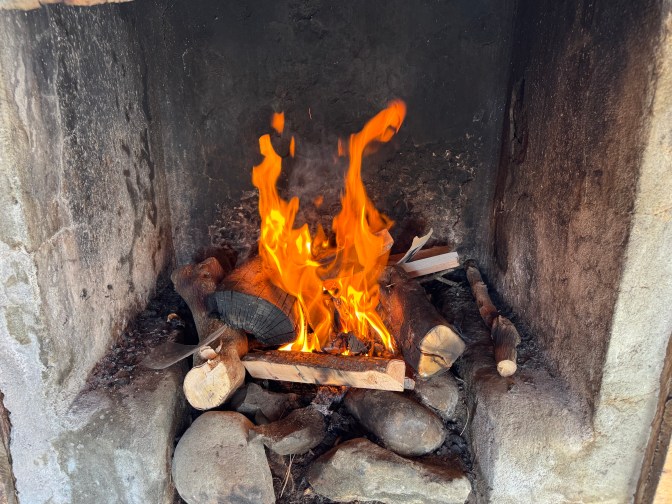
I collect some wood and light a fire. Soon the little hearth is alive. Flames climb around the logs. Smoke draws upwards. The cold interior begins, slowly, to surrender some of itself to the heat. I make coffee and sit down. And do nothing.
That is increasingly difficult to do. We have filled the modern world with things designed to prevent us from ever being alone with our thoughts. Phones vibrate. Messages arrive. Screens glow. Somewhere, somebody wants our attention. Here there is only the fire. And the wind. And space.
I find myself wondering about the men who used this hut when it was not a curiosity beside a road but part of somebody’s working life. Who slept on this bunk? Who pulled on wet boots in the dark? Who came in here with numb hands after working outside in snow? Who sat where I am sitting now and watched flames in this same hearth? I don’t know his name. That seems important. At Burkes Pass I have the man but much of his roadman’s world has disappeared. Here I have the roadman’s world but the man himself has disappeared.
Roads look permanent; but they aren’t. This is one of the great illusions of modern life. We build a road and thereafter treat it as though it has become part of the geology. It appears on maps as a fixed line. We give it a name. We paint marks on it. We put signs beside it and expect it to remain where we left it. Nature has other ideas. Water wants to wash it away. Snow wants to bury it. Frost wants to break it apart. Rivers want to cross it. Gravity wants to pull it downhill. Plants want to grow through it. Gravel moves. Culverts block. Banks slump. Potholes open. Corrugations form.
A road is not something we simply build. It is something we build and then continuously prevent nature from unbuilding. That is the job of the roadman. The technology changes. The problem does not. The men who once occupied this hut worked in a world of hand tools, gravel, horses and whatever machinery was available to him at the time. Jock belonged to another era: trucks, graders, snow-clearing machinery and radio communication. Today the equipment is more sophisticated. But after a sufficiently large snowfall, flood or slip, the question remains exactly the same. Can we get through?
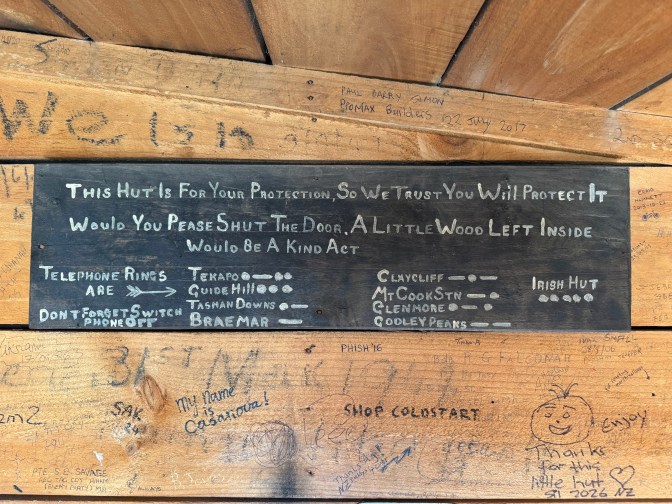
On one wall of the hut is a black board which answers another question. How did these people communicate? Written in white paint are the telephone rings for stations scattered through this enormous landscape. Tekapo. Glenmore. Mt Cook Station. Godley Peaks. Braemar. Irish Hut. Beside each name is a pattern of long and short rings. It is the language of the party line. One telephone circuit connected a string of remote stations and houses. The ringing pattern told you whether the call was yours. A particular combination of long and short rings summoned one station; another pattern summoned the next. Everyone on the line could hear it. Whether everyone refrained from listening is another matter.
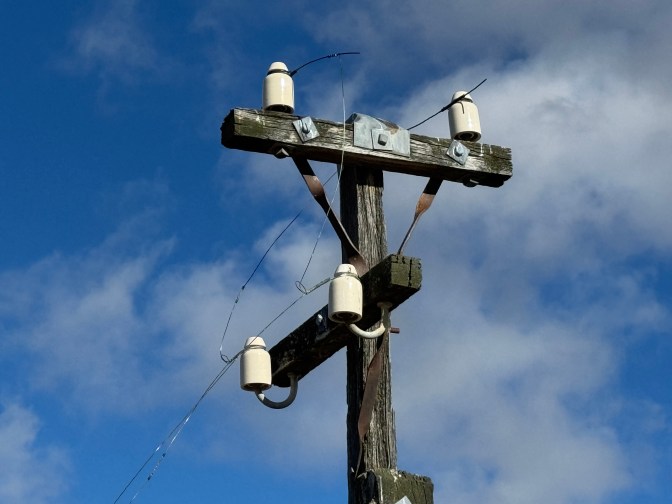
Beside the hut the old telephone pole still stands. The timber has weathered almost black. Porcelain insulators remain on the crossarms, absurdly delicate objects perched above this rough country. Fragments of wire hang uselessly from them. Once those wires carried voices. A ring sounded in a homestead miles away. Someone lifted a receiver. News travelled. A doctor might be needed. Stock might have escaped. Somebody might be coming for dinner. Snow might have closed a road. A neighbour might simply have wanted a yarn.
The road carried people. The telephone carried voices. Both were technologies for reducing distance. And distance matters enormously in country like this. But there is no longer the song of the wind singing in the wires. There is only silence here today. And space.
There are roughly forty thousand kilometres of formed road across the South Island if state highways and local roads are counted together. The exact total shifts with definitions and time, but the scale is about right: nearly five thousand kilometres of state highway and something like thirty-five thousand kilometres of local roads.
Laid end to end, they would almost reach once around the Earth. Think about that. A single island with enough road to come close to encircling the planet. And every kilometre represents an argument with geography. Look at a road map of the South Island and you are looking at a portrait of resistance. On the Canterbury Plains, roads run straight. In the Southern Alps, they wriggle. Along the West Coast they squeeze themselves between mountains and sea. They follow river valleys because rivers have already done some of the excavation. They climb saddles because mountains occasionally provide weaknesses. They avoid cliffs. They bridge rivers. They skirt lakes.
In Fiordland, where mountains, forest, rain and rock combine to make the argument particularly emphatic, the network largely gives up. The blank spaces on a road map are not empty. They are merely empty of roads. Where the land is flat, we impose ourselves upon it. Where the land is steep, we negotiate. And where the land is really difficult, we sometimes give up altogether.
The Canterbury Plains have always favoured straight lines. Roads, irrigation races, fence lines, railway tracks and survey boundaries reflect the confidence of nineteenth-century settlers who believed that order could be imposed upon an immense open landscape. From above, parts of the plains resemble graph paper stretched between the mountains and the sea.
The irony is that the ground beneath those straight lines was created by almost unimaginable disorder. The plains were built grain by grain by rivers descending from the Southern Alps. Those rivers wandered. They flooded. They split into braids and rejoined. They abandoned channels and excavated new ones. They carried boulders, gravel, sand and silt out of the mountains and spread them across the lowlands in vast overlapping fans. The roads above them run straight. The rivers that built the ground beneath them did almost everything but. The geometry belongs to us. The chaos belongs to nature.
Long before Europeans began drawing lines across survey maps, people were already moving through this island. Māori routes connected settlements, food-gathering places, rivers, lakes, passes and sources of pounamu. They followed the possibilities offered by the landscape. The first routes were not imposed upon the country. They were discovered within it. That is an important distinction. A person on foot can accommodate almost anything. A narrow track is enough. A steep bank can be climbed. A stream can be waded. A fallen tree can be stepped over.
Then Europeans brought wheels. And wheels are demanding things. A horse can negotiate a track that defeats a cart. A packhorse needs less engineering than a dray. Once wheels arrive, gradients matter more. Mud matters more. Riverbeds matter more. Holes matter more. Tracks widen. Stumps are grubbed out. Banks are cut away. Hollows are filled. Gravel is spread. Bridges appear.
Progress can almost be measured by the number of legs pulling the vehicle. First the packhorse. Then the bullock. Then the horse. Then steam, petrol, diesel. And now, electricity. There is something wonderfully circular about that last step.
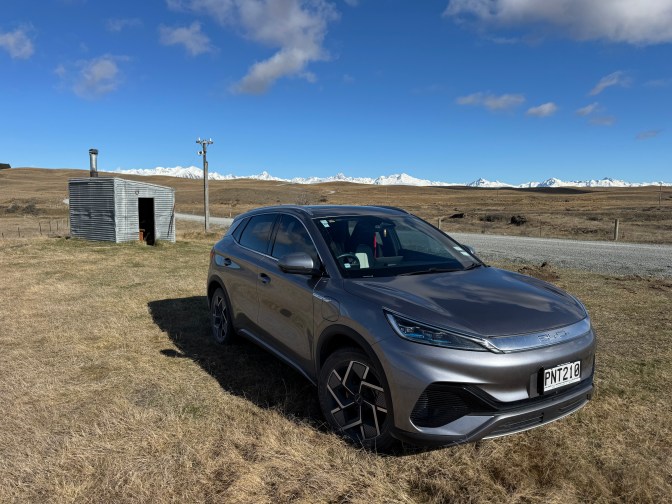
Sitting outside the roadman’s hut is my own car. It has arrived here without burning a drop of petrol or diesel. More than a century after this hut was built for men maintaining a road used by horses and early motor vehicles, I have driven here in a car powered entirely by electricity.
The motive power has changed from muscle to steam, from petroleum to electrons. The road is still made of stones. And with every change the landscape effectively becomes smaller. Not physically, of course. The mountains remain where they are. The rivers still flow to the sea. But time contracts the island. A journey that took days takes hours. A river crossing that depended upon water level becomes a bridge crossed without thought. A pass becomes a highway. Distance, in other words, is not measured solely in kilometres. It is measured in roads.
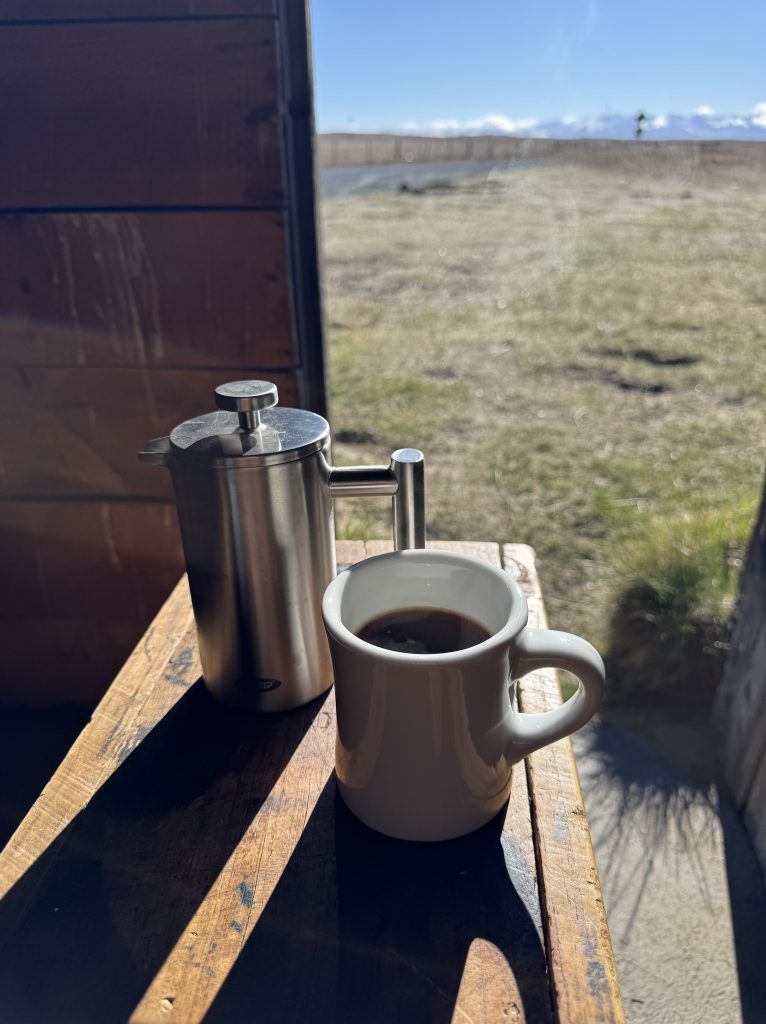
The wind outside the hut is rising. I can hear it moaning around the eaves, rising and falling. The draught pulls air across the fire and the flames suddenly burn harder. Somewhere in the distance a loose fence wire rattles against a steel post.
The embers glow. Nearby, the stream chatters in its bed of stones. I look around the little room again. It has been standing here since about 1916. More than a century of weather. Wind, snow, sunlight, passing cars, soldiers, stock, shepherds, drovers, shearers, lovers, starlight, and time.
There is a notice on the wall: “This hut is for your protection so we trust you will protect it.” I like that. It speaks from another world. Shelter in the high country was not merely convenient. Weather could turn quickly. Snow could obscure a road. A horse could founder. A vehicle could break down. Darkness could arrive before a traveller reached the next homestead. A tiny iron hut could matter. Even the instruction beneath it has the manners of another age. “Shut the door. Leave a little wood.” A kind act for somebody you have never met. Perhaps that is what roads themselves ultimately depend upon. Not merely engineers and budgets and machinery, but the assumption that somebody else will come after us.
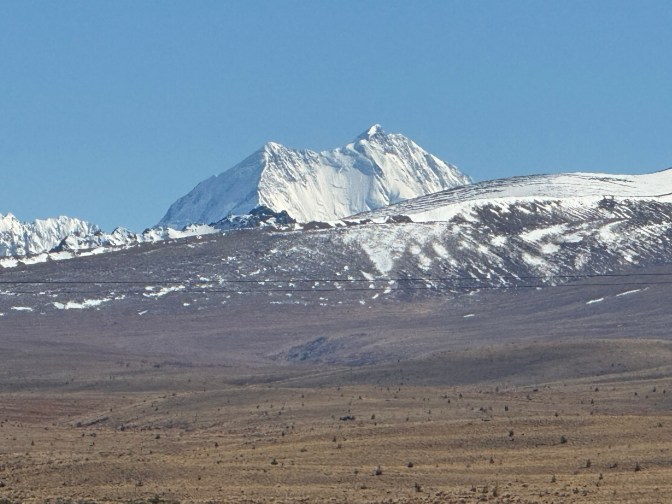
Braemar Road runs away from the hut in both directions. It looks permanent. From a distance it is a clean pale line across brown country. But walk onto it and permanence disappears. It is just crushed rock. Thousands upon thousands of small stones arranged temporarily into the shape of a road. The grader gives it a crown so water will run towards the edges. Drains take that water away. Vehicles displace the gravel. Rain shifts it. Frost works beneath it. Wheels create corrugations. Then somebody comes back with machinery and puts the road back into the shape we expect a road to have. Again, and again, and again.
That is the roadman’s work. Maintenance is one of those profoundly important human activities which becomes invisible when it is done well. We notice the roadman when the road is closed. We notice the linesman when the electricity goes off. We notice the plumber when the pipe bursts. Civilisation relies heavily upon people whose success consists of allowing everyone else not to think about them.
Jock understood that world. So, presumably, did the men who used this hut. They are separated by decades and technology, but their enemy is the same. Entropy. Things fall apart. Roads perhaps faster than most.
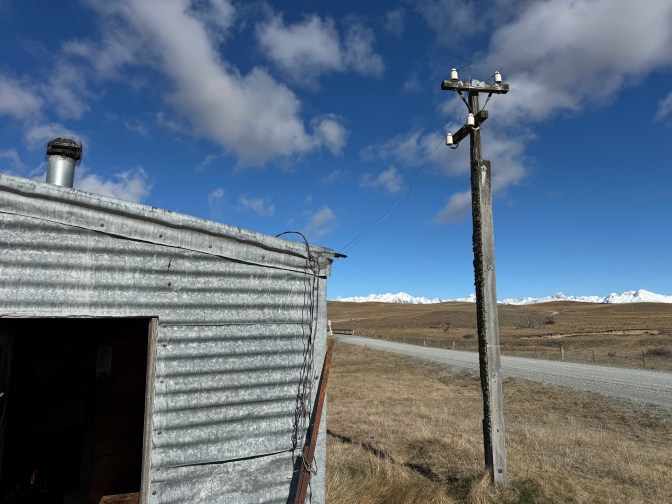
The fire has settled. The flames are lower now. I finish my coffee. For a while I simply sit there. There is a temptation, when writing about places like this, to populate them with ghosts. I don’t need to. The evidence of other lives is everywhere. A bunk polished by bodies. Soot in the fireplace. Names on timber. A telephone code painted on a wall. A pole outside carrying porcelain insulators from a communication system that no longer exists. That is enough. The past does not need to be supernatural. It leaves fingerprints.
Eventually I stand. I douse the fire carefully. The hiss seems indecently loud in the little room. Steam rises from the dead embers. I make sure everything is safe, step outside and pull the door closed behind me. The world becomes enormous again.
The mountains return. The sky returns. The road returns. My car sits beside it, absurdly modern. Electric. Silent. A little accumulation of batteries, electronics and engineering parked beside a hut built when horsepower still meant precisely that. I get in. Press the button. There is no engine to turn over, just electrons moving from one polarity to another.
As I drive away, my thoughts return to Burkes Pass. To the bare oak branches against the blue sky. To the skylark. To the magpie. To the snow still lying on the hills. And to Jock. There is something fitting about where he lies. He spent much of his life among sheep and mountains and weather. And for more than twenty years he helped keep a road open through country where winter still periodically demonstrates that our control is conditional.
Then, in 2026, he fell from the roof of his own house on the outskirts of Fairlie, beside the very road he had spent so many years keeping open. I keep returning to the irony. And to Jock telling the story. In my mind we are back in Andrews Stream Hut on Blue Mountain Station. Jock is holding court. The story is no longer about him, of course. It is about some other poor bastard, some monumental bloody fool who has decided to climb onto a roof when any sensible man would have stayed on the ground.
With every telling the roof gets higher. The ladder becomes less reliable. The victim becomes more foolish. By the end of it, no doubt, the roof is forty feet high and covered in ice, the ladder has three rungs missing, a nor’wester is blowing hard enough to lift sheep over a fence, and the silly bugger is carrying a chainsaw. That is the Jock I remember.
Now he lies a few metres from the road. Beside him sits the battered mailbox from his home in Fairlie, with the shearing handpiece and comb still attached. The highway continues past the cemetery. Cars climb towards the pass. Others descend towards Fairlie. People are going to work, heading home, towing boats, carrying stock, delivering freight, beginning holidays, ending them. Most will never notice the little cemetery. Fewer still will know the name Jock Brien. That is as it should be.
Roads encourage us to forget the people who maintain them. That is probably the measure of a good road. We drive over it without thinking about it. The snow has been cleared. The culvert is running. The pothole has been filled. The bridge is still there. The roadman’s hut sits silently beneath the blue immensity of the Mackenzie Country sky. We simply keep going.
Jock spent more than twenty years making that possible on a small stretch of the world-encircling length of roads on the South Island of New Zealand. Now he lies at Burkes Pass, a few metres from the highway he once helped keep open. Beside him sits his battered old mailbox, brought there by somebody who remembered him. Beyond the cemetery fence the traffic passes. Nobody stops. They don’t need to. The road is open.


can imagine jock having a laugh at that story – he might not have made it past paragraph one and made the rest up !!
LikeLiked by 1 person