Wulin village in Quanzhou. Hot. The heat sits on my shoulders like a hand. Above me, a pale blue sky draped with white clouds, the kind of clouds that look painted on, that do not move, that have been there since the beginning of time. I walk slowly, my notebook in my hand, my shoes silent on the old stone. The air is thick, almost syrupy, and smells of dust and dry earth and something flowering in a courtyard I cannot see.
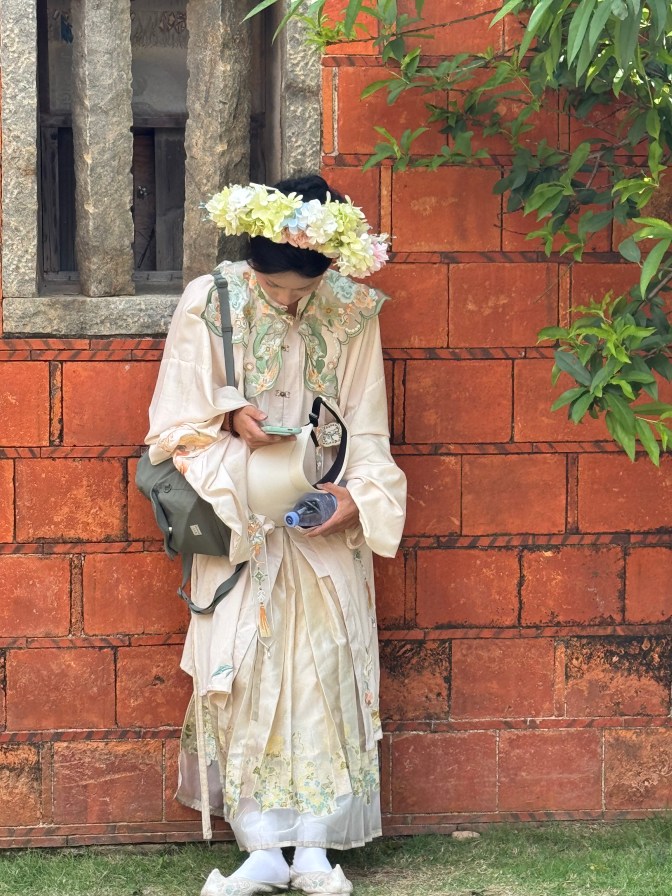
I turn a corner—no reason, just because—and there she is, posed in a stone doorway. She wears a lime green top so bright it seems to hum against the grey stone. Flowers in her hair. Real flowers, I think, or maybe silk. It does not matter. She tilts her head. She smiles. The photographer—a friend, or a boyfriend, or a hired stranger—crouches, rises, adjusts, shoots.
Click. Click. Click. This doorway has framed a thousand other moments: weddings, farewells, a grandmother resting in the shade, a child learning to stand. But today, the doorway belongs to her.
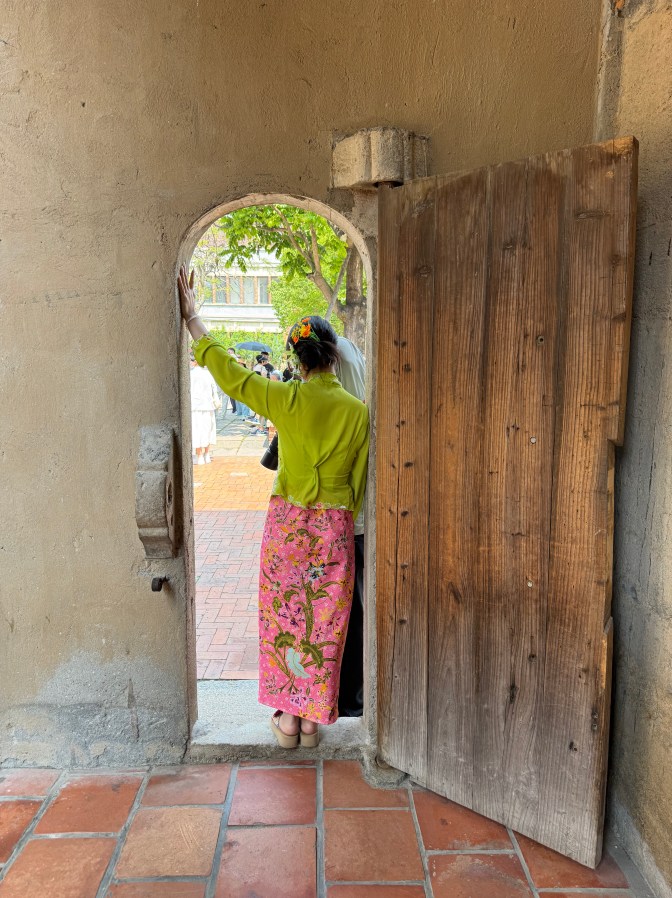
Later, I see a plaque. Carved stone, old, official. Two characters: “Civilisation endures.” I do not know what to do with these two things: the girl, the plaque. But they belong together. They must.
The walls are not ancient. The guidebooks would call them “traditional,” which is a word that means nothing and everything. Most of these buildings went up in the early 1900s, when the Qing Dynasty was taking its last breaths and the new Republic was taking its first, uncertain steps. A hundred years. Maybe a hundred and twenty. That is not old, not by Chinese standards. Not when there are temples down the road that have stood for a thousand.
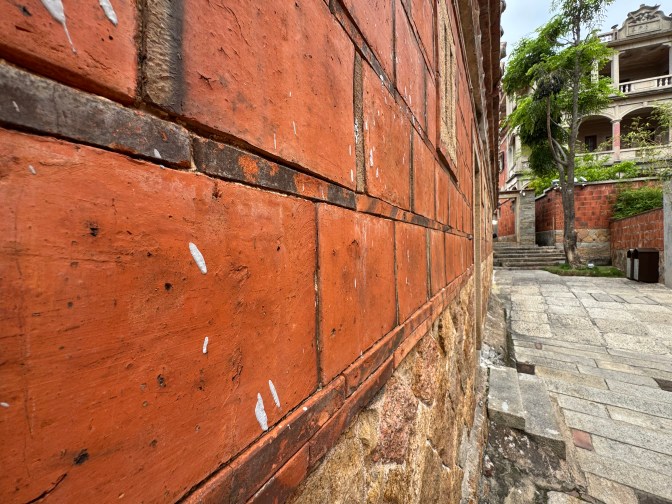
But still. The corridors are worn. The alleys are narrow. The squares and plazas feel redolent with the passage of people. Thousands of them. Tens of thousands. Each one leaving something behind: a footprint worn into the stone, a handprint smoothed into a railing, a cough, a laugh, a curse, a whispered prayer.
These walls have heard things. They have held the weight of bodies leaning against them: tired after work, drunk after a wedding, heartbroken and needing somewhere to rest. The girl in the lime green top leaned against one of those walls. She did not know its history. She did not need to. The wall held her just as it held a labourer in 1927, just as it held a child in 1968, just as it held an old woman last Tuesday. Life is here. Not preserved. Not honoured. Just here.
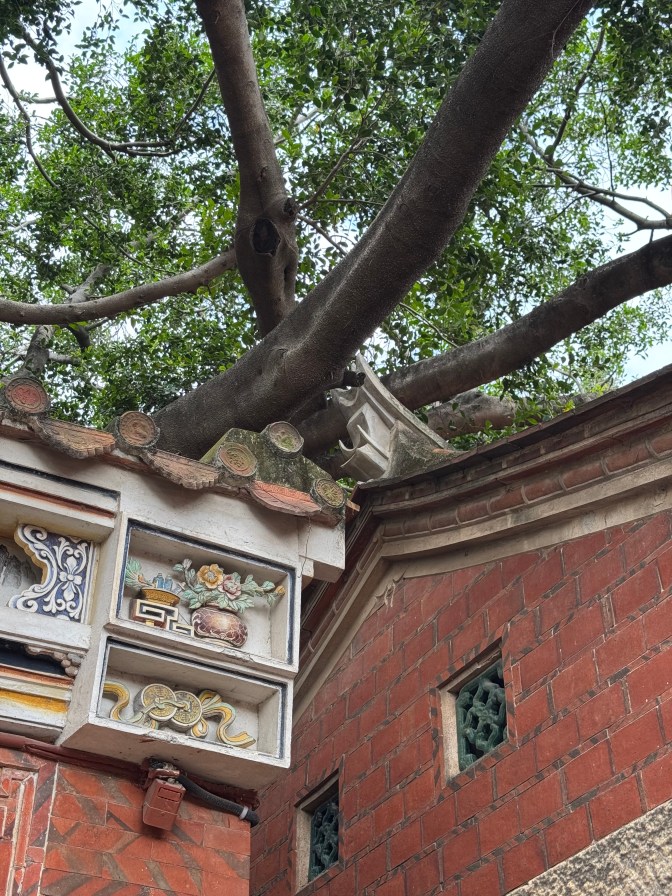
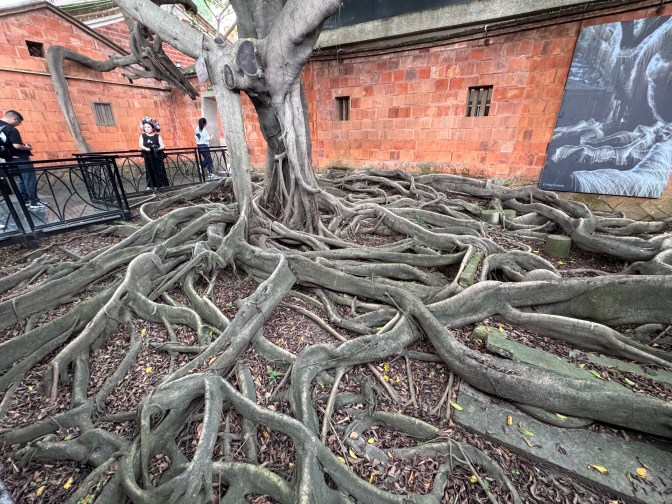
But the village holds more than stone doorways and worn walls. In the centre of an old house—a house built, perhaps, in those early uncertain decades of the 20th century—a giant banyan tree has made itself at home. No one planted it; or perhaps someone did, a lifetime ago, a child pushing a seed into the dirt, not knowing what she had begun. Now the tree is enormous, its trunk thicker than an oxen’s body, its roots snaking outward like brown rivers seeking low ground.
The roots have fed themselves into the fabric of the building: between bricks, around timbers, through cracks in the floor. They have entwined with the beams that once held a roof, with the doorframe that once kept out the cold. Wood against wood, root against beam, the tree and the house in a slow, centuries-long embrace. It is not destruction. It is conversation. The house has not fallen. The tree has not won. They have simply merged. Become one thing.
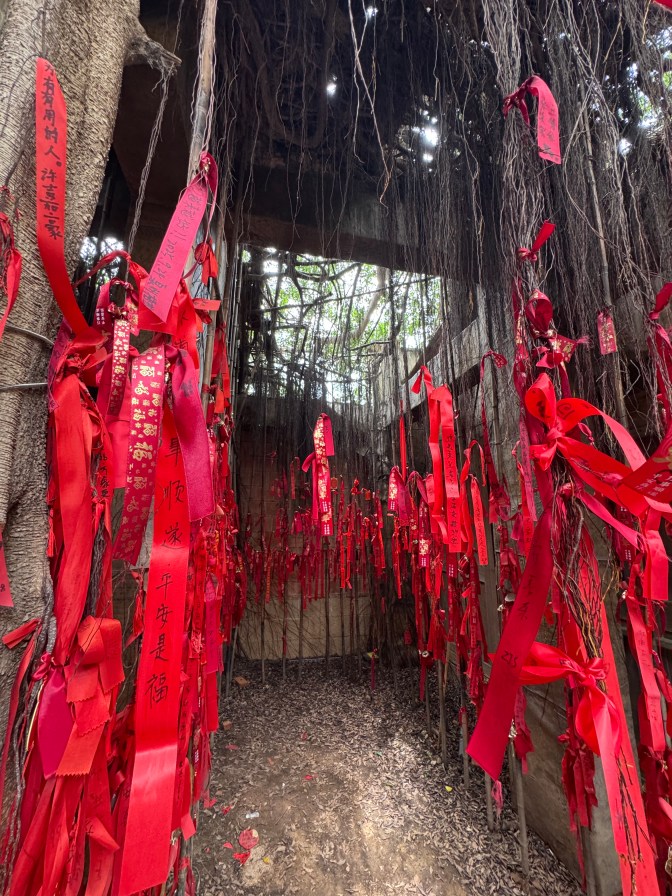
Beneath the tree, tied to its lowest branches, are ribbons. Hundreds of them, crimson red with gold lettering: the colours of luck and hope. Each ribbon carries a message, a prayer, a secret. Some are new, bright, knotted with care. Some are old, tattered, bleached nearly white by sun and rain, their prayers worn silent.
People come here. They stand beneath the tree, in the shade of a house that is no longer quite a house, and they tie a ribbon to a branch. They ask for something. Health. A child. A safe journey. A love returned.
And then, somewhat incongruously—though perhaps not incongruously at all: this is, after all, China, where juxtapositions are everywhere—there is a coffee shop in the same old house. The aroma of roasting beans mingles with incense, old wood, and spring flowers. It should not work. It should be a clash, centuries colliding, the sacred suffocated by caffeine. But it does work. It works beautifully.
The modern timber of the coffee counter is perfectly aligned with the old stones of the wall. No gap. No apology. The carpenter has matched the new to the old with the same care that the banyan has matched its roots to the beams. Old and new, seamless, intertwined.
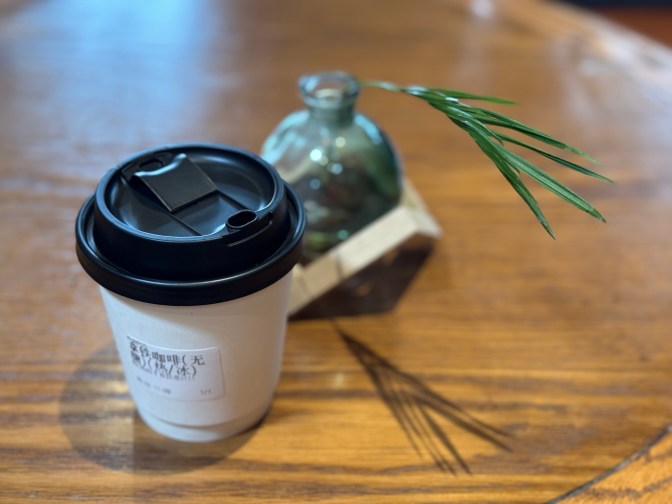
I order a latte. I carry it to a table inside a latticed room; a room that was once a bedroom, or a storeroom, or a place where a family gathered for meals. The lattice throws shadows across the floor, stripes of light and dark.
On the walls, framed prints of old scenes: black-and-white photographs of this same village, decades ago. Women in long robes. Men with bicycles. Children staring seriously at a camera that has long since rusted away. The scenes are familiar: the same streets, the same doorways, the same banyan tree, smaller then. The people are gone. The tree remains.
Around me, other visitors sit with their devices; phones on the table, cameras raised, thumbs scrolling. A girl poses for a selfie in front of the banyan’s roots, her smile bright, her hair perfect. A young man films a video, panning slowly from the ancient trunk to the modern espresso machine.
They are not being disrespectful. They are simply here, in this moment, experiencing the old through the new. The devices, the selfies, the framed prints of old scenes. The banyan, the coffee, the ribbons, the prayers. Old and new, seamlessly intertwined, just as the roots and branches of the banyan tree have intertwined with the bones of the old house.
I sit in the latticed room and think of the girl in the doorway. She is not here. She posed for her photographs—her lime green top, her flowers, her smile—and then she walked away, into the village, into the rest of her day. She will never know that a stranger sat in a coffee shop beneath a banyan tree and thought of her.
But that is the nature of these small worlds. We pass through them. We leave nothing behind but a glance, a memory, a sentence in a notebook. And then we are gone.
Civilisation endures. But so does the banyan. So do the roots. So do the ribbons, fading but not yet gone. And the girl in the doorway—the one I saw today, the one in lime green, the one who will never know I wrote about her—she is part of it now. Part of the old and the new. Part of the story.
I finish my coffee. I leave the latticed room. I walk back through the village, past the stone doorway, past the plaque, past the walls that have held so many bodies. The old house and the new coffee, the ancient roots and the modern timber, the framed prints and the glowing devices. They entwine, like the banyan with the bones of the house.
And somewhere in between is a girl in a doorway, a traveler with a notebook, and a story that will outlast them both. Civilisation endures. But so do the small wonders. So do the small worlds. So, for a few pages, does she.


