I’m getting off to get lost in the air,
At the edge of the world where the light is bending…
– Counting Crows, New Frontier
And so, at last, I reach the temple beside the sea. The South China Sea lies steely grey under a louring sky, with a strong wind blowing down from the north. The waves are not large—this is no storm—but they are constant, relentless, each one folding into the next out to the horizon. The colour is not blue. It is the grey of weathered stone, of a sky that has forgotten its own blue.
The wind comes from somewhere far away: from Siberia, perhaps, or Mongolia, or the cold heart of the north up beyond Heilongjiang and Vladivostok . It carries no warmth, no invitation. It simply blows, shivering the prayer flags, bending the trees, tugging at my shirt as if urging me to turn back.
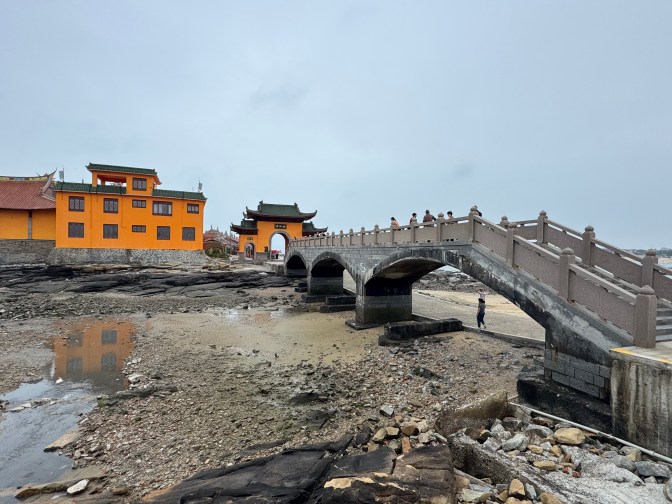
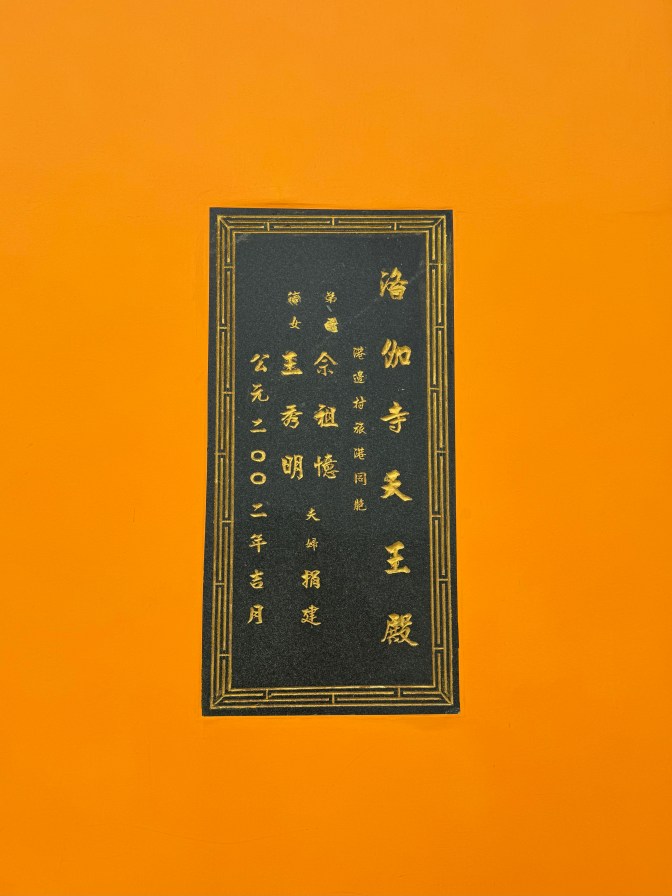
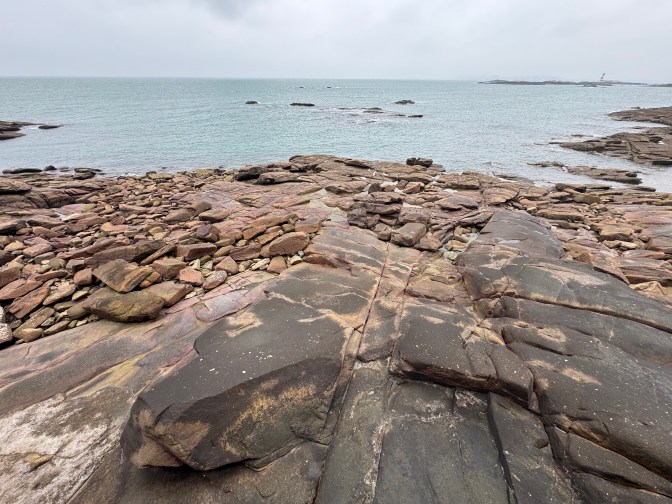
The Luojia Temple stands on a reef of black granite, its orange walls hunkered against the wind, its curved roofs rising like birds about to take flight. It has been here for centuries, watching this same sea, enduring these same winds. It will be here when I am gone, and when the wind has finally worn itself out, and when the sea has risen and fallen a million more times.
I walk towards it over the cobbled causeway that is covered twice each day by the tide. The wind pushes against my chest. The sea mutters to itself. And I think: “this is why I came here.” Not for the calm. For this. For the wind and the ocean, and the temple that does not care whether I arrive or not.
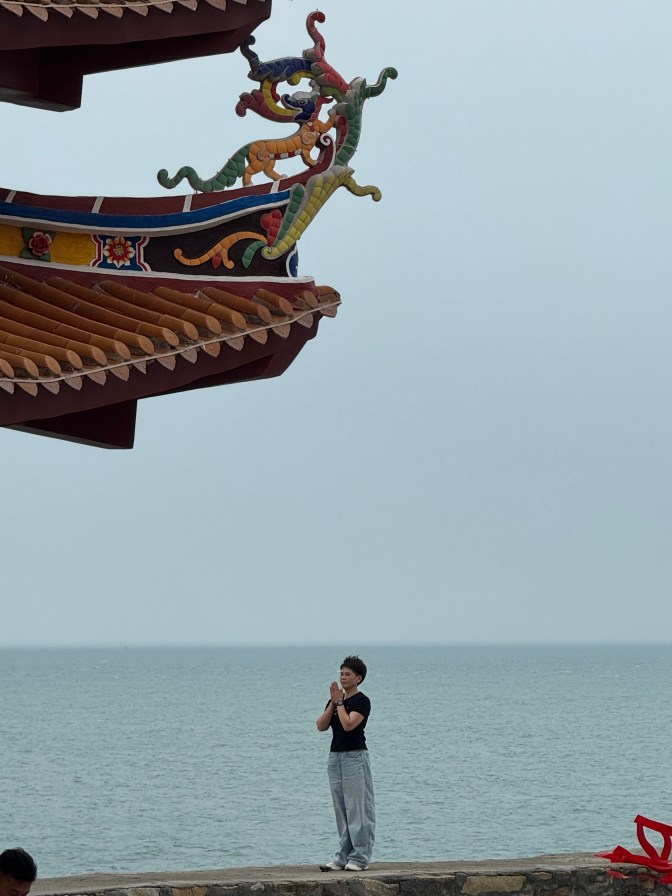
People are posing in droves. They stand before the temple walls, before the branches of the temple trees, their phones raised, their smiles fixed, their bodies angled for the perfect shot. A girl in a white dress twirls, her hair flying, her friend crouching to catch the exact moment. A couple lean together, foreheads touching, the temple blurred behind them. A family line up—parents, grandparents, children—all grinning, all waving, all wanting to be seen.
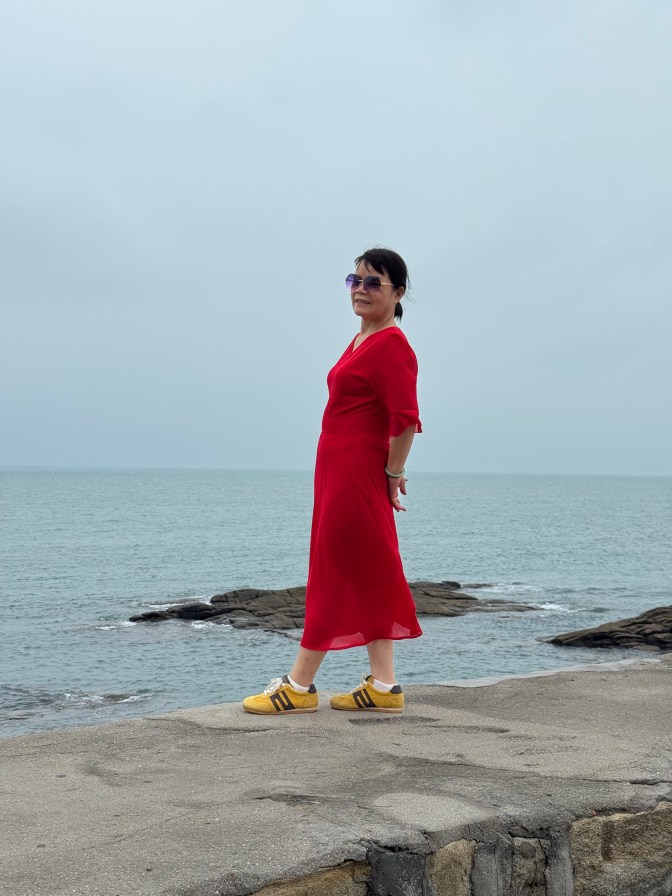
These photographs will appear on WeChat and Xiaohongshi tonight. Look where we were. Look how beautiful. Look at us, standing in the wind, smiling at the temple walls.
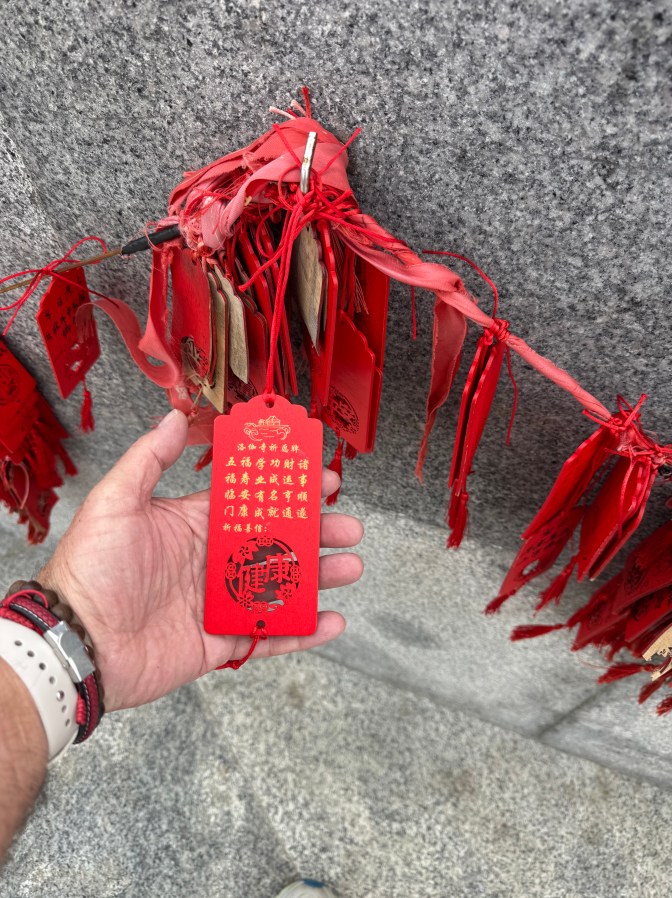
And they are beautiful. The entire scene is beautiful: colourful flags and prayer ribbons, the grey sea, the ancient stone, the young faces.
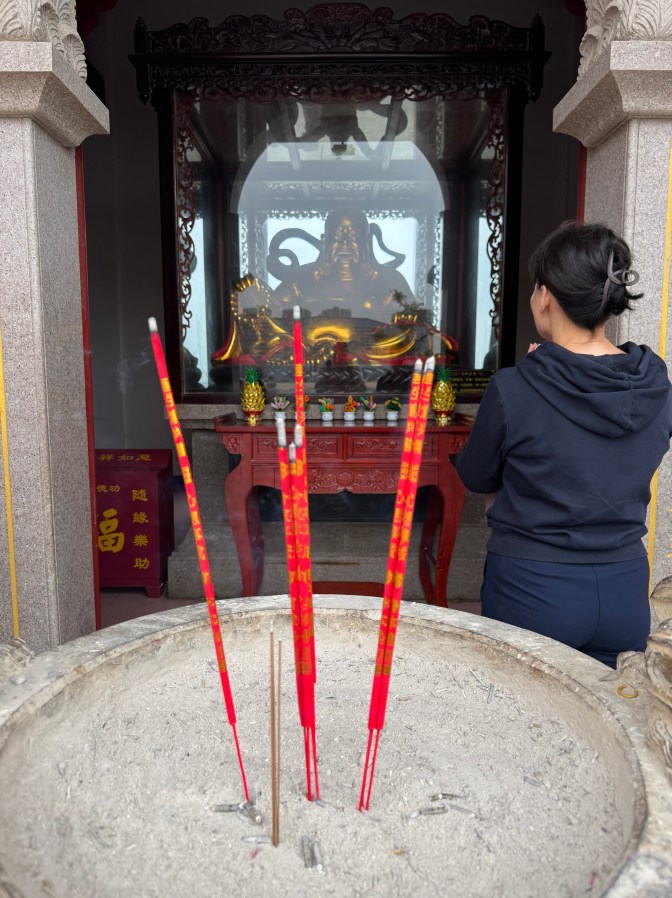
Inside the main temple quadrant, incense rises from the censers in swirling clouds. The smoke curls upward, battling the wind that sneaks through every doorway.
Along the south wall, sixteen gold gods, all in different poses, look down from pedestals. Sixteen mudras. Sixteen faces, serene and distant, their eyes half-closed, their hands raised in blessing or teaching or protection.
They have seen this wind before. They have seen this sea. They have seen countless generations of pilgrims and tourists and lovers and fools, all of them lighting incense, all of them posing for photographs, all of them hoping for something: a blessing, a memory, a moment that will outlast the wind.
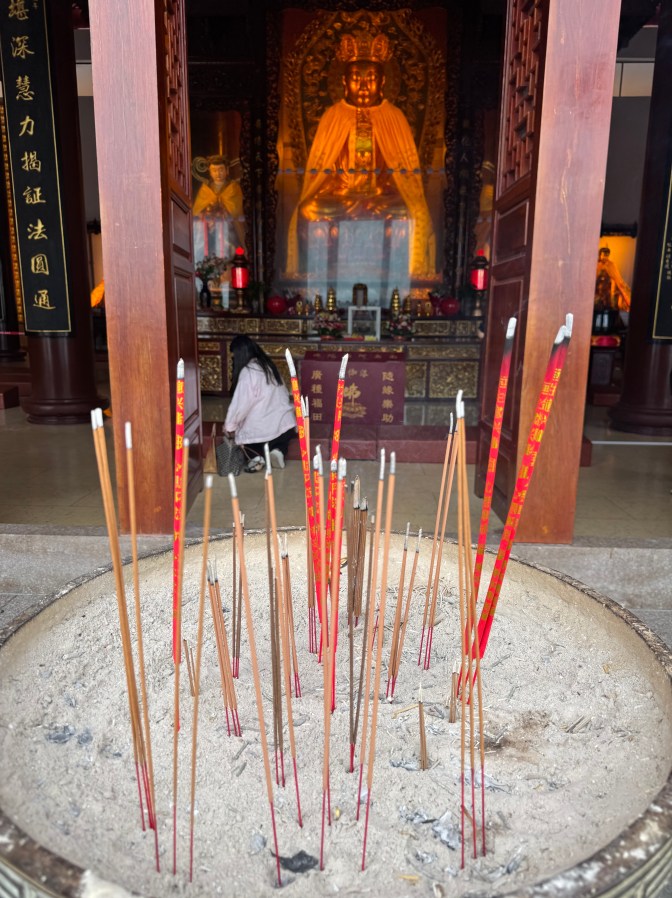
The people kneel. They bow. They press their hands together and close their eyes and whisper prayers I cannot hear. Then they stand, brush the dust from their knees, and walk back outside to pose beneath the colourful eaves. The wind does not stop. The sea does not calm. The sixteen gold gods watch it all, saying nothing, blessing everything.
I walk out along the concrete wall that protects the seaward side of the temple. In the distance, I can see the smokestack of a massive power plant: a white pillar rising from the hazy shoreline, a thin plume of steam dissolving into the grey sky. It is not beautiful. It is not ancient. It is not what the tourists came to photograph. But it is there, as real as the Laojia Temple, as real as the sea, a reminder that China is not only pagodas and incense, but also industry and energy and the hard work of keeping the lights on.
I look out across the South China Sea. It is grey to the horizon. Fold after fold of water, wave after wave. It does not promise anything. It does not threaten. It is simply there: immense, indifferent, ancient.
And yet, it seems to hold endless possibilities of adventures. Joseph Conrad wrote about that in Lord Jim. Not the adventures you plan. Not the adventures you expect. The ones that find you. The ones that are their own and only reward.
I think of my own adventures in China: the temple at night, the egg burger line, the scooter ride in the rain, the girl in green velvet, the chain-smoking temple attendant, the smell of hay in a tea shop, the 4:16 AM silence, the monk’s woodblock, the jasmine and the incense. No one sent me on these adventures. No one paid me. No one will remember them but me. But they are mine. They are their own and only reward.
I breathe in the air. It is sharp and clean and fresh, with a slight tang of Chinese life still redolent on it. I can smell flowers: something white and small, growing somewhere behind the temple, unseen but present. I can smell incense: sandalwood, or something like it, drifting from the main hall where the sixteen gold gods watch over their kneeling pilgrims. I can smell the sea: salt and iodine and the cold breath of deep water.
All of it. All at once. China in a single breath. I close my eyes. I breathe in again.
I am at the edge of the world. Not literally. There is more world beyond that horizon, more China, more adventures, more stories waiting. But this edge, this headland, this temple where the ancient granite of Fujian reaches its end and the South China Sea begins, it feels like an edge.
I am not sure what will come next. Another bus. Another temple. Another small world opening up in an alley I haven’t turned into yet. But for now—for this moment, on this headland, with the wind pushing against my chest and the sea muttering at my feet—I am exactly where I need to be. At the edge of the world, where the light is bending. At the temple beside the sea.


 TravelWriterLife